Static nearest-neighbour lattice cx_nn
A coupling graph fixed at mask level in which each qubit interacts only with lithographic neighbours; the default topology under every fielded superconducting and spin processor.
Static nearest-neighbour lattice
Heavy-hex (degree 2.3) or square lattice (degree 3.5–3.6) with on-chip couplers; ZZ crosstalk is the tax.
Brief →Key references
Design space — attributes
- (a) carrier affinity
- fabricated
- (b) time · entangling
- —
- (c) readout
- —
- (d) mobility
- static nearest-neighbour wiring
- (e) control
- —
- (f) error structure
- coherent / calibration
- (g) manufacturing
- superconducting lithography
Evaluation space — dated attributes
The 5.5×10⁻⁴ is a fitted component of the Willow error budget, not a directly measured crosstalk figure. EUV is a single point of failure for the spin branch only — no fielded transmon lattice uses it. Rigetti: median 2Q 99.5% at 36 q falls to 99.1% at 108 q (12 chiplets).
Standard records
Actors & goals — annotations
Edges
Used by 97 machines (96 primary · 1 alternate)
- superconducting circuits 81
- Academia Sinica 20-qubit superconducting quantum computer Academia Sinica press ▨ 🔎
- Alice & Bob Boson 4 Alice & Bob press ▥ 🔎
- Alice & Bob Graphene Alice & Bob press ▣ Fig. 2 (H×L lattice), Fig. 4 ([136,34,22] layout), Fig. 9; §V Chip layout ✅
- Alice & Bob Helium (on-premise system) Alice & Bob whitepaper press ▥ Fig. 'The Helium Chip' (16 cat qubits connected in a looped line); Fig. 'Surface Code vs Cat Qubit Architecture' (1-D phase-flip correction); §Cats' Hardware Efficiency: Repetition Code and LDPC Connectivity ✅
- Alice & Bob Helium 2 ("Galvanic Cat") Alice & Bob press ▨ 🔎
- IBM Quantum System Two at Amaravati Quantum Valley Tech Park IBM with TCS and the Government of Andhra Pradesh ◌ 🔎
- Anyon MonarQ Anyon Systems product page press ▨ 🔎
- AWS dual-rail transmon erasure line AWS Center for Quantum Computing (named Amazon Center for Quantum Computing in the Apr 2026 paper) paper ▣ Fig. 1a-b (coupled transmon pair + shared resonator) ✅
- AWS Ocelot AWS Center for Quantum Computing ▣ Fig. 1a-b,d (5 cats + 4 ancillas, tunable couplers C_ij); §II ✅
- Baihua (Quafu platform) Beijing Academy of Quantum Information Sciences paper ▣ Fig. 1c (schematic of the processor lattice) ✅
- Dongling (Quafu platform) Beijing Academy of Quantum Information Sciences ▣ FIG. 11 (topological structure of superconducting chip Dongling) ✅
- Haituo (Quafu platform) Beijing Academy of Quantum Information Sciences ▨ 🔎
- ScQ-136 "Baiwang" Beijing Academy of Quantum Information Sciences ▤ §III.E Backends (ScQ-P136) ✅
- Shenglian (BAQIS) Beijing Academy of Quantum Information Sciences paper ▣ App. B, Fig. S2 (topology graph) ✅
- IBM Quantum System Two, Donostia-San Sebastian Basque Government (BasQ) - IBM-Euskadi Quantum Computational Center press ◌ 🔎
- Quantum Spain quantum computer at BSC Barcelona Supercomputing Center (Quantum Spain; installed by Qilimanjaro-GMV) press ◌ 🔎
- WACQT quantum computer (Chalmers 25-qubit flip-chip processor) Chalmers University of Technology (WACQT) ▤ abstract ✅
- Tianyan-176 / Tianyan-176 II (and Tianyan-24 sibling) China Telecom Quantum Group + QuantumCTek paper paper paper ▤ §II Tianyan high-performance quantum cloud services 🔎
- Tianyan-287 China Telecom Quantum Group / QuantumCTek / CAS paper docs docs ▣ Fig. 1b (qubit/coupler layout); Fig. 2b (74-qubit pattern; inset topology) ✅
- Tianyan-504 / "Xiaohong" chip China Telecom Quantum Group + CAS + QuantumCTek paper docs docs ▨ 🔎
- D-Wave gate-model dual-rail system D-Wave Quantum press ▨ 🔎
- Surface-17 ETH Zurich (Quantum Device Lab) paper paper ▣ Fig. 1a-b ✅
- IBM Quantum System One, Ehningen Fraunhofer-Gesellschaft ◌ 🔎
- Fujitsu >10,000 physical / ~250 logical (STAR) Fujitsu + AIST + RIKEN press ▣ Fig. 2 (rotated planar surface code, d=5); §III.A ✅
- Fujitsu 1,000-qubit machine Fujitsu (+ RIKEN) link ▨ 🔎
- Sycamore Google Quantum AI paper ▣ Fig. 1a (rectangular array, each qubit coupled to four nearest neighbours) ✅
- Sycamore-class 72-qubit processor Google Quantum AI paper paper ▣ Fig. 1a (square-lattice layout); Fig. 1b (four NN CZs) ✅
- Willow Google Quantum AI paper paper product page ▣ Fig. 1a (square-lattice d=7 surface-code layout) ✅
- IBM Quantum Condor IBM blog press ▨ 🔎
- IBM Quantum Eagle r1-r3 IBM paper paper paper ▣ Fig. 3 (Eagle heavy-hex qubit layout); §III.5 ✅
- IBM Quantum Egret IBM docs ▦ 🔎
- IBM Quantum Falcon r5.11 IBM paper blog ▣ Fig. 1 (distance-3 heavy-hexagon code on 23 qubits); Fig. 4a (Falcon numbering) ✅
- IBM Quantum Flamingo (l-coupler proof of concept) IBM blog ▥ Heron R2 paragraph ('156 qubits in a heavy-hex layout') ✅
- IBM Quantum Heron r1 IBM paper blog press ▤ 🔎
- IBM Quantum Heron r2 IBM paper paper press ▣ Fig. 1b (heavy-hexagon embedding); Fig. 5 (ibm_fez connectivity) ✅
- IBM Quantum Heron r3 (ibm_pittsburgh) IBM blog press ▦ ✅
- IBM Quantum Nighthawk r1 IBM docs blog blog ▥ Fig. ('Nighthawk's qubit plane includes 120 qubits arranged in a square lattice') ✅
- IBM Quantum Nighthawk r2 IBM blog ▤ § IBM Quantum Nighthawk r2—more circuits faster ✅
- IBM Quantum Osprey IBM blog press ▨ 🔎
- IBM Quantum System Two at CSCS (Swiss Quantum Innovation Hub) IBM with ETH Zurich (CSCS) and Lockheed Martin press ▨ Nighthawk paragraph (four nearest neighbours in a square lattice) ✅
- IQCC superconducting facility Israeli Quantum Computing Center (Quantum Machines + QuantWare + Qolab + ORCA) product page product page press ▨ 🔎
- IQM Emerald (IQM Crystal 54) IQM Quantum Computers blog ▥ ✅
- IQM Garnet (IQM Crystal 20) IQM Quantum Computers paper ▣ Fig. 1b (20-qubit square-lattice crystal topology); §2.1 Connectivity ✅
- IQM Halocene IQM Quantum Computers press press link ▣ Fig. 3 (NN directional layers, square grid); §III ✅
- IQM Spark at Eldorado Research Institute IQM Quantum Computers with Instituto de Pesquisas Eldorado press ▦ specifications (5 qubits, 4 couplers) ✅
- KRISS domestic superconducting QPU Korea Research Institute of Standards and Science press press ▨ 🔎
- KRISS 50-qubit-class superconducting system Korea Research Institute of Standards and Science press ◌ 🔎
- Advanced Quantum Testbed (AQT) Lawrence Berkeley National Laboratory ▦ ✅
- Nord Quantique single-mode GKP Nord Quantique paper press ▣ Fig. 1a (single storage mode; no qubit–qubit coupling) ✅
- Nord Quantique Tesseract Nord Quantique product page press ▣ Fig. 1a (single storage mode, one auxiliary transmon) ✅
- OQC GENESIS Oxford Quantum Circuits product page product page press ▦ 🔎
- OQC Toshiko Oxford Quantum Circuits product page ▣ Fig. 1D (four qubits in a square lattice, 2 mm spacing); §II ✅
- Origin Wukong 102 Origin Quantum ▣ SI Fig. S1 (topology of Wukong and region used); Fig. 1 (deep-blue lines = allowed 2Q gates) ✅
- Origin Wukong-180 (4th gen) Origin Quantum press ▣ Fig. 1b (2×4 qubit region; blue lines = processor topology / allowed 2Q gates) ✅
- Origin Wukong (3rd gen) Origin Quantum paper ▣ Fig. 1 (processor topology, allowed 2Q gates, 2×4 region) ✅
- Aqumen Seeker Quantum Circuits Inc. (acquired by D-Wave, Jan 2026) press ▣ Fig. 1a (middle SQUID transmon coupler between two dual-rail qubits) ✅
- Qolab devices at the IQCC Qolab ▨ 🔎
- QpiAI Indus QpiAI press ▨ 🔎
- QpiAI Kaveri QpiAI press ▨ 🔎
- QuantWare Contralto-A17 QuantWare press ▦ §Introducing Contralto-A (allows distance-3 surface code implementations) 🔎
- QuantWare Tenor-D64 QuantWare product page ▨ 🔎
- QuantWare Bass-A10K (VIO-40K) QuantWare press ▨ ✅
- Rigetti Ankaa-2 Rigetti Computing paper paper ▣ Fig. 1b (Ankaa-2 sublattice to readout units); Fig. 2 (hardware connectivity edges) ✅
- Rigetti Ankaa-3 Rigetti Computing blog press press ▨ 🔎
- Rigetti Cepheus-1-108Q Rigetti Computing blog ▨ 🔎
- Rigetti Cepheus-1-36Q Rigetti Computing blog press ▨ 🔎
- Rigetti Novera Rigetti Computing product page press ▦ specifications (3x3 array, 12 tunable couplers) ✅
- RIKEN 64-qubit superconducting processor RIKEN with AIST, NICT, Osaka University, Fujitsu, NTT press press ▥ Fig. 1 (16 basic units of 4 qubits arrayed in a square); Fig. 6 (periodic planar tiling of 4-qubit units) ✅
- RIKEN-Fujitsu 256-qubit superconducting quantum computer RIKEN RQC + Fujitsu press press ▥ §Scalable 3D connection structure (4-qubit unit cells arranged in a 3D configuration) ✅
- RIKEN RQC-Fujitsu 64-qubit superconducting quantum computer RIKEN RQC + Fujitsu press ◌ 🔎
- SEEQC SFQ-controlled 5-qubit system SEEQC paper press ▤ Supp. §A Device Design and Fabrication (centre qubit capacitively coupled to 4 outer qubits); Fig. S1 (Experimental Diagram) ✅
- SpinQ Ursa Major (25 q / 103 q) SpinQ Technology product page press press ▦ spec table: Topology — 2D lattice (C25/C103); §Advantages (enhanced 2D lattice topology) ✅
- SUSTech biased-erasure cavity qubit Southern University of Science and Technology paper ▤ 🔎
- SUSTech four-dual-rail-qubit processor Southern University of Science and Technology (Huang et al.) paper paper ▣ §II, Fig. 1b ✅
- Toshiba double-transmon coupler Toshiba + RIKEN RQC + University of Tokyo paper press ▣ Fig. 1b (false-color picture of the two-qubit device: Q1-Q2 joined by the DTC) ✅
- Zuchongzhi 2.1 USTC / Hefei National Laboratory paper ▣ Fig. 1a (11x6 lattice, 110 couplers); Fig. 3a (topology diagram, 60 used qubits) ✅
- Zuchongzhi 3.0 USTC / Hefei National Laboratory paper paper press ▣ Fig. 1b (qubit/coupler topology) ✅
- Zuchongzhi 3.2 USTC / Hefei National Laboratory ▣ Fig. 1b (d=3 patches mapped onto qubit lattice) ✅
- VTT Q50 VTT Technical Research Centre of Finland product page ▨ VTT Q50 section ✅
- Zhuangzi 2.0 (Chuang-tzu 2.0) CAS / Peking University paper paper press ▣ Fig. 1a (6-by-13 square lattice, 78 qubits, 137 couplers) ✅
- Zhejiang University 125-qubit surface-code processor Zhejiang University + Graduate School of China Academy of Engineering Physics (Beijing) paper ▣ Fig. 1a (connectivity), Fig. 1b (patches on square grid) ✅
- semiconductor spins 10
- Diraq 8-qubit silicon spin quantum computer at Equinix Sydney Diraq (with Equinix) ◌ 🔎
- foundry 8-qubit array Diraq paper press ▣ Fig. 1a (linear 8-dot array schematic); §II.1 Device ✅
- RacQ (Bell-1) Equal1 product page blog blog ◌ 🔎
- Groove Quantum 18-qubit germanium spin processor Groove Quantum press ▨ 🔎
- Hitachi x Intel 18A spin programme Hitachi + Intel K.K. + AIST (G-QuAT) press press ▨ 🔎
- HRL exchange-only silicon spin processor (18 EO qubits from 54 quantum dots) HRL Laboratories (IBM since 26 Aug 2026) paper press ▣ Fig. 1c ✅
- Tunnel Falls Intel paper press press ▨ 🔎
- QM-One Quantum Motion ▨ ✅
- Alloy Pioneer (Quobly) Quobly press ▨ 🔎
- 11-qubit donor processor Silicon Quantum Computing paper press ▣ Fig. 1a (connectivity of n1–n9 and e1–e2 via hyperfine and exchange coupling); Fig. 3 (local vs non-local Bell states) ✅
- defect spins 4
- Quoll / QB-QDK 2.0 Quantum Brilliance press ▨ 🔎
- QC2026 Dual Core SaxonQ press ◌ 🔎
- SXQ4 SaxonQ product page ◌ 🔎
- Entanglement First modules Photonic Inc. paper product page product page ▦ 🔎 (alternate)
- topological 2
- Majorana 1 Microsoft paper press ▣ Fig. 6 (gate schematic of 4×2 tetron array, columns joined by double-rail quantum dots); Fig. 4 🔎
- Majorana 2 Microsoft blog blog press ▥ 🔎
Pictures
Every picture carries the story of what it shows and its credit line.
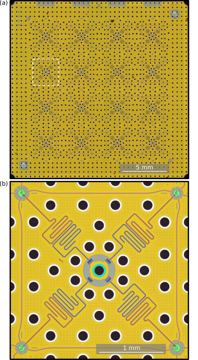
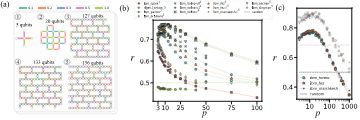
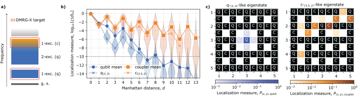
Static nearest-neighbour lattice
A coupling graph fixed at mask level in which each qubit interacts only with lithographic neighbours; the default topology under every fielded superconducting and spin processor.
Verdict. Not a design choice but the residue of planar lithography. It caps codes at the surface/colour family by geometry, and every announced escape from it is roadmap, not hardware.
Λ = error-suppression factor per code-distance step; QBI = DARPA Quantum Benchmarking Initiative (Stage A concept → B R&D plan → C government V&V); G1–G7 = the report's goal classes (see Actors & economics).
Identity & lineage
A connectivity primitive, not a qubit type: the interaction graph is frozen at mask level, each site coupling only to lithographic neighbours, because capacitive/inductive and exchange couplings decay over microns and nanometres. The anchor is Barends et al. (Google/UCSB, 2014-02): five Xmon qubits in a linear nearest-neighbour array, 2Q up to 99.4%, at the surface-code threshold D[284]. IBM's heavy-hex arrived in 2019 as a code construction — a surface/Bacon–Shor hybrid with flag qubits, cutting fixed-frequency collisions "by several orders of magnitude" at the cost of coordination number S[476]; the flagship has since returned to a square lattice C[49].
Attributes: fully fabricated affinity; no time constant, readout or control of its own — a topology, not a device; static, lithographic, coherent error: "heavy-hex (degree 2.3) or square lattice (degree 3.5–3.6) with on-chip couplers; ZZ crosstalk is the tax" (graph record).
Physics & limits
The floor is not a coherence floor. Always-on coupling leaves residual ZZ; tunable couplers null the static part but add a flux line, a leakage path and flux-noise susceptibility S[476]. In the only published full error budget at code scale — Google's d=7 run on Willow — CZ crosstalk contributes 5.5×10⁻⁴ D[1]. The binding constraint is geometric: a stabiliser code with 2D-local checks obeys the Bravyi–Poulin–Terhal bound kd² ≲ n, so this topology hosts only the surface/colour family at order 2d² physical qubits per logical one — a rate no better qubit can raise. The second tax is routing: an arbitrary interaction on a degree-2.3–3.6 graph costs SWAP depth scaling with lattice diameter. Only breaking 2D locality moves the floor.
For digital simulation of time-independent, finite-range lattice Hamiltonians in a fixed dimension, nearest-neighbour connectivity is near-optimal: a nearest-neighbour circuit reaches depth O(T log(nT/ε)) with O(nT log(nT/ε)) gates and O(n) ancilla qubits, for n qubits, evolution time T and error ε, against an unconditional lower bound of Ω(log n / log log n) depth for uniform XXZ dynamics at fixed time P[894]. The count assumes exact single-qubit rotations; synthesis over a finite gate set adds a polylogarithmic factor.
Engineering state of the art
Best demonstrated is an isolated pair: IQM's flux-tunable-coupler CZ at 99.93% over 40 hours, with 99.98% 1Q and >99.94% simultaneous readout on the same device D[38]. Typical at scale is IBM's fleet error per layered gate, 3.7×10⁻³ typical and 1.9×10⁻³ best (July 2026), measured full-width D[33]. That ≈5× gap between a characterised pair and a full-width layer is the lattice tax; inside it the two-qubit gate dominates, about 40% of Google's colour-code budget D[41]. Foundry spin arrays sit a generation behind, 2Q 99.04–99.56% D[189].
table
| Year | Figure | Who | Tag+key |
|---|---|---|---|
| 2014-02 | Five-qubit linear array, 2Q up to 99.4% | Google/UCSB | D[284] |
| 2024-12 | d=7 surface code, 105 q, Λ=2.14; CZ crosstalk 5.5×10⁻⁴ | Google Quantum AI | D[1] |
| 2025-11 | Nighthawk: 120 q, 218 couplers, 5,000 2Q gates per circuit | IBM | C[49] |
| 2026-04 | Twelve chiplets tiled into 108 q, median 2Q 99.1% (99.5% at 36 q) | Rigetti | C[36] |
Manufacturing, materials & supply chain
Superconducting lattices are Nb/Al junction films patterned by DUV or e-beam; EUV is not required and no fielded transmon lattice uses it — IBM runs 300 mm at Albany, Google in-house. Spin dot arrays are foundry-native and EUV-dependent: Intel 300 mm, >24,000 devices per wafer D[199] and 96% tune-up yield on 232 devices of one wafer D[766]; GlobalFoundries 22FDX for Quantum Motion; STMicroelectronics FD-SOI for Quobly Cfact. Uniformity, not peak fidelity, limits that branch: imec's eight-qubit device had a validated two-qubit gate on one of four pairs D[197]. Export exposure attaches to the machine, not the topology (ECCN 4A906, 3A904, 3A901.a) G[301].
Control, readout & I/O burden
The lattice buys no wiring saving. Nighthawk carries 218 tunable couplers for 120 qubits: the coupler count — roughly 1.8 flux lines per qubit above drive and readout — sets the harness C[49]. At 10³ the harness is buildable; at 10⁴ it binds on cryostat area and heat load, which IBM's 0.53 m² wiring area and 2.75 m³ vacuum volume per modular cell are sized against C[50]; at 10⁶ nothing at room temperature closes. Both mitigations sit far below lattice scale: SEEQC's millikelvin SFQ control flip-chip-integrated with qubits, 1Q up to 99.9% D[304], and HRL's 4 K cryo-CMOS sequencer running 18 qubits with no room-temperature real-time electronics D[190].
Role in the stack
It underlies the transmon architecture (IBM, Google, Rigetti, IQM, Fujitsu), the bosonic and dual-rail superconducting architectures, the silicon and germanium quantum-dot spin architecture (Intel, Diraq, Quantum Motion, HRL→IBM), the silicon donor-spin architecture, defect-spin nodes and the topological tetron (Majorana) architecture. It provides the 2D-local checks the rotated surface and colour codes need, and is the alternative to long-range on-chip couplers, shuttled spins and shared-line crossbars; switching costs a mask redesign. It conflicts with degree-≥6 qLDPC codes, all-to-all high-rate codes, transversal-permutation schemes and cm-scale 3D cavities. Having no transport step it adds zero to the transport term of the derived clock (= sum of the syndrome round: gate layers + transport + readout + reset); its cost hides in the gate term as SWAP depth. The neighbouring empty slot is a degree-≥6 static lattice at parity fidelity with degree-3.5.
Evidence — how the numbers were measured
Crosstalk and coupler figures come from randomised or cross-entropy benchmarking on pairs or small subsets. The 5.5×10⁻⁴ CZ crosstalk is a fitted component of Google's device-wide error budget, not an independent measurement; no vendor publishes full-lattice simultaneous crosstalk. Error per layered gate is the only full-width metric in fleet use and only IBM reports it, so cross-vendor comparison of the lattice tax is impossible today. Rigetti's 99.5%→99.1% median drop across its 36→108-qubit tiling is unattributed C[36].
The PatSnap patent counts come from secondary sources.
Actors & economics
Who.
| Organisation | Role | Country | What exactly they do | Evidence |
|---|---|---|---|---|
| IBM | Developer | US | Heavy-hex then square lattices; Nighthawk 120 q | C[49] |
| Google | Developer | US | Square lattices; d=7 code on 105 qubits | D[1] |
| Rigetti | Developer | US | Tiles chiplets into 108 qubits | C[36] |
| IQM | Developer | FI | Transmon line; isolated-pair CZ 99.93% | D[38] |
| GlobalFoundries | Supplier | US | 22FDX spin-dot wafers | Cfact |
Money.
- 2026-05-21 · US Dept of Commerce · CHIPS letters of intent, nine firms (IBM/Anderon $1 B, GlobalFoundries $375 M, Diraq ≤$38 M) · $2.013 B · LOI, non-binding fact
- 2026-06-02 · IBM · five-year quantum commitment · >$10 B · announced Cfact
- 2026-07-02 · IQM · Nasdaq/Helsinki listing · cash €337 M pro-forma · closed Cfact
- 2026-08 · Rigetti · Q2-2026 results · revenue $5.1 M, cash $541.3 M · reported Cfact
Market & supply chain. Transmon lattices consume DUV/e-beam tooling, flip-chip bonders, TWPA amplifiers and control racks; spin lattices consume ASML EUV inside Intel, GlobalFoundries and STMicroelectronics — a single point of failure the superconducting branch does not share. G1–G3 pay for the lattice; G4 is the goal it cannot reach unaided.
IP & standards. The IP is coupler-level: IBM US 11,727,297 B2 (granted 2023-08-15) claims an opposite-sign second coupling path cancelling coherent error Pfact. Aggregate quantum families in PatSnap's landscape published on 2026-06-30: IBM 4,388, Google 2,385 P[312]. No topology standard exists.
Roadmaps & track record. IBM Nighthawk (promised 2025-06-10, for 2025, delivered 2025-12) Cfact; Kookaburra, the first step off pure nearest-neighbour connectivity (promised 2022-05-10 for 2025, redefined for 2026, undelivered as of 2026-09-04) Rfact; Rigetti median 99.5% at 108 q (promised for end-2025, slipped to "later 2026", unmet) Rfact. IBM ships the base lattice on time and misses every date beyond it.
Strategic reading. If this topology stays the only manufacturable one, the winners own 2D-local decoding and yield — IBM and Google in superconductors, CMOS foundries in spins — and the losers are high-rate-code startups betting on connectivity nobody can fabricate. If degree rises, leverage moves to coupler and packaging IP — what IBM's coupler patents and the HRL purchase buy.
Outlook & open questions
Confirm or demote within 12–24 months: does Kookaburra ship a qLDPC memory on c-coupled hardware or slip again; does Rigetti reach median 99.5% at 108 qubits; does any vendor publish a full-lattice simultaneous-crosstalk number. Best case by 2029: degree-6 on-chip routing ships without a fidelity penalty and a planar lattice hosts a high-rate memory. Worst case: coordination stays near 3.5 and scale is bought with 2d² overhead. Open: whether the pair-to-full-width gap is intrinsic.
References
- [1] Google Quantum AI and Collaborators, “Quantum error correction below the surface code threshold,” Nature, vol. 638, no. 8052, pp. 920–926, Dec. 2024, doi: 10.1038/s41586-024-08449-y. D
- [33] IBM, “IBM Quantum Computing — Hardware and roadmap.” [Online]. Available: https://www.ibm.com/
quantum/ Dhardware - [36] Rigetti Computing, Inc., “Rigetti Announces General Availability of 108-Qubit System,” Apr. 7, 2026. [Online]. Available: https://investors.rigetti.com/
news-releases/ Cnews-release-details/ rigetti-announces-general-availability-108-qubit-system - [38] F. Marxer et al., “Above 99.9% Fidelity Single-Qubit Gates, Two-Qubit Gates, and Readout in a Single Superconducting Quantum Device,” PRX Quantum, vol. 7, Art. no. 020333, 2026, doi: 10.1103/n86s-2b88. arXiv:2508.16437. D
- [41] N. Lacroix et al., “Scaling and logic in the color code on a superconducting quantum processor,” Nature, vol. 645, no. 8081, pp. 614–619, May 2025, doi: 10.1038/s41586-025-09061-4. arXiv:2412.14256. D
- [49] IBM, “IBM Delivers New Quantum Processors, Software, and Algorithm Breakthroughs on Path to Advantage and Fault Tolerance,” Nov. 12, 2025. [Online]. Available: https://newsroom.ibm.com/
2025-11-12-ibm-delivers-new-quantum-processors,-software,-and-algorithm-breakthroughs-on-path-to-advantage-and-fault-tolerance C - [50] C. Dundon, S. Hall, M. Hollister, and A. Lindler, “IBM's new modular architecture for cryogenic systems,” IBM Quantum Computing Blog, Aug. 19, 2026. [Online]. Available: https://www.ibm.com/
quantum/ Cblog/ modular-cryogenics - [189] P. Steinacker et al., “Industry-compatible silicon spin-qubit unit cells exceeding 99% fidelity,” Nature, vol. 646, no. 8083, pp. 81–87, Sep. 2025, doi: 10.1038/s41586-025-09531-9. D
- [190] Members of the HRL Quantum Team and Collaborators, “A digitally controlled silicon quantum processing unit,” arXiv:2604.16216, Apr. 2026. D
- [197] A. Nickl et al., “Eight-qubit operation of a 300 mm SiMOS foundry-fabricated device,” Nat. Commun., vol. 17, no. 1, Art. no. 5878, Jul. 2026, doi: 10.1038/s41467-026-74597-6. D
- [199] H. C. George et al., “12-spin-qubit arrays fabricated on a 300 mm semiconductor manufacturing line,” Nano Lett., vol. 25, no. 2, pp. 793–799, Dec. 2024, doi: 10.1021/acs.nanolett.4c05205. arXiv:2410.16583. D
- [284] R. Barends et al., “Superconducting quantum circuits at the surface code threshold for fault tolerance,” Nature, vol. 508, no. 7497, pp. 500–503, Apr. 2014, doi: 10.1038/nature13171. arXiv:1402.4848. D
- [301] US Department of Commerce, Bureau of Industry and Security, “Commerce Control List Additions and Revisions; Implementation of Controls on Advanced Technologies Consistent With Controls Implemented by International Partners,” Federal Register, vol. 89, p. 72926, Sep. 6, 2024. [Online]. Available: https://www.federalregister.gov/
documents/ G2024/ 09/ 06/ 2024-19633/ commerce-control-list-additions-and-revisions-implementation-of-controls-on-advanced-technologies - [304] C. Jordan et al., “A quantum computer controlled by superconducting digital electronics at millikelvin temperature,” Nat. Electron., vol. 9, no. 3, pp. 287–294, Mar. 2026, doi: 10.1038/s41928-026-01576-6. D
- [312] PatSnap, “Quantum Computing Patent Landscape 2026,” Jun. 30, 2026. [Online]. Available: https://www.patsnap.com/
resources/ Pblog/ rd-blog/ quantum-computing-patent-landscape/ - [476] C. Chamberland, G. Zhu, T. J. Yoder, J. B. Hertzberg, and A. W. Cross, “Topological and subsystem codes on low-degree graphs with flag qubits,” arXiv:1907.09528, Jul. 2019. S
- [766] S. F. Neyens et al., “Probing single electrons across 300-mm spin qubit wafers,” Nature, vol. 629, no. 8010, pp. 80–85, May 2024, doi: 10.1038/s41586-024-07275-6. D
- [894] Z. Shen, Y. Wu, P. Yao, X. Yuan, and Y. Zhang, “Toward optimal circuit depth for geometrically local Hamiltonian simulation,” arXiv:2610.01839, Oct. 2026. P