Crossbar shared-line control (spins) cx_crossbar
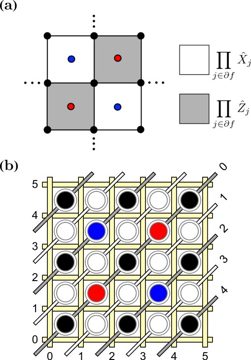
Row- and column-shared plunger and barrier lines address a two-dimensional dot array with line count scaling as the square root of dot count, trading addressing granularity for wireability.
Crossbar shared-line control (spins)
Shared plunger/barrier lines: 23 lines for 16 dots, T = 6√g − 1 scaling; no coherent qubit operation shown.
Brief →Key references
Design space — attributes
- (a) carrier affinity
- fabricated
- (b) time · entangling
- —
- (c) readout
- —
- (d) mobility
- shared-line crossbar
- (e) control
- low-frequency electrical @ room temperature
- (f) error structure
- coherent / calibration
- (g) manufacturing
- CMOS foundry 300 mm
Evaluation space — dated attributes
The 2024 crossbar (16 dots, 23 lines; founding paper online 2023-08-28) showed no coherent qubit operation. The 'one of four pairs gated' result belongs to imec/Diraq's individually wired 8-qubit 300 mm device (Nat. Commun. 17, 5878, 2026-07), not to a crossbar.
Standard records
Actors & goals — annotations
Edges
Used by no registered machine
Pictures
Every picture carries the story of what it shows and its credit line.
Crossbar shared-line control (spins)
Row- and column-shared plunger and barrier lines address a two-dimensional dot array with line count scaling as the square root of dot count, trading addressing granularity for wireability.
Verdict. Removes the I/O wall on paper and in a 1,058-site chip, but no crossbar array has published a two-qubit gate, a crosstalk figure or an independent replication.
Λ = error-suppression factor per code-distance step; QBI = DARPA Quantum Benchmarking Initiative (Stage A concept → B R&D plan → C government V&V); G1–G7 = the report's goal classes (see Actors & economics).
Identity & lineage
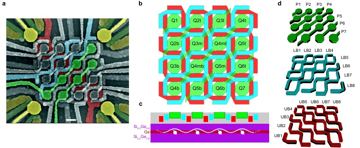
A crossbar shares gate lines across rows and columns of a dot array: an n×m grid needs O(n+m) lines, not O(nm), at the price that every pulse reaches every dot on the line. Selectivity comes from cross-capacitance compensation and the operating-point spread between tiles: addressing becomes calibration. Proposed for spin qubits by Li et al. (QuTech, Sci. Adv. 2018); first demonstrated by Borsoi et al. (Veldhorst group, QuTech/TU Delft): 16 germanium dots on 23 lines, published January 2024 D[520]. Attributes: connectivity — shared row/column addressing, carrier immobile; control and error — low-frequency drive from room temperature, coherent shared-line crosstalk over ordinary charge noise, CMOS fabrication.
Physics & limits
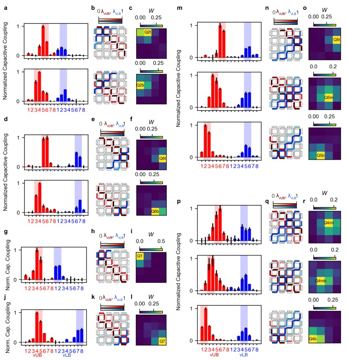
Line count follows a Rent exponent near 0.5: T = 6√g − 1 terminals for g dots D[520], and n+m+7 = 53 lines for the 23×23 QARPET array, capacity 1,058 sites at 2×10⁶ tiles/mm² D[521]. The binding constraint is uniformity, not wiring: one shared voltage must land inside every tile's operating window at once, so threshold spread sets how many tiles a line serves. QARPET's 38-of-40 addressable tiles show T2* 4.43–5.75 µs and Hahn-echo T2 10.11–12.69 µs, comparable to individually wired germanium devices: sharing lines costs no coherence D[521]. What it adds is coherent error correlated along a whole row or column, the structure decoders assume away. On-chip demultiplexing would move the floor.
Engineering state of the art
table
Dominant term: addressing coverage. Neither device published a two-qubit gate on a shared line.
Not published: a shared-line crosstalk figure for any crossbar array; the conflict with per-pair exchange calibration follows from the addressing scheme, not from a measurement.
Manufacturing, materials & supply chain
Both devices are Ge/SiGe heterostructures made in a university cleanroom, not on a 300 mm line, and no foundry has announced a crossbar process step as of 4 Sep 2026 — GlobalFoundries' Quantum Technology Solutions unit, with cryogenic control ICs and packaging, is the closest named capability C[353]. Control burden is the whole point, and its cost reappears as sequencing: one row and one column select at a time, so at 10³ tiles parallel operation needs on-chip decoding, and at 10⁴–10⁶ the wall is addressing bandwidth, not connector count. No demultiplexer has been demonstrated inside an array.
Role in the stack
Requires a gate-defined quantum-dot spin carrier; replaces one-line-per-electrode wiring; conflicts with per-pair exchange calibration, since a shared barrier cannot deliver an independently tuned pulse to every pair at once. Belongs to the silicon and germanium quantum-dot spin architecture. Its clock contribution is a sequencing multiplier on derived clock = sum of the syndrome round: gate layers + transport + readout + reset (8.5 µs here, readout-set), unquantified in any publication. Verification: 1,058 is a site capacity, not a qubit count, and no crossbar has published a two-qubit fidelity, a crosstalk figure or a replication. The "only some pairs work" result often cited here — one of four pairs gated on imec's eight-qubit 300 mm device D[197] — is individually wired, not a crossbar.
Actors & economics
Who.
| Organisation | Role | Country | What they do | Evidence |
|---|---|---|---|---|
| QuTech/TU Delft | research | Netherlands | Built both crossbar devices, including QARPET | D[521] |
| Groove Quantum | developer | Netherlands | Commercialises the germanium dot platform | fact |
| GlobalFoundries | supplier | USA | Cryogenic control ICs and packaging | C[353] |
| Quantum Machines | supplier | Israel | Sequencing hardware for shared-line addressing | C[449] |
Money. 2026-04-30 · Groove Quantum · venture round · €16 M · investors undisclosed · €26 M cumulative · closed fact. 2026-05-21 · GlobalFoundries · CHIPS letter of intent · $375 M · US Commerce · non-binding fact.
Market & supply chain. No crossbar-specific equipment vendor exists; the scheme sets how many fridge lines an array needs, making cryogenic control ICs the contested layer C[353]. Pays into G3 and G4 only — below ~10³ dots individual wiring is cheaper and better characterised.
IP & standards. No dated crossbar patent family found in a named database as of 4 Sep 2026; the shared-line principle is commodity-memory word-line addressing, long out of patent.
Roadmaps & track record. QuTech (2026-02-12 · QARPET as a shared benchmarking chip · delivered, no scaling roadmap) D[521]. Diraq's 2029 roadmap names no wiring scheme Rfact. The demonstrations are modest and honestly stated; no vendor has committed to a crossbar.
Strategic reading. If crossbars scale, leverage shifts from rack-electronics vendors to whichever foundry can put demultiplexers at millikelvin; if uniformity blocks them, per-qubit wiring with cold multiplexing — the HRL/IBM route — wins and the rack vendors keep their position.
Outlook & open questions
Confirm or demote in 12–24 months: two tiles gated independently through one shared line; a published crosstalk figure; a foundry crossbar step by 2027. Best case 2029: on-chip demultiplexing addresses >10⁴ dots with hundreds of lines. Worst case: crossbars stay a wireability demonstration while cold per-qubit multiplexing wins. Open: (1) what fraction of tiles stays addressable as arrays grow; (2) whether row-correlated error breaks decoder assumptions; (3) whether demultiplexers fit the millikelvin power budget.
References
- [197] A. Nickl et al., “Eight-qubit operation of a 300 mm SiMOS foundry-fabricated device,” Nat. Commun., vol. 17, no. 1, Art. no. 5878, Jul. 2026, doi: 10.1038/s41467-026-74597-6. D
- [353] GlobalFoundries, “GlobalFoundries launches Quantum Technology Solutions to scale U.S. quantum manufacturing,” May 21, 2026. [Online]. Available: https://gf.com/
gf-press-release/ Also https://investors.gf.com/globalfoundries-launches-quantum-technology-solutions-to-scale-us-quantum-manufacturing/ news-releases/ . Cnews-release-details/ globalfoundries-launches-quantum-technology-solutions-scale-us - [449] Quantum Machines, “Semiconductor Spin Qubits,” Aug. 11, 2026. [Online]. Available: https://www.quantum-machines.co/
qubit-types/ Csemiconductor-spin-qubits/ - [520] F. Borsoi et al., “Shared control of a 16 semiconductor quantum dot crossbar array,” Nat. Nanotechnol., vol. 19, no. 1, pp. 21–27, Jan. 2024, doi: 10.1038/s41565-023-01491-3. D
- [521] A. Tosato et al., “A crossbar chip for benchmarking semiconductor spin qubits,” Nat. Electron., vol. 9, no. 3, pp. 324–333, Mar. 2026, doi: 10.1038/s41928-026-01569-5. D