Continuous atom reloading (reservoir + optical conveyor belt) cx_reload
A continuously fed atom reservoir (optical-lattice conveyor belts from a distant MOT, a cavity-enhanced lattice or a molasses-stopped beam) from which tweezers extract fresh atoms into the array while the stored qubits keep their coherence.
Continuous atom reloading (reservoir + optical conveyor belt)
A continuously fed atom reservoir (optical-lattice conveyor belts, a cavity-enhanced lattice or a molasses-stopped beam) from which tweezers extract new atoms into the array while the stored qubits keep their coherence; it replaces atom loss and turns a one-lifetime run into continuous operation.
Brief →Key references
Design space — attributes
- (a) carrier affinity
- natural
- (b) time · entangling
- 79 ms
- (c) readout
- —
- (d) mobility
- physical transport
- (e) control
- optical @ room temperature
- (f) error structure
- loss (erasure)
- (g) manufacturing
- optical / mechanical assembly
Evaluation space — dated attributes
Reload flux and coherence during reload are the figures of merit; a ~10,000-qubit processor at 1 ms per gate layer needs about 15,000 rearranged qubits per second (Chiu et al., a sufficiency estimate).
Standard records
Actors & goals — annotations
Edges
Used by 2 machines (1 primary · 1 alternate)
- neutral atoms 2
- continuously reloaded 3,000-atom machine Harvard / MIT paper paper ▣ Fig. 1a (two optical-lattice conveyor belts transport atoms 0.5 m from MOT region to science region); Extended Data Fig. 2 (Dual-lattice conveyor belt transport); Methods: Dual-Lattice Optical Transport ✅
- Phoenix (Gen-1) and Gen-2 Atom Computing press press ▤ Abstract ✅ (alternate)
Pictures
Every picture carries the story of what it shows and its credit line.
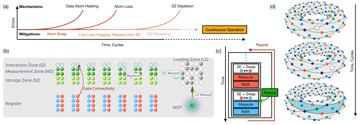
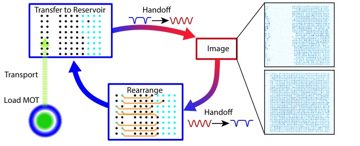
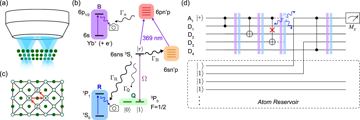
Continuous atom reloading (reservoir + optical conveyor belt)
A continuously fed atom reservoir (optical-lattice conveyor belts from a distant MOT, a cavity-enhanced lattice or a molasses-stopped beam) from which tweezers extract fresh atoms into the array while the stored qubits keep their coherence.
Verdict. Demonstrated as an enabler: Harvard/MIT held over 3,000 atoms for over 2 h and sort 15,000 qubits/s, the authors' own sufficiency figure for a ~10,000-qubit processor; as of 2026-09-26 the largest published QEC run with reservoir reloading found is 64 atoms, and the register's only primary carrier has no entangling result.
MOT = magneto-optical trap; AOD = acousto-optic deflector; DD = dynamical decoupling (XY16 = its 16-pulse sequence); T2 / T2* = echo / Ramsey coherence time; ³P₀ = metastable clock state of Sr and Yb; QEC = quantum error correction; G1–G7 = the report's goal classes (see Actors & economics).
Identity & lineage
A tweezer array is normally loaded once and sorted by AOD moves — Caltech's 6,100 atoms fill about half of ~12,000 sites D[138] — and then only loses atoms. This technology adds a reservoir refilled during the computation, from which tweezers extract fresh atoms without disturbing stored qubits. Feeds: lattice conveyor belts from a MOT 0.5 m away (Harvard/MIT, Rb) D[144]; a repetitively filled cavity-enhanced lattice (Atom Computing, ¹⁷¹Yb) D[505]; a molasses-stopped reservoir several hundred µm from the qubits (Princeton, ¹⁷¹Yb) D[506].
Attributes: natural carrier; transport mobility; removes loss; optical control at room temperature; optics manufacturing.
Physics & limits
N atoms of lifetime τ are lost at N/τ: the first loss comes after ~τ/N, and one lifetime leaves e⁻¹ ≈ 37 % of the array S. At Harvard's ~60 s storage lifetime D[144], 3,000 atoms lose 50 per second; at Caltech's 23 min D[138], the first of 10⁴ atoms goes after ~0.14 s S. Operations lose more: entangling errors and readout join trap lifetime as loss sources D[144], and loss is "a significant fraction of all errors" D[506]. Chiu et al. estimate that 15,000 rearranged qubits/s replenish ~10,000 qubits at ~99.5 % gate fidelity and 1 ms per layer S[144] — 1.5 × 10⁻³ replacements per qubit per layer, ~1 % of them due to a 60 s lifetime S. Cryogenic lifetimes of 5,000–6,000 s D[507]D[146] remove only that 1 %.
Light constrains refilling: MOT and imaging light is near-resonant for Rb qubits, so Harvard adds distance, a differential pumping tube tilted ~4° and a 1529 nm light shift of 5P₃/₂ that suppresses scattering >10⁴-fold D[144]. The Yb ³P₀ qubit is isolated from cooling and imaging light D[506]; stored ⁸⁸Sr is shelved in ³P₀ (13 s lifetime) with the MOT repumper off D[259].
Engineering state of the art
table
| Year | Figure | Who | Tag+key |
|---|---|---|---|
| 2021-06 | Tweezers at ~4 K, lifetime >6,000 s | Institut d'Optique | D[507] |
| 2024-01 | 1,225 Yb sites, 99 % filled from a lattice reservoir | Atom Computing | D[505] |
| 2024-02 | >1,000 Sr atoms, ~130 refilled per 2.5 s cycle, >1.5 h | MPQ | D[259] |
| 2024-03 | >6,100 atoms, single load, 23 min lifetime | Caltech | D[138] |
| 2025-06 | 7.3 × 10⁴ atoms/s extracted; 1 ms per replacement | Princeton | D[506] |
| 2025-09 | 3 × 10⁵ atoms/s into tweezers; >3 × 10⁴ qubits/s; >3,000 atoms for >2 h | Harvard/MIT | D[144] |
| 2026-04 | 1,024-atom defect-free arrays at 4 K, ~5,000 s | Lim et al. | D[146] |
| 2026-06 | Toric code, 90 cycles with reservoir reloading | Atom Computing/Microsoft | D[148] |
Harvard/MIT sort 15,000 qubits/s in 600-qubit batches D[144], one per ~40 ms S; one of six 540-site storage subarrays is refilled every ~80 ms D[144], so each atom is replaced about every 0.5 s — 6.75 × 10³ atoms/s over >2 h, the ~5 × 10⁷ reported S. The run proves throughput and 99.3 % filling D[144], not hours-long qubit survival S.
Manufacturing, materials & supply chain
Vacuum and optics, not a fabricated part: a second MOT chamber behind a differential pumping tube and two lattice stages, ~39 cm and ~17 cm, delivering ~2.5 × 10⁶ atoms every ~150 ms D[144]; Atom Computing's MOT sits 30 cm below its array D[148]. Delivery, ~1.7 × 10⁷ atoms/s, exceeds tweezer loading ~50-fold, so extraction bounds the flux S. Optical access to the science region, shared with tweezers, Rydberg beams and imaging, is the scaling limit S.
Control, readout & I/O burden
Three synchronised loops — reservoir delivery (~150 ms), batch extraction, imaging and sorting, storage refill (~80 ms) — interleave with XY16 DD on stored qubits D[144]. Every fresh atom is imaged: 25–50 camera frames and rearrangement solutions per second S. Yb needs no shield; Princeton prepares 30 complete arrays per second D[506].
Role in the stack
Slot 4 of Rydberg tweezer array — alkali (Rb/Cs) and Rydberg tweezer array — alkaline-earth(-like) (Yb/Sr), erasure-native, beside cx_aod. It requires ct_laser (lattice and tweezer light) and fab_optics (second MOT region, conveyor optics, vacuum). It replaces one-shot loading (the edge from cx_aod), though every machine keeps AOD tweezers for extraction and sorting. The gap ledger holds: AOD moves span hundreds of micrometres in 0.4–1.6 ms; a conveyor carries a ~10⁶-atom reservoir half a metre D[144]. Filed by function: a lattice reservoir or a molasses-stopped beam does the same job. Conflicts with alkali (scattered MOT light) and ae_atom (repumper depleting stored atoms) are mitigated (2025-09; 2024-02). It provides reload flux and run length: >2 h, >5 × 10⁷ atoms through 3,000 sites D[144].
Reload closes the loop erasure conversion opens: converting 98 % of ¹⁷¹Yb errors to erasures raised the simulated threshold from 0.937 % to 4.15 % S[8]; Atom Computing corrected on average 1.8 lost atoms across 24 logical qubits D[149]; delayed-erasure decoding uses loss of unknown timing S[508]. Each converted error is a hole that mid-circuit imaging locates and the reservoir fills D[148]; without reload, conversion shortens the run.
Register: two machines — the continuously reloaded 3,000-atom machine (Harvard/MIT, primary, demonstrated Sep 2025), cell ✅ verified (arXiv:2506.20660, Fig. 1a), two-qubit error n/a — an enabler without an entangling result; and Phoenix (Gen-1) and Gen-2 (Atom Computing, alternate), cell ✅.
Evidence — how the numbers were measured
The discriminating test is stored-qubit coherence with reload on versus off. Harvard (Rb, XY16): T2 1.34(4) s reference, 1.15(3) s with the MOT, 1.09(3) s adding imaging and shielding D[144] — 14–19 % lower, ~4–5σ S. Princeton (Yb): echo T2 5.4(9) versus 7(1) s, T2* 0.73(2) versus 0.69(2) s, unchanged within 1.5σ D[506]. No gate fidelity on stored qubits during reload is published, as of 2026-09-26. The one logical figure: 0.63(3) % and 0.64(4) % error per cycle over up to 90 cycles with reloading, on 32- and 64-atom toric codes, cycle time unstated D[148]. Flux is quoted as atoms, initialised or sorted qubits, a tenfold spread; the Atlas uses initialised qubits/s.
The Harvard/MIT batch cadence is derived from flux and batch size, not quoted by the source.
Actors & economics
Who.
| Organisation | Role | Country | What exactly they do with this technology | Evidence |
|---|---|---|---|---|
| Harvard University / MIT | research | US | Two-stage lattice conveyor, 3,000-atom continuous array | D[144] |
| QuEra Computing | developer | US | Libra roadmap with a reloading reservoir | R[509] |
| Atom Computing (with Microsoft) | developer | US | Lattice reservoir; toric code with reloading | D[505]D[148] |
| Princeton University | research | US | Yb metastable reservoir | D[506] |
| MPQ | research | DE | Refilled Sr lattice array | D[259] |
| Caltech | research | US | Single-load reference array | D[138] |
Money. No dated financial item is specific to continuous reloading as of 2026-09-26.
Market & supply chain. No separate market: makers build reservoirs from the laser, modulator and vacuum classes they already buy. The technology pays into G1, G3 and G7 by lifting the depth bound.
IP & standards. No patent count was checked; no standard defines how reload flux or coherence during reload is reported, as of 2026-09-26.
Roadmaps & track record. (for 2028 · QuEra Libra · >10,000 physical, 256 logical qubits at 10⁻⁶, fresh qubits loaded "mid-circuit from Libra's reloading reservoir") R[509]; Chiu et al.: ~99.9 % fidelity with 80,000 qubits/s could run several hundred surface-code logical qubits at 10⁻⁸ S[144]. Flux is ahead of plan; integration is behind — gates plus reload are published only at 64 atoms.
Strategic reading. Reload makes loss the cheapest error to correct, as both atom architectures' QEC plans assume. The flux record comes from a group whose senior authors co-founded QuEra D[144]; only Atom Computing's reservoir has run inside QEC. If coherence and gate fidelity hold under reload at 10³–10⁴ atoms, depth stops being the atom platform's weakness; if not, runs stay bounded by τ/N.
Outlook & open questions
Confirm if, by 2027-12-31, a published experiment runs gates or QEC rounds on ≥1,000 atoms while reloading, with logical error flat across reload events; demote if QuEra's 2028 reservoir has no such precursor by then. Open questions. (1) Does flux scale with array area, or do extraction and imaging cap it? (2) What gate-fidelity tax do stored qubits pay beside an active preparation zone? (3) What does re-cooling fresh atoms cost in time? (4) Can a conveyor share optical access with a zoned architecture at 10⁴ sites? (5) At 5,000–6,000 s cryogenic lifetimes, is operation-induced loss the whole budget?
References
- [8] Y. Wu, S. Kolkowitz, S. Puri, and J. D. Thompson, “Erasure conversion for fault-tolerant quantum computing in alkaline earth Rydberg atom arrays,” Nat. Commun., vol. 13, Art. no. 4657, 2022, doi: 10.1038/s41467-022-32094-6. arXiv:2201.03540. S
- [138] H. J. Manetsch, G. Nomura, E. Bataille, K. H. Leung, X. Lv, and M. Endres, “A tweezer array with 6100 highly coherent atomic qubits,” Nature, vol. 647, pp. 60–67, 2025, doi: 10.1038/s41586-025-09641-4. arXiv:2403.12021. D
- [144] N.-C. Chiu et al., “Continuous operation of a coherent 3,000-qubit system,” Nature, vol. 646, no. 8087, pp. 1075–1080, Sep. 2025, doi: 10.1038/s41586-025-09596-6. D
- [146] D. Lim et al., “Defect-free arrays at the thousand-atom scale in a 4-K cryogenic environment,” PRX Quantum, vol. 7, Art. no. 033032, Apr. 2026, doi: 10.1103/45t1-vl5y. arXiv:2604.07205. D
- [148] Atom Computing and Collaborators, “Quantum error correction with the toric code,” arXiv:2606.04079, Jun. 2026. D
- [149] B. W. Reichardt et al., “Fault-tolerant quantum computation with a neutral atom processor,” arXiv:2411.11822, Nov. 2024. D
- [259] F. Gyger et al., “Continuous operation of large-scale atom arrays in optical lattices,” Phys. Rev. Research, vol. 6, no. 3, Art. no. 033104, Feb. 2024, doi: 10.1103/PhysRevResearch.6.033104. arXiv:2402.04994. D
- [505] M. A. Norcia et al., “Iterative assembly of ¹⁷¹Yb atom arrays with cavity-enhanced optical lattices,” PRX Quantum, vol. 5, no. 3, Art. no. 030316, Jan. 2024, doi: 10.1103/PRXQuantum.5.030316. arXiv:2401.16177. D
- [506] Y. Li, Y. Bao, M. Peper, C. Li, and J. D. Thompson, “Fast, continuous and coherent atom replacement in a neutral atom qubit array,” arXiv:2506.15633, Jun. 2025. D
- [507] K.-N. Schymik et al., “Single Atoms with 6000-Second Trapping Lifetimes in Optical-Tweezer Arrays at Cryogenic Temperatures,” Phys. Rev. Appl., vol. 16, no. 3, Art. no. 034013, Jun. 2021, doi: 10.1103/PhysRevApplied.16.034013. arXiv:2106.07414. D
- [508] G. Baranes et al., “Leveraging Qubit Loss Detection in Fault-Tolerant Quantum Algorithms,” Phys. Rev. X, vol. 16, no. 1, Art. no. 011002, Jan. 2026, doi: 10.1103/ycwc-3myc. arXiv:2502.20558. S
- [509] QuEra Computing, “Our Quantum Roadmap,” Sep. 15, 2026. [Online]. Available: https://www.quera.com/
our-quantum-roadmap R