Alkaline-earth(-like) atom (Yb/Sr) — erasure-native ae_atom
Ytterbium/strontium tweezer qubits whose metastable clock manifold makes decay and loss optically detectable, converting physical errors into heralded erasures rather than silent Pauli errors.
Alkaline-earth(-like) atom (Yb/Sr) — erasure-native
Nuclear-spin / clock-state qubits with metastable levels; decays are detectable → erasures (98% theory, 56% shown).
Brief →Key references
Design space — attributes
- (a) carrier affinity
- natural
- (b) time · entangling
- 251 ns · deterministic
- (c) readout
- fluorescence imaging (camera) · 501 µs · non-destructive · mid-circuit
- (d) mobility
- physical transport
- (e) control
- optical @ room temperature
- (f) error structure
- erasure-convertible, loss (erasure)
- (g) manufacturing
- optical / mechanical assembly
Evaluation space — dated attributes
Atom Computing (Yb), Princeton, Caltech (Sr), Pasqal (Rb→?)
Standard records
Actors & goals — annotations
Edges
Used by 7 machines (7 primary · 0 alternate)
- neutral atoms 7
- Magne Atom Computing + Microsoft, for QuNorth press press ▨ 🔎
- Phoenix (Gen-1) and Gen-2 Atom Computing press press ▣ Fig. 1b (zone-based tweezer architecture); §II ✅
- QUIONE ICFO - Institut de Ciencies Fotoniques press ▤ abstract ✅
- DiNAQC planqc, for the DLR Quantum Computing Initiative product page press link ▦ project description ('the bosonic isotope of the alkaline earth atom strontium') ✅
- MAQCS planqc press ▨ ✅
- metastable Yb-171 erasure array Princeton (Thompson group) paper paper paper ▣ Fig. 1a (storage/gate zones with metastable 171Yb qubits) ✅
- neutral-ytterbium QPU Yaqumo (+ Fujitsu) press press ▨ ✅
Pictures
Every picture carries the story of what it shows and its credit line.

Alkaline-earth(-like) atom (Yb/Sr) — erasure-native
Ytterbium/strontium tweezer qubits whose metastable clock manifold makes decay and loss optically detectable, converting physical errors into heralded erasures rather than silent Pauli errors.
Verdict. Erasure conversion is real and internally consistent (1.9(4)× unconditional decay suppression), but the metastable encoding costs ~6× in CZ error and is unreplicated outside Princeton and Caltech.
Λ = error-suppression factor per code-distance step; QBI = DARPA Quantum Benchmarking Initiative (Stage A concept → B R&D plan → C government V&V); G1–G7 = the report's goal classes (see Actors & economics).
Identity & lineage
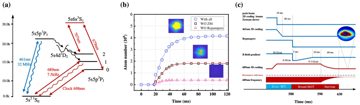
¹⁷¹Yb and ⁸⁷Sr have two valence electrons: a seconds-scale ³P₀/³P₂ metastable triplet above the ¹S₀ ground singlet, on a narrow clock line (578 nm Yb, 698 nm Sr). A ground-manifold imaging beam is dark to a metastable-manifold qubit, so decay and loss scatter photons while the code space stays quiet — the "omg" (optical–metastable–ground) scheme, from a 2021 ion-trap blueprint D[333]. Errors then arrive located, as erasures, not silent Pauli flips. Demonstrated in Yb (Princeton) and Sr (Caltech), May 2023 D[141], [143].
Attributes: natural carrier; deterministic Rydberg-blockade entanglement ~250 ns; fluorescence readout ~0.5 ms, non-destructive, mid-circuit-capable.
Optical control from room temperature; error structure erasure and loss, not native Pauli; manufacture by optical assembly, not lithography.
Physics & limits
Erasure conversion relabels error rather than reducing it; the payoff is in the decoder — at 1% erasure the erasure-aware surface code tolerates Pauli error to 0.51%, 5.2× the standard protocol D[334]. The gate floor sits elsewhere: Rydberg-blockade CZ runs in a few hundred nanoseconds against Rydberg spontaneous plus blackbody decay (0.05–0.1%), laser phase noise (0.1–0.2%) and thermal motion (~0.1%), which a 2026 review argues caps the standard scheme near 99.9% absent a new gate mechanism P[140]. Atom loss is over 80% of leakage events D[4] — precisely what omg sees. Moving the floor needs a cryogenic enclosure against blackbody-driven Rydberg decay, lower trap-light scattering out of the metastable manifold (it sets the check interval), and imaging that spares neighbouring sites.
Engineering state of the art
table
| Year | Figure | Who | Tag/key |
|---|---|---|---|
| 2023-05 | 56% of 1Q errors → erasures, ¹⁷¹Yb (98% ceiling) | Princeton | D[141] |
| 2024-07 | Sr CZ 99.71% | Caltech | D[136] |
| 2024-11 | Yb CZ 99.72% post-selected / 99.40% raw | Atom Computing | D[135] |
| 2026-06 | Metastable CZ error 0.016(1), 38(6)% flagged; [[4,2,2]] decay 1.9(4)× slower | Princeton | D[142]fact |
| 2026-08 | 17.6 µs imaging, 99.89(5)% discrimination, 98.80(44)% survival, ¹⁷⁴Yb | Kyoto/Yaqumo | P[261]fact |
The dominant term is the gate, not the erasure machinery: Princeton's metastable CZ error 0.016(1) is ~6× Atom Computing's raw ground-state Yb CZ of 0.0060 D[135], [142], and only ~38% of it returns as flags. The 17.6 µs record is spinless ¹⁷⁴Yb, not ¹⁷¹Yb readout, so 0.5 ms stays the honest cycle.
Manufacturing, materials & supply chain
No lithographic chip: the fab is a UHV chamber, a high-NA objective, SLM/AOD steering and clock, Rydberg, imaging and shelving lasers; yield is per-site loading probability plus SLM-aberration trap non-uniformity. Optics is the cost driver — Fraunhofer ILT's 2026 system makes 2,000 controllable Rydberg tweezers from four beams totalling 20 W Dfact, about 10 mW per site, so 10⁴ sites is a 100 W-class laser problem S. The thin points are not foundries: two crossed-AOD vendors appear anywhere in the literature (AA Opto-Electronic, Gooch & Housego) Dfact and Hamamatsu's SLM and camera line has no identified alternative Pfact. Export exposure is at system level: ECCN 4A906 controls quantum computers above a qubit-count and error-rate threshold (in force 2024-09-06, Licence Exception IEC for partners); no ECCN names tweezer optics, AODs or UHV chambers G[301]fact.
Control, readout & I/O burden
Addressing is AOD/SLM tweezers plus global clock and Rydberg beams; readout is imaging at 0.5–1 ms. A mid-circuit erasure check must be manifold-selective and must not heat the neighbours it illuminates — the constraint holding demonstrated conversion at 38–56% rather than the 98% ceiling D[141], [142]. Global beams plus AOD addressing suffice at 10³ sites; at 10⁴ beam steering bottlenecks parallel local operations — a deflector resolves as many spots as its rf bandwidth times the acoustic transit across the beam, a transit that also bounds how fast it re-points, and liquid-crystal modulators reframe at tens of hertz — and trap power crosses 100 W; at 10⁶ no path exists short of metasurface or photonic delivery.
Role in the stack
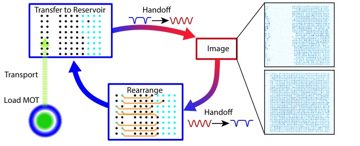
This carrier defines the "Rydberg tweezer array — alkaline-earth(-like) (Yb/Sr), erasure-native" architecture (Atom Computing/Microsoft, Princeton, Caltech, planqc, Yaqumo) and is the alternate carrier of the "Neutral-atom analogue simulator (Rydberg arrays, lattice gases)" (ICFO's QUIONE, an ⁸⁴Sr lattice gas): optical assembly only, no foundry and no cryostat, hence no CHIPS-style capital wall. It feeds Rydberg-blockade CZ, the omg encoding, imaging readout, fast (≤20 µs) array readout and the atom–photon cavity interface. It replaces alkali species; a Rb incumbent's switching cost is a new laser and imaging system. Derived clock on the tweezer array of alkaline-earth and alkaline-earth-like atoms (Sr, Yb) = sum of the syndrome round (gates 1 µs, transport 800 µs, 1Q 0.34 µs, readout 501 µs) = 1.3 ms, transport-limited, against the measured ~1–4 ms round. The salient empty slot is an erasure-aware real-time decoder fed by live array syndromes.
Evidence — how the numbers were measured
Fractions come from state-selective fluorescence after gates; CZ fidelity from randomised benchmarking or tomography, reported raw and post-selected on the flag. A code spends a correction cycle on every heralded erasure, so raw numbers govern cost. The 1.9(4)× vs 3.6× conflict resolves inside arXiv:2506.13724v2: both figures are in that paper and describe different quantities — decay is 3.6(1)× slower during hold for the post-selected logical qubit, 1.9(4)× slower under unconditional decoding with erasure information D[142]. Only 1.9(4)× is architecturally meaningful; the Nature Physics text is paywalled [142]. The 56% (1Q, 2023) and 38(6)% (CZ, 2026) figures are different metrics and must not be averaged. No independent replication was found.
Not published: Magne's installation status after the 2025-07-17 order announcement. The ≈10 mW per site trap power at 10⁴ sites is an extrapolation from the Fraunhofer figures, not a measurement S. No ECCN names tweezer optics, AODs or UHV chambers; only the finished system is export-controlled.
Actors & economics
Who.
| Organisation | Role | Country | What they do | Evidence |
|---|---|---|---|---|
| Atom Computing | developer | US | Ships ¹⁷¹Yb arrays; 1,225-site Magne | C[154] |
| Princeton University | research | US | Originated Yb erasure conversion; [[4,2,2]] logical qubit | D[141], [142] |
| Caltech | research | US | Sr erasure excision; 99.71% CZ | D[136], [143] |
| Microsoft | developer | US | Co-sells Magne; QEC and decoder stack | C[11] |
| Hamamatsu Photonics | supplier | JP | SLM and camera; sole identified source | P[335] |
| US Dept of Commerce | regulator | US | CHIPS LOI; ECCN 4A906 | G[300], [301] |
Money.
2025-07-17 · QuNorth · "Magne" order, 1,225 physical / 50 logical, from Atom Computing/Microsoft · €80 M · EIFO + Novo Nordisk Foundation · ordered C[11]fact
2025-11-06 · Atom Computing · DARPA QBI Stage B · up to $15 M · DARPA · awarded G[65]fact
2026-05-21 · Atom Computing · CHIPS letter of intent · $100 M · US DoC, $2.013 B package · LOI G[300]fact
2026-06-16 · Atom Computing · Series C · $100 M · Third Point · cumulative > $300 M · closed C[154]fact
Market & supply chain. Specialty optics, not silicon: narrow-linewidth lasers, crossed AODs (two vendors named anywhere), SLMs and cameras (one), UHV chambers. No $/qubit is public; QuNorth's €80 M for 1,225 physical / 50 logical implies ≈ €65 k per site and ≈ €1.6 M per logical qubit C[11]. G3 pays for this node, G4 conditionally, G1 shared with Rb arrays.
IP & standards. No dated patent family specific to alkaline-earth(-like) erasure encoding was found; the nearest grant is Amazon's US 11,748,652 B1 (2023-09-05), heralding amplitude-damping decay on dual-rail superconducting embodiments, not atoms G[336]fact. No standards activity identified.
Roadmaps & track record. Magne, 50 logical (promised 2025-07-17 · for turn of 2026/27 · no completion announcement as of 4 Sep 2026) R[11]; QuEra, 100 logical (2024-01 · for 2026 · became Libra, >256 logical, 2028) R[162]; Pasqal, 10,000 physical (2024-03 · for 2026 · slipped to 2028, SPAC-funded ~$360 M) R[156]. Princeton is peer-reviewed and self-consistent; Atom Computing ships hardware but saw suppression vanish once reloading was included D[148].
Strategic reading. If erasure bias holds at code distance, Yb/Sr gains a structural overhead edge toward G3/G4 over Rb incumbents, who must pivot lasers and imaging or invent native-Rb heralding; Google's undeclared species is the tell C[9]. Optics suppliers win either way, so the AOD and camera duopolies hold the durable bargaining power. The substitution threat is superconducting dual-rail erasure on a ~500 ns clock, D-Wave's $550 M purchase of Quantum Circuits being the bet Cfact.
Outlook & open questions
Milestones (12–24 months): Magne shows 50 logical qubits under erasure-biased decoding in situ, not post-selected (confirm); an outside group replicates >50% 1Q conversion (confirm); a real-time decoder consumes array erasure flags inside the cycle budget (confirm) — or conversion vanishes under reloading as Λ did (demote). Best case 2029: erasure-native arrays underpin a >100-logical-qubit machine with validated overhead reduction; worst case, conversion stays a single-gate effect and the millisecond cycle decides the platform. Open questions: does conversion survive ms-scale reloading; can the metastable encoding recover its 6× gate deficit; does trap power or AOD bandwidth bind first above 10⁴. Watch: Magne acceptance, Google's species choice, the first non-Princeton replication.
References
- [4] D. Bluvstein et al., “A fault-tolerant neutral-atom architecture for universal quantum computation,” Nature, vol. 649, no. 8095, pp. 39–46, Nov. 2025, doi: 10.1038/s41586-025-09848-5. arXiv:2506.20661. D
- [9] H. Neven, “Building superconducting and neutral atom quantum computers,” Google, Mar. 24, 2026. [Online]. Available: https://blog.google/
innovation-and-ai/ Ctechnology/ research/ neutral-atom-quantum-computers/ - [11] Novo Nordisk Foundation, “New quantum computer with great potential to boost Nordic research and innovation,” Novo Nordisk Fonden, Jul. 17, 2025. [Online]. Available: https://novonordiskfonden.dk/
en/ Cnews/ new-quantum-computer-with-great-potential-to-boost-nordic-research-and-innovation/ - [65] DARPA, “Stage B selection,” Nov. 6, 2025. [Online]. Available: https://www.darpa.mil/
research/ Gprograms/ quantum-benchmarking-initiative/ stage-b-selection - [135] J. A. Muniz et al., “High-fidelity universal gates in the ¹⁷¹Yb ground state nuclear spin qubit,” arXiv:2411.11708, Nov. 2024. D
- [136] R. B.-S. Tsai, X. Sun, A. L. Shaw, R. Finkelstein, and M. Endres, “Benchmarking and linear response modeling of high-fidelity Rydberg gates,” arXiv:2407.20184, Jul. 2024. D
- [140] J. Wang, Z. Wang, L. Li, F. Wang, S. Liang, and K. Yan, “Neutral Atom Quantum Computing: Principles, Routes, Progress, and Challenges,” arXiv:2608.05010, Aug. 2026. P
- [141] S. Ma et al., “High-fidelity gates with mid-circuit erasure conversion in a metastable neutral atom qubit,” Nature, vol. 622, p. 279, 2023, doi: 10.1038/s41586-023-06438-1. arXiv:2305.05493. D
- [142] B. Zhang et al., “Logical qubits with erasure conversion using metastable neutral atoms,” Nat. Phys., vol. 22, no. 6, pp. 910–916, Jun. 2026, doi: 10.1038/s41567-026-03309-0. arXiv:2506.13724. D
- [143] P. Scholl, A. L. Shaw, R. B.-S. Tsai, R. Finkelstein, J. Choi, and M. Endres, “Erasure conversion in a high-fidelity Rydberg quantum simulator,” Nature, vol. 622, p. 273, 2023, doi: 10.1038/s41586-023-06516-4. arXiv:2305.03406. D
- [148] Atom Computing and Collaborators, “Quantum error correction with the toric code,” arXiv:2606.04079, Jun. 2026. D
- [154] Atom Computing, “Atom Computing Raises More Than $300 Million to Accelerate Deployment of Fault-Tolerant, Neutral-Atom Quantum Computers,” PR Newswire, Jun. 16, 2026. [Online]. Available: https://www.prnewswire.com/
news-releases/ Catom-computing-raises-more-than-300-million-to-accelerate-deployment-of-fault-tolerant-neutral-atom-quantum-computers-302800832.html - [156] M. Swayne, “Pasqal Completes SPAC Merger With $360 Million in Cash,” The Quantum Insider, Aug. 28, 2026. [Online]. Available: https://thequantuminsider.com/
2026/ R08/ 28/ pasqal-completes-spac-merger-with-360-million-in-cash/ - [162] QuEra Computing, “QuEra Announces 2028 Fault-Tolerant Quantum Computer and Expanded Multi-Year Strategic Collaboration with AWS,” Jun. 15, 2026. [Online]. Available: https://www.quera.com/
press-releases/ Rquera-announces-2028-fault-tolerant-quantum-computer-and-expanded-multi-year-strategic-collaboration-with-aws - [261] R. Yokoyama et al., “Minimally Destructive Fast Imaging of Single Atoms in an Optical Tweezer Array with Coherent Excitation,” arXiv:2605.24175, Jun. 2026. Also https://arxiv.org/
abs/ . P2605.24175 - [300] National Institute of Standards and Technology, “Department of Commerce Announces Letters of Intent With 9 Companies for $2 Billion to Accelerate U.S. Leadership in Quantum Computing,” NIST News, May 21, 2026. [Online]. Available: https://www.nist.gov/
news-events/ Gnews/ 2026/ 05/ department-commerce-announces-letters-intent-9-companies-2-billion - [301] US Department of Commerce, Bureau of Industry and Security, “Commerce Control List Additions and Revisions; Implementation of Controls on Advanced Technologies Consistent With Controls Implemented by International Partners,” Federal Register, vol. 89, p. 72926, Sep. 6, 2024. [Online]. Available: https://www.federalregister.gov/
documents/ G2024/ 09/ 06/ 2024-19633/ commerce-control-list-additions-and-revisions-implementation-of-controls-on-advanced-technologies - [333] D. T. C. Allcock et al., “omg blueprint for trapped ion quantum computing with metastable states,” Appl. Phys. Lett., vol. 119, no. 21, Art. no. 214002, Nov. 2021, doi: 10.1063/5.0069544. arXiv:2109.01272. D
- [334] A. Kubica et al., “Erasure Qubits: Overcoming the T₁ Limit in Superconducting Circuits,” Phys. Rev. X, vol. 13, no. 4, Art. no. 041022, Nov. 2023, doi: 10.1103/PhysRevX.13.041022. arXiv:2208.05461. D
- [335] M. Abdel-Kareem, “Hamamatsu Photonics, NKT Photonics, and Yaqumo Form Alliance to Industrialize Cold-Atom Quantum Core Components,” Quantum Computing Report, Jun. 4, 2026. [Online]. Available: https://quantumcomputingreport.com/
hamamatsu-photonics-nkt-photonics-and-yaqumo-form-alliance-to-industrialize-cold-atom-quantum-core-components/ P - [336] A. M. Kubica and A. Retzker, “Heralding of amplitude damping decay noise for quantum error correction,” Google Patents, Sep. 5, 2023. [Online]. Available: https://patents.google.com/
patent/ GUS11748652B1/ en