Phoenix (Gen-1) and Gen-2
Phoenix (Gen-1) and Gen-2
architecture: Rydberg tweezer array — alkaline-earth(-like) (Yb/Sr), erasure-native · Open on the map
Register profile — the machine's variant of its architecture
qubit type: Yb-171 nuclear-spin qubits (Gen-1 Phoenix was Sr-87 - a species change across generations)
gate mechanism: Rydberg-blockade CZ
connectivity: tweezer grid with AOD moves
control: SLM tweezers + AOD moves + Rydberg lasers
control placement: optics (room temperature)
readout: non-destructive, state-selective imaging that also flags loss ('delayed erasure conversion'): ancillas at each mid-circuit measurement, data qubits when measured; missing atoms replaced from a storage zone; loss-aware decoding offline (Jun 2026). Nov 2024 logical runs: loss from a separate end-of-circuit survival image
gate evidence: a number stated by the vendor, protocol unstated
decoder mode: offline — syndromes decoded after the run
codes: css_4_1_2, quantum_repetition, stab_4_2_2, toric
flags: code and technology disagree, no numbers published
Technologies by layer — the machine's cell per layer
| 1 Qubit carrier | Alkaline-earth(-like) atom (Yb/Sr) — erasure-native · primary ▣ Fig. 1b (zone-based tweezer architecture); §II ✅ 171Yb nuclear-spin qubits in Gen-2 (1,180 in 1,225 sites, Oct 2023); Gen-1 Phoenix was 87Sr - species change across generations |
| 2 Encoding | Hyperfine / clock-state qubit · primary ▤ §II (Architecture) ✅ nuclear-spin qubit (171Yb, Gen-2); T2 ~40 s reported for Phoenix (2021) |
| 3 Gate mechanism | Rydberg-blockade CZ · primary ▣ Fig. 2a (CZ in syndrome extraction); §II (CZ in interaction zone) ✅ Rydberg-blockade CZ; 2Q fidelity 99.6% claimed (2025) |
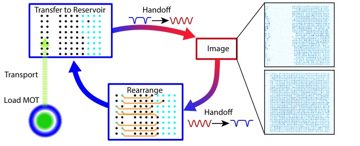
| 4 Connectivity / transport | Atom transport by AOD tweezers (zoned architecture) · primary ▣ Fig. 1b (movable tweezers between zones) ✅ tweezer grid with AOD moves; 1,225-site grid with 1,180 sites filled (Oct 2023) Continuous atom reloading (reservoir + optical conveyor belt) · alternate ▤ Abstract ✅ toric-code syndrome extraction with mid-circuit measurement, replacement of lost qubits and 'reloading of a qubit reservoir for indefinite coherent operation' (Jun 2026) |
| 5 Control | Laser + AOD/SLM optical control (atoms) · primary ▤ §II (register/interaction zones); SM §SII (1Q gates) 🔎 SLM tweezers + AOD moves + Rydberg lasers; optics (room temperature) |
| 6 Readout | Fluorescence imaging of atom arrays · primary ▣ Fig. 2a (MCM + replacement), Fig. 2c inset (MCM contrast); Fig. 1b,c ✅ fluorescence imaging; mid-circuit measurement and replacement of lost qubits, with qubit-reservoir reloading (Jun 2026) |
| 7 Code | Rotated surface code (+ yoked variants) · alternate ▣ Fig. 1d (twisted toric code layout); SM §SIII (twisted toric codes) ✅ toric = periodic-boundary surface code; Atlas code_surface is the rotated variant; also stab_4_2_2 and bacon_shor_9 with Microsoft (Nov 2024) — (Atlas gap: ∅G-toric) · primary ▣ Fig. 1d (twisted toric code); Fig. 2b,c; Fig. 3 (det 8/16 LER per cycle) ✅ toric code d=4 and d=6, up to 90 syndrome-extraction rounds; lower logical error at larger d; no Λ or per-round error published (Jun 2026) |
| 8 Decoder | Correlated / loss-aware decoding (transversal, atom loss) · primary ▤ SM §SIV (loss-aware decoding) ✅ loss-aware decoding of the toric-code run (offline) |
| 9 Interconnect | — none — nothing in this layer ◌ 🔎 single vacuum cell; monolithic, no interconnect (Nu Quantum/Cisco MoUs carry no numbers) |
| 10 Manufacturing | Optical / mechanical assembly (lasers, vacuum, objectives) · primary ▣ Fig. 1b (MOT → loading → storage zone); SM §SI (SZ reloading sequence) ✅ room-temperature optical/vacuum assembly: SLM tweezers, AOD moves, Rydberg lasers; qubit-reservoir reloading |
Standard records
2Q layers per syndrome round → 90 rounds · best (successive syndrome-extraction rounds)
no Lambda, no logical error per round and no acceptance fraction published · Jun 2026 · source
T2 coherence (echo/DD) → 40 s · best (Gen-1 87Sr nuclear spin, 2021 — not the Gen-2 171Yb array)
2021 · source
device yield → 0.963 · typical (1,180 of 1,225 sites filled)
Oct 2023 · source
evidence: ✅ 10 / 13
Pictures
Every picture carries the story of what it shows and its credit line.