Rydberg-blockade CZ g_ryd
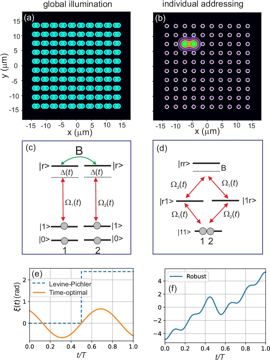
Global laser pulses drive neighbouring tweezer-trapped atoms to a Rydberg state whose interaction blocks double excitation, giving a deterministic 270 ns CZ.
Rydberg-blockade CZ
Global Rydberg pulses entangle neighbouring atoms; 270 ns; fast for a natural carrier.
Key references
Design space — attributes
- (a) carrier affinity
- natural
- (b) time · entangling
- 251 ns · deterministic
- (c) readout
- —
- (d) mobility
- physical transport
- (e) control
- optical @ room temperature
- (f) error structure
- loss (erasure), leakage, coherent / calibration
- (g) manufacturing
- optical / mechanical assembly
Evaluation space — dated attributes
Standard records
Actors & goals — annotations
Edges
Used by 22 machines (20 primary · 2 alternate)
- neutral atoms 22
- Magne Atom Computing + Microsoft, for QuNorth press press ▨ 🔎
- Phoenix (Gen-1) and Gen-2 Atom Computing press press ▣ Fig. 2a (CZ in syndrome extraction); §II (CZ in interaction zone) ✅
- Hanyuan-1 Zhongke Kuyuan (Wuhan, CAS) press press ▨ 🔎
- Hanyuan-2 Zhongke Kuyuan (Wuhan, CAS) press press ▨ 🔎
- 448-atom fault-tolerant processor Harvard / MIT / QuEra paper press ▣ Fig. 3a (transversal gates by atomic motion); Methods: System overview (Rydberg CZ) ✅
- Infleqtion Illinois neutral-atom quantum computer (IQMP, Chicago) Infleqtion press ◌ 🔎
- Sqale Infleqtion press ▣ Fig. 1b (CZ fidelities per connection); Fig. 6 (CZ fidelities) ✅
- 72-qubit neutral-atom (Rb) quantum computer prototype (50 qubits in Dec 2024) Lomonosov Moscow State University with the Russian Quantum Center ▨ 🔎
- Pasqal Centaurus Pasqal product page press ◌ 🔎
- Pasqal Lyra Pasqal press ◌ 🔎
- Orion Alpha / Beta ("Ruby") / Gamma Pasqal product page press press ▨ 🔎
- Vela Pasqal blog ▦ §Next-Gen of Pasqal's Quantum Computers (local detuning enables precise control of individual atoms) ✅
- DiNAQC planqc, for the DLR Quantum Computing Initiative product page press link ▦ project description ✅
- MAQCS planqc press ▨ ✅
- metastable Yb-171 erasure array Princeton (Thompson group) paper paper paper ▣ Fig. 2 (amplitude-robust CZ gates) ✅
- Qinghe-1 (Qinghe No. 1, 清河一号) Zhongqi Wuliang (Shanghai, CAS SIOM spin-off) press press ▨ 🔎
- Gemini-class QuEra paper product page ▣ Extended Data Fig. 1b (Rydberg-blockade entangling layers) ✅
- Libra QuEra press ▨ ✅
- Quantum X Labs neutral-atom platform (50+ qubits, claimed) Quantum X Labs Inc. (Nasdaq: QXL) press link ▨ 🔎
- neutral-ytterbium QPU Yaqumo (+ Fujitsu) press press ▨ 🔎
- continuously reloaded 3,000-atom machine Harvard / MIT paper paper ▤ 🔎 (alternate)
- Fresnel / Fresnel 2 Pasqal ▣ Fig. 7b (target qubit rotates by π conditioned on control qubit); Fig. 9a (5-pulse CCZ sequence); §2.2.1 Digital quantum processing ✅ (alternate)
Pictures
Every picture carries the story of what it shows and its credit line.

Rydberg-blockade CZ
Global laser pulses drive neighbouring tweezer-trapped atoms to a Rydberg state whose interaction blocks double excitation, giving a deterministic 270 ns CZ.
Verdict. Best natural-carrier entangler by speed; 99.854% raw as of April 2026, but the standard scheme sits within ~0.05% of its own ceiling and its residual error is atom loss.
Λ = error-suppression factor per code-distance step; QBI = DARPA Quantum Benchmarking Initiative (Stage A concept → B R&D plan → C government V&V); G1–G7 = the report's goal classes (see Actors & economics).
Identity & lineage
Two atoms ~2 µm apart in tweezers are driven on the qubit-to-Rydberg transition by one beam covering both. Because a doubly-excited pair repels through a van der Waals shift V=C6/R6 far larger than the drive, double excitation is pushed out of resonance and the pair acquires a phase set by how many atoms started in the coupled state — a controlled-phase gate. Jaksch, Cirac, Zoller, Rolston, Côté and Lukin proposed it in 2000 D[427]; blockade between two atoms was seen in 2009 (~58% fidelity) P[140], with the first gates and a CNOT in 2010. Levine et al. replaced the three-pulse addressed sequence with a two-pulse global time-optimal CZ in 2019 (97.4%) D[428] — the form every leading group still runs, and why the gate needs no per-qubit control line.
Attributes (technology graph). a — carrier affinity: fully natural; the gate adds no fabricated structure to the qubit. b — characteristic time: 10-6.6 s ≈ 250 ns, deterministic rather than heralded. c — readout: not set here; inherited from the atom and imaging nodes. d — mobility: connectivity by physically transporting atoms between gate zones, not fixed couplers. e — control @ placement: optical, generated entirely at room temperature. f — error structure as the code sees it: atom loss, leakage out of the qubit space, coherent over/under-rotation. g — manufacturing: optics, not lithography.
Physics & limits
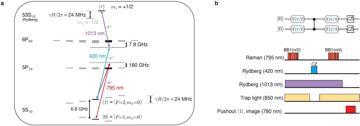
Three scales set everything. The drive Ω (Harvard: peak 2π×17 MHz, two-photon 420 + 1015 nm at 7.8 GHz intermediate detuning, Rb 53S1/2) fixes the gate at 270 ns D[134]D[4]; the blockade shift must satisfy V≫ℏΩ, residual double excitation costing roughly (Ω/V)2. The Rydberg lifetime (tens of µs at n≈53, blackbody-limited) costs the Rydberg dwell time divided by it. Raising Ω cuts decay and raises leakage, so the optimum is shallow: a 2026 review adds spontaneous Rydberg emission (0.05–0.1%), laser phase noise (0.1–0.2%) and thermal motion (~0.1%) and concludes the standard blockade CZ has a "physical limit of 99.9%" absent new mechanisms such as Förster-resonance gates P[140].
The measured budget agrees in shape but not in villain. In the April 2026 Harvard result the largest single term is atom loss, 0.087(5)% per gate, about 60% of the total error, with leakage to other hyperfine levels 0.008(1)% per atom per gate; the authors assign the remainder to ground-Rydberg coherence (T2^), intermediate-state scattering and unwanted coupling to a nearby Rydberg level, and project 99.9–99.95% from better T2^, suppression of that coupling and more laser power D[134]. That makes the gate structurally interesting: its dominant failure is detectable — the atom is gone from the image — so it converts to an erasure, not an unlocated Pauli. Loss-post-selection lifts the same data from 99.854(4)% to 99.941(3)% D[134], and in the 448-atom architecture >80% of leakage events are atom loss, used as "supercheck" information in decoding D[4]fact.
What moves the floor: single-photon UV excitation, with no intermediate state to scatter from — the Yb and Sr route D[135]D[136]; spectrally clean lasers against servo-bump phase noise at Ω; ground-state cooling against Doppler and position spread; and new gate physics (Förster resonance, modulated off-resonant driving, circular Rydberg states) P[140]. None is demonstrated above 99.9% raw as of 3 Sep 2026.
Engineering state of the art
table
| Year | Figure | Who | Tag+key |
|---|---|---|---|
| 2009 | ~58% two-atom entanglement via blockade | Wisconsin (Saffman/Walker) | P[140] |
| 2019 | 97.4% CZ, two-pulse global scheme | Harvard/MIT (Levine) | D[428] |
| 2023 | 99.5% CZ, parallel across an array | Harvard/MIT/QuEra (Evered) | D[391] |
| 2024-07 | 99.71(5)% CZ, Sr, leakage-corrected | Caltech (Endres) | D[136] |
| 2024-11 | 99.72(3)% post-selected / 99.40(3)% raw, ¹⁷¹Yb nuclear spin | Atom Computing | D[135] |
| 2026-04 | 99.854(4)% raw / 99.941(3)% loss-post-selected, stable 10 h | Harvard | D[134] |
| 2026 | 99.2% global two-qubit on a 260-physical-qubit product | QuEra Gemini | C[137] |
Best-versus-typical is the story: the record comes from ~8 sparsely spaced gate sites at 20–30 Hz D[134], the shipped figure is 99.2% global on 260 qubits C[137], the largest array under fault-tolerant control is 448 atoms D[4], and arrays of 6,100 and 11,000 atoms exist without gates at these fidelities D[138]D[145].
Manufacturing, materials & supply chain
There is no wafer; the manufacturing surface is the laser and beam-steering chain. Alkali two-photon excitation needs a fibre-amplified 1013–1015 nm source of tens of watts plus a frequency-doubled 420 nm beam; Yb/Sr need a single ~300–320 nm UV source; all need phase noise suppressed near the Rabi frequency, plus acousto-optic deflectors and spatial light modulators for placement. Yield and uniformity become intensity and phase homogeneity across the array; Harvard's 10-hour run drifted mainly through Rydberg laser power and pointing D[134]. The vendor pool for narrow-linewidth high-power lasers, UV sources, AODs and SLMs is small — TOPTICA, M Squared, Coherent, AA Opto-Electronic, Gooch & Housego, Hamamatsu, Meadowlark are the usual names — but no dated procurement disclosure ties a machine to a supplier (see Open verification items). Export control runs through the US BIS quantum controls of September 2024 (ECCN 3A901 and related) and Category 6 laser entries; which applies to a 10 W 1013 nm amplifier is unsettled in any public ruling found.
Control, readout & I/O burden
The gate is global: one beam pair entangles every blockaded pair at once, so per-qubit control lines scale as O(1), not O(N). The cost is optical power — holding 2π×17 MHz over N atoms scales power linearly in N — and beam steering: an acousto-optic deflector resolves as many spots as its rf bandwidth times the acoustic transit across the beam, a transit that also bounds how fast it re-points, while liquid-crystal modulators reframe at tens of hertz. At 103 nothing breaks; at 104 power and steering bind; at 106 multi-core optical interconnects are required and undemonstrated. The gate's own control latency is sub-µs, but it sits inside a round dominated by ~0.8 ms of transport between gate layers and ~0.5 ms imaging, giving measured QEC rounds of ~1–4.5 ms D[4]S[31]; the compensating theory is transversal gates with correlated decoding, keeping syndrome rounds constant per logical gate S[152].
Role in the stack
The gate serves both Rydberg tweezer-array architectures — alkali (Rb/Cs: Harvard/MIT, QuEra, Pasqal, Infleqtion, Google) and alkaline-earth(-like) (Yb/Sr: Atom Computing/Microsoft, Princeton, Caltech). It requires an atom in a tweezer plus the laser and deflector chain, and provides the entangling channel every atom-based code consumes; it has no in-platform replacement at comparable fidelity, so the switching price is the platform itself. A natural, unfabricated carrier gets a sub-microsecond deterministic entangler where trapped ions pay 10–100 µs — hence the platform's clock problem lives in imaging and transport, not the gate. Derived clock = sum of the syndrome round (gates 1×10⁻⁶ s, transport 8×10⁻⁴ s, 1Q 1×10⁻⁵ s, readout 5×10⁻⁴ s) ≈ 1.3 ms on both tweezer-array architectures, of which the gate is 0.08%. Neighbouring empty slots: sub-100 µs non-destructive array readout, and a blockade gate whose dominant error is not atom loss.
Evidence — how the numbers were measured
The 2026 record uses echo randomised benchmarking and symmetric stabiliser benchmarking on ~8 sparse gate sites D[134]; Atom Computing used Clifford and symmetric-subspace RB with >200 CZ gates per circuit D[135]; Caltech built a fidelity-response theory and quotes 0.9971(5) downward-corrected for leakage D[136]. What these miss: loss-post-selection removes 60% of the error, so 99.941% is not a circuit-level number and must not be set against a raw superconducting figure; sparse-site benchmarking misses dense-array crosstalk and next-nearest-neighbour blockade error; and none measures the gate inside a transport-and-image cycle, where re-trapping and heating act. Conflict: the August 2026 review tabulates a 2025 USTC CZ of 99.84% P[140] that no primary source corroborates, so this brief uses Harvard's 99.854(4)% D[134]. Note also three conventions behind three headline numbers — Atom Computing's 99.72/99.40 is post-selected/raw D[135], Caltech's is leakage-corrected D[136], Harvard's is raw plus post-selected D[134].
The 270 ns gate duration is the value in [4]; the April 2026 record paper gives a peak Rabi frequency of 2π×17 MHz but no extractable gate duration, so the two are treated as one scheme. Not published: the laser, AOD or SLM supplier of any specific neutral-atom machine in a dated procurement disclosure — the vendor names under Manufacturing are the field's usual pool; an export-control ruling on high-power 1013 nm Rydberg-laser subsystems (US BIS quantum ECCNs against Category 6 laser entries); and QuEra Gemini's availability date, deployment site and price.
Actors & economics
Who.
| Organisation | Role | Country | What exactly they do with this technology | Evidence |
|---|---|---|---|---|
| Harvard/MIT (Lukin, Greiner, Vuletić) | research | US | Hold the CZ record and the 448-atom architecture | D[134]D[4] |
| QuEra | developer | US | Commercialises that line; Gemini ships 99.2% two-qubit | C[137]Cfact |
| Atom Computing | developer | US | ¹⁷¹Yb nuclear spin, single-photon excitation; builds Magne | D[135]Cfact |
| Microsoft | integrator | US | Logical layer on Atom hardware; co-sells Magne | Cfact |
| Pasqal | developer | FR | Rb arrays, analogue and digital; SPAC-listed Aug 2026 | Pfact |
| Infleqtion | developer | US | Cs arrays, logical qubits with loss correction | Cfact |
| Caltech (Endres) | research | US | Sr gates, erasure excision, benchmarking theory | D[136] |
| Princeton (Thompson) | research | US | Metastable Yb erasure conversion on this gate | D[142] |
| Google Quantum AI | developer | US | Neutral-atom track opened under Adam Kaufman | Cfact |
| DARPA | funder | US | QBI Stage B includes Atom Computing and QuEra | fact |
| US Dept of Commerce | funder | US | $100 M CHIPS LOIs to Atom Computing and Infleqtion | fact |
| QuNorth (EIFO + Novo Nordisk Fdn) | buyer | DK | Ordered Magne, 1,225 physical / 50 logical | Cfact |
Money.
- 2025-07-17 · QuNorth · order (Magne, from Atom Computing/Microsoft) · €80 M · EIFO + Novo Nordisk Foundation · ordered Cfact
- 2025-09-09 · QuEra · financing round · $230 M+ · Google, SoftBank Vision Fund 2, NVentures · closed Cfact
- 2025-11-06 · Atom Computing, QuEra · DARPA QBI Stage B · up to $15 M each · DARPA · selected fact
- 2026-02-17 · Infleqtion · IPO (NYSE: INFQ) · >$550 M gross · SPAC · closed Cfact
- 2026-03-24 · Google · neutral-atom hardware programme · amount undisclosed · internal · announced Cfact
- 2026-05-21 · Atom Computing, Infleqtion · CHIPS letters of intent · $100 M each, of $2.013 B to nine companies · US Dept of Commerce · LOI, non-binding fact
- 2026-06-16 · Atom Computing · Series C plus LOI · $100 M equity, >$300 M cumulative · Third Point · closed + LOI Cfact
- 2026-08-28 · Pasqal · SPAC completion (Nasdaq: PSQL) · ~$360 M cash; 2025 revenue €16.5 M · closed Pfact
Market & supply chain. What is sold is systems, not gates: Magne prices 1,225 physical / 50 logical qubits at €80 M, roughly €65 k per physical qubit Cfact; Gemini packages 260 physical qubits at 1 shot/second C[137]. The enabling-equipment pool — high-power 1013 nm amplifiers, UV sources, AODs, SLMs — is narrow enough that one vendor's lead time can gate a machine build, though it is shared with atomic clocks and cold-atom sensing. G1 (analogue simulation) and G5 (optimisation) pay for atom arrays today; the gate fidelity discussed here is bought almost entirely for G3 (early fault tolerance) and, through Magne and Libra, G4. G6 (networking) has no demonstrated atom-to-atom photonic link at this scale.
IP & standards. No dated patent-family count from a named database was found for Rydberg-gate IP, so none is asserted. Open stacks: QuEra's Bloqade, Pasqal's Pulser, Infleqtion's Superstaq, with AWS Braket the named delivery channel for QuEra's 2028 system Cfact; no gate-level standard or consortium specific to Rydberg CZ exists as of 3 Sep 2026.
Roadmaps & track record. QuEra (promised 2024-01 · 100 logical qubits in 2026 · not delivered; superseded 2026-06 by Libra, >256 logical in 2028 — a two-year slip) Cfact. Atom Computing/Microsoft (promised 2025-07 · Magne, 50 logical, turn of 2026/27 · being installed as of 3 Sep 2026) Cfact. Pasqal (promised 2024-03 · 10,000 physical in 2026 · slipped to 2028; 100 logical 2029) Cfact. Infleqtion (promised 2025 · 30 logical in 2026 · unverified as of 3 Sep 2026) C[150]. Judgment: Harvard/MIT's device claims have survived replication and are the most credible; Atom Computing has a customer, a price and a delivery date, the strongest commercial commitment here; QuEra and Pasqal have each slipped a headline number by two years, so their 2028–29 dates read as intentions.
Strategic reading. If raw fidelity crosses 99.9% while loss stays erasure-convertible, neutral atoms reach fault tolerance without a wiring problem: platform vendors and laser suppliers win, and the superconducting camp's argument that only cryogenic integration scales loses. If it stalls at 99.85%, the millisecond cycle leaves atoms as the analogue-simulation and optimisation platform while ions and superconductors take fault tolerance. There is no substitution threat within the platform — every neutral-atom company runs this gate — making the ceiling a sector risk, not a company risk, and giving these laser suppliers more bargaining power than their revenue suggests.
Outlook & open questions
Confirm/demote milestones for 12–24 months: (1) a raw CZ ≥99.9% in a dense array by 2027-09 confirms the review's ceiling was engineering, not physics; failure demotes the gate to saturated; (2) Magne accepted at QuNorth with 50 logical qubits by mid-2027; (3) a >50-round below-threshold memory run with continuous reloading showing Λ>2 — the Atom/Microsoft 90-round toric-code run lost its suppression once reloading was included D[148]; (4) a CZ fidelity measured inside a transport-and-image QEC cycle. Best case by 2029: 99.95% raw, loss converted to erasures, Libra-class 256-logical machines on a cloud channel. Worst case: 99.85% raw persists, the millisecond cycle stays, atoms hold G1/G5 and cede G3/G4.
Open questions. Does the loss channel scale with array density and transport, or is 0.087% per gate a floor set by trap depth? Can single-photon UV excitation recover the phase-noise and scattering terms without new UV-induced loss? Is Förster-resonance or modulated-driving physics real above 99.9%? Does erasure conversion survive at circuit level, where a decoder must locate losses inside a 1 ms budget? Watch for a raw record without post-selection, and whether Google's atom track publishes a gate before 2027.
References
- [4] D. Bluvstein et al., “A fault-tolerant neutral-atom architecture for universal quantum computation,” Nature, vol. 649, no. 8095, pp. 39–46, Nov. 2025, doi: 10.1038/s41586-025-09848-5. arXiv:2506.20661. D
- [31] H. Zhou et al., “Resource Analysis of Low-Overhead Transversal Architectures for Reconfigurable Atom Arrays,” Proc. 52nd Annu. Int. Symp. Comput. Archit. (ISCA), 2025, doi: 10.1145/3695053.3731039. arXiv:2505.15907. S
- [134] S. J. Evered et al., “High-fidelity entangling gates and nonlocal circuits with neutral atoms,” arXiv:2604.25987, Apr. 2026. D
- [135] J. A. Muniz et al., “High-fidelity universal gates in the ¹⁷¹Yb ground state nuclear spin qubit,” arXiv:2411.11708, Nov. 2024. D
- [136] R. B.-S. Tsai, X. Sun, A. L. Shaw, R. Finkelstein, and M. Endres, “Benchmarking and linear response modeling of high-fidelity Rydberg gates,” arXiv:2407.20184, Jul. 2024. D
- [137] QuEra Computing Inc., “Gemini-Class Gate-Model Quantum Computer.” [Online]. Available: https://www.quera.com/
gemini C - [138] H. J. Manetsch, G. Nomura, E. Bataille, K. H. Leung, X. Lv, and M. Endres, “A tweezer array with 6100 highly coherent atomic qubits,” Nature, vol. 647, pp. 60–67, 2025, doi: 10.1038/s41586-025-09641-4. arXiv:2403.12021. D
- [140] J. Wang, Z. Wang, L. Li, F. Wang, S. Liang, and K. Yan, “Neutral Atom Quantum Computing: Principles, Routes, Progress, and Challenges,” arXiv:2608.05010, Aug. 2026. P
- [142] B. Zhang et al., “Logical qubits with erasure conversion using metastable neutral atoms,” Nat. Phys., vol. 22, no. 6, pp. 910–916, Jun. 2026, doi: 10.1038/s41567-026-03309-0. arXiv:2506.13724. D
- [145] Y. Wang et al., “Trapping 11,000 Atoms in a Tweezer Array Generated by a Single Metasurface,” arXiv:2606.02715, Jun. 2026. D
- [148] Atom Computing and Collaborators, “Quantum error correction with the toric code,” arXiv:2606.04079, Jun. 2026. D
- [150] L. Roady, “Infleqtion Unveils New Architecture to Accelerate Its Quantum Computing Roadmap To Achieve 1000 Logical Qubits by 2030,” Infleqtion, Sep. 17, 2025. [Online]. Available: https://infleqtion.com/
infleqtion-unveils-new-architecture-to-accelerate-its-quantum-computing-roadmap-to-achieve-1000-logical-qubits-by-2030/ C - [152] H. Zhou et al., “Low-Overhead Transversal Fault Tolerance for Universal Quantum Computation,” Nature, vol. 646, no. 8084, pp. 303–308, 2025, doi: 10.1038/s41586-025-09543-5. arXiv:2406.17653. S
- [391] S. J. Evered et al., “High-fidelity parallel entangling gates on a neutral-atom quantum computer,” Nature, vol. 622, no. 7982, pp. 268–272, Oct. 2023, doi: 10.1038/s41586-023-06481-y. arXiv:2304.05420. D
- [427] D. Jaksch et al., “Fast Quantum Gates for Neutral Atoms,” Phys. Rev. Lett., vol. 85, no. 10, pp. 2208–2211, Sep. 2000, doi: 10.1103/PhysRevLett.85.2208. arXiv:quant-ph/0004038. D
- [428] H. Levine et al., “Parallel Implementation of High-Fidelity Multiqubit Gates with Neutral Atoms,” Phys. Rev. Lett., vol. 123, no. 17, Art. no. 170503, Oct. 2019, doi: 10.1103/PhysRevLett.123.170503. arXiv:1908.06101. D