Electronic microwave gate (ions, laser-free: near-field or static gradient) g_elec
Currents in a microfabricated trap chip entangle ions through microwave field gradients, with no laser and no ground-state cooling.
Electronic microwave gate (ions, laser-free: near-field or static gradient)
Chip currents create microwave gradients; no lasers for gates, no ground-state cooling; 120–226 µs.
Key references
Design space — attributes
- (a) carrier affinity
- fabricated
- (b) time · entangling
- 200 µs · deterministic
- (c) readout
- —
- (d) mobility
- shared bus (motional / cavity)
- (e) control
- microwave @ room temperature
- (f) error structure
- stochastic Pauli, coherent / calibration
- (g) manufacturing
- MEMS / surface-electrode traps
Evaluation space — dated attributes
Oxford Ionics → IonQ.
Standard records
Actors & goals — annotations
Edges
Used by 8 machines (8 primary · 0 alternate)
- trapped ions 8
- JION eleQtron + Forschungszentrum Julich press ▣ Fig. 1 (MAGIC scheme with magnetic-field gradient); §II ✅
- QSea I (DLR QCI ion-trap demonstrator) eleQtron with NXP Semiconductors and ParityQC, for the DLR Quantum Computing Initiative press press link ▦ MAGIC paragraph ('MAGIC stands for Magnetic Gradient Induced Coupling') ✅
- QUARTET Oxford Ionics (IonQ) press ▣ Fig. 3 (two-qubit MS interactions via currents through the shared trace, B-field gradient); §III.2 High-fidelity tunable two-qubit gates; App. B ✅
- IonQ Superion 10K IonQ press ▨ EQC and Oxford Ionics paragraphs 🔎
- Superion 256 IonQ press press ▤ §II.1 Architecture ✅
- XAPHIRO (QUDORA 50-qubit NFQC prototype for the DLR Quantum Computing Initiative) QUDORA Technologies ▣ Fig. 1 (electrode configuration with embedded microwave conductor); Fig. 3 (parity oscillation of entangled state) ✅
- NFQC-1k QUDORA Technologies-led consortium (TU Braunschweig, Leibniz University Hannover, PTB, Forschungszentrum Jülich, NXP Semiconductors Germany, AQT Germany) press ▨ NFQC paragraph (chip-scale microwave radiation fields) ✅
- iQPU / UQConnect Universal Quantum press ▨ ✅
Pictures
Every picture carries the story of what it shows and its credit line.

Electronic microwave gate (ions, laser-free: near-field or static gradient)
Currents in a microfabricated trap chip entangle ions through microwave field gradients, with no laser and no ground-state cooling.
Verdict. Holds the highest two-qubit fidelity measured on any modality (8.4×10⁻⁵ error) but only on chips of ≤10 qubits; demote if no ≥50-qubit device publishes gate time, heating and crosstalk by end-2027.
Λ = error-suppression factor per code-distance step; QBI = DARPA Quantum Benchmarking Initiative (Stage A concept → B R&D plan → C government V&V); G1–G7 = the report's goal classes (see Actors & economics).
Identity & lineage
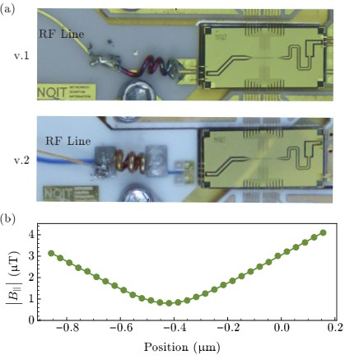
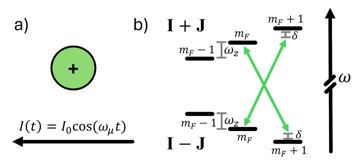
An entangling gate on hyperfine ion qubits driven entirely by currents in the trap chip. Oscillating currents in electrodes tens of micrometres from the ion produce a microwave field whose gradient, not its amplitude, couples spin to the shared motional mode; a state-dependent force closes a loop in phase space and imprints a geometric phase, as a Mølmer–Sørensen gate does, with a ~10 GHz field replacing two laser beams. Demonstrated at NIST Boulder in 2011 (76(3)%, 20 ns single-qubit pulses) D[444], brought to useful fidelity at Oxford in 2016 with dynamically decoupled ⁴³Ca⁺ clock qubits D[445], industrialised by Oxford Ionics — the Ballance/Harty spin-out of that group, part of IonQ since 2025 — as Electronic Qubit Control C[446]. A parallel lineage at Sussex (Hensinger), its spin-out Universal Quantum, and eleQtron's MAGIC drives global microwave fields across a static gradient P[328], [447]; the near-field variant here holds the records.
Attributes (technology graph):
- Carrier affinity: fully natural — the qubit is an atomic ion; only the trap is fabricated.
- Characteristic time: 2×10⁻⁴ s per entangling operation, deterministic, not heralded.
- Readout: not defined by this node; it inherits the host ion's fluorescence detection.
- Mobility: shared motional bus within a zone, ions transported between zones.
- Control modality and placement: microwave, sources at room temperature.
- Error structure as the code sees it: Pauli plus a coherent component.
- Manufacturing: microfabricated surface trap with buried current traces.
Physics & limits
Gate rate is set by the microwave gradient at the ion and the Lamb–Dicke parameter; both are geometric. Halving the ion–electrode distance roughly doubles the gradient but raises anomalous heating steeply (surface noise near d⁻⁴), so speed is bought against motional decoherence — hence durations of 120–226 µs, not sub-microsecond. There is no photon-scattering floor, the dominant fundamental error of laser gates, which is why the achievable ceiling is higher D[102].
What replaces it is a.c. Zeeman shift from the field's non-gradient component, magnetic-field noise, and residual spin–motion entanglement at finite temperature. The first two are attacked with clock qubits and dynamical decoupling D[445]; the third bound everything until the 2025 "smooth gate", which ramps the gate detuning to adiabatically eliminate spin–motion entanglement and tolerate a hot mode — it ran at mean phonon number n̄ = 9.4(3), above the Doppler limit, with error ≲5×10⁻⁴ even hotter D[102]. The residual error is largely coherent — miscalibrated phase and gradient amplitude — which a code sees as correlated rather than depolarising noise, so logical extrapolations assuming Pauli noise run optimistic. Moving the floor further needs lower trap-surface noise and better microwave amplitude and phase stability, not new physics.
Engineering state of the art
Best demonstrated: two-qubit error 8.4(7)×10⁻⁵ (2025-10) on a laboratory chip D[102]. Typical at scale: no gate figure above ten qubits is published — the 2024 device giving 99.97(1)% two-qubit and 99.99916(7)% single-qubit fidelity is a seven-zone chip controlling up to ten qubits D[257], and eleQtron's 30-ion JION, deployed 2026-09-03, launched without a gate fidelity. That gap is the most important fact about this node.
table
| Year | Figure | Who | Tag+key |
|---|---|---|---|
| 2011 | First near-field microwave two-qubit gate, 76(3)% | NIST Boulder (Ospelkaus, Leibfried, Wineland) | D[444] |
| 2016 | 99.7(1)% two-qubit, ⁴³Ca⁺ clock qubits, dynamically decoupled | Oxford (Harty, Lucas) | D[445] |
| 2024-07 | 99.97(1)% two-qubit, 99.99916(7)% single-qubit, seven-zone chip, ≤10 qubits | Oxford Ionics | D[257] |
| 2024-12 | Single-qubit error 1.5(4)×10⁻⁷ per Clifford, chip-integrated microwave resonator | Oxford (Lucas group) | D[103] |
| 2025-10 | Two-qubit error 8.4(7)×10⁻⁵ at n̄ = 9.4(3), no ground-state cooling | Oxford Ionics / IonQ | D[102] |
Dominant terms today: temperature-dependent residual spin–motion entanglement and coherent control error. The headline is an estimate from subspace-leakage randomised benchmarking, not tomography D[102]. Gate duration is 225.8 µs in 2025 and ≈120 µs (two 60 µs pulses) in 2024 D[102], [257].
Manufacturing, materials & supply chain
The trap is a surface-electrode chip with buried current-carrying traces and local tuning electrodes in a standard semiconductor process; IonQ's framing is that control lives on "classical semiconductor chips" built in "existing semiconductor fabs" C[446]. That claim is now vertically integrated: IonQ closed the SkyWater Technology acquisition (~$1.8 B, announced 2026-01-26, closed 2026-07-31) Cfact[19], giving it a US 200 mm trusted foundry instead of a merchant relationship. Packaging is the named weak point: Oxford Ionics uses Bay Photonics for the electrical, photonic and electrostatically shielded packaging of high-density trap devices C[448]. No yield, uniformity, defect-density or per-qubit cost figure is published by any actor as of 3 Sep 2026. Export exposure runs through the US BIS interim final rule of 2024-09-06, which created ECCN 4A906 for quantum computers (34-qubit floor with error-rate tiers) plus 3A904/3B904 for enabling equipment fact[301]: a ≥34-qubit electronic-gate system meeting the error tiers falls inside it, and the UK-design/US-parent structure makes licensing a design constraint.
Control, readout & I/O burden
A laser-gate machine of comparable ambition needs many wavelengths and per-zone optical addressing — Helios uses at least seven laser wavelengths and 1,228 electrodes D[97]. The electronic gate deletes the gate lasers, leaving light only for cooling, state preparation and readout, and substitutes room-temperature microwave sources plus d.c. electrode drivers. Per-qubit I/O becomes a mixed-signal ASIC problem — coherent microwave channels and many d.c. lines — a familiar scaling exercise rather than an optical one.
The wall moves rather than disappears. At 10³ qubits it is the count of independent microwave channels and their phase coherence, since amplitude and phase errors are the leading coherent term. At 10⁴ it is routing current-carrying traces, with on-chip dissipation and zone-to-zone crosstalk; no actor has published a crosstalk or heating figure for a 2D array. At 10⁶ nothing in the public record connects this gate to a demonstrated 2D trap. Control-loop latency demands are modest — millisecond-class syndrome cycles suffice.
Role in the stack
The node sits on the architecture "Trapped ions — electronic qubit control (laser-free, microwave-driven gates)" (IonQ/Oxford Ionics, eleQtron, QUDORA) as its primary gate, and is the alternate gate on "Trapped ions — QCCD (transport between zones)" (Universal Quantum). It requires a trapped atomic ion as carrier and chip-integrated microwave control as signal source; it provides nothing downstream that the laser gate does not, and directly replaces the laser Mølmer–Sørensen gate. The switching price is one-directional: buried traces and electrode geometry are co-designed with the gate, so an electronic-gate machine cannot fall back to lasers, while a laser machine can in principle add microwave electrodes. Here a natural, unfabricated carrier is steered by purely electronic control — a semiconductor supply chain driving an atomic qubit. Contribution to the derived clock: 2.3×10⁻⁴ s per entangling gate. Derived clock = sum of the syndrome round: gate layers + transport + readout + reset for the architecture ≈1.5×10⁻³ s, gate layers 1.4 ms of it; on a multi-zone machine transport dominates instead (Helios ~55 ms per full-width layer D[97]), so the gate's speed advantage is invisible at product scale. The neighbouring empty slot is the cryogenic version: nothing published combines electronic gates with a cryogenic trap, which is where the heating-versus-gradient trade would be won.
Evidence — how the numbers were measured
The headline 8.4(7)×10⁻⁵ comes from subspace-leakage randomised benchmarking at Doppler temperature, not from tomography or interleaved RB against an independent reference D[102]. Two-qubit RB twirls coherent errors into an effective depolarising rate, understating the coherent residual, and says nothing about crosstalk to spectator ions — the term that will decide performance at scale. No independent group has replicated the electronic gate above 99.9%: the 2016 Oxford D[445] and 2011 NIST D[444] results are the only non-Oxford-Ionics near-field microwave gates on record, and neither eleQtron nor Universal Quantum has published a comparable fidelity as of 3 Sep 2026. The company line "99.99% two-qubit gate fidelity" C[446] rounds the preprint's 1 − 8.4(7)×10⁻⁵ — consistent, but with no error bar and no width.
The 225.8 µs gate duration of the 2025 record is not stated in the abstract of arXiv:2510.17286. Not published: a patent family or patent count for Oxford Ionics / IonQ Electronic Qubit Control; any delivery or milestone under Universal Quantum's €67 M DLR contract (four-year term from 2022-11) as of 2026-09-03; eleQtron's ion species, qubit count, fidelity and gate time, MAGIC being described only qualitatively; the value of the Innovate UK / DSIT Quantum Missions Pilot award to Oxford Ionics; and any crosstalk, heating-rate or on-chip dissipation figure for an electronic-gate trap chip.
Actors & economics
Who.
| Organisation | Role | Country | What exactly they do with this technology | Evidence |
|---|---|---|---|---|
| IonQ | developer | US | Owns Oxford Ionics and its Electronic Qubit Control line; holds the gate record | D[102] C[446] |
| Oxford Ionics | developer | UK | Designs the trap chips and ran both record experiments | D[102], [257] |
| eleQtron | developer | DE | MAGIC static-gradient microwave ion control; €57 M Series A, >€54 M backlog | Pfact[129], [447] |
| Universal Quantum | developer | UK | Sussex spin-out; modular microwave machines under a German state contract | P[328] |
| University of Oxford | research | UK | Lucas group: single-qubit 1.5(4)×10⁻⁷ with a chip-integrated microwave resonator | D[103] |
| NIST Boulder | research | US | Originated the near-field microwave gate in 2011 | D[444] |
| NQCC | user | UK | Hosts the Oxford Ionics "Quartet" system; 2D trap upgrade | C[448] |
| Innovate UK | funder | UK | Quantum Missions Pilot award for the 2D trap upgrade, value undisclosed | C[448] |
| SkyWater Technology | supplier | US | 200 mm US foundry, acquired by IonQ to fabricate trap chips in-house | Cfact[19] |
| Bay Photonics | supplier | UK | Packaging of high-density trap devices | C[448] |
| DARPA | evaluator | US | QBI: Oxford Ionics in Stage A, IonQ carried into Stage B | fact[243] fact[65] |
Money.
- 2022-11-02 · Universal Quantum · contract · €67 M · German Aerospace Center (DLR); two machines in four years, multi-chip system up to 100 qubits · — · announced P[328]
- 2025-03-11 · Oxford Ionics · programme award (Quantum Missions Pilot, "Q-Surge") · undisclosed · DSIT and Innovate UK · — · announced C[448]
- 2025-04-03 · Oxford Ionics · DARPA QBI Stage A selection · — · DARPA · — · selected fact[243]
- 2025-09-17 · IonQ · M&A, Oxford Ionics (announced 2025-06-09) · $1.075 B · — · — · closed Cfact[18]
- 2025-10-12 · IonQ · equity · $2.0 B at $93/share, after $1.0 B on 2025-07-08 · — · cash $3.0 B · closed Cfact[326]
- 2025-11-06 · IonQ · DARPA QBI Stage B selection, up to $15 M each · — · DARPA · — · selected fact[65]
- 2026-04-27 · Quantum Art · Series A extension · $140 M, from $100 M on 2025-12-10 · — · — · closed Pfact[125]
- 2026-05-05 · eleQtron · Series A · €57 M · Schwarz Digits lead, with EIC Fund, Earlybird, Ankaa Ventures, Precitec, NRW.BANK · backlog >€54 M · closed Pfact[129], [447]
- 2026-07-31 · IonQ · M&A, SkyWater (announced 2026-01-26) · ~$1.8 B · — · — · closed Cfact[19]
- 2026-Q2 · IonQ · revenue · $80.1 M, +287% YoY; FY guidance $280–290 M · — · cash $3.0 B · reported Cfact[326]
Market & supply chain. There is no merchant market for electronic ion gates. The enabling assets are trap-chip fabrication (in-house at IonQ via SkyWater), microwave sources and amplifiers (commodity RF, low concentration risk) and specialist packaging — Bay Photonics is a genuine single point of failure for the UK line. Concentration risk is corporate rather than industrial: one company holds the record, the patents and the fab. Unit economics are unquotable; nobody publishes cost or power per qubit. The goals that pay for it are G3 (early fault tolerance) and G7 (deployable systems): the case for deleting gate lasers is manufacturability and field-deployability, not speed. G6 is untouched — the node provides no photonic interface.
IP & standards. Oxford Ionics describes Electronic Qubit Control as patented C[446], and the $1.075 B acquisition price is best read as a purchase of that portfolio plus the team; no patent family number, database-sourced count or litigation could be verified as of 3 Sep 2026 (Google Patents assignee search is robots-blocked). No standards body or consortium is specific to this gate.
Roadmaps & track record. (promised on · promised for · status as of 2026-09-03): IonQ, 2025-06-13 · 256 qubits at 99.99% in 2026 · slipped to commissioning in H1 2027 Rfact[132]. IonQ, 2025-06-13 · 10,000 physical qubits on one chip in 2027 and 2 M physical / 40–80 k logical by 2030 · no 2D-trap heating, gate-time or interconnect data published Rfact[132]. Universal Quantum, 2022-11-02 · two machines including up to 100 qubits within four years · no delivery announced as the term elapses P[328]. Credibility: Oxford Ionics' physics claims have held and improved on schedule; IonQ's scale promises have not — the 2020 roadmap's 4,000 qubits by 2026 missed by roughly 40× — so read fidelity commitments as credible and qubit-count dates as aspirational.
Strategic reading. If the electronic gate scales, IonQ converts a physics lead into a manufacturing lead and the optical supply chain for ions loses its strongest customer class; Quantinuum's advantage narrows to systems engineering and error correction rather than gate quality. If it stalls at a few tens of ions, the record becomes a laboratory curiosity and laser gates with integrated photonics win on demonstrated width. Bargaining power sits with the platform vendor: nothing in the chain is scarce except packaging know-how, and IonQ has internalised the fab.
Outlook & open questions
Confirm-or-demote milestones for 12–24 months: a device above ~30 electronic-gate qubits with published two-qubit fidelity, gate time and crosstalk (absent by end-2027, demote); IonQ's 256-qubit system commissioned in H1 2027 near 99.99%; any independent replication above 99.9%; a 2D trap running electronic gates with published heating rates. Best case by 2029: chip-trap machines of a few thousand ions, laser hardware reduced to cooling and readout, gate error near 10⁻⁴, error correction limited by transport rather than gates. Worst case: fidelity degrades by an order of magnitude once hundreds of microwave channels share a die, and the platform reverts to laser gates for addressing.
Open questions: does the microwave gradient survive dense 2D routing without unacceptable crosstalk and dissipation? How much of the residual 8.4×10⁻⁵ is coherent, and what does that do to Λ? Does SkyWater's process yield trap chips at volume, or was the acquisition supply security rather than capability?
References
- [18] IonQ, “IonQ Completes Acquisition of Oxford Ionics, Rapidly Accelerating Its Quantum Computing Roadmap,” Sep. 17, 2025. [Online]. Available: https://www.ionq.com/
news/ Cionq-completes-acquisition-of-oxford-ionics-rapidly-accelerating-its-quantum - [19] IonQ, “IonQ Completes Acquisition of SkyWater Technology,” Jul. 31, 2026. [Online]. Available: https://www.ionq.com/
news/ Cionq-completes-acquisition-of-skywater-technology - [65] DARPA, “Stage B selection,” Nov. 6, 2025. [Online]. Available: https://www.darpa.mil/
research/ Gprograms/ quantum-benchmarking-initiative/ stage-b-selection - [97] A. Ransford et al., “A 98-qubit trapped-ion quantum computer with all-to-all connectivity,” Nature, vol. 655, no. 8121, pp. 81–86, Jun. 2026, doi: 10.1038/s41586-026-10676-4. arXiv:2511.05465. D
- [102] A. C. Hughes et al., “Trapped-ion two-qubit gates with >99.99% fidelity without ground-state cooling,” arXiv:2510.17286, Oct. 2025. D
- [103] M. C. Smith, A. D. Leu, K. Miyanishi, M. F. Gely, and D. M. Lucas, “Single-qubit gates with errors at the 10⁻⁷ level,” Phys. Rev. Lett., vol. 134, no. 23, Art. no. 230601, Jun. 2025, doi: 10.1103/42w2-6ccy. arXiv:2412.04421. D
- [125] M. Abdel-Kareem, “Quantum Art Extends Series A to $140M to Scale Trapped-Ion Architecture,” Quantum Computing Report, Apr. 27, 2026. [Online]. Available: https://quantumcomputingreport.com/
quantum-art-extends-series-a-to-140m-to-scale-trapped-ion-architecture/ P - [129] A. Cordes, “Quantum computing scale-up eleQtron secures €57 million in one of the largest Series A funding rounds worldwide,” eleQtron, May 5, 2026. [Online]. Available: https://eleqtron.com/
en/ Cquantum-computing-scale-up-eleqtron-secures-57-million-in-one-of-the-largest-series-a-funding-rounds-worldwide/ - [132] IonQ, “IonQ's Accelerated Roadmap: Turning Quantum Ambition into Reality,” Jun. 13, 2025. [Online]. Available: https://www.ionq.com/
blog/ Rionqs-accelerated-roadmap-turning-quantum-ambition-into-reality - [243] DARPA, “DARPA eyes companies targeting industrially useful quantum computers,” Apr. 3, 2025. [Online]. Available: https://www.darpa.mil/
news/ G2025/ companies-targeting-quantum-computers - [257] C. Löschnauer et al., “Scalable, High-Fidelity All-Electronic Control of Trapped-Ion Qubits,” PRX Quantum, vol. 6, no. 4, Art. no. 040313, Oct. 2025, doi: 10.1103/h4wk-v31j. arXiv:2407.07694. D
- [301] US Department of Commerce, Bureau of Industry and Security, “Commerce Control List Additions and Revisions; Implementation of Controls on Advanced Technologies Consistent With Controls Implemented by International Partners,” Federal Register, vol. 89, p. 72926, Sep. 6, 2024. [Online]. Available: https://www.federalregister.gov/
documents/ G2024/ 09/ 06/ 2024-19633/ commerce-control-list-additions-and-revisions-implementation-of-controls-on-advanced-technologies - [326] IonQ, “IonQ Announces Record Second Quarter 2026 Revenues, Growing 287% YoY,” Aug. 5, 2026. [Online]. Available: https://www.ionq.com/
news/ Cionq-announces-record-second-quarter-2026-revenues-growing-287-yoy - [328] A. Ingall, “German government tasks Sussex spin-out with building a powerful quantum computer in €67M contract,” University of Sussex Broadcast, Nov. 2, 2022. [Online]. Available: https://www.sussex.ac.uk/
broadcast/ Pread/ 59206 - [444] C. Ospelkaus et al., “Microwave quantum logic gates for trapped ions,” Nature, vol. 476, no. 7359, pp. 181–184, Aug. 2011, doi: 10.1038/nature10290. arXiv:1104.3573. D
- [445] T. P. Harty et al., “High-fidelity trapped-ion quantum logic using near-field microwaves,” Phys. Rev. Lett., vol. 117, no. 14, Art. no. 140501, Sep. 2016, doi: 10.1103/PhysRevLett.117.140501. arXiv:1606.08409. D
- [446] IonQ, “IonQ Achieves Landmark Result, Setting New World Record in Quantum Computing Performance,” Oct. 21, 2025. [Online]. Available: https://www.ionq.com/
news/ Cionq-achieves-landmark-result-setting-new-world-record-in-quantum-computing - [447] D. Finke, “eleQtron Secures €57 Million ($61.5M USD) Series A to Scale MAGIC Trapped-Ion Platform,” Quantum Computing Report, May 5, 2026. [Online]. Available: https://quantumcomputingreport.com/
eleqtron-secures-e57-million-61-5m-usd-series-a-to-scale-ion-trap-systems/ P - [448] Oxford Ionics, “Oxford Ionics selected for Quantum Missions Pilot to upgrade NQCC testbed with advanced 2D ion traps,” Mar. 11, 2025. [Online]. Available: https://www.oxionics.com/
announcements/ Coxford-ionics-selected-for-quantum-missions-pilot-to-upgrade-nqcc-testbed-with-advanced-2d-ion-traps/