Tunable-coupler CZ / iSWAP g_tc
A flux-tuned coupler switches the exchange and ZZ interaction between transmons on and off, giving deterministic 25–70 ns CZ or iSWAP gates.
Tunable-coupler CZ / iSWAP
Flux-tunable coupler switches ZZ/exchange on and off; 30–70 ns gates.
Brief →Key references
Design space — attributes
- (a) carrier affinity
- fabricated
- (b) time · entangling
- 40 ns · deterministic
- (c) readout
- —
- (d) mobility
- static nearest-neighbour wiring
- (e) control
- microwave @ room temperature
- (f) error structure
- coherent / calibration, leakage, stochastic Pauli
- (g) manufacturing
- superconducting lithography
Evaluation space — dated attributes
The often-quoted Oxford '25 ns at 99.8%' is a fixed-coupling coaxmon pair with no tunable coupler and does not belong to this node.
Standard records
Actors & goals — annotations
Edges
Used by 65 machines (61 primary · 4 alternate)
- superconducting circuits 65
- IBM Quantum System Two at Amaravati Quantum Valley Tech Park IBM with TCS and the Government of Andhra Pradesh ◌ 🔎
- Anyon MonarQ Anyon Systems product page press ▨ 🔎
- Baihua (Quafu platform) Beijing Academy of Quantum Information Sciences paper ▣ Fig. 1e (130 calibrated CZ gates); Fig. 1f (IRB of CZ Q144–Q145); main text (tunable couplers) ✅
- Dongling (Quafu platform) Beijing Academy of Quantum Information Sciences ▤ §4.4 Results on Real Quantum Devices (Dongling parameter table) ✅
- Haituo (Quafu platform) Beijing Academy of Quantum Information Sciences ▨ 🔎
- ScQ-136 "Baiwang" Beijing Academy of Quantum Information Sciences ▤ §III.E Backends (ScQ-P136) ✅
- Shenglian (BAQIS) Beijing Academy of Quantum Information Sciences paper ▣ §II; Fig. 2a (SRB/IRB); Fig. 3 (72 CZ gates) ✅
- IBM Quantum System Two, Donostia-San Sebastian Basque Government (BasQ) - IBM-Euskadi Quantum Computational Center press ◌ 🔎
- WACQT quantum computer (Chalmers 25-qubit flip-chip processor) Chalmers University of Technology (WACQT) ▤ abstract ✅
- Tianyan-176 / Tianyan-176 II (and Tianyan-24 sibling) China Telecom Quantum Group + QuantumCTek paper paper paper ▤ §II Tianyan high-performance quantum cloud services 🔎
- Tianyan-287 China Telecom Quantum Group / QuantumCTek / CAS paper docs docs ▣ Fig. 2b (iSWAP-like gate patterns A-D on couplers); Fig. 1b (e1/e2 heat map) ✅
- Surface-17 ETH Zurich (Quantum Device Lab) paper paper ▣ Methods A; Appendix B (Fig. 5); Appendix C (Fig. 6a) 🔎
- Fujitsu >10,000 physical / ~250 logical (STAR) Fujitsu + AIST + RIKEN press ▨ 🔎
- Sycamore Google Quantum AI paper ▣ Fig. 1a (couplers, blue); Fig. 3b (1Q/2Q gate control waveforms); SI §II (88 adjustable couplers) ✅
- Sycamore-class 72-qubit processor Google Quantum AI paper paper ▣ Fig. 1b (stabilizer circuit, CZ gates); Fig. 1c (CZ error CDF) ✅
- Willow Google Quantum AI paper paper product page ▣ Fig. 2a (cycle circuit, CZ); Fig. 1b (CZ error CDF); SI §I ✅
- IBM Quantum Blue Jay IBM blog ▦ 🔎
- IBM Quantum Cockatoo IBM press ▦ 🔎
- IBM Quantum Egret IBM docs ▥ §Heron ('Heron is an Eagle-sized upgrade to Egret'; Osprey signal-delivery innovations) ✅
- IBM Quantum Flamingo (l-coupler proof of concept) IBM blog ▥ Heron R2 paragraph ('preserves the tunable coupler architecture'); 'L-couplers allow us to implement CNOT gates across distant chips' ✅
- IBM Quantum Heron r1 IBM paper blog press ▤ §III.7; Table 5 (ibm_torino metrics) ✅
- IBM Quantum Heron r2 IBM paper paper press ▣ Fig. 5 (ibm_fez CZ edges, 2Q error map); Methods: IBM hardware ✅
- IBM Quantum Heron r3 (ibm_pittsburgh) IBM blog press ▨ ✅
- IBM Quantum Kookaburra IBM docs ▤ 🔎
- IBM Quantum Loon IBM blog ▨ 🔎
- IBM Quantum Nighthawk r1 IBM docs blog blog ▥ §New capabilities for scaling advantage (couplers 176→218; 30% more complex circuits, fewer SWAPs) ✅
- IBM Quantum Nighthawk r2 IBM blog ▤ § IBM Quantum Nighthawk r2—more circuits faster ✅
- IBM Quantum Starling IBM blog ▨ 🔎
- IBM Quantum System Two at CSCS (Swiss Quantum Innovation Hub) IBM with ETH Zurich (CSCS) and Lockheed Martin press ▨ Nighthawk paragraph (120 qubits, 218 next-generation tunable couplers) ✅
- IQCC superconducting facility Israeli Quantum Computing Center (Quantum Machines + QuantWare + Qolab + ORCA) product page product page press ▨ 🔎
- IQM Emerald (IQM Crystal 54) IQM Quantum Computers blog ▣ Fig. 1a (floating coupler qubit); Fig. 3 (interleaved RB of CZ over 40 h) ✅
- IQM Garnet (IQM Crystal 20) IQM Quantum Computers paper ▣ Fig. 2 (circuit representation of the qubit-coupler-qubit unit); §2.2 Quantum gates; Fig. 8b (1QB/CZ error CDFs) ✅
- IQM Halocene IQM Quantum Computers press press link ▣ Fig. 3 (nearest-neighbour directional layers); §III ✅
- IQM Spark at Eldorado Research Institute IQM Quantum Computers with Instituto de Pesquisas Eldorado press ▦ specifications (CZ fidelity); features (tunable couplers) ✅
- IQM Star 24 IQM Quantum Computers link ▣ Fig. 1a (tunable couplers, green, to central resonator); Fig. 1b (resonator-qubit CZ and MOVE gates) ✅
- IQM six-qubit star QPU (Deneb-class) IQM Quantum Computers paper paper docs ▤ §II (MOVE and CZ operations) ✅
- KRISS domestic superconducting QPU Korea Research Institute of Standards and Science press press ▨ 🔎
- Origin Wukong 102 Origin Quantum ▤ SI 'Device' (gate set I, X, √X, Rz, CZ; CZ 40 ns); SI Table S2 (CZ XEB fidelities) ✅
- Origin Wukong-180 (4th gen) Origin Quantum press ▨ ✅
- Origin Wukong (3rd gen) Origin Quantum paper ▤ 🔎
- Qolab devices at the IQCC Qolab ▨ 🔎
- QpiAI Indus QpiAI press ▨ 🔎
- QpiAI Kaveri QpiAI press ▨ 🔎
- QuantWare Contralto-A17 QuantWare press ▦ §Introducing Contralto-A (tunable couplers and Purcell filters) ✅
- QuantWare Tenor-D64 QuantWare product page ▦ §D-line (tunable transmon qubits with fixed couplers) ✅
- QuantWare Bass-A10K (VIO-40K) QuantWare press ▦ §VIO-40K announcement (chiplet modules via ultra-high-fidelity chip-to-chip connections) 🔎
- Rigetti Ankaa-2 Rigetti Computing paper paper ▣ Fig. 2e–j (CZ gate layers on hardware edges); Methods: Ankaa-2 device specifications ✅
- Rigetti Ankaa-3 Rigetti Computing blog press press ▨ 🔎
- Rigetti Cepheus-1-108Q Rigetti Computing blog ▣ §II.A Design of a floating tunable coupler; Fig. 4 (net qubit-qubit coupling, g=0 point); Fig. 6 (CZ RB on Four-Bump device); §III.C ✅
- Rigetti Cepheus-1-36Q Rigetti Computing blog press ▣ §II.A Design of a floating tunable coupler; Fig. 4 (net qubit-qubit coupling, g=0 point); Fig. 6 (CZ RB on Four-Bump device); §III.C ✅
- Rigetti Novera Rigetti Computing product page press ▦ specifications ('Tunable Couplers 12') ✅
- SpinQ Ursa Major (25 q / 103 q) SpinQ Technology product page press press ▦ spec table: Coupler type — Tunable couplers (C5, C25); 2Q fidelity C25 Pro ≥99% med. ✅
- SUSTech four-dual-rail-qubit processor Southern University of Science and Technology (Huang et al.) paper paper ▤ §IV (coupler-induced XX coupling, √iSWAP, CNOT); Fig. 4a ✅
- Toshiba double-transmon coupler Toshiba + RIKEN RQC + University of Tokyo paper press ▣ Fig. 1a (DTC circuit); §IV CZ-gate implementation; Fig. 4c-d (interleaved RB; 12-hour CZ-error run); Fig. 5 (error vs gate length) ✅
- Kunlun Tsinghua University IIIS (D.-L. Deng) with Zhejiang University (H. Wang, C. Song groups) paper paper ▣ Fig. S5 (parallel CZ gates); SI: Multi-length couplers; SI: Single- and two-qubit gates ✅
- Zuchongzhi 2.1 USTC / Hefei National Laboratory paper ▣ Fig. 1b (qubit, coupler and readout circuit schematic); Fig. 2c (Pauli error of 99 2Q gates) ✅
- Zuchongzhi 3.0 USTC / Hefei National Laboratory paper paper press ▣ Fig. 1c (two qubits via coupler); §II ✅
- Zuchongzhi 3.2 USTC / Hefei National Laboratory ▤ 🔎
- VTT Q50 VTT Technical Research Centre of Finland product page ▨ VTT Q50 section ✅
- Zhuangzi 2.0 (Chuang-tzu 2.0) CAS / Peking University paper paper press ▣ Fig. 1a (137 couplers linking all adjacent qubits); Suppl. Fig. 10b (coupler Z-pulse calibration); §S4 ✅
- Zhejiang University 125-qubit surface-code processor Zhejiang University + Graduate School of China Academy of Engineering Physics (Beijing) paper ▣ Fig. 1c (CZ Pauli error CDF); §II ✅
- Tianyan-504 / "Xiaohong" chip China Telecom Quantum Group + CAS + QuantumCTek paper docs docs ▨ 🔎 (alternate)
- Fujitsu 1,000-qubit machine Fujitsu (+ RIKEN) link ▨ 🔎 (alternate)
- RIKEN 64-qubit superconducting processor RIKEN with AIST, NICT, Osaka University, Fujitsu, NTT press press ▨ 🔎 (alternate)
- RIKEN-Fujitsu 256-qubit superconducting quantum computer RIKEN RQC + Fujitsu press press ▨ 🔎 (alternate)
Pictures
Every picture carries the story of what it shows and its credit line.
Tunable-coupler CZ / iSWAP
A flux-tuned coupler switches the exchange and ZZ interaction between transmons on and off, giving deterministic 25–70 ns CZ or iSWAP gates.
Verdict. Falsifiable — isolated pairs are already at the coherence limit, so if fleet-width error does not fall below 0.2% by 2027 the binding constraint is T1 and calibration, not the coupler.
Λ = error-suppression factor per code-distance step; QBI = DARPA Quantum Benchmarking Initiative (Stage A concept → B R&D plan → C government V&V); G1–G7 = the report's goal classes (see Actors & economics).
Identity & lineage
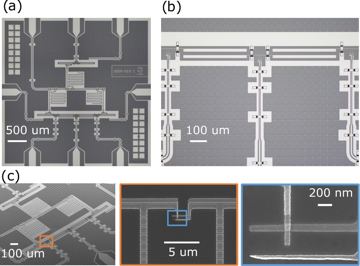
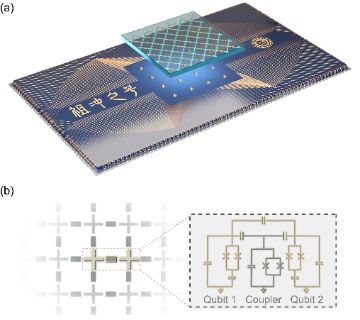
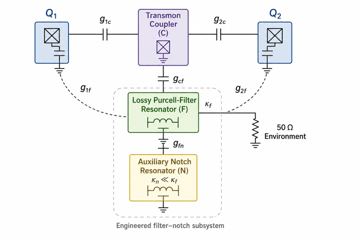
A flux-tunable coupler is a third element — usually a tunable transmon — bridging two data qubits. Its frequency sets an indirect coupling path that interferes with the direct capacitive one, so a bias sweep tunes net exchange through zero: at the off point static ZZ cancels; a pulse away from it drives a deterministic CZ or iSWAP via the |11⟩–|20⟩ crossing. Google/UCSB introduced it as the gmon in 2014, coupling settable to zero at nanosecond resolution without spoiling coherence D[422].
Attributes: carrier affinity a = 1.0, fully fabricated, no natural analogue. Gate time ≈40 ns (10^−7.4 s), deterministic.
Physics & limits
The coupler buys speed and isolation at the cost of a third noisy degree of freedom. Tens of MHz on-coupling sets 25–70 ns gates. Three mechanisms set the floor. Coherence: at 40 ns against Willow's mean T1 of 68 µs, relaxation and dephasing during the pulse already cost a few 10⁻⁴, most of the gap between the 99.88% device mean and unity D[1] — pulse shaping cannot recover it, only longer T1 or shorter gates. Leakage: the pulse passes near |20⟩ and the coupler's second level, so population leaves the computational space — an unheralded, sticky error to the code. And 1/f flux noise on the bias moves the off point between calibrations, leaving a drifting residual ZZ that appears as coherent, correlated error. What moves the floor: higher T1, larger anharmonicity (fluxonium couplers), shaped flux pulses, and couplers biased at a flux-insensitive point.
Engineering state of the art
table
| Year | Figure | Who | Tag+key |
|---|---|---|---|
| 2024-11 | Double-transmon coupler CZ 99.90% in 48 ns | Toshiba | D[37] |
| 2024-12 | Willow, 105 q: mean 2Q 99.88%, mean T1 68 µs, 1.1 µs cycle | D[1] | |
| 2025-08 | CZ 99.93% over 40 h, 1Q 99.98%, readout >99.94% on one device | IQM | D[38] |
| 2026-07 | Fleet EPLG, full width: best 0.19%, typical 0.37% | IBM | C[34] |
Three regimes, not one number: a characterised pair reaches 99.93% D[38]; a 105-qubit device averages 99.88% D[1]; IBM's full-width fleet benchmark reads 0.37% typical, 0.19% best C[34]. Zuchongzhi 3.0 sits at 99.62% over 105 qubits D[35]. The two-qubit gate is still ~40% of Google's colour-code error budget, leakage next D[41].
Manufacturing, materials & supply chain
There is no separate coupler process: the coupler is another junction and SQUID loop in the same superconducting lithography, so its defects are the platform's own — junction-frequency spread and two-level-system defects pulling the off point. The manufacturing cost is I/O, not lithography: Nighthawk carries 218 couplers across 120 qubits, each demanding a bias line C[49]. QuantWare is the only merchant seller of tunable-coupler chips, funded by a $178 M Series B and building a Delft fab P[298]. Export control names whole computers (4A906) and cryogenic electronics (3A901), not gate mechanisms G[301]. No coupler yield or cost is published.
Control, readout & I/O burden
On a square lattice couplers outnumber qubits about two to one, each needing a fast flux line with its own DAC and filtering. At 10³ qubits that is thousands of flux lines; at 10⁴ it binds before fidelity does, and the only demonstrated escape is an on-chip bias source, as in D-Wave's flip-chip flux DAC on a fluxonium at 10 mK C[316]. The recurring cost is calibration, not latency: off points drift with 1/f flux noise, so calibration scales with coupler count — hence Google steering it by reinforcement learning during error correction, at 7.72×10⁻⁴ logical error per cycle at d=7 D[2].
Role in the stack
It belongs to the transmon lattice with tunable couplers (Google, IBM, Rigetti, IQM, OQC, USTC, Fujitsu) and requires the transmon carrier. It replaces fixed-frequency cross-resonance; the switching price is redesigning every qubit-coupler-qubit cell, roughly double the bias lines and a new calibration stack — the trade IBM accepted at Heron (2023-12) after a decade on cross-resonance and kept in Nighthawk C[49]. Its clock contribution is small: derived clock = sum of the syndrome round: gate layers + transport + readout + reset is 0.65 µs, its gate-layer term ~0.16 µs at 0.048 µs per layer D[1], so this node moves the error budget more than the clock. No neighbouring empty slot in the technology graph.
Evidence — how the numbers were measured
The 99.90% and 99.93% headlines are interleaved randomised benchmarking on one characterised pair, and RB is blind to leakage unless a leakage protocol runs alongside — leakage being this gate's second error term. EPLG is a different observable, full-width layered gates including crosstalk, so the 0.37% versus 0.07% gap is definitional as much as fleet variability. Neither record has been replicated by an independent laboratory. One attribution conflict: the cited "25 ns at 99.8%" Oxford result is a fixed-coupling coaxmon pair with no coupler at all C[423].
Not published: the gate duration of IQM's 99.93% CZ, of which only the fidelity and the 40-hour averaging window are stated; a coupler-specific yield or defect rate from any vendor; and the share of IBM's fleet EPLG due to residual coupler-off ZZ rather than coherence or crosstalk.
Actors & economics
Who.
| Organisation | Role | Country | What exactly they do with this technology | Evidence |
|---|---|---|---|---|
| Google | developer | US | Originated the gmon; Willow uses tunable couplers | D[422] |
| IBM | developer | US | Nighthawk: 218 couplers on 120 qubits; coupler patent | C[49] |
| IQM | developer | Finland | Record CZ 99.93% with a floating tunable coupler | D[38] |
| QuantWare | supplier | Netherlands | Sells tunable-coupler transmon chips; Delft fab | P[298] |
| Rigetti | developer | US | Tunable-coupler chiplets, median 2Q 99.1% | Cfact |
Money.
- 2026-06-02 · IBM · programme (5-year quantum commitment) · >$10 B · — · announced fact
- 2026-05-05 · QuantWare · Series B · $178 M (€152 M) · Intel Capital, In-Q-Tel, ETF Partners · closed P[298]fact
- 2026-07-02 · IQM · listing (Nasdaq/Helsinki) · cash €337 M, H1-2026 revenue €8.9 M · closed fact
- 2025-11-06 · DARPA · QBI Stage B, IBM the only transmon vendor of eleven · ≤$15 M each · announced fact
Market & supply chain. What this gate consumes is flux control — multi-channel AWGs (arbitrary waveform generators) and DACs from Zurich Instruments, Quantum Machines and Keysight, none coupler-specific — so concentration risk sits in chips, not instruments. QuantWare is the only merchant route; everyone else fabricates in-house, making coupler design proprietary and control electronics commodity. G2 and G3 pay for this node: both need 10⁻³ two-qubit error at fleet width.
IP & standards. IBM holds US 11,727,297 B2, "Tunable quantum coupler facilitating a quantum gate between qubits" (granted 2023-08-15), claiming an opposite-sign second coupling path that cancels unwanted coherent rotation G[424]; Google's 2014 gmon work is published prior art D[422]. No litigation identified, no standards body for coupler design or reporting.
Roadmaps & track record. IBM: Nighthawk 5,000 two-qubit gates per circuit (promised 2025-06-10 · for 2025 · delivered 2025-12) → 7,500 in 2026 → 10,000 in 2027 Rfact, on schedule, though the coupler switch is one generation old. IQM: 2Q above 99.94% (promised for 2025–26) is within error of the 99.93% delivered D[38]. Rigetti: 108 qubits at 99.5% slipped to "later 2026", the gap sitting in the coupler-mediated gate Cfact.
Strategic reading. IBM's move off cross-resonance settles the architecture argument for tunable coupling, strengthening control-electronics vendors — every coupler is another channel sold — and merchant chip suppliers. The substitution threat is not cross-resonance but passive ZZ cancellation by design: a fixed-coupling coaxmon pair reached 25 ns at 99.8% with no coupler and no flux line C[423]; if that scales, the line tax becomes a liability. Bargaining power stays with whoever owns the fab.
Outlook & open questions
Confirm or demote within 12–24 months: does Nighthawk reach 7,500 two-qubit gates by end-2026; does any fleet report typical EPLG below 0.2%; does a second laboratory reproduce 99.93%. Best case by 2029: fleet-width error near 10⁻³ at 10³ qubits, on-chip biasing removing the line tax. Worst case: coupler count caps chips near 10³ qubits and the 40 ns coherence limit holds error at a few 10⁻⁴, too high for Λ to grow. Open questions: does IBM's patent constrain merchant coupler chips; can fluxonium couplers cut leakage; will fixed coupling remove the line tax at scale.
References
- [1] Google Quantum AI and Collaborators, “Quantum error correction below the surface code threshold,” Nature, vol. 638, no. 8052, pp. 920–926, Dec. 2024, doi: 10.1038/s41586-024-08449-y. D
- [2] V. Sivak et al., “Reinforcement learning control of quantum error correction,” Nature, vol. 655, no. 8124, pp. 879–884, Jul. 2026, doi: 10.1038/s41586-026-10759-2. D
- [34] IBM Quantum, “What's new at IBM Quantum - Q2 2026.” [Online]. Available: https://www.ibm.com/
quantum/ Cblog/ whats-new-q2-2026 - [35] D. Gao et al., “Establishing a New Benchmark in Quantum Computational Advantage with 105-qubit Zuchongzhi 3.0 Processor,” Phys. Rev. Lett., vol. 134, Art. no. 090601, Mar. 2025, doi: 10.1103/PhysRevLett.134.090601. arXiv:2412.11924. D
- [37] R. Li, K. Kubo, Y. Ho, Z. Yan, Y. Nakamura, and H. Goto, “Realization of High-Fidelity CZ Gate Based on a Double-Transmon Coupler,” Phys. Rev. X, vol. 14, no. 4, Art. no. 041050, Nov. 2024, doi: 10.1103/PhysRevX.14.041050. arXiv:2402.18926. D
- [38] F. Marxer et al., “Above 99.9% Fidelity Single-Qubit Gates, Two-Qubit Gates, and Readout in a Single Superconducting Quantum Device,” PRX Quantum, vol. 7, Art. no. 020333, 2026, doi: 10.1103/n86s-2b88. arXiv:2508.16437. D
- [41] N. Lacroix et al., “Scaling and logic in the color code on a superconducting quantum processor,” Nature, vol. 645, no. 8081, pp. 614–619, May 2025, doi: 10.1038/s41586-025-09061-4. arXiv:2412.14256. D
- [49] IBM, “IBM Delivers New Quantum Processors, Software, and Algorithm Breakthroughs on Path to Advantage and Fault Tolerance,” Nov. 12, 2025. [Online]. Available: https://newsroom.ibm.com/
2025-11-12-ibm-delivers-new-quantum-processors,-software,-and-algorithm-breakthroughs-on-path-to-advantage-and-fault-tolerance C - [298] M. Ivezic, “QuantWare Raises $178M Series B — What It Means for Quantum Open Architecture,” PostQuantum.com, May 6, 2026. [Online]. Available: https://postquantum.com/
industry-news/ Pquantware-178m-series-b-qoa/ - [301] US Department of Commerce, Bureau of Industry and Security, “Commerce Control List Additions and Revisions; Implementation of Controls on Advanced Technologies Consistent With Controls Implemented by International Partners,” Federal Register, vol. 89, p. 72926, Sep. 6, 2024. [Online]. Available: https://www.federalregister.gov/
documents/ G2024/ 09/ 06/ 2024-19633/ commerce-control-list-additions-and-revisions-implementation-of-controls-on-advanced-technologies - [316] D-Wave Quantum Inc., “Digital control of a high-coherence fluxonium qubit,” D-Wave Quantum Inc., Jan. 2026. [Online]. Available: https://www.dwavequantum.com/
media/ C41upubz2/ 14-1090a-a_fluxonium-dac-control.pdf - [422] Y. Chen et al., “Qubit architecture with high coherence and fast tunable coupling,” Phys. Rev. Lett., vol. 113, no. 22, Art. no. 220502, Nov. 2014, doi: 10.1103/PhysRevLett.113.220502. arXiv:1402.7367. D
- [423] A. Curbison, “Oxford research group demonstrate fundamental speed-up of two-qubit gate,” OQC, Mar. 21, 2025. [Online]. Available: https://oqc.tech/
company/ Cnewsroom/ oxford-research-group-demonstrate-fundamental-speed-up-of-two-qubit-gate - [424] J. Stehlik, D. L. Underwood, D. Zajac, and M. Steffen, “Tunable quantum coupler facilitating a quantum gate between qubits,” Google Patents, Aug. 15, 2023. [Online]. Available: https://patents.google.com/
patent/ GUS11727297/ en
General facts cited above: fact, fact, fact, fact, fact, fact, fact.