Fluxonium fluxonium
Josephson-junction-array-shunted superconducting qubit at 0.2–1 GHz with large anharmonicity and long T1, bought at the price of a flux-bias line per qubit.
Fluxonium
Low-frequency (0.2–1 GHz) superconducting qubit with large anharmonicity; longer T1, flux-biased.
Brief →Key references
Design space — attributes
- (a) carrier affinity
- fabricated
- (b) time · entangling
- 50 ns · deterministic
- (c) readout
- dispersive microwave · 316 ns · non-destructive · mid-circuit
- (d) mobility
- static nearest-neighbour wiring
- (e) control
- low-frequency electrical @ room temperature
- (f) error structure
- stochastic Pauli, coherent / calibration
- (g) manufacturing
- superconducting lithography
Evaluation space — dated attributes
Atlantic Quantum absorbed by Google (Oct 2025); D-Wave on-chip flux-DAC control on fluxonium (Jan 2026); D-Wave's DR17/DR49/DR181 are dual-rail cavity qubits, not fluxonium.
Standard records
Actors & goals — annotations
Edges
Used by no registered machine
Pictures
Every picture carries the story of what it shows and its credit line.

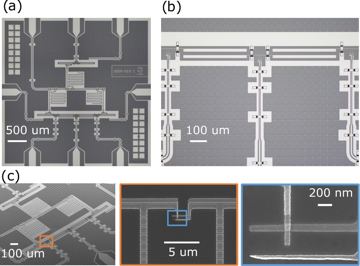
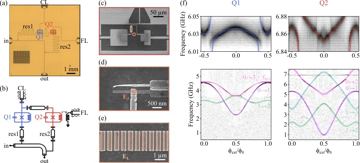
Fluxonium
Josephson-junction-array-shunted superconducting qubit at 0.2–1 GHz with large anharmonicity and long T1, bought at the price of a flux-bias line per qubit.
Verdict. Best two-qubit number on any superconducting carrier (99.94% CNOT, 60 ns, stable 24 days) yet nobody's product carrier as of 2026-09-04; it wins only if cold flux control arrives before transmon couplers close the gap.
Λ = error-suppression factor per code-distance step; QBI = DARPA Quantum Benchmarking Initiative (Stage A concept → B R&D plan → C government V&V); G1–G7 = the report's goal classes (see Actors & economics).
Identity & lineage
A superconducting circuit shunted by a large junction-array inductance, putting the 0→1 transition at 0.2–1 GHz with gigahertz anharmonicity; Manucharyan, Koch, Glazman and Devoret, 2009. Charge dispersion vanishes.
Attributes: fabricated carrier; deterministic entangling ~50 ns (10^-7.3 s); dispersive readout ~0.3 µs, non-destructive, mid-circuit-capable.
Static mobility; low-frequency flux control at room temperature; Pauli plus coherent error; superconducting lithography.
Physics & limits
Dielectric loss scales with ω, so T1 of 160–260 µs at ~300 MHz is routine where a transmon fights the same bath at 5 GHz D[39]. But kT/h ≈ 420 MHz at 20 mK: equilibrium leaves tens of percent in |1⟩, making active reset (~98% D[315]) mandatory. The floor is 1/f flux dephasing — T2* 20–110 µs against those T1 D[39], [316] — second-order at the sweet spot and untunable. In the record CNOT the dominant term is instead coherent: off-resonant control-qubit flips, residual error below 2×10⁻⁴ D[39]. A quieter bias generated closer to the chip is what moves the floor.
Engineering state of the art
table
| Date | Figure | Who | Tag |
|---|---|---|---|
| 2023-09-25 | CZ 99.922 ± 0.009% (RL-optimised mean) | MIT / MIT Lincoln Lab | D[40] |
| 2024-07-22 | CNOT 99.94% in 60 ns, >99.9% for 24 days uncalibrated | Maryland–EPFL–UMass–Wisconsin | D[39] |
| 2025-01-14 | Single-qubit gate 99.998% | MIT EQuS | D[317] |
| 2026-01-23 | On-chip flux-DAC control, T1 ≈ 200 µs preserved | D-Wave | D[316] |
All one- or two-qubit devices; no fluxonium lattice or QEC cycle exists as of 2026-09-04.
D-Wave quotes 200 bias wires (2026-01-06) and ~300 bias lines (2026-01-23) for the same annealer scheme fact. Not published: the gate duration of MIT's 99.922% CZ, which the PRX abstract does not state, and a dated fluxonium-specific patent family.
Manufacturing, materials & supply chain
Same Nb/Al junction lithography as transmon, inheriting its foundries and its TLS problem; record devices come from MIT Lincoln Laboratory and no merchant supplier exists. The I/O cost is drive, readout and a flux line per qubit: a fridge carries a few hundred DC bias lines, so the burden bites at 10³, and at 10⁴–10⁶ the bias must be generated cold. D-Wave flip-chips a multiplexed Φ-DAC die across a ~7 µm gap at 10 mK with no resolvable added decoherence (T1 ≈ 200 µs D[316]), key parts from NASA JPL C[281]; Shenzhen runs XY and Z down one warm line per qubit D[315]. Export exposure is generic superconducting (US EAR ECCN 3A901).
Role in the stack
A drop-in Layer-1 alternative on the transmon lattice with tunable couplers, replacing transmon where coherence beats control simplicity; nothing downstream requires it. Its 60 ns gate does not set the derived clock — dispersive readout at ~0.3 µs does, as for transmon — so fluxonium buys error, not speed. Verification: the headline numbers are RB averages on isolated pairs, blind to lattice crosstalk, flux drift and fluxon leakage, and 99.94% is unreplicated; the main report's 99.92% record D[40] is superseded by it, and 99.922% is itself an RL-optimised mean (unassisted peaks 99.85–99.9%).
Actors & economics
Who.
| Organisation | Role | Country | What exactly they do | Evidence |
|---|---|---|---|---|
| developer | US | Absorbed Atlantic Quantum's fluxonium team; silent since | P[55] | |
| D-Wave | developer | US | On-chip Φ-DAC control of a fluxonium | D[316] |
| University of Maryland | research | US | Manucharyan-group 99.94% CNOT | D[39] |
| S Lab, Shenzhen | research | CN | Single-channel unified flux control | D[315] |
Money.
2025-10-03 · Google · acquisition of Atlantic Quantum · terms undisclosed · closed P[55]fact
2025-11-06 · Atlantic Quantum · absent from QBI Stage B (11 teams, ≤ $15 M each) · DARPA · official fact
2026-08-06 · D-Wave · H1-2026 revenue $5.9 M, cash $546.2 M · reported C[15]fact
Market & supply chain. No commercial supply chain: transmon's kit plus cryogenic DAC/SFQ control, built only in-house (D-Wave) or at government laboratories (JPL, MIT Lincoln Laboratory) — a single point of failure on the one scalable control path. Pays for G3/G4 and G7.
IP & standards. No dated fluxonium-specific patent family found as of 2026-09-04; PatSnap's 2026-06-30 superconducting-device counts are not broken out by carrier Pfact.
Roadmaps & track record. Atlantic Quantum (2025-04 · fluxonium machine under QBI · absorbed, no roadmap survives). D-Wave (2026-06-01 · DR17/DR49/DR181 · dual-rail cavity qubits, not fluxonium Pfact) — its fluxonium work is control IP with no product attached.
Strategic reading. The advantage over a good transmon is thin — Toshiba's double-transmon coupler gives CZ 99.90% in 48 ns D[37] — so fluxonium wins only if cold flux control lands first. Then cryogenic-control vendors and die-bonding capacity capture the value and power sits with the control-chip supplier, not the qubit fab.
Outlook & open questions
Confirm by end-2027: a ≥ 4-qubit fluxonium under on-chip flux control with published two-qubit RB, or a replication of 99.94%; demote if neither appears. Best case 2029: 2Q error near 10⁻⁴ cuts the surface-code budget for a given Λ; worst case, switching noise from the control die eats the coherence advantage. Does the flux-noise floor survive multiplexing? Can 0.2–1 GHz readout reach 99.5% in a lattice? What became of the Atlantic Quantum team?
References
- [15] D-Wave Quantum Inc., “D-Wave Reports Second Quarter 2026 Results,” Aug. 6, 2026. [Online]. Available: https://www.dwavequantum.com/
company/ Cnewsroom/ press-release/ d-wave-reports-second-quarter-2026-results/ - [37] R. Li, K. Kubo, Y. Ho, Z. Yan, Y. Nakamura, and H. Goto, “Realization of High-Fidelity CZ Gate Based on a Double-Transmon Coupler,” Phys. Rev. X, vol. 14, no. 4, Art. no. 041050, Nov. 2024, doi: 10.1103/PhysRevX.14.041050. arXiv:2402.18926. D
- [39] W.-J. Lin, H. Cho, Y. Chen, M. G. Vavilov, C. Wang, and V. E. Manucharyan, “24 days-stable CNOT-gate on fluxonium qubits with over 99.9% fidelity,” arXiv:2407.15783, Jul. 2024. D
- [40] L. Ding et al., “High-Fidelity, Frequency-Flexible Two-Qubit Fluxonium Gates with a Transmon Coupler,” Phys. Rev. X, vol. 13, no. 3, Art. no. 031035, Sep. 2023, doi: 10.1103/PhysRevX.13.031035. D
- [55] M. Swayne, “Atlantic Quantum Joins Google Quantum AI,” The Quantum Insider, Oct. 3, 2025. [Online]. Available: https://thequantuminsider.com/
2025/ P10/ 03/ atlantic-quantum-joins-google-quantum-ai/ - [281] D-Wave, “D-Wave Demonstrates First Scalable, On-Chip Cryogenic Control of Gate-Model Qubits,” Jan. 6, 2026. [Online]. Available: https://www.dwavequantum.com/
company/ Cnewsroom/ press-release/ d-wave-demonstrates-first-scalable-on-chip-cryogenic-control-of-gate-model-qubits/ - [315] X. Pan et al., “Unified Flux Control Architecture for Fluxonium Qubits,” arXiv:2605.25948, May 2026. D
- [316] D-Wave Quantum Inc., “Digital control of a high-coherence fluxonium qubit,” D-Wave Quantum Inc., Jan. 2026. [Online]. Available: https://www.dwavequantum.com/
media/ D41upubz2/ 14-1090a-a_fluxonium-dac-control.pdf - [317] S. Miller, “Fast control methods enable record-setting fidelity in superconducting qubit,” MIT News, Jan. 14, 2025. [Online]. Available: https://news.mit.edu/
2025/ Dfast-control-methods-enable-record-setting-fidelity-superconducting-qubit-0114