Dispersive microwave readout (+TWPA, Purcell) ro_disp
The qubit state is read as a dispersive shift of a coupled resonator, Purcell-filtered on chip and amplified near the quantum limit before the HEMT.
Dispersive microwave readout (+TWPA, Purcell)
Resonator shift read through a parametric amplifier; 240 ns pulse at 99.94% (IQM); readout-induced leakage is the hidden cost.
Brief →Key references
Design space — attributes
- (a) carrier affinity
- fabricated
- (b) time · entangling
- —
- (c) readout
- dispersive microwave · 282 ns · non-destructive · mid-circuit
- (d) mobility
- —
- (e) control
- microwave @ room temperature
- (f) error structure
- leakage
- (g) manufacturing
- superconducting lithography
Evaluation space — dated attributes
Standard records
Actors & goals — annotations
Edges
Used by 89 machines (80 primary · 9 alternate)
- superconducting circuits 87
- Academia Sinica 20-qubit superconducting quantum computer Academia Sinica press ◌ 🔎
- Alice & Bob Boson 4 Alice & Bob press ▣ §II ('Measuring Z is done by a memory displacement followed by a photon number measurement'); App. C1 and Fig. C1 (longitudinal photon-number readout calibration) ✅
- Alice & Bob Graphene Alice & Bob press ◌ 🔎
- Alice & Bob Helium (on-premise system) Alice & Bob whitepaper press ▥ §MILESTONE 2 Challenge 2: Count the Flips (X measurement of auxiliary cats detects phase-flips) 🔎
- Alice & Bob Helium 2 ("Galvanic Cat") Alice & Bob press ◌ 🔎
- IBM Quantum System Two at Amaravati Quantum Valley Tech Park IBM with TCS and the Government of Andhra Pradesh ◌ 🔎
- Anyon MonarQ Anyon Systems product page press ▦ §How does a quantum computer like MonarQ work? (microwave signal analysis reads qubit state) 🔎
- AWS Ocelot AWS Center for Quantum Computing ▤ ✅
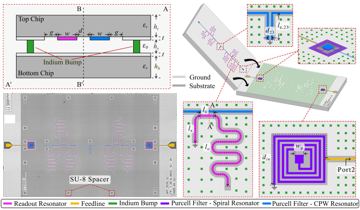
- Baihua (Quafu platform) Beijing Academy of Quantum Information Sciences paper ▤ main text (individual readout resonator per qubit; each 13-qubit row on a common feedline) ✅
- Dongling (Quafu platform) Beijing Academy of Quantum Information Sciences ◌ 🔎
- Haituo (Quafu platform) Beijing Academy of Quantum Information Sciences ◌ 🔎
- ScQ-136 "Baiwang" Beijing Academy of Quantum Information Sciences ◌ 🔎
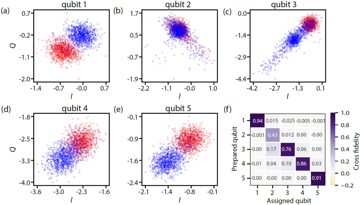
- Shenglian (BAQIS) Beijing Academy of Quantum Information Sciences paper ▣ Fig. 1(f) (three-state single-shot readout clouds) 🔎
- IBM Quantum System Two, Donostia-San Sebastian Basque Government (BasQ) - IBM-Euskadi Quantum Computational Center press ◌ 🔎
- Quantum Spain quantum computer at BSC Barcelona Supercomputing Center (Quantum Spain; installed by Qilimanjaro-GMV) press ◌ 🔎
- WACQT quantum computer (Chalmers 25-qubit flip-chip processor) Chalmers University of Technology (WACQT) ▤ abstract ✅
- Tianyan-176 / Tianyan-176 II (and Tianyan-24 sibling) China Telecom Quantum Group + QuantumCTek paper paper paper ◌ 🔎
- Tianyan-287 China Telecom Quantum Group / QuantumCTek / CAS paper docs docs ▣ Fig. 2a (readout error CDF, mean 1.3%); Fig. 1c (daily readout error e3) ✅
- Tianyan-504 / "Xiaohong" chip China Telecom Quantum Group + CAS + QuantumCTek paper docs docs ◌ 🔎
- 6-qubit superconducting quantum processor DRDO DYSL-QT with TIFR and TCS ◌ 🔎
- Surface-17 ETH Zurich (Quantum Device Lab) paper paper ▣ Fig. 1b,d; Methods B; Appendix F; Table I ✅
- IBM Quantum System One, Ehningen Fraunhofer-Gesellschaft ◌ 🔎
- Fujitsu >10,000 physical / ~250 logical (STAR) Fujitsu + AIST + RIKEN press ◌ 🔎
- Fujitsu 1,000-qubit machine Fujitsu (+ RIKEN) link ◌ 🔎
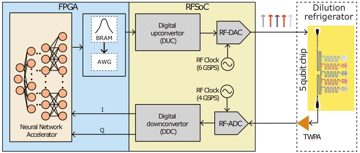
- Sycamore Google Quantum AI paper ▣ SI Fig. S2c (readout chain: AWG, amplification, IF mixing, ADCs); SI §III.2 Readout ✅
- IBM Quantum Blue Jay IBM blog ◌ 🔎
- IBM Quantum Cockatoo IBM press ◌ 🔎
- IBM Quantum Condor IBM blog press ◌ 🔎
- IBM Quantum Eagle r1-r3 IBM paper paper paper ▣ Fig. 4 (readout error map of ibm_sherbrooke) ✅
- IBM Quantum Egret IBM docs ◌ 🔎
- IBM Quantum Falcon r5.11 IBM paper blog ▣ Fig. 5a (repeated measurement sequence); Methods: Leakage in the system ✅
- IBM Quantum Flamingo (l-coupler proof of concept) IBM blog ◌ 🔎
- IBM Quantum Heron r1 IBM paper blog press ◌ 🔎
- IBM Quantum Heron r2 IBM paper paper press ▣ Fig. 5 (readout error map); Methods: IBM hardware ✅
- IBM Quantum Heron r3 (ibm_pittsburgh) IBM blog press ▨ ✅
- IBM Quantum Kookaburra IBM docs ◌ 🔎
- IBM Quantum Nighthawk r1 IBM docs blog blog ◌ 🔎
- IBM Quantum Osprey IBM blog press ◌ 🔎
- IBM Quantum Starling IBM blog ◌ 🔎
- IBM Quantum System Two at CSCS (Swiss Quantum Innovation Hub) IBM with ETH Zurich (CSCS) and Lockheed Martin press ◌ 🔎
- IQCC superconducting facility Israeli Quantum Computing Center (Quantum Machines + QuantWare + Qolab + ORCA) product page product page press ◌ 🔎
- IQM Emerald (IQM Crystal 54) IQM Quantum Computers blog ▣ Fig. 4f-i (single-shot readout clouds); Table S1 (resonators/Purcell) ✅
- IQM Garnet (IQM Crystal 20) IQM Quantum Computers paper ▣ Fig. 3 (designed readout circuit: S21 and impedance vs frequency, target modes); §2.3 Qubit readout; Fig. 8b (RO error CDF) ✅
- IQM Halocene IQM Quantum Computers press press link ◌ 🔎
- IQM Spark at Eldorado Research Institute IQM Quantum Computers with Instituto de Pesquisas Eldorado press ◌ 🔎
- IQM Star 24 IQM Quantum Computers link ▤ App. G (Qubit specifications); Fig. 1b (ancilla measurements, final data-qubit readout) 🔎
- IQM six-qubit star QPU (Deneb-class) IQM Quantum Computers paper paper docs ▤ App. G, Table III 🔎
- VLQ IT4Innovations National Supercomputing Center (VSB - Technical University of Ostrava) press ◌ 🔎
- KRISS domestic superconducting QPU Korea Research Institute of Standards and Science press press ◌ 🔎
- KRISS 50-qubit-class superconducting system Korea Research Institute of Standards and Science press ◌ 🔎
- Advanced Quantum Testbed (AQT) Lawrence Berkeley National Laboratory ▦ ✅
- Nord Quantique single-mode GKP Nord Quantique paper press ▣ Fig. 1a (on-chip readout resonator + Purcell filter); Fig. 2b; App. A.3–A.4 ✅
- Nord Quantique Tesseract Nord Quantique product page press ▣ Fig. 1a (on-chip readout resonator + Purcell filter); App. A.4 Mid-circuit measurements calibration ✅
- OQC Toshiko Oxford Quantum Circuits product page ▤ §III Basic characterization / §IX Materials and Methods (heterodyne single-shot readout, 5 µs pulses) 🔎
- Origin Wukong 102 Origin Quantum ▤ SI 'Device', Table S1 (per-qubit readout F00/F11) ✅
- Origin Wukong-180 (4th gen) Origin Quantum press ▨ ✅
- Origin Wukong (3rd gen) Origin Quantum paper ◌ 🔎
- Qolab devices at the IQCC Qolab ▦ §Cryogenic integrated circuits (Josephson photomultipliers + SQUID amplifiers replace TWPAs and circulators) 🔎
- QpiAI Indus QpiAI press ◌ 🔎
- QpiAI Kaveri QpiAI press ◌ 🔎
- QuantWare Contralto-A17 QuantWare press ▦ §Introducing Contralto-A (Purcell filters) 🔎
- QuantWare Tenor-D64 QuantWare product page ◌ 🔎
- QuantWare Bass-A10K (VIO-40K) QuantWare press ◌ 🔎
- Rigetti Ankaa-2 Rigetti Computing paper paper ▣ Fig. 1b (multiplexed readout feedlines to RX/TX cards); Fig. 1a (latency A–B) ✅
- Rigetti Ankaa-3 Rigetti Computing blog press press ◌ 🔎
- Rigetti Cepheus-1-108Q Rigetti Computing blog ▤ §II.B (one readout resonator per qubit; readout lines routed through the carrier chip) 🔎
- Rigetti Cepheus-1-36Q Rigetti Computing blog press ▤ §II.B (one readout resonator per qubit; readout lines routed through the carrier chip) 🔎
- Rigetti Novera Rigetti Computing product page press ▦ readout description ('based on their dispersive shifts') ✅
- RIKEN 64-qubit superconducting processor RIKEN with AIST, NICT, Osaka University, Fujitsu, NTT press press ▥ Fig. 3 (16 output wires for readout, microwave receiver); Fig. 2 (readout wiring) ✅
- RIKEN-Fujitsu 256-qubit superconducting quantum computer RIKEN RQC + Fujitsu press press ◌ 🔎
- RIKEN RQC-Fujitsu 64-qubit superconducting quantum computer RIKEN RQC + Fujitsu press ◌ 🔎
- SEEQC SFQ-controlled 5-qubit system SEEQC paper press ▤ Supp. §B Experimental Setup; Fig. S1 (Experimental Diagram) 🔎
- SpinQ Ursa Major (25 q / 103 q) SpinQ Technology product page press press ◌ 🔎
- Toshiba double-transmon coupler Toshiba + RIKEN RQC + University of Tokyo paper press ▣ Fig. 1a (readout elements); Fig. 10 (single-shot readouts of the three resonators); Appendix F State discrimination ✅
- Kunlun Tsinghua University IIIS (D.-L. Deng) with Zhejiang University (H. Wang, C. Song groups) paper paper ▣ Fig. S6 (readout resonator frequencies, dispersive shift χ); SI: Measurement setup ✅
- Zuchongzhi 2.1 USTC / Hefei National Laboratory paper ▣ Fig. 1b (readout circuit schematic); Fig. 2a (readout error of 60 qubits) ✅
- Zuchongzhi 3.0 USTC / Hefei National Laboratory paper paper press ▣ Fig. 1a (readout resonators on second chip); §II ✅
- VTT Q50 VTT Technical Research Centre of Finland product page ◌ 🔎
- Zhuangzi 2.0 (Chuang-tzu 2.0) CAS / Peking University paper paper press ▣ Suppl. Fig. 9c (readout resonator frequency distribution); Suppl. Fig. 7 (wiring); §S3.B ✅
- Zhejiang University 125-qubit surface-code processor Zhejiang University + Graduate School of China Academy of Engineering Physics (Beijing) paper ▣ Fig. 1c (two-/three-state readout error CDFs); §II ✅
- Sycamore-class 72-qubit processor Google Quantum AI paper paper ▣ Fig. 1b (measure and reset); Fig. 1c (Meas. error CDF) ✅ (alternate)
- Willow Google Quantum AI paper paper product page ▤ SI §I (gates and readout); Fig. 1b blue (measurement error CDF) ✅ (alternate)
- IBM Quantum Loon IBM blog ▨ 🔎 (alternate)
- IBM Quantum Nighthawk r2 IBM blog ▨ ✅ (alternate)
- OQC GENESIS Oxford Quantum Circuits product page product page press ▣ Fig. 1c (EOL readout signal); §II (dispersive shifts χ_QR, χ_DR) ✅ (alternate)
- Aqumen Seeker Quantum Circuits Inc. (acquired by D-Wave, Jan 2026) press ▣ Fig. 1a (readout resonator per cavity for SPAM) 🔎 (alternate)
- Zuchongzhi 3.2 USTC / Hefei National Laboratory ▤ ✅ (alternate)
- quantum annealers 2
- Advantage D-Wave Quantum docs ◌ 🔎 (alternate)
- Advantage2 D-Wave Quantum paper docs docs ◌ 🔎 (alternate)
Pictures
Every picture carries the story of what it shows and its credit line.
Dispersive microwave readout (+TWPA, Purcell)
The qubit state is read as a dispersive shift of a coupled resonator, Purcell-filtered on chip and amplified near the quantum limit before the HEMT.
Verdict. Falsifiable — assignment fidelity is already 99.94%, so if fleet readout error stays near 1% through 2027 the binding term is measurement-induced leakage and QND violation, not amplifier noise.
Λ = error-suppression factor per code-distance step; QBI = DARPA Quantum Benchmarking Initiative (Stage A concept → B R&D plan → C government V&V); G1–G7 = the report's goal classes (see Actors & economics).
Identity & lineage
A resonator coupled off-resonantly (coupling g, detuning Δ ≫ g) acquires a state-dependent shift χ ≈ g²/Δ, so a probe tone carries the state in its phase without exchanging quanta with the qubit — non-demolition by construction. Wallraff and colleagues at Yale established it as circuit QED's readout channel D[591]. Two additions make it usable: an on-chip Purcell filter, which passes the probe while blocking qubit emission into the same line, and a near-quantum-limited parametric amplifier before the HEMT (high-electron-mobility transistor).
Attributes: carrier affinity a = 1.0, fully fabricated. Readout ≈280 ns (10^−6.55 s), non-destructive, mid-circuit capable.
Physics & limits
Separation needs a fixed number of signal photons at the amplifier input, so readout time falls with probe power and rises with chain noise. A Josephson travelling-wave amplifier giving 12 dB across 4 GHz near the quantum limit D[592] removes the HEMT's noise penalty, so the amplifier is not the floor. The floor is what hard probing does to the qubit: above a critical photon number the dressed system undergoes measurement-induced transitions out of the computational subspace, and the code inherits leakage — unheralded, sticky, correlated in time, not a Pauli flip. The IQM device shows the split: 99.94% simultaneous assignment fidelity with a 240 ns pulse and shelving into the second excited state, but 99.3% QNDness D[38]. Assignment error is 6×10⁻⁴; the chance the qubit does not survive as measured is an order of magnitude larger — and that is what syndrome extraction consumes. The Purcell filter's linewidth buys speed but, widened, reopens the emission channel it exists to close. What moves the floor: shelving-free discrimination, on-chip isolation, and encodings that turn a failed measurement into a heralded erasure.
Engineering state of the art
table
| Year | Figure | Who | Tag+key |
|---|---|---|---|
| 2024-12 | Willow, 105 q: readout 99.5%, 1.1 µs error-correction cycle | D[1] | |
| 2025-08 | 99.94% simultaneous readout, 240 ns pulse, QNDness 99.3% | IQM | D[38] |
| 2026-08 | Dual-rail cavity readout: SPAM ≈0.02%, erasure ≈0.5% per gate | Quantum Circuits | D[84] |
| 2026-07 | Fleet readout error ~1×10⁻² | IBM | C[33] |
The spread is the story: 6×10⁻⁴ on a characterised pair, 5×10⁻³ over 105 qubits, ~10⁻² across a fleet D[38]D[1]C[33]; Zuchongzhi 3.0 reads out at 99.13% D[35]. Readout is the largest single-channel error term at scale, larger than two-qubit gates, and the one whose fleet value has barely moved in two years.
Manufacturing, materials & supply chain
On chip there is no extra process: resonator and Purcell filter are patterned in the qubit's own lithography, the cost being area and frequency planning: each qubit on a feedline needs a distinct resonator frequency in the amplifier's band. Off chip the chain — isolators, circulators, parametric amplifier, HEMT — is the fridge's bulkiest hardware and where a merchant market has appeared: Silent Waves (Grenoble) sells Argo, Carthago and Zephyr, the last launched 2026-03-13, to Rigetti, Alice & Bob, Qilimanjaro, QphoX and CEA C[593]; QuantWare sells a Crescendo TWPA C[594]; QuantumCore is developing one with the Institute for Quantum Computing P[595]. Export exposure is direct: ECCN 3A901, effective 2024-09-06, covers sub-4.5 K electronics and names parametric amplifiers, so a TWPA is controlled in its own right G[301].
Control, readout & I/O burden
Each qubit consumes a resonator, a share of a feedline (eight to ten qubits multiplexed per line), a share of one amplifier's dynamic range, and a digitiser channel with real-time discrimination. The amplifier is the scaling constraint nobody has published a number for: TWPA saturation caps simultaneous tones per device, and each feedline needs its own isolator stack — volume, not silicon. Instrumentation has followed (over 1,000 channels per rack C[526]), but the budget is set downstream: Google's real-time decoder ran at 63 µs latency for d=5 against a 1.1 µs cycle D[1], so readout plus decode defines the loop. At 10⁶ the chain must move into the cold, and no cryogenic digitiser has been shown beyond a handful of qubits.
Role in the stack
It serves every superconducting-family architecture: transmons, bosonic cat and GKP encodings, dual-rail erasure qubits, and the same chain in annealers. It requires the transmon's dispersive shift and, for bosonic codes, an ancilla mediating the cavity measurement, and provides the mid-circuit non-destructive measurement every error-correction scheme here assumes — no substitute exists inside the family. Its clock contribution is direct: derived clock = sum of the syndrome round: gate layers + transport + readout + reset is 0.65 µs, of which readout is 0.28 µs — the largest term, against ~0.048 µs per gate layer D[1]D[38] — inside a measured 1.1 µs cycle. No neighbouring empty slot in the technology graph.
Evidence — how the numbers were measured
Three quantities circulate as "readout fidelity" and are not interchangeable: assignment fidelity, QNDness (the qubit is left in the state reported), and SPAM. The 99.94% headline is simultaneous assignment fidelity with shelving; QNDness on the same device is 99.3% D[38]. IBM's fleet ~10⁻² is undecomposed into amplifier noise, Purcell-limited decay and measurement-induced transitions C[33]. Value conflict: the graph record quotes 280 ns readout, the preprint a 240 ns pulse, so ~280 ns should be read as the full window. No independent laboratory has replicated the 99.94% result.
Not published: a named TWPA or Purcell-filter patent family with assignee and grant year; TWPA yield, unit cost, or the number of multiplexed tones one amplifier sustains before compression, from any supplier; and a fleet-average QNDness from any vendor.
Actors & economics
Who.
| Organisation | Role | Country | What exactly they do with this technology | Evidence |
|---|---|---|---|---|
| IQM | developer | Finland | Readout record: 99.94% with shelving, QNDness 99.3% | D[38] |
| Google | developer | US | 99.5% readout across 105 qubits in a 1.1 µs cycle | D[1] |
| IBM | developer | US | Publishes the only at-scale fleet readout error, ~10⁻² | C[33] |
| Silent Waves | supplier | France | Merchant TWPA maker, three shipping products | C[593] |
| QuantumCore | supplier | Canada | TWPA development with IQC Waterloo | P[595] |
Money.
- 2026-05-05 · QuantWare · Series B · $178 M (€152 M) · Intel Capital, In-Q-Tel, ETF Partners · closed C[547]fact
- 2026-04-25 · QuantumCore · listing (CSE: QNCR, 2026-04-14) plus NSERC Alliance grant · $10.7 M raised, $1.7 M grant · NSERC/IQC · closed P[595]
- 2026-01 · D-Wave · M&A (Quantum Circuits) · $550 M · — · announced C[84]
Market & supply chain. The chain, not the chip, is what this node buys: isolators and circulators, HEMTs, the parametric amplifier. The TWPA market is thin — three small merchant suppliers against in-house builds at Google and IBM — so one exit matters more here than anywhere else, and the parts are export-controlled G[301]. G2 and G3 pay for this node; G7 buys the instrumentation.
IP & standards. No TWPA or Purcell-filter patent family with a named assignee and grant year was found; Silent Waves' 2025 Nature Electronics amplifier-isolator is a published design, not a grant C[593]. No litigation identified, and no standards body defines how readout fidelity is reported — hence three numbers quoted interchangeably.
Roadmaps & track record. Silent Waves: three products with named customers (Zephyr promised and launched 2026-03-13) C[593], the most credible record here. QuantumCore: announced 2026-04-25, too recent to judge P[595]. No platform vendor publishes a fleet-average readout target as distinct from best-device fidelity — a notable omission when readout is the largest fleet error term.
Strategic reading. This is a shared chokepoint: four architectures depend on the same amplification and isolation hardware, so concentration risk is systemic in a way qubit-chip choices are not. If fleet readout stays near 10⁻², Λ stalls whatever gates do, since syndrome extraction inherits the measurement error — the case for erasure-style encodings that make a failed measurement heralded. Winners: merchant amplifier suppliers and whichever vendor solves QND rather than assignment. Bargaining power sits with the platform vendors, though export licensing gives regulators a lever.
Outlook & open questions
Confirm or demote within 12–24 months: does any vendor publish a fleet-average QNDness; does fleet readout error fall below 5×10⁻³. Best case by 2029: shelving-free discrimination and on-chip isolation take fleet readout error toward 10⁻³ without slowing the cycle. Worst case: measurement-induced leakage holds QNDness near 99.3% whatever the amplifier does, and readout stays the term that caps Λ. Open questions: how the fleet 1% decomposes; how many tones one TWPA carries before compression.
References
- [1] Google Quantum AI and Collaborators, “Quantum error correction below the surface code threshold,” Nature, vol. 638, no. 8052, pp. 920–926, Dec. 2024, doi: 10.1038/s41586-024-08449-y. D
- [33] IBM, “IBM Quantum Computing — Hardware and roadmap.” [Online]. Available: https://www.ibm.com/
quantum/ Chardware - [35] D. Gao et al., “Establishing a New Benchmark in Quantum Computational Advantage with 105-qubit Zuchongzhi 3.0 Processor,” Phys. Rev. Lett., vol. 134, Art. no. 090601, Mar. 2025, doi: 10.1103/PhysRevLett.134.090601. arXiv:2412.11924. D
- [38] F. Marxer et al., “Above 99.9% Fidelity Single-Qubit Gates, Two-Qubit Gates, and Readout in a Single Superconducting Quantum Device,” PRX Quantum, vol. 7, Art. no. 020333, 2026, doi: 10.1103/n86s-2b88. arXiv:2508.16437. D
- [84] N. Mehta et al., “An entangling gate for dual-rail erasure qubits,” Nature, vol. 656, no. 8126, pp. 47–53, Aug. 2026, doi: 10.1038/s41586-026-10822-y. arXiv:2503.10935. D
- [301] US Department of Commerce, Bureau of Industry and Security, “Commerce Control List Additions and Revisions; Implementation of Controls on Advanced Technologies Consistent With Controls Implemented by International Partners,” Federal Register, vol. 89, p. 72926, Sep. 6, 2024. [Online]. Available: https://www.federalregister.gov/
documents/ G2024/ 09/ 06/ 2024-19633/ commerce-control-list-additions-and-revisions-implementation-of-controls-on-advanced-technologies - [526] Zurich Instruments, “Zurich Instruments Launches the ZQCS Quantum Control System to Master the Long-Lived Logical Qubit Challenge,” Mar. 9, 2026. [Online]. Available: https://www.zhinst.com/
americas/ Cen/ news/ zurich-instruments-launches-zqcs-quantum-control-system-master-long-lived-logical-qubit/ - [547] QuantWare, “QuantWare Raises $178 Million to Build World’s Most Powerful Quantum Processors at an Industrial Scale,” May 5, 2026. [Online]. Available: https://quantware.com/
news/ Cquantware-raises-178-million - [591] A. Wallraff et al., “Strong coupling of a single photon to a superconducting qubit using circuit quantum electrodynamics,” Nature, vol. 431, no. 7005, pp. 162–167, Sep. 2004, doi: 10.1038/nature02851. arXiv:cond-mat/0407325. D
- [592] T. C. White et al., “Traveling wave parametric amplifier with Josephson junctions using minimal resonator phase matching,” arXiv:1503.04364, Mar. 2015. D
- [593] Silent Waves, “Silent Waves - Traveling-Wave Parametric Amplifiers (TWPAs),” Mar. 13, 2026. [Online]. Available: https://www.silent-waves.com/ C
- [594] QuantWare, “Peripherals — Crescendo TWPA,” 2026. [Online]. Available: https://quantware.com/
product/ Cperipherals - [595] D. Finke, “QuantumCore Secures $1.7M NSERC Grant to Advance Superconducting Amplifiers,” Quantum Computing Report, Apr. 25, 2026. [Online]. Available: https://quantumcomputingreport.com/
quantumcore-partners-with-iqc-and-nserc-in-1-7m-traveling-wave-parametric-amplifier-twpa-development-initiative/ P