Bosonic cavity mode cavity
A harmonic microwave mode of a 3D or planar superconducting resonator used as the qubit carrier; its error is structured photon loss, not generic Pauli noise.
Bosonic cavity mode
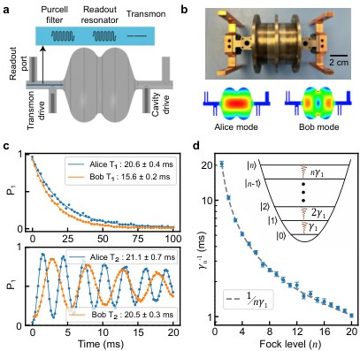
Harmonic mode of a 3D/planar superconducting resonator; single-photon T1 10 ms (Al, Yale 2013), cavity-qubit T2 34 ms (Weizmann 2023); errors = photon loss (structured).
Brief →Key references
Design space — attributes
- (a) carrier affinity
- fabricated
- (b) time · entangling
- 316 ns · deterministic
- (c) readout
- dispersive microwave · 1.0 µs · non-destructive · mid-circuit
- (d) mobility
- shared bus (motional / cavity)
- (e) control
- microwave @ room temperature
- (f) error structure
- loss (erasure), biased
- (g) manufacturing
- 3D machined cavities
Evaluation space — dated attributes
The 25.6 ms / 34 ms figures are Weizmann (Milul/Rosenblum, PRX Quantum 4, 030336), not a Yale-lineage result; the cavity material is not stated, so 'Nb-coated' is unsupported.
Standard records
Actors & goals — annotations
Edges
Used by 10 machines (10 primary · 0 alternate)
- superconducting circuits 10
- Alice & Bob Boson 4 Alice & Bob press ▣ §I and Fig. 2A–C (memory mode at 1.1 GHz, buffer at 7.9 GHz, ATS); abstract (22 s bit-flip time); the paper Alice & Bob's Boson 4 page links as Boson 4 ✅
- Alice & Bob Graphene Alice & Bob press ▥ ✅
- Alice & Bob Helium (on-premise system) Alice & Bob whitepaper press ▥ Fig. 'A Cat Qubit Zoom-In' (sapphire chip, resonator, buffer); Fig. 'The Helium Chip' (16 cat qubits, 72 ports); §The Hardware Behind Cat Qubits ✅
- Alice & Bob Helium 2 ("Galvanic Cat") Alice & Bob press ▨ ✅
- AWS Ocelot AWS Center for Quantum Computing ▣ Fig. 1a-c (storage modes S1-S5, buffers B1-B5); §II ✅
- D-Wave gate-model dual-rail system D-Wave Quantum press ▣ Fig. 1a (device hardware schematic: pair of 3D λ/4 coaxial cavities per qubit, 3 SQUID transmon couplers) ✅
- Nord Quantique single-mode GKP Nord Quantique paper press ▣ Fig. 1a (device schematic: double-post cavity + auxiliary transmon); App. A.1 ✅
- Nord Quantique Tesseract Nord Quantique product page press ▣ Fig. 1a (device schematic: double-post Al cavity, storage mode, auxiliary transmon chip) ✅
- Aqumen Seeker Quantum Circuits Inc. (acquired by D-Wave, Jan 2026) press ▣ Fig. 1a (dual-rail pairs of 3D λ/4 coaxial cavities) ✅
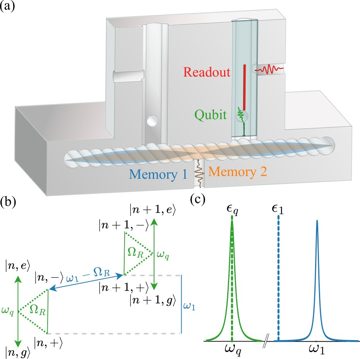
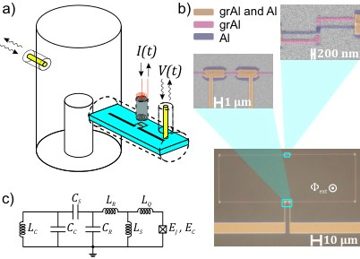
- SUSTech biased-erasure cavity qubit Southern University of Science and Technology paper ▣ Fig. 1b (cavity coaxial stub, transmon ancilla, readout resonator); SI §I.A ✅
Pictures
Every picture carries the story of what it shows and its credit line.
Bosonic cavity mode
A harmonic microwave mode of a 3D or planar superconducting resonator used as the qubit carrier; its error is structured photon loss, not generic Pauli noise.
Verdict. Laboratory memories reach 25.6 ms photon lifetime, but working bosonic devices run two to three orders shorter; the carrier's limit is the ancilla coupled to it, not the cavity.
Λ = error-suppression factor per code-distance step; QBI = DARPA Quantum Benchmarking Initiative (Stage A concept → B R&D plan → C government V&V); G1–G7 = the report's goal classes (see Actors & economics).
Identity & lineage
The quantised harmonic mode of a machined 3D or planar superconducting resonator, driven and read out dispersively through a coupled transmon ancilla. Yale's 3D circuit-QED work made it a carrier in 2013: Q > 0.5×10⁹, 10 ms single-photon lifetime in aluminium D[318]. Readout is ancilla-mediated at ~1 µs, non-destructive, mid-circuit capable; the carrier is fabricated, bus-connected, room-temperature microwave driven.
Physics & limits
A harmonic mode's dominant decay channel is amplitude damping alone — the whole argument for bosonic codes, since an encoding can target one known channel instead of an unstructured Pauli basis. Loss scales linearly with occupation, so κ caps the bias any cat encoding can reach. The floor is surface two-level systems, seam conductance and radiative leakage: 25.6 ms lifetime, 34 ms coherence (Weizmann, 2023), from a geometry that "couples minimally to the control qubit" D[319]. That phrase is the limit — a mode whose ancilla is driven hard inherits its dephasing, and Nord Quantique's working GKP mode runs T1 = 360 µs D[82]. Moving it means ancilla decoupling and surface treatment.
Engineering state of the art
table
Typical at scale is far below best: 18 cat modes (Helium), five storage modes (Ocelot) C[87]D[80]. The dominant operating term is ancilla-induced dephasing plus gate-visible loss, the 0.5%-per-gate erasure being that loss detected D[84].
The 25.6 ms and 34 ms Weizmann figures come from a single group, with no independent replication. Helium's "up to 200× lower hardware requirements" is a company claim with no logical-level data behind it C[87]. Not published: the material (aluminium or niobium) of the Weizmann cavity, and a quality factor for the λ/4 coaxial bodies of the 2026-08 dual-rail CZ [84].
Manufacturing, materials & supply chain
Two routes make the mode. Machined bodies of aluminium or niobium, polished and sealed, hold Nord Quantique's GKP mode and D-Wave's λ/4 dual-rail pairs D[82]D[84]; such a mode occupies cm scale against a transmon's ~100 µm — that ratio, not Q, is the liability. The cat chips are planar: Alice & Bob's are tantalum-on-sapphire circuits, Boson 3's memory a quarter-wave coplanar resonator fact, and Ocelot's modes are coplanar-waveguide resonators on two bump-bonded dies D[80]. Per mode the burden is one drive line plus an ancilla with its own drive and readout chain — at Alice & Bob, a buffer mode and its pumps instead of the ancilla Cfact. No cryogenic-CMOS or on-chip multiplexing of cavity control exists, so lines grow linearly: at 10³ modes the wall is coax count and cryostat volume in one dilution unit; 10⁴–10⁶ needs different packaging. Machining is in-house at every vendor that machines bodies; no third-party foundry and no cavity-specific export rule were found. Concentration sits around it: Bluefors refrigerators, Cryomech pulse tubes included fact.
Role in the stack
Requires one of two manufacturing routes, machined 3D cavities or planar superconducting lithography; provides the mode for cat and GKP encodings, dual-rail erasure, ancilla-mediated gates and dispersive readout. Derived clock = sum of the syndrome round: gate layers + transport + readout + reset: 2.8 µs on the dual-rail erasure architecture, four 500 ns CZ layers over a ~0.4 µs check D[84], and 1.44 µs on the cat-and-GKP cavity architecture, gate-set, against its measured 2.8 µs cycle D[80]. Verification: the 25.6/34 ms figures are single-group and unreplicated D[319]; the dual-rail CZ's Pauli error is post-selected, and its Λ ≈ 27 is simulated, not measured Sfact.
Actors & economics
Who.
| Organisation | Role | Country | What exactly they do | Evidence |
|---|---|---|---|---|
| Alice & Bob | developer | FR | 18-cat-mode Helium system, ~40 kW, sold to GENCI | C[87] |
| D-Wave | developer | US | λ/4 coaxial cavity dual-rail qubits, via Quantum Circuits | D[84] |
| AWS | developer | US | Ocelot: five storage modes, four ancillas, five buffers | D[80] |
| Nord Quantique | developer | CA | Multimode cavity GKP, T1 360 µs | D[82] |
| Weizmann Institute | research | IL | Cavity memory record holder | D[319] |
Money.
2026-01-20 · D-Wave · M&A of Quantum Circuits · $550 M · — · closed fact
2026-08-06 · D-Wave · Q2 report · $9.3 M acquisition cost, $2.3 M inherited bookings · reported fact
2026-05-18 · Nord Quantique · growth equity · $30 M at $1.4 B · — · closed C[89]
Market & supply chain. Nobody sells cavities; the money is downstream in fridges and amplifiers. Unit economics are unpublished — Helium's ~40 kW for 18 modes is a whole-system figure C[87]. G3 pays here, G4 does not at cm scale.
IP & standards. No dated patent family specific to the cavity mode was found; Amazon's US 11,748,652 B1 covers the layer above fact.
Roadmaps & track record. Alice & Bob delivered Helium 2026-06 as promised, without logical data C[87]. D-Wave promises DR17 (2026), DR49 (2027), DR181 (2028), 10 logical (2030), 100 logical (2032) at Λ = 10 Rfact. Both ship on time and defer the numbers that matter.
Strategic reading. If cavity modes stay the best-structured error channel in superconducting hardware, their vendors trade error quality for fewer physical qubits; if planar dual-rail or on-chip GKP match those erasure fractions, cm-scale bodies lose on density and the branch narrows to a memory niche.
Outlook & open questions
Confirm by 2028 if an operating multi-mode device holds photon lifetime above 1 ms; demote if operating lifetimes stay near 10² µs while planar erasure qubits close the gap. Best case 2029: multiplexed control, sub-cm bodies; worst case, single-digit-mode demonstrators indefinitely. Open: how much operating dephasing is ancilla-borne; will anyone publish Q for the λ/4 bodies? Watch Alice & Bob logical data and DR49.
References
- [80] H. Putterman et al., “Hardware-efficient quantum error correction via concatenated bosonic qubits,” Nature, vol. 638, no. 8052, pp. 927–934, Feb. 2025, doi: 10.1038/s41586-025-08642-7. D
- [82] S. Turcotte et al., “Quantum error correction of a grid-state qubit with state preparation and measurement errors below 10⁻³,” arXiv:2607.06718, Jul. 2026. D
- [84] N. Mehta et al., “An entangling gate for dual-rail erasure qubits,” Nature, vol. 656, no. 8126, pp. 47–53, Aug. 2026, doi: 10.1038/s41586-026-10822-y. arXiv:2503.10935. D
- [87] N. Coppola, “Alice & Bob Unveils First Quantum System, Helium,” Alice & Bob, Jun. 10, 2026. [Online]. Available: https://alice-bob.com/
newsroom/ Calice-bob-unveils-first-quantum-system/ - [89] Nord Quantique, “Nord Quantique Reaches $1.4 Billion USD Valuation with Latest Investment,” Business Wire, May 18, 2026. [Online]. Available: https://www.businesswire.com/
news/ Chome/ 20260518358351/ en/ Nord-Quantique-Reaches-$1.4-Billion-USD-Valuation-with-Latest-Investment - [318] M. Reagor et al., “Reaching 10 ms single photon lifetimes for superconducting aluminum cavities,” arXiv:1302.4408, Feb. 2013. D
- [319] O. Milul et al., “Superconducting Cavity Qubit with Tens of Milliseconds Single-Photon Coherence Time,” PRX Quantum, vol. 4, no. 3, Art. no. 030336, Sep. 2023, doi: 10.1103/PRXQuantum.4.030336. D