Cat-code encoding (biased noise) enc_cat
A two-photon-dissipation-stabilised coherent-state qubit whose bit-flips fall exponentially with photon number while phase-flips rise linearly with it.
Cat-code encoding (biased noise)
Two-photon-dissipation-stabilised coherent states; bit-flips exponentially suppressed, phase-flips grow ∝ n̄.
Brief →Key references
Design space — attributes
- (a) carrier affinity
- fabricated
- (b) time · entangling
- —
- (c) readout
- —
- (d) mobility
- —
- (e) control
- —
- (f) error structure
- biased
- (g) manufacturing
- —
Evaluation space — dated attributes
Alice & Bob (DARPA QBI Stage A only), AWS. The '27–33' figures quoted elsewhere are phase-flip *times* in µs, not bias values.
Actors & goals — annotations
Edges
Used by 5 machines (5 primary · 0 alternate)
- superconducting circuits 5
- Alice & Bob Boson 4 Alice & Bob press ▣ §I (dissipation engineering for squeezed-like cat qubits); Fig. 3 (bit-flip protection by squeezing) ✅
- Alice & Bob Graphene Alice & Bob press ▣ Abstract (ε≈0.1%); Table I; Fig. 5c (cat-qubit circuit-level model) ✅
- Alice & Bob Helium (on-premise system) Alice & Bob whitepaper press ▥ §More Than a Pendulum: Cat's Autonomous Stabilization; §Bit-Flips Protection Record; Fig. 'Exponential Suppression of Bit-Flips on Boson 4' ✅
- Alice & Bob Helium 2 ("Galvanic Cat") Alice & Bob press ▨ ✅
- AWS Ocelot AWS Center for Quantum Computing ▣ Fig. 1e (cat Wigner functions), Fig. 1f (bit-/phase-flip times) ✅
Pictures
Every picture carries the story of what it shows and its credit line.
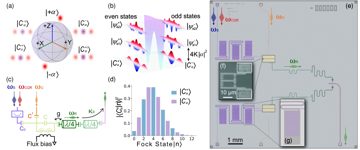
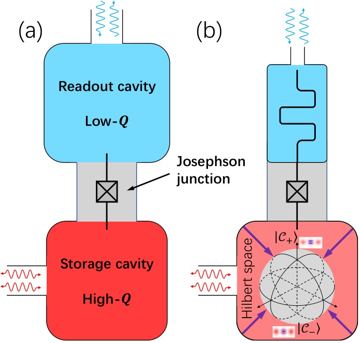
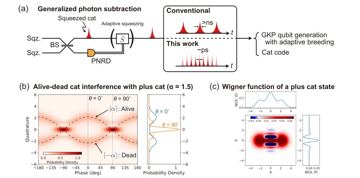
Cat-code encoding (biased noise)
A two-photon-dissipation-stabilised coherent-state qubit whose bit-flips fall exponentially with photon number while phase-flips rise linearly with it.
Verdict. The bias is real but small where measured — bias > 25 under a CX at n̄ = 2; the resource estimates imply a cavity lifetime near 50 ms, twice the best ever built.
Λ = error-suppression factor per code-distance step; QBI = DARPA Quantum Benchmarking Initiative (Stage A concept → B R&D plan → C government V&V); G1–G7 = the report's goal classes (see Actors & economics).
Identity & lineage
A qubit spanned by two coherent states of a cavity mode, held there by engineered two-photon exchange with a lossy buffer. Bit-flips must cross phase space between the lobes, exponentially suppressed in n̄; one photon loss flips the phase, linear in n̄. Demonstrated from about 2020 (Lescanne, Leghtas and colleagues), commercialised by Alice & Bob and AWS. It has no gate time or readout of its own; its only product is the asymmetry.
Physics & limits
Γ_Z ≈ n̄/T1: the encoding turns cavity lifetime directly into logical quality, and photon number buys bit-flip suppression at a linear price. Ocelot closes the loop: at n̄ = 2 the storage lifetime is 57–68 µs D[80]. Run that arithmetic at the operating point the estimates assume, n̄ ≈ 19 and 10⁻³ phase-flip per cycle, and the required cavity T1 is n̄·t/p ≈ 53 ms S[80], [95]. The best published cavity memory is 25.6 ms, built by decoupling the mode from its ancilla — the opposite of what a stabilised cat does D[319]. That is the floor: the qubit-count argument is a claim about cavity lifetime under strong drive. What moves it: lower single-photon loss at high pump power, or squeezed cats D[78].
Engineering state of the art
table
| Date | Figure | Who | Tag |
|---|---|---|---|
| 2025-02 | Per CX at n̄ = 2: phase-flip 9.6(4)×10⁻², bit-flip 3.5(4)×10⁻³ → bias > 25, idle > 30; repetition code 1.75(2)% (d=3, n̄=1) → 1.65(3)% (d=5, n̄=1.5) per 2.8 µs cycle | AWS/Caltech | D[80] |
| 2025-09 | 12-cat chip: mean bit-flip 44 min, peak 252 min, preliminary | Alice & Bob | C[77] |
| 2025-02 | Squeezed-cat variant: 22 s bit-flip | Alice & Bob | D[78] |
Phase-flip dominates: ~10⁻¹ per cycle where a code has run, against the ~10⁻³ assumed; bit-flip suppression stopped being the problem two years ago.
The 9.6×10⁻² is the phase-flip error of the CX gate at n̄ = 2, not a per-QEC-cycle figure; the noise bias is > 25 under the CX and > 30 idle, and the "27–33" in circulation are phase-flip times in µs, not bias values D[80]. The 44-minute mean bit-flip time of the 12-cat chip (September 2025) is preliminary and vendor-published, with no peer-reviewed follow-up, and the vendor's roadmap page gives a 252-minute peak for the same period. The 53 ms cavity-lifetime requirement is derived from Γ_Z ≈ n̄/T1 under the estimates' own assumptions; neither source states it. Nord Quantique's QBI Stage B award [65] funds its GKP route, which does not use this encoding.
Manufacturing, materials & supply chain
It has no fabrication step of its own, adding a continuous parametric pump and buffer mode to the host cavity. That pump is the I/O cost: a drive line, a pump line and a readout chain per cat — through a shared ancilla transmon on Ocelot, through the buffer at Alice & Bob Cfact. Ocelot spends five buffers and four ancilla transmons on five cats D[80]. At 10³ cats the wall is pump-line count and pump heating in one dilution unit; 10⁴–10⁶ needs multiplexed cryogenic drive, undemonstrated here. Supply chain and export exposure are the host cavity's.
Role in the stack
Architecture: bosonic cavity qubits — cat and GKP, where it is the primary encoding. Requires a bosonic cavity mode; provides the biased inner qubit for repetition-cat and LDPC-cat concatenation and for a cat–cat CNOT. It replaces the bare two-level encoding, competes with GKP and conflicts with the unbiased surface code. Derived round 1.44 µs, gate-set, against the measured 2.8 µs syndrome cycle D[80]. Verification: the distance-3 and distance-5 points were taken at n̄ = 1 and n̄ = 1.5, so "flat with distance" mixes distance with operating point D[80]. The 44-minute mean bit-flip is preliminary; the same vendor's roadmap quotes a 252-minute peak from that run C[77]C[412].
Actors & economics
Who.
| Organisation | Role | Country | What exactly they do | Evidence |
|---|---|---|---|---|
| Alice & Bob | developer | FR | Bit-flip records, 18-cat Helium, a cat-only roadmap | C[77] |
| AWS | developer | US | Ocelot, the only published cat code with a budget | D[80] |
| DARPA | investor | US | Stage B selected Nord Quantique, not Alice & Bob | fact |
Money.
2025-01-28 · Alice & Bob · Series B · €100 M · — · closed fact
2026-05-22 · Alice & Bob · Series B extension · undisclosed · NVentures lead · closed C[88]
Market & supply chain. Nothing is sold at this layer; the encoding is a design choice on the cavity supply chain, bought as a promise about G3 and G4. Alice & Bob's business rests on it.
IP & standards. No dated patent family specific to cat-code encoding was found; filings attach to gates, pumps and readout.
Roadmaps & track record. The published ladder runs Helium (18 cats, 1 logical, 10⁻², delivered 2026-06) → Lithium (48/4, 10⁻³) → Beryllium (250/5, 10⁻⁴) → Graphene (2,000/100, 10⁻⁶, 2030) R[412]. Chips arrive on time, but no logical error rate has been published for any, so every defining number is a promise. AWS has published no cat roadmap past Ocelot.
Strategic reading. If phase-flip per cycle falls two orders, cat encoding wins the physical-qubit count; if not, the branch is a memory technology and the budget goes to qLDPC or dual-rail erasure.
Outlook & open questions
Confirm by 2027 if phase-flip per cycle falls below 10⁻² with bias above 100 at fixed n̄; demote the efficiency claims if it stays near 10⁻¹. Best case 2029: a cat at n̄ ≥ 5 with millisecond lifetime under active stabilisation. Worst case: bias saturates and the 758-cat and 126,133-cat estimates stay unreachable S[95], [96]. Open: does squeezing survive multi-qubit operation; can pump power rise without loading T1? Watch Lithium and any Ocelot successor.
References
- [65] DARPA, “Stage B selection,” Nov. 6, 2025. [Online]. Available: https://www.darpa.mil/
research/ Gprograms/ quantum-benchmarking-initiative/ stage-b-selection - [77] N. Coppola, “Alice & Bob Shares Preliminary Results Vastly Surpassing Previous Bit-Flip Time Record,” Alice & Bob, Sep. 25, 2025. [Online]. Available: https://alice-bob.com/
newsroom/ Calice-bob-surpasses-bit-flip-stability-record - [78] N. Coppola, “Alice & Bob Improves Error Suppression in Quantum Computers by 'Squeezing' Cat Qubits,” Alice & Bob, Mar. 11, 2025. [Online]. Available: https://alice-bob.com/
newsroom/ Dsqueezed-cat-qubit/ - [80] H. Putterman et al., “Hardware-efficient quantum error correction via concatenated bosonic qubits,” Nature, vol. 638, no. 8052, pp. 927–934, Feb. 2025, doi: 10.1038/s41586-025-08642-7. D
- [88] N. Coppola, “Alice & Bob announces Series B Extension,” Alice & Bob, May 22, 2026. [Online]. Available: https://alice-bob.com/
newsroom/ Calice-bob-announces-series-b-extension/ - [95] É. Gouzien, D. Ruiz, F.-M. Le Régent, J. Guillaud, and N. Sangouard, “Performance Analysis of a Repetition Cat Code Architecture: Computing 256-bit Elliptic Curve Logarithm in 9 Hours with 126133 Cat Qubits,” Phys. Rev. Lett., vol. 131, Art. no. 040602, Jul. 2023, doi: 10.1103/PhysRevLett.131.040602. arXiv:2302.06639. S
- [96] D. Ruiz, J. Guillaud, A. Leverrier, M. Mirrahimi, and C. Vuillot, “LDPC-cat codes for low-overhead quantum computing in 2D,” Nat. Commun., vol. 16, Art. no. 1040, 2025, doi: 10.1038/s41467-025-56298-8. arXiv:2401.09541. S
- [319] O. Milul et al., “Superconducting Cavity Qubit with Tens of Milliseconds Single-Photon Coherence Time,” PRX Quantum, vol. 4, no. 3, Art. no. 030336, Sep. 2023, doi: 10.1103/PRXQuantum.4.030336. D
- [412] Alice & Bob, “Roadmap,” Jun. 23, 2026. [Online]. Available: https://alice-bob.com/
roadmap/ C