Bare physical qubit (no encoding) enc_bare
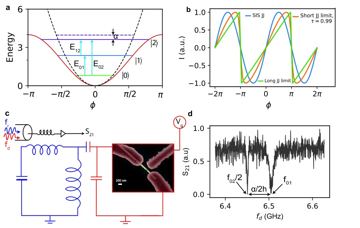
The {|0⟩,|1⟩} subspace of a weakly anharmonic Josephson oscillator used directly as the qubit, with no bosonic, erasure or bias structure on top.
Bare physical qubit (no encoding)
Computational subspace of an anharmonic oscillator; leakage to |2⟩ is the price.
Brief →Key references
Design space — attributes
- (a) carrier affinity
- fabricated
- (b) time · entangling
- —
- (c) readout
- —
- (d) mobility
- —
- (e) control
- —
- (f) error structure
- leakage
- (g) manufacturing
- —
Evaluation space — dated attributes
USTC leakage suppression = PRL 135, 260601 (2025-12-22), Λ = 1.40(6) at d=7; the paper does not name the processor 'Zuchongzhi 3.2'.
Actors & goals — annotations
Edges
Used by 78 machines (78 primary · 0 alternate)
- superconducting circuits 78
- Academia Sinica 20-qubit superconducting quantum computer Academia Sinica press ◌ 🔎
- IBM Quantum System Two at Amaravati Quantum Valley Tech Park IBM with TCS and the Government of Andhra Pradesh ◌ 🔎
- Anyon MonarQ Anyon Systems product page press ◌ 🔎
- Baihua (Quafu platform) Beijing Academy of Quantum Information Sciences paper ◌ 🔎
- Dongling (Quafu platform) Beijing Academy of Quantum Information Sciences ◌ 🔎
- Haituo (Quafu platform) Beijing Academy of Quantum Information Sciences ◌ 🔎
- ScQ-136 "Baiwang" Beijing Academy of Quantum Information Sciences ◌ 🔎
- Shenglian (BAQIS) Beijing Academy of Quantum Information Sciences paper ◌ 🔎
- IBM Quantum System Two, Donostia-San Sebastian Basque Government (BasQ) - IBM-Euskadi Quantum Computational Center press ◌ 🔎
- Quantum Spain quantum computer at BSC Barcelona Supercomputing Center (Quantum Spain; installed by Qilimanjaro-GMV) press ◌ 🔎
- WACQT quantum computer (Chalmers 25-qubit flip-chip processor) Chalmers University of Technology (WACQT) ◌ 🔎
- Tianyan-176 / Tianyan-176 II (and Tianyan-24 sibling) China Telecom Quantum Group + QuantumCTek paper paper paper ◌ 🔎
- Tianyan-287 China Telecom Quantum Group / QuantumCTek / CAS paper docs docs ◌ 🔎
- Tianyan-504 / "Xiaohong" chip China Telecom Quantum Group + CAS + QuantumCTek paper docs docs ◌ 🔎
- 6-qubit superconducting quantum processor DRDO DYSL-QT with TIFR and TCS ◌ 🔎
- Surface-17 ETH Zurich (Quantum Device Lab) paper paper ◌ 🔎
- IBM Quantum System One, Ehningen Fraunhofer-Gesellschaft ◌ 🔎
- Fujitsu >10,000 physical / ~250 logical (STAR) Fujitsu + AIST + RIKEN press ◌ 🔎
- Fujitsu 1,000-qubit machine Fujitsu (+ RIKEN) link ◌ 🔎
- Sycamore Google Quantum AI paper ◌ 🔎
- Sycamore-class 72-qubit processor Google Quantum AI paper paper ◌ 🔎
- Willow Google Quantum AI paper paper product page ◌ 🔎
- IBM Quantum Blue Jay IBM blog ◌ 🔎
- IBM Quantum Cockatoo IBM press ◌ 🔎
- IBM Quantum Condor IBM blog press ◌ 🔎
- IBM Quantum Eagle r1-r3 IBM paper paper paper ◌ 🔎
- IBM Quantum Egret IBM docs ◌ 🔎
- IBM Quantum Falcon r5.11 IBM paper blog ▣ Fig. 5 (leakage to |2⟩); Methods: Leakage in the system ✅
- IBM Quantum Flamingo (l-coupler proof of concept) IBM blog ◌ 🔎
- IBM Quantum Heron r1 IBM paper blog press ◌ 🔎
- IBM Quantum Heron r2 IBM paper paper press ◌ 🔎
- IBM Quantum Heron r3 (ibm_pittsburgh) IBM blog press ◌ 🔎
- IBM Quantum Kookaburra IBM docs ◌ 🔎
- IBM Quantum Loon IBM blog ◌ 🔎
- IBM Quantum Nighthawk r1 IBM docs blog blog ◌ 🔎
- IBM Quantum Nighthawk r2 IBM blog ◌ 🔎
- IBM Quantum Osprey IBM blog press ◌ 🔎
- IBM Quantum Starling IBM blog ◌ 🔎
- IBM Quantum System Two at CSCS (Swiss Quantum Innovation Hub) IBM with ETH Zurich (CSCS) and Lockheed Martin press ◌ 🔎
- IQCC superconducting facility Israeli Quantum Computing Center (Quantum Machines + QuantWare + Qolab + ORCA) product page product page press ◌ 🔎
- IQM Emerald (IQM Crystal 54) IQM Quantum Computers blog ◌ 🔎
- IQM Garnet (IQM Crystal 20) IQM Quantum Computers paper ◌ 🔎
- IQM Halocene IQM Quantum Computers press press link ◌ 🔎
- IQM Spark at Eldorado Research Institute IQM Quantum Computers with Instituto de Pesquisas Eldorado press ◌ 🔎
- IQM Star 24 IQM Quantum Computers link ◌ 🔎
- IQM six-qubit star QPU (Deneb-class) IQM Quantum Computers paper paper docs ◌ 🔎
- VLQ IT4Innovations National Supercomputing Center (VSB - Technical University of Ostrava) press ◌ 🔎
- KRISS domestic superconducting QPU Korea Research Institute of Standards and Science press press ◌ 🔎
- KRISS 50-qubit-class superconducting system Korea Research Institute of Standards and Science press ◌ 🔎
- Advanced Quantum Testbed (AQT) Lawrence Berkeley National Laboratory ◌ 🔎
- OQC Toshiko Oxford Quantum Circuits product page ◌ 🔎
- Origin Wukong 102 Origin Quantum ◌ 🔎
- Origin Wukong-180 (4th gen) Origin Quantum press ◌ 🔎
- Origin Wukong (3rd gen) Origin Quantum paper ◌ 🔎
- Qolab devices at the IQCC Qolab ◌ 🔎
- QpiAI Indus QpiAI press ◌ 🔎
- QpiAI Kaveri QpiAI press ◌ 🔎
- QuantWare Contralto-A17 QuantWare press ◌ 🔎
- QuantWare Tenor-D64 QuantWare product page ◌ 🔎
- QuantWare Bass-A10K (VIO-40K) QuantWare press ◌ 🔎
- Rigetti Ankaa-2 Rigetti Computing paper paper ◌ 🔎
- Rigetti Ankaa-3 Rigetti Computing blog press press ◌ 🔎
- Rigetti Cepheus-1-108Q Rigetti Computing blog ◌ 🔎
- Rigetti Cepheus-1-36Q Rigetti Computing blog press ◌ 🔎
- Rigetti Novera Rigetti Computing product page press ◌ 🔎
- RIKEN 64-qubit superconducting processor RIKEN with AIST, NICT, Osaka University, Fujitsu, NTT press press ◌ 🔎
- RIKEN-Fujitsu 256-qubit superconducting quantum computer RIKEN RQC + Fujitsu press press ◌ 🔎
- RIKEN RQC-Fujitsu 64-qubit superconducting quantum computer RIKEN RQC + Fujitsu press ◌ 🔎
- SEEQC SFQ-controlled 5-qubit system SEEQC paper press ◌ 🔎
- SpinQ Ursa Major (25 q / 103 q) SpinQ Technology product page press press ◌ 🔎
- Toshiba double-transmon coupler Toshiba + RIKEN RQC + University of Tokyo paper press ◌ 🔎
- Kunlun Tsinghua University IIIS (D.-L. Deng) with Zhejiang University (H. Wang, C. Song groups) paper paper ◌ 🔎
- Zuchongzhi 2.1 USTC / Hefei National Laboratory paper ◌ 🔎
- Zuchongzhi 3.0 USTC / Hefei National Laboratory paper paper press ◌ 🔎
- Zuchongzhi 3.2 USTC / Hefei National Laboratory ◌ 🔎
- VTT Q50 VTT Technical Research Centre of Finland product page ◌ 🔎
- Zhuangzi 2.0 (Chuang-tzu 2.0) CAS / Peking University paper paper press ▤ §Experimental setup (anharmonicity −200 MHz ≫ hopping strength; two-level qubit subspace) 🔎
- Zhejiang University 125-qubit surface-code processor Zhejiang University + Graduate School of China Academy of Engineering Physics (Beijing) paper ◌ 🔎
Pictures
Every picture carries the story of what it shows and its credit line.

Bare physical qubit (no encoding)
The {|0⟩,|1⟩} subspace of a weakly anharmonic Josephson oscillator used directly as the qubit, with no bosonic, erasure or bias structure on top.
Verdict. The default of every mainstream superconducting vendor as of 2026-09-04; its structural cost is leakage plus an unbiased error model, which caps measured Λ at 1.4–2.1 where erasure encodings simulate an order of magnitude higher.
Λ = error-suppression factor per code-distance step; QBI = DARPA Quantum Benchmarking Initiative (Stage A concept → B R&D plan → C government V&V); G1–G7 = the report's goal classes (see Actors & economics).
Identity & lineage
Using the lowest two levels of a Josephson circuit directly as a qubit is as old as the Cooper-pair box (Nakamura, 1999); the transmon (Koch et al., 2007) made it the default by buying charge insensitivity with lower anharmonicity — which is what creates the leakage problem.
Attributes: it adds no characteristic time, readout, mobility, control or fabrication of its own — each is the carrier's.
Error structure as the code sees it: unbiased Pauli plus leakage out of the subspace.
Physics & limits
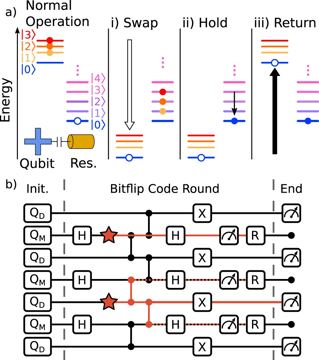
The scale that matters is α ≈ −EC ≈ 2π × 200–300 MHz: it sets the minimum gate time and the leakage per gate, which DRAG (derivative removal by adiabatic gate) pulse shaping suppresses but cannot remove. Raising α costs charge dispersion, which grows as exp(−√(8E_J/E_C)); that trade is the floor here. Leakage persists where a Pauli fault does not: the second excited state survives tens of QEC cycles at Willow's 1.1 µs D[1], feeding the decoder correlated wrong syndromes. Hence dedicated removal: USTC's all-microwave scheme suppresses leakage 72×, to a residual 6.4(5)×10⁻⁴ after 40 cycles D[3]. What moves the floor is leakage-aware decoding and faster multi-level reset.
Engineering state of the art
table
Best in class is one characterised IQM pair, CZ 99.93% over 40 h D[38]; typical at scale is IBM's fleet EPLG 3.7×10⁻³, best 1.9×10⁻³ D[34], and Rigetti's 108-qubit median 99.1% C[36].
The 72× leakage suppression and the 6.4(5)×10⁻⁴ residual come from one USTC device, unreplicated as of 2026-09-04; the paper does not name the processor, and the "Zuchongzhi 3.2" label comes from outside it. Not published: a leakage figure for IBM's fleet, whose EPLG aggregates all error mechanisms.
Manufacturing, materials & supply chain
Nothing of its own: it inherits the carrier's 300 mm Nb/Al lithography, yield spread and one drive plus one readout line per qubit. That is the whole commercial argument — dual-rail erasure adds a rail and a check per qubit (384 ns, 2.54×10⁻² erasure D[85]), cat codes a pump and buffer mode. The I/O wall is the carrier's: coax per qubit, ~10³ qubits per fridge. What this encoding adds at 10⁴–10⁶ is leakage removal inside every 1.1 µs cycle and the decoder bandwidth to use it. Export exposure is the carrier's (US EAR ECCN 3A901).
Role in the stack
The default Layer-2 encoding on the transmon lattice with tunable couplers (IBM, Google, Rigetti, IQM, OQC, USTC/Zhejiang, Fujitsu). Dual-rail erasure or cat encoding replaces it when a vendor trades control complexity for a friendlier error structure: Alice & Bob, AWS and D-Wave/Quantum Circuits have, IBM and Google have not. The price is quantifiable: measured dual-rail gate errors simulate to Λ ≈ 27 against 14 for 0.1% depolarising noise S[84], where this encoding measures 2.14 and 1.40(6) D[1], [3]. It adds nothing to the derived clock, which stays the carrier's 0.65 µs round inside its measured 1.1 µs cycle. Verification: the 72× is one unreplicated USTC device, and leakage is self-reported with no cross-vendor protocol.
Actors & economics
Who.
Money.
2026-06-02 · IBM · investment commitment · > $10 B over five years · announced G[57]fact
2026-07-02 · IQM · Nasdaq and Helsinki listing · pro-forma cash €337 M · closed C[58]fact
Market & supply chain. No supply chain of its own; concentration sits one layer down, in Nb/Al lithography and dilution refrigerators. Being free, it is what every G1–G4 budget on this architecture buys.
IP & standards. No dated patent family found for bare-subspace leakage mitigation as of 2026-09-04; PatSnap's 2026-06-30 counts are not encoding-specific Pfact.
Roadmaps & track record. IBM (2025-06-10 · Starling, 200 logical / 10⁸ gates in 2029 · Nighthawk on plan, Kookaburra slipped a year fact). Google (2025 · long-lived logical qubit at 10⁻⁶ · no successor to Willow). Neither publishes a leakage target.
Strategic reading. Its edge is that it is free, so the fork is capital allocation: money spent switching to erasure is not spent scaling the bare fleet. If Λ stays near 2, erasure encodings win on physical qubits per logical; otherwise incumbents keep the field.
Outlook & open questions
Confirm by end-2027: ≥ 50× leakage suppression in a below-threshold code outside USTC, or leakage published as a line item in a vendor's logical error budget; otherwise demote it to a single-device claim. Best case 2029: leakage falls under the correlated-event floor (≈10⁻¹⁰, hourly bursts on Willow D[1]); worst case, Λ stays near 2 and physical-per-logical above 10³. Does leakage or 2Q error dominate at 10⁴ qubits? Can removal keep up at 10⁶? Does erasure conversion ever cross over commercially?
References
- [1] Google Quantum AI and Collaborators, “Quantum error correction below the surface code threshold,” Nature, vol. 638, no. 8052, pp. 920–926, Dec. 2024, doi: 10.1038/s41586-024-08449-y. D
- [2] V. Sivak et al., “Reinforcement learning control of quantum error correction,” Nature, vol. 655, no. 8124, pp. 879–884, Jul. 2026, doi: 10.1038/s41586-026-10759-2. D
- [3] T. He et al., “Experimental Quantum Error Correction below the Surface Code Threshold via All-Microwave Leakage Suppression,” Phys. Rev. Lett., vol. 135, no. 26, Art. no. 260601, Dec. 2025, doi: 10.1103/rqkg-dw31. D
- [34] IBM Quantum, “What's new at IBM Quantum - Q2 2026.” [Online]. Available: https://www.ibm.com/
quantum/ Dblog/ whats-new-q2-2026 - [36] Rigetti Computing, Inc., “Rigetti Announces General Availability of 108-Qubit System,” Apr. 7, 2026. [Online]. Available: https://investors.rigetti.com/
news-releases/ Cnews-release-details/ rigetti-announces-general-availability-108-qubit-system - [38] F. Marxer et al., “Above 99.9% Fidelity Single-Qubit Gates, Two-Qubit Gates, and Readout in a Single Superconducting Quantum Device,” PRX Quantum, vol. 7, Art. no. 020333, 2026, doi: 10.1103/n86s-2b88. arXiv:2508.16437. D
- [57] IBM Quantum, “Why IBM is investing $10 billion into quantum computing,” Jun. 2, 2026. [Online]. Available: https://www.ibm.com/
quantum/ Gblog/ 10-billion-investment-faq - [58] IQM Quantum Computers, “IQM Quantum Computers Becomes First European Quantum Computing Company Listed on a Major U.S. Exchange,” Jul. 2, 2026. [Online]. Available: https://iqm.tech/
press-releases/ Ciqm-quantum-computers-becomes-first-european-quantum-computing-company-listed-on-a-major-u-s-exchange/ - [84] N. Mehta et al., “An entangling gate for dual-rail erasure qubits,” Nature, vol. 656, no. 8126, pp. 47–53, Aug. 2026, doi: 10.1038/s41586-026-10822-y. arXiv:2503.10935. S
- [85] J. S.-C. Hung et al., “Fast, High-Fidelity Erasure Detection of Dual-Rail Qubits with Symmetrically Coupled Readout,” arXiv:2604.16292, Apr. 2026. D