Exchange-only / singlet–triplet spin encoding enc_eo
One logical qubit in the total-spin subspace of three exchange-coupled spins (exchange-only) or two spins plus a field gradient (singlet–triplet), driven entirely by baseband voltage pulses, with leakage as the price of removing microwave control.
Exchange-only / singlet–triplet spin encoding
Encoded spin qubits controlled purely by baseband exchange pulses; leakage 0.015%/Clifford (AEON).
Brief →Key references
Design space — attributes
- (a) carrier affinity
- fabricated
- (b) time · entangling
- —
- (c) readout
- —
- (d) mobility
- —
- (e) control
- —
- (f) error structure
- leakage, coherent / calibration
- (g) manufacturing
- —
Evaluation space — dated attributes
Actors & goals — annotations
Edges
Used by 1 machine (1 primary · 0 alternate)
- semiconductor spins 1
- HRL exchange-only silicon spin processor (18 EO qubits from 54 quantum dots) HRL Laboratories (IBM since 26 Aug 2026) paper press ▣ Abstract; Fig. 1c; Methods: Exchange-only qubits ✅
Pictures
Every picture carries the story of what it shows and its credit line.
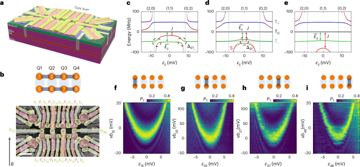
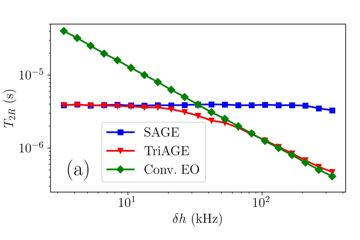
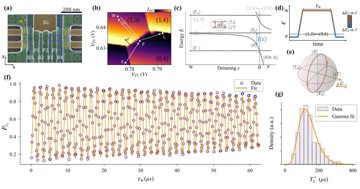
Exchange-only / singlet–triplet spin encoding
One logical qubit in the total-spin subspace of three exchange-coupled spins (exchange-only) or two spins plus a field gradient (singlet–triplet), driven entirely by baseband voltage pulses, with leakage as the price of removing microwave control.
Verdict. The only spin encoding that has run error correction with no room-temperature real-time electronics; it costs three dots per qubit and a leakage channel, and its headline code result is bit-flip only.
Λ = error-suppression factor per code-distance step; QBI = DARPA Quantum Benchmarking Initiative (Stage A concept → B R&D plan → C government V&V); G1–G7 = the report's goal classes (see Actors & economics).
Identity & lineage
Two or three spins in adjacent dots encode one qubit in a subspace of fixed total spin, every gate a pulse of Heisenberg exchange — baseband voltage, never a microwave tone. The basis is DiVincenzo, Bacon, Kempe, Burkard and Whaley, Nature 408, 339 (2000): exchange alone implements any circuit, so local single-qubit drive disappears S[416]. Scaled three-dot demonstrations date from about 2013. Attributes: affinity — fully composite, the opposite pole from the bare spin; error — leakage plus coherent exchange error, no control modality or fabrication of its own.
Physics & limits
Three spins span eight states and the qubit uses two, so population leaks into the spin-3/2 manifold, invisible to a Pauli-frame decoder unless converted into detectable error. That is the encoding-specific floor: 0.015% per Clifford for always-on two-exchange operation against a 0.029% single-exchange average D[417]. In return it is a decoherence-free subspace against uniform field noise, but exchange depends exponentially on barrier voltage, so charge noise enters the gate. Neither term dominates: HRL attributes roughly 80% of its CNOT error to extrinsic control and calibration D[190]. Sweet-spot operation, always-on pulsing (1.9 versus 2.7 pulses per Clifford D[417]) and cold calibration move it.
Engineering state of the art
table
Dominant term: extrinsic control and calibration, then leakage; best reproducible CNOT 9×10⁻⁴ D[190].
Benchmarked as one system rather than as encoded qubits, 48 spins of HRL's 54-dot device span the whole total-spin-zero space, of dimension C₂₄ ≈ 2⁴⁰ (a Catalan number), which includes the states a three-spin encoding treats as leakage; mirror randomised benchmarking gives an error of 3.2×10⁻⁴ per exchange pulse (2.2×10⁻⁴ device-wide by cross-entropy benchmarking), with the 4 K cryo-CMOS controller in the loop P[900]. That is an error per exchange pulse, not a two-qubit gate error: at 37 exchanges per encoded CNOT the additive estimate is about 1%. The space has no local qubits, and no method yet compiles programs or runs error correction in it P[900].
The 0.2 W per qubit is derived from HRL's published controller power and qubit count; the paper states no scaling figure. HRL's ~80% extrinsic-error attribution is self-reported, and neither the UCLA nor the HRL result has an independent replication. Not published: all-pairs two-qubit fidelities for any exchange-only device.
Manufacturing, materials & supply chain
Three dots per qubit — two for singlet–triplet — triples gate-stack density per logical unit on the hosting 300 mm process, with no encoding-specific step. The win is control: purely baseband, no microwave lines or micromagnets, the sequencer inside a 4 K controller in commercial 130 nm RF CMOS — 366 DACs, 296 lines, ≤3.5 W, no room-temperature real-time electronics D[190] — the first sign a control rack can become a cold ASIC. That sets the wall: ≤3.5 W for 18 qubits is ≈0.2 W per qubit, so 10³ qubits need hundreds of watts at 4 K, one to two orders beyond a standard pulse-tube stage S[190]. Power per qubit, not line count, is the scaling problem.
Role in the stack
Requires a gate-defined quantum-dot carrier at three dots per qubit, in the silicon and germanium quantum-dot spin architecture; replaces single-spin encoding, the central fork. Exchange pulses are nanoseconds, but a Clifford costs about two, so the encoding multiplies gate count, not gate time; readout still sets derived clock = sum of the syndrome round: gate layers + transport + readout + reset at 8.5×10⁻⁶ s, 6.3 µs of it readout. Verification: Λ₅/₃ = 4.7 and the 5.0×10⁻³ logical error come from a distance-5 repetition code, bit-flip only, not below-threshold operation of a full code; the [[4,2,2]] fidelity of 0.95 is post-selected D[190]. The UCLA 99.86% is single-qubit blind benchmarking, not device-wide D[417]; neither result is replicated.
Actors & economics
Who.
| Organisation | Role | Country | What they do | Evidence |
|---|---|---|---|---|
| HRL Laboratories | developer | USA | 18 exchange-only qubits, 4 K controller | D[190] |
| IBM | developer | USA | Acquired HRL; no spin milestone on its roadmap | Cfact |
| UCLA | research | USA | Always-on two-exchange qubit | D[417] |
| Quantum Machines | supplier | Israel | Named control-stack supplier to HRL | Cfact |
Money. 2026-06-02 · IBM · quantum programme commitment · >$10 B over five years · announced Cfact. 2026-08-26 · IBM · HRL acquisition completed · undisclosed · closed Cfact.
Market & supply chain. No encoding-specific supply chain exists; the distinctive asset is HRL's cryogenic controller, now IBM property. Removing microwave generation shrinks the rack vendors' share of the bill — the only spin encoding threatening the control duopoly. Pays into G3.
IP & standards. The 2000 exchange-universality result is prior art out of patent term S[416]; IBM's HRL purchase is the clearest IP consolidation, terms undisclosed Cfact. No dated patent family for the encoding is in a named database as of 4 Sep 2026.
Roadmaps & track record. IBM and HRL (2026-08-26 · acquisition completed · no dated qubit-count milestone, no spin entry on Starling 2029 or Blue Jay) Cfact. The July 2026 paper is a physics demonstration, not a scaling promise.
Strategic reading. If leakage holds near 10⁻⁴ per Clifford at scale, three dots per qubit buys away the microwave subsystem and the rack — a system win for IBM and any fab printing dense arrays. If single-spin encoding closes the calibration gap, the overhead is pure area cost and the rack vendors keep their position.
Outlook & open questions
Confirm or demote in 12–24 months: a second laboratory reproducing the 18-qubit result; a full code below threshold; a dated IBM milestone. Best case 2029: IBM folds the cold sequencer into a foundry-scale device with unconditional performance. Worst case: a single-laboratory result. Open: (1) whether controller power per qubit falls two orders; (2) whether leakage stays flat as arrays grow; (3) whether always-on pulsing becomes the standard.
References
- [190] Members of the HRL Quantum Team and Collaborators, “A digitally controlled silicon quantum processing unit,” arXiv:2604.16216, Apr. 2026. D
- [416] D. P. DiVincenzo, D. Bacon, J. Kempe, G. Burkard, and K. B. Whaley, “Universal quantum computation with the exchange interaction,” Nature, vol. 408, no. 6810, pp. 339–342, 2000, doi: 10.1038/35042541. arXiv:quant-ph/0005116. S
- [417] J. D. Broz, J. C. Hoke, E. Acuna, and J. R. Petta, “Demonstration of an always-on exchange-only spin qubit,” Nat. Commun., vol. 17, no. 1, Art. no. 4794, Apr. 2026, doi: 10.1038/s41467-026-70943-w. D
- [900] HRL Quantum Team and Microsoft collaborators, “Benchmarking exchange-only control of a 48-spin singlet manifold,” arXiv:2610.07393, Oct. 2026. P