Exchange gate (spins; incl. shuttled-spin CZ) g_exch
Voltage-pulsed Heisenberg exchange between neighbouring or shuttled spins in gate-defined dots or donors — the only entangling mechanism that needs nothing but CMOS gate electrodes.
Exchange gate (spins; incl. shuttled-spin CZ)
Voltage-pulsed exchange J (10–90 MHz); 58–500 ns; ~80% of error is calibration/control (HRL).
Brief →Key references
Design space — attributes
- (a) carrier affinity
- fabricated
- (b) time · entangling
- 100 ns · deterministic
- (c) readout
- —
- (d) mobility
- static nearest-neighbour wiring
- (e) control
- low-frequency electrical @ room temperature
- (f) error structure
- coherent / calibration, stochastic Pauli, leakage
- (g) manufacturing
- CMOS foundry 300 mm
Evaluation space — dated attributes
Best exchange gate is HRL's exchange-only CNOT at 9×10⁻⁴; SQC (Nature 2025): nuclear CZ 99.90(4)%, 1Q 99.10–99.99%, Bell 91.4–99.5% local and 87.0–97.0% non-local — no Bell > 99%.
Standard records
Actors & goals — annotations
Edges
Used by 10 machines (10 primary · 0 alternate)
- semiconductor spins 10
- Diraq 8-qubit silicon spin quantum computer at Equinix Sydney Diraq (with Equinix) ◌ 🔎
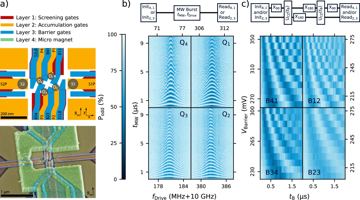
- foundry 8-qubit array Diraq paper press ▣ Fig. 3 (P1-P2 exchange, CZ phase calibration); Fig. 2b (Rabi freqs); §II.2 ✅
- RacQ (Bell-1) Equal1 product page blog blog ▦ 🔎
- Groove Quantum 18-qubit germanium spin processor Groove Quantum press ▨ 🔎
- Hitachi x Intel 18A spin programme Hitachi + Intel K.K. + AIST (G-QuAT) press press ▨ 🔎
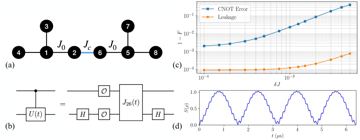
- HRL exchange-only silicon spin processor (18 EO qubits from 54 quantum dots) HRL Laboratories (IBM since 26 Aug 2026) paper press ▣ Fig. 2c; Fig. 3a ✅
- Tunnel Falls Intel paper press press ▨ 🔎
- QM-One Quantum Motion ▨ 🔎
- Alloy Pioneer (Quobly) Quobly press ▨ 🔎
- 11-qubit donor processor Silicon Quantum Computing paper press ▣ Fig. 2 (two-qubit operation: nuclear CZ and electron CROT); Methods: Randomized benchmarking ✅
Pictures
Every picture carries the story of what it shows and its credit line.
Exchange gate (spins; incl. shuttled-spin CZ)
Voltage-pulsed Heisenberg exchange between neighbouring or shuttled spins in gate-defined dots or donors — the only entangling mechanism that needs nothing but CMOS gate electrodes.
Verdict. Best exchange CNOT is 9×10⁻⁴ (HRL, 18 qubits) and foundry pairs sit at 99.0–99.6%, but ~80% of two-qubit error is calibration rather than physics, and no device past eight qubits publishes all-pairs fidelity.
Λ = error-suppression factor per code-distance step; QBI = DARPA Quantum Benchmarking Initiative (Stage A concept → B R&D plan → C government V&V); G1–G7 = the report's goal classes (see Actors & economics).
Identity & lineage
A voltage pulse lowers the tunnel barrier between two neighbouring quantum-dot or donor spins, turning on Heisenberg exchange J for a set time to realise a SWAP-family entangler; nothing is radiated, so no antenna, laser or resonator is needed. Loss and DiVincenzo proposed spin qubits on it in 1998; DiVincenzo, Bacon, Kempe, Burkard and Whaley showed in 2000 that exchange alone is universal at ~3× more qubits and ~10× more two-qubit operations — the encoding HRL builds on S[416]. The shuttled variant moves one electron through a conveyor potential into exchange range with a distant partner.
Attributes: fully fabricated carrier; deterministic entangling at ≈10⁻⁷ s (~100 ns), static nearest-neighbour coupling by default.
Baseband voltage control, room temperature but moving cryogenic; error coherent, Pauli, leakage; manufacturing is CMOS.
Physics & limits
J rises exponentially as the barrier is lowered and tunes electrically from near zero to tens of MHz; gate time goes as 1/J, which is why measured gates land at 58–500 ns for 10–90 MHz exchange. The exponential is the liability: the lever that makes J fast makes δJ/J large under gate-voltage and charge-trap noise, so there is a working point rather than a maximum — push J up and charge noise dephases the gate, pull it down and the longer pulse does. Hence HRL's finding that roughly 80% of two-qubit error is extrinsic control and calibration, not decoherence D[190]. Beneath that sit the residual ²⁹Si bath, 1/f charge noise at the oxide interface and small valley splitting, which makes leakage a first-class error. Moving the floor needs ²⁸Si enrichment, better interfaces, and a controller that keeps 1/f noise off the barrier gates.
Engineering state of the art
Best exchange gate: HRL's exchange-only CNOT at 9×10⁻⁴ best reproducible, 3×10⁻³ mean across 18 qubits formed from 54 dots, single-qubit mean 2×10⁻⁴, sequenced by a 4 K controller in commercial 130 nm RF CMOS D[190]. At foundry scale Diraq and imec report 99.04–99.56% two-qubit and 99.9% SPAM on 300 mm SiMOS D[189]. The shuttled variant adds a weight-four parity check at 97.7% per 1.2 µm round trip, motion and idling supplying about a quarter of its error D[349]. SQC's 11-qubit donor device is different in kind: nuclear spins hyperfine-coupled to a shared electron, registers linked by exchange D[192]. Nothing beyond eight qubits publishes all-pairs fidelity.
table
| Year | Figure | Who | Tag+key |
|---|---|---|---|
| 2025-09 | Two-qubit 99.04–99.56%, 300 mm foundry | Diraq with imec | D[189] |
| 2025-12 | 11 donor qubits, registers linked by exchange | Silicon Quantum Computing | D[192] |
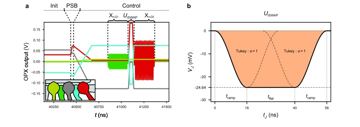
| 2026-05 | Shuttled-spin CZ 98.86% in 58 ns | QuTech | D[193] |
| 2026-07 | Exchange-only CNOT 9×10⁻⁴ best, 18 qubits | HRL Laboratories | D[190] |
Manufacturing, materials & supply chain
It needs only gate electrodes and voltage pulses, so it rides existing lines: Intel 300 mm EUV (>24,000 devices per wafer D[199]; 96% tune-up yield on 232 devices of one wafer D[766]), imec 300 mm, GlobalFoundries 22FDX, STMicroelectronics FD-SOI. Two concentrations matter — GlobalFoundries has folded the modality into one business unit behind a USD 375 M CHIPS letter of intent C[353], and Quantum Machines' control stack sits under Diraq, HRL, imec, Equal1, Sandia and the UK NQCC C[449]. Export exposure is direct: the 2024-09-06 BIS rule created ECCN 3A901.a for CMOS circuits designed to run at or below 4.5 K — a design-intent test, so a cryo-CMOS controller design file of the HRL type is itself controlled G[301].
Control, readout & I/O burden
A double dot needs roughly 4–6 baseband channels, so wiring grows faster than qubit count under room-temperature control; HRL's answer is 296 lines and 366 DACs inside the fridge at ≤3.5 W, with no real-time room-temperature loop D[190]. Readout, not the gate, sets the cycle: 1–100 µs against a 58–500 ns gate. At 10³ qubits room-temperature fan-out is impractical without cryogenic integration; at 10⁴–10⁶ the crossbar schemes that cut wire count collide with the need to calibrate every exchange pair separately — this mechanism's unresolved architectural conflict.
Role in the stack
It entangles two families: silicon and germanium quantum-dot spins (Intel, Diraq, Quantum Motion, HRL under IBM, Quobly, Equal1) and donor spins (SQC). It requires a gate-defined dot or donor plus baseband control, and provides the entangling layer both families build codes on — at HRL a distance-5 repetition code with Λ(5/3) = 4.7 over 200 rounds, which detects bit flips only and is therefore not a below-threshold result for a full code, plus a post-selected [[4,2,2]] at 0.95 logical fidelity D[190]. It conflicts with crossbar addressing, calibration being per pair. Derived round 8.5 µs on dot spins and 7.7 µs on donors, readout-limited, against the ~100–300 µs typically run: the gate is not the bottleneck. Neighbouring empty slot: an all-pairs, same-chip result past eight qubits.
Evidence — how the numbers were measured
HRL's headline figures and the 80% calibration split are vendor-reported and unreplicated D[190]. Diraq and imec's 99.04–99.56% is a population statistic over foundry devices, not an all-pairs same-chip result; imec's eight-qubit device validates exchange on one of four pairs D[197]. Nature's July 2026 spin-qubit feature was corrected on 2026-08-04, revising single-qubit error rates attributed to HRL and QuTech P[450]. No below-threshold logical memory exists on any spin platform as of 2026-09-04.
SQC's fidelities in [192] read 99.5–99.99%, with Bell states beyond 99%, in the arXiv abstract, and 99.10–99.99%, with Bell states up to 99.5%, in the Nature version; the main report's single 99.90% donor nuclear CZ does not appear in the abstract. Diraq's total raised (">USD 100 M") comes from trade press, not a company release. Not published: the financial terms of IBM's acquisition of HRL, and a dated patent-family count for exchange gates.
Actors & economics
Who.
| Organisation | Role | Country | What exactly they do with this technology | Evidence |
|---|---|---|---|---|
| Diraq | developer | Australia | 300 mm foundry two-qubit gates, 99.04–99.56% | D[189] |
| HRL Laboratories (IBM) | developer | US | 18 exchange-only qubits, sequenced at 4 K | D[190] |
| QuTech | research | Netherlands | Shuttled-spin CZ, mobile-ancilla parity checks | D[193] |
| Silicon Quantum Computing | developer | Australia | Donor registers linked by electron exchange | D[192] |
| Quantum Motion | developer | UK | Full-stack 22FDX system at the UK NQCC | C[355] |
| Quantum Machines | supplier | Israel | Control stack under most published spin results | C[449] |
Money.
- 2025-11-06 · DARPA · QBI Stage B · ≤USD 15 M each · Diraq, Quantum Motion, SQC of eleven · awarded G[65]
- 2026-05-07 · Quantum Motion · Series C · USD 160 M · DCVC, Kembara · closed C[355]
- 2026-05-21 · Diraq · CHIPS letter of intent · up to USD 38 M · US Commerce · LOI, not an award G[300]
- 2026-08-26 · IBM · M&A, HRL Laboratories · terms undisclosed · closed C[204]
Market & supply chain. No lasers, no vacuum: the equipment is a CMOS line plus baseband electronics, so the supply chain is four foundry lines and one control vendor — a cost argument and a concentration risk at once. Diraq's "<USD 1 per qubit by 2031" is a target, not a cost R[211]. It sells G1 and G2 devices; IBM's purchase bets it carries to G3 and G4.
IP & standards. The foundational results — Loss–DiVincenzo 1998 and exchange-only universality in 2000 S[416] — are published, not proprietary, so defensible IP sits in device geometry, cryogenic control silicon and calibration software. No dated patent-family count specific to this gate was found as of 2026-09-04.
Roadmaps & track record. Diraq (promised 2026-08-27 · 150 k physical, 1 k logical by 2029 · six weeks earlier the same company said "thousands by 2029") R[211] — inconsistent. Intel (promised 2026-01 · Tunnel Falls scaling to "hundreds of dots" · no dated follow-up) C[207] — unscorable. IBM (promised 2026-07-23 · HRL close by end Q3 2026 · closed 2026-08-26) C[10], [204] — met.
Strategic reading. If exchange gates reach fault-tolerant fidelity, the winners are the foundries and whoever owns the cryogenic controller — the qubit becomes a process option, not a product — and the losers are platforms whose cost base is optics and vacuum. IBM's acquisition turns HRL into a hyperscaler's spin programme and forces Diraq, Quantum Motion and Quobly to compete on balance sheet. If calibration burden persists, spins stay a G1/G2 curiosity.
Outlook & open questions
Falsifiable in 12–24 months: confirm/demote that a foundry device publishes all-pairs fidelity past eight qubits, and that IBM places a dated spin milestone on a public roadmap. Best case by 2029: a cryogenically sequenced foundry chip shows below-threshold logical memory with a full code. Worst case: uniformity stalls past ten qubits and roadmaps stay two orders ahead of hardware. Open: can calibration error fall without importing the controller's own error budget; does shuttled CZ displace static exchange; what IBM does with HRL's silicon.
References
- [10] IBM, “IBM to Acquire HRL Laboratories to Power the Future of Quantum,” Jul. 23, 2026. [Online]. Available: https://newsroom.ibm.com/
2026-07-23-ibm-to-acquire-hrl-laboratories-to-power-the-future-of-quantum C - [65] DARPA, “Stage B selection,” Nov. 6, 2025. [Online]. Available: https://www.darpa.mil/
research/ Gprograms/ quantum-benchmarking-initiative/ stage-b-selection - [189] P. Steinacker et al., “Industry-compatible silicon spin-qubit unit cells exceeding 99% fidelity,” Nature, vol. 646, no. 8083, pp. 81–87, Sep. 2025, doi: 10.1038/s41586-025-09531-9. D
- [190] Members of the HRL Quantum Team and Collaborators, “A digitally controlled silicon quantum processing unit,” arXiv:2604.16216, Apr. 2026. D
- [192] H. Edlbauer et al., “An 11-qubit atom processor in silicon,” Nature, vol. 648, no. 8094, pp. 569–575, Dec. 2025, doi: 10.1038/s41586-025-09827-w. arXiv:2506.03567. D
- [193] Y. Matsumoto et al., “Two-qubit logic and teleportation with mobile spin qubits in silicon,” Nature, vol. 653, no. 8114, pp. 391–397, May 2026, doi: 10.1038/s41586-026-10423-9. D
- [197] A. Nickl et al., “Eight-qubit operation of a 300 mm SiMOS foundry-fabricated device,” Nat. Commun., vol. 17, no. 1, Art. no. 5878, Jul. 2026, doi: 10.1038/s41467-026-74597-6. D
- [199] H. C. George et al., “12-spin-qubit arrays fabricated on a 300 mm semiconductor manufacturing line,” Nano Lett., vol. 25, no. 2, pp. 793–799, Dec. 2024, doi: 10.1021/acs.nanolett.4c05205. arXiv:2410.16583. D
- [204] IBM, “IBM Completes Acquisition of HRL Laboratories to Accelerate the Future of Quantum,” Aug. 26, 2026. [Online]. Available: https://newsroom.ibm.com/
2026-08-26-ibm-completes-acquisition-of-hrl-laboratories-to-accelerate-the-future-of-quantum C - [207] L. Hesla, “Argonne launches silicon quantum processor collaboration with Intel,” Argonne National Laboratory, Jan. 6, 2026. [Online]. Available: https://www.anl.gov/
article/ Cargonne-launches-silicon-quantum-processor-collaboration-with-intel - [211] F. Elliott, “Diraq charts course to utility-scale quantum computing with millions of spin qubits on a single silicon chip,” Diraq, Aug. 27, 2026. [Online]. Available: https://www.diraq.com/
newsdesk/ Rdiraq-sets-roadmap-for-utility-scale-quantum-computing-with-millions-of-qubits-on-a-single-silicon-chip - [300] National Institute of Standards and Technology, “Department of Commerce Announces Letters of Intent With 9 Companies for $2 Billion to Accelerate U.S. Leadership in Quantum Computing,” NIST News, May 21, 2026. [Online]. Available: https://www.nist.gov/
news-events/ Gnews/ 2026/ 05/ department-commerce-announces-letters-intent-9-companies-2-billion - [301] US Department of Commerce, Bureau of Industry and Security, “Commerce Control List Additions and Revisions; Implementation of Controls on Advanced Technologies Consistent With Controls Implemented by International Partners,” Federal Register, vol. 89, p. 72926, Sep. 6, 2024. [Online]. Available: https://www.federalregister.gov/
documents/ G2024/ 09/ 06/ 2024-19633/ commerce-control-list-additions-and-revisions-implementation-of-controls-on-advanced-technologies - [349] B. Undseth et al., “Weight-four parity checks in a spin-shuttling architecture,” Nature, vol. 655, no. 8125, pp. 1160–1166, Jul. 2026, doi: 10.1038/s41586-026-10766-3. D
- [353] GlobalFoundries, “GlobalFoundries launches Quantum Technology Solutions to scale U.S. quantum manufacturing,” May 21, 2026. [Online]. Available: https://gf.com/
gf-press-release/ Also https://investors.gf.com/globalfoundries-launches-quantum-technology-solutions-to-scale-us-quantum-manufacturing/ news-releases/ . Cnews-release-details/ globalfoundries-launches-quantum-technology-solutions-scale-us - [355] Quantum Motion, “Quantum Motion Raises $160 Million Series C to Deliver Quantum Computing's "Transistor Moment,” May 7, 2026. [Online]. Available: https://quantummotion.com/
quantum-motion-raises-160-million-series-c-to-deliver-quantum-computings-transistor-moment/ C - [416] D. P. DiVincenzo, D. Bacon, J. Kempe, G. Burkard, and K. B. Whaley, “Universal quantum computation with the exchange interaction,” Nature, vol. 408, no. 6810, pp. 339–342, 2000, doi: 10.1038/35042541. arXiv:quant-ph/0005116. S
- [449] Quantum Machines, “Semiconductor Spin Qubits,” Aug. 11, 2026. [Online]. Available: https://www.quantum-machines.co/
qubit-types/ Csemiconductor-spin-qubits/ - [450] D. Garisto, “Underdog 'spin qubits' leap forward in race to a useful quantum computer,” Nature, vol. 656, no. 8127, pp. 280–281, Aug. 2026, doi: 10.1038/d41586-026-02357-z. P
- [766] S. F. Neyens et al., “Probing single electrons across 300-mm spin qubit wafers,” Nature, vol. 629, no. 8010, pp. 80–85, May 2024, doi: 10.1038/s41586-024-07275-6. D