Baseband electrical control (spins, Majorana) ct_base
DC-to-few-GHz voltage pulses on lithographic gate electrodes drive exchange, tunnelling and parity in spin and Majorana devices, with no resonant drive.
Baseband electrical control (spins, Majorana)
Voltage pulses on gates; digital, dense; the calibration burden shows up as coherent error.
Brief →Key references
Design space — attributes
- (a) carrier affinity
- fabricated
- (b) time · entangling
- —
- (c) readout
- —
- (d) mobility
- —
- (e) control
- low-frequency electrical @ room temperature
- (f) error structure
- coherent / calibration
- (g) manufacturing
- CMOS foundry 300 mm
Evaluation space — dated attributes
QuTech's baseband hopping-gate figure of 99.50(6)% is a lower bound, not a point estimate. HRL's Λ = 4.7 is a bit-flip-only repetition code, and its [[4,2,2]] fidelity of 0.95 is post-selected.
Standard records
Actors & goals — annotations
Edges
Used by 9 machines (7 primary · 2 alternate)
- semiconductor spins 5
- foundry 8-qubit array Diraq paper press ▤ §IV.2 Methods: Measurement ✅
- Groove Quantum 18-qubit germanium spin processor Groove Quantum press ▨ 🔎
- Alloy Pioneer (Quobly) Quobly press ▨ 🔎
- 11-qubit donor processor Silicon Quantum Computing paper press ▤ Methods: Experimental set-up 🔎
- HRL exchange-only silicon spin processor (18 EO qubits from 54 quantum dots) HRL Laboratories (IBM since 26 Aug 2026) paper press ▣ Introduction; Fig. 2c ✅ (alternate)
- defect spins 2
- Entanglement First modules Photonic Inc. paper product page product page ▣ Fig. 2A (on-chip MW/RF antenna, grating coupler); Fig. 2B (MW lines, optical modulators) ✅
- Quoll / QB-QDK 2.0 Quantum Brilliance press ▨ 🔎 (alternate)
- topological 2
- Majorana 1 Microsoft paper press ▤ §Device design and setup; Fig. 3 caption (VWP1 gate voltage and B∥ operating point) ✅
- Majorana 2 Microsoft blog blog press ◌ 🔎
Pictures
Every picture carries the story of what it shows and its credit line.
Baseband electrical control (spins, Majorana)
DC-to-few-GHz voltage pulses on lithographic gate electrodes drive exchange, tunnelling and parity in spin and Majorana devices, with no resonant drive.
Verdict. The physics is settled and the wiring is not. HRL attributes roughly 80% of its CNOT error to control and calibration rather than the qubit, so cold co-location — not faster pulses — is the lever.
Λ = error-suppression factor per code-distance step; QBI = DARPA Quantum Benchmarking Initiative (Stage A concept → B R&D plan → C government V&V); G1–G7 = the report's goal classes (see Actors & economics).
Identity & lineage
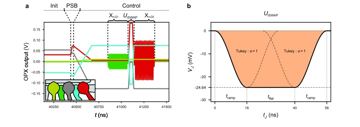
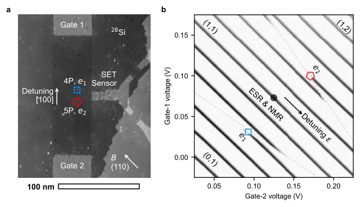
Baseband control manipulates a qubit with DC-to-few-GHz voltage pulses on lithographic gates rather than a resonant drive: a pulse shifts the electrostatic potential, and with it the exchange coupling between dots or the tunnel coupling of a Majorana junction. The licence is old and precise: DiVincenzo, Bacon, Kempe, Burkard and Whaley showed in 2000 that the Heisenberg interaction alone suffices for universal computation, at about 3× more qubits and ~10× more two-qubit operations S[416]. Every exchange-only architecture since pays that bill to delete microwave hardware.
- Control and placement: low-frequency voltage pulses generated warm, routed to millikelvin gates.
- Error structure: coherent and correlated, not stochastic — miscalibration is what the code sees.
Physics & limits
Exchange coupling J depends exponentially on detuning and barrier height, so a rotation angle is the time integral of J and a small voltage error is a proportionally large angle error. There is no drive-frequency selectivity: 1/f charge noise modulates the same potential that carries the signal, and crosstalk from a neighbouring gate is indistinguishable from an intended pulse. Hence the field's most useful number — HRL measures ~80% of its CNOT error as extrinsic, in control and calibration rather than the qubit Dfact. The floor is waveform accuracy and recalibration cadence, not T2: foundry devices reach 1.31(4) ms echo coherence Dfact against 58 ns exchange gates Dfact. Moving it means a shorter electrical path — a controller on the cold stage, ideally on-die — plus automated recalibration.
Engineering state of the art
table
| Year | Figure | Who | Tag+key |
|---|---|---|---|
| 2025-07 | Microwave-free hopping control, 2×2 array with a micromagnet gradient: hopping-gate fidelity lower bound 99.50(6)%, echo T2 up to ~49 µs | QuTech | Dfact |
| 2026-07-29 | 18 exchange-only qubits from 54 dots, sequenced by a 4 K controller: mean 1Q error 2×10⁻⁴, mean CNOT 3×10⁻³ (best 9×10⁻⁴) | HRL | Dfact |
| 2026-07-29 | Same device, distance-5 repetition code over 200 rounds: logical error 5.0×10⁻³, Λ₅/₃ = 4.7 — bit-flip only | HRL | Dfact |
Dominant term: extrinsic control and calibration, ~80% of the CNOT budget.
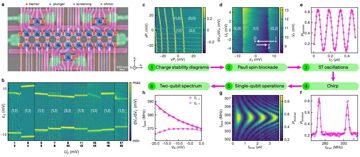
Baseband control can drop per-pair barrier pulsing: in a 6×6 germanium hole-dot array, one shared barrier gate held at a fixed voltage, with only the individual plunger gates pulsed, sufficed for electric-dipole spin resonance (EDSR) driving, shuttling and exchange tuning from about 20 kHz to about 80 MHz P[898].
Manufacturing, materials & supply chain
The node rides ordinary CMOS: Intel's 300 mm EUV line reports over 24,000 devices per wafer D[199], with 96% tune-up yield on 232 devices of one wafer D[766], and Quantum Motion characterises 1,024 dots in five minutes on GlobalFoundries 22FDX C[200]. That is the asset and the exposure: each developer sole-sources one foundry it does not own — Quobly to STMicroelectronics, Quantum Motion to GlobalFoundries, Diraq to imec — so a fab-side decision is a company-level failure mode. Room-temperature pulse generation is uncontrolled, but a controller "designed to operate at" ≤4.5 K falls under ECCN 3A901.a from the design file on fact: cold integration imports export control.
Control, readout & I/O burden
Baseband control costs about one line per gate and two to four gates per dot, so a naive 10³-qubit array wants 10³–10⁴ addressed lines from room temperature. HRL's counter-example is the number to hold: 296 lines and 366 DACs at ≤3.5 W driving 54 dots, with a 250 MHz on-chip sequencer and no room-temperature real-time electronics Dfact — ~20 DACs per qubit, cold multiplexing rather than wire elimination. At 10³ the harness is impractical without cold DACs; at 10⁴ per-qubit DAC count must fall an order of magnitude; at 10⁶ nothing exists. The binding constraint is recalibration cadence.
Role in the stack
It requires nothing upstream, provides the exchange gate directly, and reaches four architectures: quantum-dot spins (Intel, Diraq, Quantum Motion, HRL/IBM, QuTech, Quobly, Equal1), donor spins (Silicon Quantum Computing), colour-centre spin network nodes and Majorana devices, where gate voltages tune the dots that report parity. It competes with microwave and electric-dipole spin resonance, which buys frequency selectivity at the price of antennas and heating. Its clock contribution is negligible: exchange gates run at ~58 ns Dfact against 6.3 µs readout, so derived clock = sum of the syndrome round: gate layers + transport + readout + reset ≈ 8.5 µs here, set by readout with reset next.
Evidence — how the numbers were measured
Fidelities come from randomised benchmarking and gate-set tomography, and the headline QuTech number is a lower bound, not a point estimate Dfact. The 80% extrinsic share deserves most scrutiny: it is inferred from measured error against a modelled noise budget, not independently partitioned, and unreplicated. No spin device above 12 qubits has published all-pairs two-qubit fidelities, so simultaneous-operation crosstalk — this node's own failure mode — is uncharacterised at scale. HRL's Λ₅/₃ = 4.7 is a repetition code, bit-flip only, not below-threshold evidence, and its [[4,2,2]] fidelity of 0.95 is post-selected Dfact. On the Majorana side the control works but the qubit does not exist: parity readout is real, X-loop lifetimes ran ~1,000× shorter than Z-loop lifetimes, no two-qubit operation D[13].
Not published: a dated patent-family count for baseband gate-voltage control.
Actors & economics
Who.
| Organisation | Role | Country | What exactly they do | Evidence |
|---|---|---|---|---|
| HRL Laboratories | Developer | USA | Only self-sequenced baseband QEC demonstration; acquired by IBM | Dfact |
| Diraq | Developer | Australia | SiMOS exchange qubits on imec's 300 mm line | Dfact |
| Quantum Motion | Developer | UK | Full-stack 300 mm CMOS system at the UK NQCC | Cfact |
| QuTech | Research | Netherlands | Microwave-free hopping control, 2D array | Dfact |
| Microsoft | Developer | USA | Gate-voltage-tuned parity measurement in tetrons | D[13] |
Money. 2025-11-06 · Diraq, Quantum Motion, Silicon Quantum Computing · DARPA QBI Stage B · up to $15 M USD each · programme fact. 2026-05-07 · Quantum Motion · Series C · $160 M USD · DCVC, Kembara · closed Cfact. 2026-05-21 · Diraq · CHIPS letter of intent · up to $38 M USD · US Commerce · non-binding fact. 2026-06-03 · Quobly · Series A · €115 M · Bpifrance, SEALSQ, STMicro · €134 M cumulative · closed Cfact. 2026-07-23 · IBM · acquires HRL · undisclosed · closed 2026-08-26 Cfactfact.
Market & supply chain. Nothing is sold as "baseband control"; what sells is foundry capacity, enriched ²⁸Si, and the warm waveform racks Quantum Machines dominates with over half of developers as customers Cfact. Cold integration threatens that rack business, and is why IBM bought HRL. Diraq's under-$1-per-qubit figure is a target, not a cost. This node pays for G3 and G4 on the spin architecture, G4 on the Majorana architecture if a qubit appears.
IP & standards. No patent family specific to baseband gate-voltage control was found in a named dated database as of 4 Sep 2026. The foundational exchange-only claim is a 2000 publication, long out of patent term S[416] — part of why this layer is crowded. IBM's HRL deal brings undisclosed controller IP in-house. No standards body governs gate-pulse interfaces today.
Roadmaps & track record. Diraq (2026-08-27 · 150 k physical, 1 k logical by 2029, > 2 M by 2031 · its 2026-07-09 release said "thousands by 2029") — low on messaging, real on devices fact. Quantum Motion (full-stack delivery · met, NQCC 2025-09-15) — the only met hardware date here. HRL/IBM (no public date · QPU delivered 2026-07-29) — strongest result here. Microsoft ("years not decades" → 2029 · no two-qubit operation) — no base.
Strategic reading. If baseband control scales, foundry-native platforms inherit decades of CMOS investment free while exotic-control platforms fund their own hardware forever — the argument IBM made by buying HRL. Losers are room-temperature control-rack vendors, displaced from inside the cryostat rather than out-competed on price. The live substitution question is warm versus cold placement, not baseband versus microwave drive. Bargaining power sits with the foundries: every developer above depends on a relationship it cannot replace within a product cycle.
Outlook & open questions
Confirm by 2027 if any developer publishes all-pairs two-qubit fidelities above 12 qubits, or an independent group reproduces the extrinsic/intrinsic split; demote if crosstalk caps arrays at ≤20 qubits through 2028. Best case 2029: cold self-sequenced control becomes default and two-qubit errors move from 3×10⁻³ toward 10⁻⁴. Worst case: calibration overhead outruns qubit count and the CMOS argument stalls at demonstration scale. Open questions: does the 80% figure survive independent measurement; can per-qubit DAC counts fall an order of magnitude; does recalibration keep pace with array size; does Majorana control ever get a qubit.
References
- [13] Microsoft Azure Quantum, “Interferometric single-shot parity measurement in InAs–Al hybrid devices,” Nature, vol. 638, no. 8051, pp. 651–655, Feb. 2025, doi: 10.1038/s41586-024-08445-2. D
- [199] H. C. George et al., “12-spin-qubit arrays fabricated on a 300 mm semiconductor manufacturing line,” Nano Lett., vol. 25, no. 2, pp. 793–799, Dec. 2024, doi: 10.1021/acs.nanolett.4c05205. arXiv:2410.16583. D
- [200] Quantum Motion, “Quantum Motion Delivers the Industry's First Full-Stack Silicon CMOS Quantum Computer,” Sep. 15, 2025. [Online]. Available: https://quantummotion.com/
quantum-motion-delivers-the-industrys-first-full-stack-silicon-cmos-quantum-computer/ C - [416] D. P. DiVincenzo, D. Bacon, J. Kempe, G. Burkard, and K. B. Whaley, “Universal quantum computation with the exchange interaction,” Nature, vol. 408, no. 6810, pp. 339–342, 2000, doi: 10.1038/35042541. arXiv:quant-ph/0005116. S
- [766] S. F. Neyens et al., “Probing single electrons across 300-mm spin qubit wafers,” Nature, vol. 629, no. 8010, pp. 80–85, May 2024, doi: 10.1038/s41586-024-07275-6. D
- [898] A. S. Ivlev et al., “Sparse qubit operation in a 6×6 quantum dot array,” arXiv:2610.07683, Oct. 2026. P