Microwave / optical spin gates (defect centres, 1Q spins) g_mwspin
Resonant microwave rotation of a defect electron spin, hyperfine-conditional rotation of its neighbouring nuclei, and optical pulses for initialisation and readout.
Microwave / optical spin gates (defect centres, 1Q spins)
ESR/EDSR-driven rotations and hyperfine-conditional gates; < 0.1% error on NV electron+nuclear registers.
Brief →Key references
Design space — attributes
- (a) carrier affinity
- intermediate / carrier-agnostic
- (b) time · entangling
- 1.0 µs · deterministic
- (c) readout
- —
- (d) mobility
- static nearest-neighbour wiring
- (e) control
- microwave @ room temperature
- (f) error structure
- stochastic Pauli, coherent / calibration
- (g) manufacturing
- diamond growth / implantation
Evaluation space — dated attributes
The Fujitsu/QuTech '< 0.1%' figure is cited from the press release [P], which names a Phys. Rev. Applied paper (2025-03-21) not yet located by us.
Standard records
Actors & goals — annotations
Edges
Used by 5 machines (5 primary · 0 alternate)
- defect spins 5
- Diamond-spin quantum computer prototype Fujitsu (with TU Delft and QuTech) press ▨ Overview of developed technologies: quantum circuit conversion for the diamond spin approach ✅
- Entanglement First modules Photonic Inc. paper product page product page ▣ Fig. 4B,D (MW/RF Rabi; π rotation = C_HNOT_e / C_eNOT_H); Fig. 8 (teleported CNOT) ✅
- Quoll / QB-QDK 2.0 Quantum Brilliance press ▨ ✅
- QC2026 Dual Core SaxonQ press ▦ 🔎
- SXQ4 SaxonQ product page ▦ technology paragraph ('Spin states are initialised and read out optically, then steered with microwave-frequency gates') ✅
Pictures
Every picture carries the story of what it shows and its credit line.
Microwave / optical spin gates (defect centres, 1Q spins)
Resonant microwave rotation of a defect electron spin, hyperfine-conditional rotation of its neighbouring nuclei, and optical pulses for initialisation and readout.
Verdict. Sub-0.1% single-node gate error, but the optical cycles that initialise and read the spin are also its dominant decoherence source, and no benchmark in use separates the two.
Λ = error-suppression factor per code-distance step; QBI = DARPA Quantum Benchmarking Initiative (Stage A concept → B R&D plan → C government V&V); G1–G7 = the report's goal classes (see Actors & economics).
Identity & lineage
Resonant microwave drive rotates a colour centre's electron spin between ground-state sublevels — 2.87 GHz at zero field for NV, a Zeeman-split pair for the group-IV centres. Hyperfine coupling to ¹³C or ¹⁴N neighbours makes them addressable by conditional rotations — a register from one defect. Optical pulses do the initialisation and readout microwaves cannot. Coherent single-defect Rabi driving dates to 2004; the benchmark is Fujitsu/QuTech gate-set tomography below 0.1% P[208].
Attributes: engineered placement of a natural defect, static, entangling near 1 µs (electron) and milliseconds (nuclear); microwave plus optical control; Pauli and coherent error.
Physics & limits
Two rates set the architecture: megahertz electron Rabi gives gates of tens to hundreds of nanoseconds, while hyperfine-conditional nuclear gates run at kilohertz — three orders slower, so the long-lived memory is the slow one. The floor is optical duty cycle, not microwave power: every initialisation or readout pulse drives the defect through an excited state that can ionise it and shifts the local charge environment, so the error of the next gate depends on how many photons the last one scattered. Isotopic ¹²C purity lengthens T2 but does nothing about that; only fewer optical cycles per operation move the floor, which is why Delft's ~10× collection gain is a gate result as much as a link result D[359].
Engineering state of the art
table
| year | figure | who | tag+key |
|---|---|---|---|
| 2025-03-28 | NV 1Q and 2Q gate error below 0.1% by gate-set tomography | Fujitsu with QuTech | P[208] |
| 2025-11-27 | resonant photon collection ~0.05% → ~0.5%, echo coherence above 100 µs kept | QuTech | D[359] |
| 2026-05-26 | unconditional teleported CNOT between cryostats, 63(4)% | QuTech | D[360] |
Dominant term: optically induced charge instability, not microwave control.
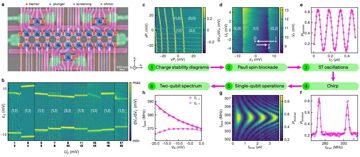
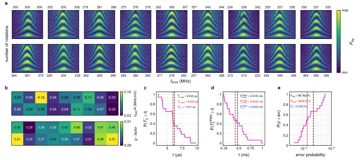
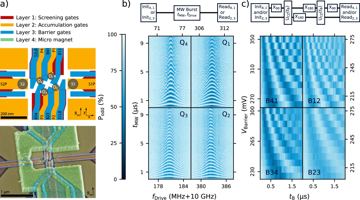
On germanium hole spins, a geometric form of the electric-dipole spin resonance (EDSR) pulse — a non-adiabatic, three-segment loop whose rotation is set by the loop's geometry rather than by the pulse's dynamics — kept X/2 and Y/2 above 99% at ±2.5 MHz microwave detuning and the idle gate at ±1.2 MHz, peaking at 99.98% (idle), 99.80% (X/2) and 99.97% (Y/2) by gate-set tomography P[888]. The price is four to six times the duration of the ordinary gate, and which loop works best depends on the dominant noise.
The below-0.1% NV gate-set-tomography figure rests on a joint Fujitsu/QuTech press release relayed by trade press [208], with no peer-reviewed paper giving error bars or an error budget; it is tagged P here and D in the main report and the graph record. Not published: nuclear-spin gate durations alongside the NV fidelities, so the kilohertz Rabi rate is a mechanism, not a measured device figure; dates for Quantum Brilliance's named deployment sites [823] and any funding after its January 2025 Series A; and a dated roadmap with qubit counts from any defect-gate actor.
Manufacturing, materials & supply chain
The gate inherits diamond's constraints: CVD growth from Element Six, implanted defects, per-device nanophotonics. Nothing in the drive chain multiplexes: each addressed defect needs its own resonant laser line, microwave feed and detector channel, so hardware scales linearly with sites — the opposite of a shared microwave plant. Control latency is set by the link, not the gate: the teleported CNOT needed feed-forward inside the memory lifetime D[360]. At 10³ sites the wall is laser count and optical fan-out, with no published plan. No export rule names colour centres.
Role in the stack
Requires the colour-centre carrier and provides the gate the defect-node architecture uses; it is also the alternate gate on the silicon / germanium quantum-dot spin and donor-spin architectures. The register lists 5 machines using it, among them SaxonQ's QC2026 Dual Core, Quantum Brilliance's Quoll / QB-QDK 2.0 and Fujitsu's Diamond-spin quantum computer prototype. Its clock contribution never binds: ~10⁻⁷–10⁻⁶ s electron gates against ~100 µs readout and links six to nine orders slower; no code runs on the defect architecture, so sum of the syndrome round: gate layers + transport + readout + reset has no value here and the link rate is the clock. Verification: the sub-0.1% figure is one collaboration, published through a press release, and gate-set tomography as applied does not separate microwave error from optically induced charge-state error — a composite that will not transfer to another readout duty cycle. The teleported CNOT is unconditional, unlike the post-selected T-centre result at Bell 0.60(8) P[363].
Actors & economics
Who.
| Organisation | Role | Country | What exactly they do | Evidence |
|---|---|---|---|---|
| QuTech | developer | Netherlands | Cavity NV control, remote gate | D[359], [360] |
| Fujitsu | user | Japan | Joint NV gate programme | P[208] |
| Quantum Brilliance | developer | Australia | Room-temperature units | P[823] |
| Photonic Inc. | developer | Canada | T-centre spin control | P[363] |
| Element Six | supplier | UK | Merchant CVD diamond | P[364] |
Money. 2026-05-12 · Photonic Inc. · equity · USD 200 M at USD 2 B · Microsoft returning · closed Cfact. 2026-07 · QuantumDiamonds · EUR 91 M, EUR 76 M of it EU Chips Act · closed P[364]. 2025-01 · Quantum Brilliance · Series A · USD 20 M · ~USD 58 M cumulative · closed P[364]. No QBI stage names this gate mechanism.
Market & supply chain. One merchant diamond supplier and a thin detector base are the concentration risks; microwave hardware is shared with every modality. Pays into G6 and sensing; no G3 or G4 money reaches this gate.
IP & standards. No dated patent family from a named database as of 4 Sep 2026; no standards body covers defect-spin control.
Roadmaps & track record. Quantum Brilliance (units at three laboratories · delivered, sites undated) P[823]. SaxonQ (QC2026 Dual Core · shipped) P[364]. Photonic Inc. (fault tolerance "within five years" of 2023-11 · unmet). Credibility is inverted: the smallest actors ship, the best-funded promises.
Strategic reading. This gate wins only inside a networking or edge thesis, not the fault-tolerance budget. Suppliers hold leverage: no vendor sells an integrated defect-control stack.
Outlook & open questions
Confirm/demote (12–24 months): a peer-reviewed sub-0.1% gate-set result with an explicit charge-state error term confirms; two more years of press-release fidelities demotes it. Best case 2029: a small error-detected multi-node register. Worst case: excellent gates that never enter a code. Open: (1) can optical addressing be multiplexed; (2) does anyone report nuclear-gate times with fidelities; (3) does a defect platform reach a logical qubit.
References
- [208] M. Swayne, “Fujitsu And QuTech Realize High-Precision Quantum Gates,” The Quantum Insider, Mar. 28, 2025. [Online]. Available: https://thequantuminsider.com/
2025/ P03/ 28/ fujitsu-and-qutech-realize-high-precision-quantum-gates/ - [359] J. Fischer et al., “Spin-photon correlations from a Purcell-enhanced diamond nitrogen-vacancy center coupled to an open microcavity,” Nat. Commun., vol. 16, no. 1, Art. no. 11680, Nov. 2025, doi: 10.1038/s41467-025-66722-8. D
- [360] M. Iuliano et al., “Unconditionally teleported quantum gates between remote solid-state qubit registers,” Nat. Commun., vol. 17, no. 1, Art. no. 4694, May 2026, doi: 10.1038/s41467-026-72818-6. D
- [363] F. Afzal et al., “Distributed Quantum Computing in Silicon,” arXiv:2406.01704, Jun. 2024. P
- [364] M. U. Rehman, “Top Diamond NV-Centre Quantum Computing Companies in 2026,” The Quantum Insider, Jul. 10, 2026. [Online]. Available: https://thequantuminsider.com/
2026/ P07/ 10/ 8-quantum-computing-companies-working-with-nv-centre-in-diamond-technology/ - [823] Oak Ridge National Laboratory, “Quantum Brilliance, ORNL pioneer quantum-classical hybrid computing,” ORNL News, Sep. 2, 2025. [Online]. Available: https://www.ornl.gov/
news/ Also https://www.iaf.fraunhofer.de/quantum-brilliance-ornl-pioneer-quantum-classical-hybrid-computing en/ . Also https://quantumbrilliance.com/media-library/ press-releases/ first-room-temperature-quantum-accelerator-in-europe.html news/ . Psupercomputer-with-quantum-accelerator-pawsey-commissions-first-room-temperature-on-premises-quantum-computer-in-supercomputing-center/ - [888] Y.-C. Zhou et al., “High-fidelity geometric quantum gates exceeding 99.9% in germanium quantum dots,” arXiv:2609.33251, Sep. 2026. P