Colour-centre / defect spin (NV, SiV, SnV, T centre) defect
An optically addressable point-defect spin in diamond or silicon whose electron couples coherently to a photon, making it a network node with a small nuclear register rather than a processor qubit.
Colour-centre / defect spin (NV, SiV, SnV, T centre)
Optically addressable spin in a solid host; network node with spin–photon interface rather than a processor qubit.
Brief →Key references
Design space — attributes
- (a) carrier affinity
- intermediate / carrier-agnostic
- (b) time · entangling
- 1.0 µs · deterministic
- (c) readout
- fluorescence (PMT/SNSPD) · 100 µs · non-destructive · mid-circuit
- (d) mobility
- flying qubits (photons)
- (e) control
- optical @ room temperature
- (f) error structure
- stochastic Pauli, loss (erasure)
- (g) manufacturing
- diamond growth / implantation
Evaluation space — dated attributes
QuTech/Fujitsu, Harvard, Photonic Inc (T centres), Quantum Brilliance. Element Six's DNV-B1 is an NV-*ensemble* sensing grade, not a single-defect node substrate.
Standard records
Actors & goals — annotations
Edges
Used by 5 machines (5 primary · 0 alternate)
- defect spins 5
- Diamond-spin quantum computer prototype Fujitsu (with TU Delft and QuTech) press ▨ opening paragraph (SnV centers in photonic integrated circuits) ✅
- Entanglement First modules Photonic Inc. paper product page product page ▣ Fig. 2A (T centre in Si lattice inside photonic-chip cavity); Fig. 3A (level structure) ✅
- Quoll / QB-QDK 2.0 Quantum Brilliance press ▨ 🔎
- QC2026 Dual Core SaxonQ press ▨ SaxonQ paragraph ('two parallel NV diamond processors at 5 qubits per core') ✅
- SXQ4 SaxonQ product page ▦ SXQ4 card ('Scale 4 qubits', 'Cores 1 core'); technology paragraph ✅
Pictures
Every picture carries the story of what it shows and its credit line.

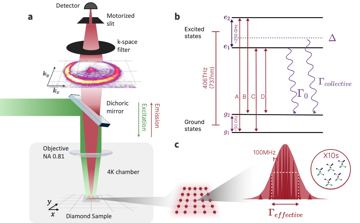

Colour-centre / defect spin (NV, SiV, SnV, T centre)
An optically addressable point-defect spin in diamond or silicon whose electron couples coherently to a photon, making it a network node with a small nuclear register rather than a processor qubit.
Verdict. The best spin–photon interface in solid state, but link rates of millihertz to hertz keep every actor in networking and sensing; no defect platform has a logical qubit or a dated processor roadmap.
Λ = error-suppression factor per code-distance step; QBI = DARPA Quantum Benchmarking Initiative (Stage A concept → B R&D plan → C government V&V); G1–G7 = the report's goal classes (see Actors & economics).
Identity & lineage
A point defect — nitrogen-vacancy, the group-IV silicon- and tin-vacancies in diamond, or silicon's T centre — read by fluorescence and entangled with an emitted photon, nearby nuclei as a small memory. Coherent single-spin control dates to 2004. The split that matters is symmetry: NV lacks inversion symmetry and so diffuses spectrally; SiV and SnV are inversion-symmetric.
Attributes: natural defect, engineered placement, static host with a flying photon, ~1 µs gates; fluorescence readout ~100 µs, non-destructive and mid-circuit; optical plus microwave control; Pauli and loss error.
Physics & limits
Everything rests on the chance an excited defect puts a usable photon into fibre. NV emits a few per cent into its zero-phonon line and diffuses spectrally under charge switching, so a cavity is mandatory — Delft's fibre microcavity took resonant collection from ~0.05% to ~0.5% at echo coherence above 100 µs D[359]. Group-IV centres fix the linewidth by symmetry but pay in temperature: SiV below 100 mK, SnV nearer 1–4 K. Heralded rate goes as efficiency squared — 10× optical gain is 100× in rate; link rate, not gate error, is the figure of merit. Loss is heralded, entering the code as erasure — the one structural edge over dot and donor spins.
Engineering state of the art
table
Local gates are not the problem: Fujitsu and QuTech report NV errors below 0.1% by gate-set tomography P[208]. Collection dominates; no defect platform has a logical qubit.
The Fujitsu/QuTech "below 0.1%" NV gate error comes only from a joint press release relayed by trade press [208]. Element Six's lead as the diamond source of most NV-centre companies rests on a secondary survey [364]. Photonic Inc.'s T-centre tCNOT is post-selected [363]. Not published: a peer-reviewed paper with gate-set-tomography error bars for the Fujitsu/QuTech figure; Element Six's capacity, revenue or quantum-segment figures; a journal paper on Photonic Inc.'s T-centre work, as of 2026-09-04, and a gate fidelity for its tCNOT; and the dates of Quantum Brilliance's three deployments at Oak Ridge, Fraunhofer IAF and Pawsey [364].
Manufacturing, materials & supply chain
Hosts: CVD diamond with implanted defects, or defect-engineered silicon for T centres. Element Six is the main merchant supplier, selling DNV-B1 (2020-06-15) by catalogue — but that grade targets NV ensembles C[361]; single-defect nodes need electronic-grade plates. Two smaller sources exist: Diatope, an Ulm University spin-out (2021) selling engineered NV diamond, and Quantum Brilliance's quantum-diamond foundry in Melbourne (2025) P[364]. Device yield is the missing number: QuTech's SnV study P[362] characterised 327 nanocavities at room temperature, found coupled centres in 7 of the 9 it cooled and measured two above cooperativity one, with no chip-wide fraction Dfact. Optical I/O does not multiplex — each node needs its own resonant laser, microwave line, detector and fast feed-forward D[360], so burden scales per node and 10³ nodes is nobody's target. Export control does name diamond: ECCN 3C005.a has covered diamond semiconductor substrates and their ingots above 10⁴ Ω·cm since 2022-08-15, and 3C006 such substrates carrying an epitaxial layer fact; whether a quantum-grade plate counts as a semiconductor substrate is the open question.
Role in the stack
Architecture: colour-centre spins — network nodes (NV/SiV/T), as its primary carrier. The register lists 5 machines using it, among them SaxonQ's QC2026 Dual Core, Quantum Brilliance's Quoll / QB-QDK 2.0 and Fujitsu's Diamond-spin quantum computer prototype. Requires diamond growth or implantation; provides spin gating, fluorescence readout and the spin–photon link consumed upstream. The derived clock is transport-dominated by six to nine orders: ~1 µs gates against heralded links at 7.5 mHz (T centre, 40 m) to ~1 Hz (SiV, 20 m) P[363]D[209]. Two teleported-CNOT (tCNOT) claims coexist, one on T centres and one on NV, and both are right. Photonic Inc.'s T-centre tCNOT between cryostats was post-selected, no feed-forward and no gate fidelity, at Bell 0.60(8) P[363]; QuTech's NV gate is unconditional at 63(4)% D[360]. Only the second is a gate.
Actors & economics
Who.
| Organisation | Role | Country | What exactly they do | Evidence |
|---|---|---|---|---|
| QuTech | developer | Netherlands | NV cavities, SnV nanocavities, teleported CNOT | D[359], [360], fact |
| Photonic Inc. | developer | Canada | Silicon T-centre modules | P[363] |
| Harvard | research | USA | SiV nodes over urban fibre | D[209] |
| Element Six | supplier | UK | Merchant CVD diamond | C[361] |
| Quantum Brilliance | developer | Australia | Room-temperature diamond units | P[364] |
Money. 2025-11-06 · Photonic Inc. · QBI Stage B · up to USD 15 M · DARPA · awarded fact. 2026-05-12 · Photonic Inc. · equity · USD 200 M at USD 2 B · Microsoft returning · USD 350 M cumulative · closed P[186]. 2026-07 · QuantumDiamonds · EUR 91 M, EUR 76 M of it EU Chips Act · closed P[364].
Market & supply chain. Two concentration points: substrate, where Element Six dominates and its two alternatives date only from 2021 and 2025, and a thin detector base for readout. Sensing revenue funds the field; nothing here is bought against G3 or G4.
IP & standards. No dated patent family from a named database as of 4 Sep 2026; Element Six's DNV grades are a de facto benchmark.
Roadmaps & track record. Photonic Inc. (2023-11 · fault-tolerant distributed computing "within five years" · unmet; its published rate is seven orders below its own ~200 kHz target) P[364]. Quantum Brilliance ships rather than promises; QuTech is on schedule.
Strategic reading. Defect spins win only if distributed modules bind before monolithic fault tolerance does — then every platform buys this interface instead of building it. Element Six holds supplier power because it never competes on qubit design.
Outlook & open questions
Confirm/demote (12–24 months): an unconditional inter-node gate above 90%, or a link above 1 kHz, confirms the thesis; two more years at hertz rates demotes it to sensing. Best case 2029: a multi-node repeater segment with error detection. Worst case: laboratory links only. Open: (1) does anyone publish a chip-wide SnV device yield; (2) do Diatope or Quantum Brilliance's foundry grow into a second source at Element Six's scale; (3) can T-centre rates close on SiV.
References
- [186] M. Abdel-Kareem, “Photonic Inc. Reaches $2B Valuation with $200M Final Close,” Quantum Computing Report, May 12, 2026. [Online]. Available: https://quantumcomputingreport.com/
photonic-inc-reaches-2b-valuation-with-200m-final-close/ P - [208] M. Swayne, “Fujitsu And QuTech Realize High-Precision Quantum Gates,” The Quantum Insider, Mar. 28, 2025. [Online]. Available: https://thequantuminsider.com/
2025/ P03/ 28/ fujitsu-and-qutech-realize-high-precision-quantum-gates/ - [209] C. M. Knaut et al., “Entanglement of nanophotonic quantum memory nodes in a telecom network,” Nature, vol. 629, no. 8012, pp. 573–578, May 2024, doi: 10.1038/s41586-024-07252-z. D
- [359] J. Fischer et al., “Spin-photon correlations from a Purcell-enhanced diamond nitrogen-vacancy center coupled to an open microcavity,” Nat. Commun., vol. 16, no. 1, Art. no. 11680, Nov. 2025, doi: 10.1038/s41467-025-66722-8. D
- [360] M. Iuliano et al., “Unconditionally teleported quantum gates between remote solid-state qubit registers,” Nat. Commun., vol. 17, no. 1, Art. no. 4694, May 2026, doi: 10.1038/s41467-026-72818-6. D
- [361] Element Six, “Element Six launches DNV-B1™ – its first commercially-available, general-purpose quantum grade diamond,” Jun. 15, 2020. [Online]. Available: https://www.e6.com/
en/ Cabout/ news/ dnv-b1-launch - [362] QuTech, “Coherent coupling of diamond colour centre to a nanocavity,” Jun. 25, 2026. [Online]. Available: https://qutech.nl/
2026/ P06/ 25/ a-step-toward-faster-quantum-networks/ - [363] F. Afzal et al., “Distributed Quantum Computing in Silicon,” arXiv:2406.01704, Jun. 2024. P
- [364] M. U. Rehman, “Top Diamond NV-Centre Quantum Computing Companies in 2026,” The Quantum Insider, Jul. 10, 2026. [Online]. Available: https://thequantuminsider.com/
2026/ P07/ 10/ 8-quantum-computing-companies-working-with-nv-centre-in-diamond-technology/