Single-spin (Loss–DiVincenzo) / nuclear-spin encoding enc_spin_ld
One qubit per spin-1/2 — a confined electron, hole or nucleus — with no encoded subspace, giving the smallest footprint and no leakage channel.
Single-spin (Loss–DiVincenzo) / nuclear-spin encoding
Bare spin-1/2 of an electron, hole or nucleus; needs microwave/EDSR for 1Q.
Brief →Key references
Design space — attributes
- (a) carrier affinity
- hybrid (fabricated host)
- (b) time · entangling
- —
- (c) readout
- —
- (d) mobility
- —
- (e) control
- —
- (f) error structure
- coherent / calibration, stochastic Pauli
- (g) manufacturing
- —
Evaluation space — dated attributes
no dated attribute
Actors & goals — annotations
Edges
Used by 14 machines (14 primary · 0 alternate)
- semiconductor spins 9
- Diraq 8-qubit silicon spin quantum computer at Equinix Sydney Diraq (with Equinix) ◌ 🔎
- foundry 8-qubit array Diraq paper press ▣ Fig. 1d (Rabi chevrons, qubits 1-8); Fig. 2a (Larmor frequencies) ✅
- RacQ (Bell-1) Equal1 product page blog blog ▦ UnityQ page (qubit state 'electron spin ↑ / ↓') ✅
- Groove Quantum 18-qubit germanium spin processor Groove Quantum press ◌ 🔎
- Hitachi x Intel 18A spin programme Hitachi + Intel K.K. + AIST (G-QuAT) press press ◌ 🔎
- Tunnel Falls Intel paper press press ◌ 🔎
- QM-One Quantum Motion ▤ §II Spin-dependent tunneling (single-electron spin up/down in a QD) ✅
- Alloy Pioneer (Quobly) Quobly press ◌ 🔎
- 11-qubit donor processor Silicon Quantum Computing paper press ▣ Fig. 1 (single-qubit characteristics of the 11-qubit atom processor) ✅
- defect spins 5
- Diamond-spin quantum computer prototype Fujitsu (with TU Delft and QuTech) press ◌ 🔎
- Entanglement First modules Photonic Inc. paper product page product page ▣ Fig. 3A (electron/hole/H spin fine structure); Fig. 4 (electron + nuclear spin transitions) ✅
- Quoll / QB-QDK 2.0 Quantum Brilliance press ◌ 🔎
- QC2026 Dual Core SaxonQ press ◌ 🔎
- SXQ4 SaxonQ product page ◌ 🔎
Pictures
Every picture carries the story of what it shows and its credit line.
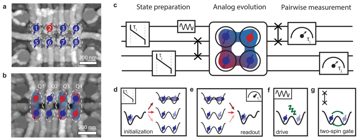
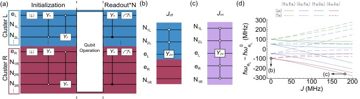
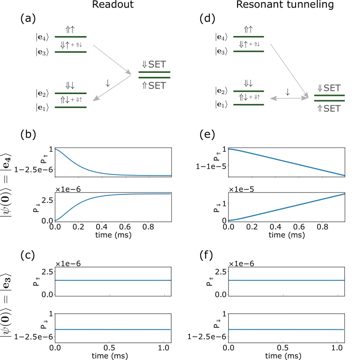
Single-spin (Loss–DiVincenzo) / nuclear-spin encoding
One qubit per spin-1/2 — a confined electron, hole or nucleus — with no encoded subspace, giving the smallest footprint and no leakage channel.
Verdict. The default encoding on every silicon, germanium, donor and defect platform; it buys minimum area and a clean Pauli error model at the cost of a resonant drive per qubit.
Λ = error-suppression factor per code-distance step; QBI = DARPA Quantum Benchmarking Initiative (Stage A concept → B R&D plan → C government V&V); G1–G7 = the report's goal classes (see Actors & economics).
Identity & lineage
One physical spin-1/2 is one qubit: an electron or hole in a gate-defined dot, or a nucleus bound to a donor or defect. Loss and DiVincenzo set it out in 1998 — dot-confined electron spins, rotations by a local resonant field, two-qubit gates by pulsed exchange D[819]. The nuclear variant drives a ³¹P or defect nucleus by radio frequency through hyperfine coupling to an electron, trading speed for coherence: nuclei as data, electrons as ancillas. Attributes: affinity — a near-natural carrier with no composite structure; error — coherent dephasing plus Pauli error, no leakage subspace, no control modality or fabrication of its own.
Physics & limits
The computational space is the whole two-level system: nothing leaks out, so every error is Pauli or coherent as the codes assume — and nothing is filtered out either. T2* is set by residual ²⁹Si hyperfine coupling and by charge noise turned into a frequency shift through the g-factor or a micromagnet; ²⁸Si purification removes the first term. Coherence is not the limit today: QuTech's microwave-free array bounds its hopping gate at ≥99.50(6)% D[820] and foundry two-qubit gates sit at 99.04–99.56% D[189] — a calibration-limited plateau, not a T2 limit. Deeper purification, baseband control and cold calibration move the floor.
Engineering state of the art
table
| year | figure | who | tag+key |
|---|---|---|---|
| 2025-07-01 | ≥99.50(6)% hopping gate (lower bound), no microwave, 2×2 array | QuTech/TU Delft | D[820] |
| 2025-09-24 | 99.04–99.56% two-qubit on 300 mm foundry SiMOS | Diraq | D[189] |
| 2025-12-17 | 11-qubit donor register, 9 nuclear plus 2 electron, 99.10–99.99% | Silicon Quantum Computing | D[192] |
Dominant term: calibration drift across the array; no device above 12 qubits publishes all-pairs fidelities.
The 99.90% donor nuclear-spin CZ fidelity cannot be isolated in the SQC abstract, whose published range is 99.10–99.99%. Intel's "scale to hundreds of dots" carries no date or milestone.
Manufacturing, materials & supply chain
The encoding adds no structure — one dot or donor per qubit, about a third of the dots an exchange-only qubit needs — and inherits the carrier's process: Intel's 300 mm EUV line at >24,000 devices per wafer D[199] and 96% tune-up yield on 232 devices of one wafer D[766], plus 22FDX, FD-SOI and imec 300 mm. The burden it imposes is control: one resonant drive per qubit frequency, so at 10³ qubits the wall is frequency crowding and microwave power at millikelvin, at 10⁴–10⁶ the count of addressable tones.
Role in the stack
The base encoding for the silicon and germanium quantum-dot architecture, the donor architecture and defect-spin network nodes. It is replaced in some designs by exchange-only encoding — the central fork: microwave hardware for minimum footprint and no leakage, against extra dots for baseband-only control and a leakage channel. It adds nothing to derived clock = sum of the syndrome round: gate layers + transport + readout + reset, which on silicon stays readout-dominated at 8.5×10⁻⁶ s. Verification: the 99.50(6)% is a lower bound and the accompanying ~49 µs Hahn-echo a maximum, both routinely requoted as point estimates D[820]; the main report's "99.90% donor nuclear CZ" conflicts with the published SQC range D[192]; and HRL's 2×10⁻⁴ single-qubit error belongs to exchange-only encoding, not this one D[190].
Actors & economics
Who.
| Organisation | Role | Country | What they do | Evidence |
|---|---|---|---|---|
| Intel | developer | USA | 300 mm EUV single-spin devices | D[199] |
| Diraq | developer | Australia | Electron spins on 300 mm imec SiMOS | D[189] |
| QuTech/TU Delft | research | Netherlands | Microwave-free baseband control | D[820] |
| Silicon Quantum Computing | developer | Australia | Nuclear-spin encoding on donors | D[192] |
| Quobly | developer | France | Single spins on STMicroelectronics FD-SOI | Cfact |
Money. 2026-06-03 · Quobly · Series A · €115 M · Bpifrance, SEALSQ, STMicroelectronics · €134 M cumulative · closed Cfact. 2026-06 · SQC · NRFC · A$60 M · Australia's National Reconstruction Fund · closed fact.
Market & supply chain. No supplier is specific to this encoding — it is a layout and pulse-sequence choice on shared CMOS lines — and its one distinctive demand, a resonant drive per qubit, is what the control-electronics duopoly sells. Pays into G2, G3 and G6.
IP & standards. The 1998 proposal is prior art long out of patent term D[819]; no dated patent family for single-spin encoding found in a named database as of 4 Sep 2026.
Roadmaps & track record. Intel (2026-01-06 · 12 qubits at Argonne, "scale to hundreds of dots" · no successor chip, no dated roadmap) fact. Diraq (2026-08-27 · 150 k physical, 1 k logical by 2029 · its 2026-07-09 release said "thousands by 2029") Rfact. Both are orders of magnitude beyond any demonstrated device.
Strategic reading. Every spin team can fall back on it, so it differentiates nobody: value accrues to the fab and the control stack. If baseband control matures the microwave vendors lose their strongest claim; if encoded qubits win, area matters less than wafer economics.
Outlook & open questions
Confirm or demote in 12–24 months: all-pairs fidelities above 12 qubits; baseband control beyond a 2×2 array. Best case 2029: baseband plus 1 K operation removes most microwave I/O at >99.5% two-qubit fidelity. Worst case: the plateau holds. Open: (1) whether hopping-gate control scales past four qubits; (2) whether the calibration-limited diagnosis generalises; (3) which platform shows a below-threshold logical qubit.
References
- [189] P. Steinacker et al., “Industry-compatible silicon spin-qubit unit cells exceeding 99% fidelity,” Nature, vol. 646, no. 8083, pp. 81–87, Sep. 2025, doi: 10.1038/s41586-025-09531-9. D
- [190] Members of the HRL Quantum Team and Collaborators, “A digitally controlled silicon quantum processing unit,” arXiv:2604.16216, Apr. 2026. D
- [192] H. Edlbauer et al., “An 11-qubit atom processor in silicon,” Nature, vol. 648, no. 8094, pp. 569–575, Dec. 2025, doi: 10.1038/s41586-025-09827-w. arXiv:2506.03567. D
- [199] H. C. George et al., “12-spin-qubit arrays fabricated on a 300 mm semiconductor manufacturing line,” Nano Lett., vol. 25, no. 2, pp. 793–799, Dec. 2024, doi: 10.1021/acs.nanolett.4c05205. arXiv:2410.16583. D
- [766] S. F. Neyens et al., “Probing single electrons across 300-mm spin qubit wafers,” Nature, vol. 629, no. 8010, pp. 80–85, May 2024, doi: 10.1038/s41586-024-07275-6. D
- [819] D. Loss and D. P. DiVincenzo, “Quantum computation with quantum dots,” Phys. Rev. A, vol. 57, no. 1, pp. 120–126, Jan. 1998, doi: 10.1103/PhysRevA.57.120. D
- [820] F. K. Unseld et al., “Baseband control of single-electron silicon spin qubits in two dimensions,” Nat. Commun., vol. 16, no. 1, Art. no. 5605, Jul. 2025, doi: 10.1038/s41467-025-60351-x. D