Donor spin (P in ²⁸Si) donor
Phosphorus donors placed by STM lithography in enriched silicon-28, the bound electron giving drive and readout, the ³¹P nucleus the long-lived qubit.
Donor spin (P in ²⁸Si)
STM-placed phosphorus atoms; nuclear qubits gated through a shared electron's hyperfine coupling; no foundry path.
Brief →Key references
Design space — attributes
- (a) carrier affinity
- intermediate / carrier-agnostic
- (b) time · entangling
- 1.0 µs · deterministic
- (c) readout
- spin-to-charge + rf reflectometry · 10 µs · non-destructive · mid-circuit
- (d) mobility
- static nearest-neighbour wiring
- (e) control
- low-frequency electrical @ room temperature
- (f) error structure
- stochastic Pauli
- (g) manufacturing
- STM hydrogen-resist lithography
Evaluation space — dated attributes
SQC (Australia), founded 2017; the first deterministically placed single-donor device is UNSW/Simmons (2012). ²⁸Si feedstock from ASP Isotopes and DOE/ORNL.
Standard records
Actors & goals — annotations
Edges
Used by 1 machine (1 primary · 0 alternate)
- semiconductor spins 1
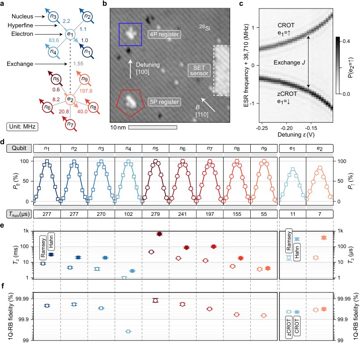
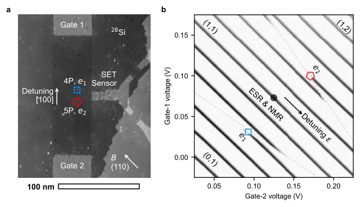
- 11-qubit donor processor Silicon Quantum Computing paper press ▣ Fig. 1b (STM micrograph of processor core: 4P register n1–n4/e1, 5P register n5–n9/e2) ✅
Pictures
Every picture carries the story of what it shows and its credit line.
Donor spin (P in ²⁸Si)
Phosphorus donors placed by STM lithography in enriched silicon-28, the bound electron giving drive and readout, the ³¹P nucleus the long-lived qubit.
Verdict. Highest published per-gate fidelities in silicon, but a serial atom-by-atom write process and a single practitioner cap the register at eleven qubits with no dated parallelisation scheme.
Λ = error-suppression factor per code-distance step; QBI = DARPA Quantum Benchmarking Initiative (Stage A concept → B R&D plan → C government V&V); G1–G7 = the report's goal classes (see Actors & economics).
Identity & lineage
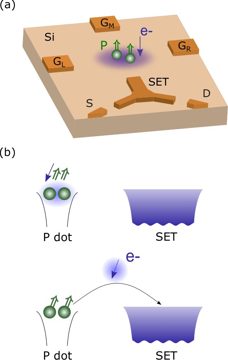
A single ³¹P donor placed atom-by-atom in enriched ²⁸Si: the bound electron gives drive and spin-to-charge readout, the spin-1/2 ³¹P nucleus the memory. Nuclear qubits inside a register are gated through their hyperfine coupling to a shared electron; registers are linked by electron exchange D[192]. Kane proposed the architecture in 1998; UNSW's Simmons group built the first deterministically placed single-donor device in 2012 D[357]; SQC, its 2017 spin-out, is the sole operator at device scale as of 4 Sep 2026.
Attributes: natural dopant at engineered placement, static, deterministic entangling near 1 µs; spin-to-charge readout ~10 µs, non-destructive and mid-circuit capable; Pauli error; STM fabrication, no foundry equivalent.
Physics & limits
The qubit is a nucleus, not a confined electron: with no orbital degree of freedom there is no first-order charge-noise coupling — the term that plateaus gate-defined dots at 99.0–99.6%. But every operation routes through the one electron that does couple to charge noise, which is coupler, readout probe and dominant error source at once; the budget is set by electron dephasing during the hyperfine-conditional pulse, not by nuclear coherence. Residual ²⁹Si and the regrown STM interface set that electron's T2. A sharper tip will not move the floor: exchange varies exponentially with separation, so a donor mis-sited by a few nm gives a dead register.
Engineering state of the art
table
Dominant term: register size and the electron-mediated gate. The main report's single "99.90% donor nuclear CZ" is not isolable from this work D[192].
The 99.90% donor nuclear-spin CZ fidelity cannot be isolated from [192], whose preprint gives 99.5–99.99% and published version 99.10–99.99%; the fidelity is a range. Not published: a placement yield or cost per donor, from any actor; Firgun Ventures' investment amount, and the split of the A$60 M NRFC total between its two tranches; and any SQC statement on the consequences of IonQ's acquisition of SkyWater.
Manufacturing, materials & supply chain
Serial by construction: one tip, one site, so throughput is qubit-hours, not wafer-hours; no parallel exposure is published. Enriched ²⁸Si is dual-sourced as of 4 Sep 2026 — ASP Isotopes' Pretoria line since 2025-03, US DOE silane at 99.9999% ²⁸Si from 2026-07-16 P[348] — so feedstock is not the constraint. Suppliers: SkyWater for US resonators C[276], Bluefors for cryogenics C[358]. The single point of failure moved in 2026: IonQ closed its ~USD 1.8 B purchase of SkyWater on 2026-07-31 G[19], putting SQC's only named US manufacturing route inside a competitor. Export exposure sits in the feedstock, not the machine: the US rule of 2024-09-06 created Export Control Classification Numbers (ECCNs) for isotopically enriched silicon and germanium — silicon qualifies below 0.08% of the nuclear-spin isotope ²⁹Si — as epitaxial layers (3C907), hydrides such as silane (3C908) and bulk material or oxide (3C909), so qubit-grade ²⁸Si is itself a controlled item; its quantum-computer ECCN, 4A906, starts at 34 qubits and, below 2,000, applies only under a two-qubit (C-NOT) error ceiling set for each size band — out of reach of an eleven-qubit register G[301]. Wiring is not the wall; the write step is.
Role in the stack
Architecture: donor spins in silicon, as its primary carrier. Requires STM hydrogen-resist lithography; provides the carrier for exchange links and spin-to-charge readout; substitutes for gate-defined dots at the cost of the whole process flow. Its clock contribution is not distinctive — µs gates and ~6 µs readout match dot spins, so sum of the syndrome round: gate layers + transport + readout + reset is 7.7 µs against their 8.5 µs, and the real bottleneck is a manufacturing quantity the clock cannot express. Verification: one group, one device, no replication, three inconsistent fidelity framings D[192].
Actors & economics
Who.
| Organisation | Role | Country | What exactly they do | Evidence |
|---|---|---|---|---|
| SQC | developer | Australia | Sole STM donor fabricator, 11-qubit processor | D[192] |
| SkyWater Technology | supplier | USA | Resonators, packaging | C[276] |
| IonQ | supplier | USA | Owns SkyWater since 2026-07-31 | G[19] |
Money. 2025-11-06 · SQC · QBI Stage B award · up to USD 15 M · DARPA · awarded fact. 2026-03-24 and 2026-06-11 · SQC · equity · A$60 M combined · Australia's NRFC · closed fact. 2026-07-31 · IonQ · acquisition of supplier SkyWater · ~USD 1.8 B · closed G[19].
Market & supply chain. No merchant sells an STM placement tool: SQC's asset is know-how, so no second source can be bought. ²⁸Si is the one input with two suppliers P[348]; cost per donor is unpublished. Pays into G2 and G3 on fidelity, not count.
IP & standards. Foundational patents trace to the UNSW/Simmons line; no dated family count from a named database as of 4 Sep 2026.
Roadmaps & track record. SQC (2026-06 · commercial scale by 2033 Rfact · unmet; 11 qubits is the maximum published). It delivers what it publishes, but 2033 presumes a parallelisation scheme absent from the literature — unfalsifiable rather than aggressive.
Strategic reading. If donor spins win, they win as a precision register bolted onto a foundry dot array, and SQC captures little of it: it owns the write process, not the wafer. Acute risk: a competitor owns its US packaging supplier.
Outlook & open questions
Confirm/demote (12–24 months): a device beyond 11 qubits or a dated parallel-write scheme confirms; silence through 2028 demotes this to a physics testbed. Best case 2029: a few dozen donor qubits above 99.5%. Worst case: eleven remains the record. Open: (1) can hydrogen-resist patterning be parallelised; (2) does SkyWater's new owner keep the relationship; (3) does QBI Stage C fund SQC; (4) what is the placement-yield distribution.
References
- [19] IonQ, “IonQ Completes Acquisition of SkyWater Technology,” Jul. 31, 2026. [Online]. Available: https://www.ionq.com/
news/ Gionq-completes-acquisition-of-skywater-technology - [192] H. Edlbauer et al., “An 11-qubit atom processor in silicon,” Nature, vol. 648, no. 8094, pp. 569–575, Dec. 2025, doi: 10.1038/s41586-025-09827-w. arXiv:2506.03567. D
- [276] Silicon Quantum Computing, “SkyWater x SQC: Advancing Hybrid Quantum-Classical Computing,” Nov. 20, 2025. [Online]. Available: https://sqc.com/
news/ Cskywater-and-sqc-advancing-hybrid-quantum-classical-computing - [301] US Department of Commerce, Bureau of Industry and Security, “Commerce Control List Additions and Revisions; Implementation of Controls on Advanced Technologies Consistent With Controls Implemented by International Partners,” Federal Register, vol. 89, p. 72926, Sep. 6, 2024. [Online]. Available: https://www.federalregister.gov/
documents/ G2024/ 09/ 06/ 2024-19633/ commerce-control-list-additions-and-revisions-implementation-of-controls-on-advanced-technologies - [348] U.S. Department of Energy, “DOE Advances Domestic Supply of Silicon, Germanium Isotopes for Quantum Computing,” HPCwire, Jul. 16, 2026. [Online]. Available: https://www.hpcwire.com/
off-the-wire/ Pdoe-advances-domestic-supply-of-silicon-germanium-isotopes-for-quantum-computing/ - [357] M. Fuechsle et al., “A single-atom transistor,” Nat. Nanotechnol., vol. 7, no. 4, pp. 242–246, Apr. 2012, doi: 10.1038/nnano.2012.21. D
- [358] Silicon Quantum Computing, “Silicon Quantum Computing — News,” sqc.com. [Online]. Available: https://sqc.com/
news/ C