Optical narrow-line qubit (ion S–D, atom clock) enc_opt
A qubit split between a ground level and a metastable level one optical photon above it — the S₁/₂–D₅/₂ quadrupole line of ⁴⁰Ca⁺ or ⁸⁸Sr⁺, or the ¹S₀–³P₀ clock line of neutral Sr/Yb — with one narrow-line laser driving every gate.
Optical narrow-line qubit (ion S–D, atom clock)
Qubit on an optical transition to a metastable level: the S₁/₂–D₅/₂ quadrupole line of an alkaline-earth ion (⁴⁰Ca⁺ at 729 nm, ⁸⁸Sr⁺ at 674 nm) or the ¹S₀–³P₀ clock line of a neutral Sr/Yb atom. One narrow-line laser drives every gate; coherence is bounded by the upper level's lifetime and the laser's phase noise, not by hyperfine structure — the classic Innsbruck encoding, still the AQT product's, and planqc's clock qubit.
Brief →Key references
Design space — attributes
- (a) carrier affinity
- natural
- (b) time · entangling
- —
- (c) readout
- —
- (d) mobility
- —
- (e) control
- —
- (f) error structure
- stochastic Pauli, leakage
- (g) manufacturing
- —
Evaluation space — dated attributes
Register carriers: AQT IBEX Q1, PSNC PIAST-Q (an AQT system), Innsbruck (⁴⁰Ca⁺ S–D); planqc MAQCS (Sr clock qubit — resolves the register's gap G-enc-clock). Hyperfine-free ⁴⁰Ca⁺ has no field-insensitive clock transition, so its T2 rests on magnetic shielding and laser stability; the atomic clock line is field-insensitive but laser-linewidth-limited; the 'omg' erasure proposal reuses the same metastable manifold.
Actors & goals — annotations
Edges
Used by 7 machines (7 primary · 0 alternate)
- trapped ions 5
- IBEX Q1 (Marmot / PINE) Alpine Quantum Technologies product page ▤ §II The qubit system ✅
- AQT LYNX Alpine Quantum Technologies press press ◌ 🔎
- PIAST-Q Poznan Supercomputing and Networking Center (PCSS) ◌ §II The qubit system (AQT platform) 🔎
- University of Innsbruck trapped-ion demonstrator (Institut für Experimentalphysik) University of Innsbruck paper paper paper ▤ §VI.A Trapping and cooling; §VI.B Qubit manipulation ✅
- Innsbruck trapped-ion analog quantum simulator (up to 51 ions) IQOQI Innsbruck (Austrian Academy of Sciences) with the University of Innsbruck (M. Joshi, C. Roos) paper press ▤ App. B1 (Engineered many-body interactions) ✅
- neutral atoms 2
- DiNAQC planqc, for the DLR Quantum Computing Initiative product page press link ◌ 🔎
- MAQCS planqc press ▨ 🔎
Pictures
Every picture carries the story of what it shows and its credit line.
Optical narrow-line qubit (ion S–D, atom clock)
A qubit split between a ground level and a metastable level one optical photon above it — the S₁/₂–D₅/₂ quadrupole line of ⁴⁰Ca⁺ or ⁸⁸Sr⁺, or the ¹S₀–³P₀ clock line of neutral Sr/Yb — with one narrow-line laser driving every gate.
Verdict. Proven on both carriers — ⁴⁰Ca⁺ in AQT's shipped machines, ⁸⁸Sr clock qubits at 99.62(3) % entangling fidelity in the laboratory — but coherence is set by the laser and the magnetic field, not the atom: 90(30) ms against a 1.168(7) s D₅/₂ lifetime in AQT's demonstrator. As of 2026-09-26 planqc, the register's only company on the atomic clock qubit, publishes no gate error or coherence time of its own.
T2 = Ramsey phase-coherence time; MS = Mølmer–Sørensen gate; CZ = controlled-Z gate; SPAM = state preparation and measurement; QV = quantum volume; TRL = technology readiness level; G1–G7 = the report's goal classes (see Actors & economics).
Identity & lineage
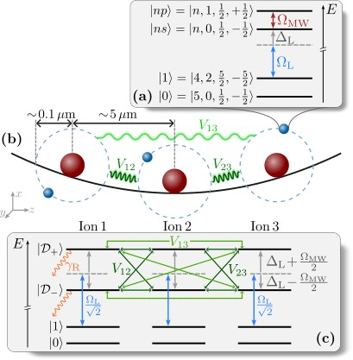
The ion realisation stores |1⟩ in |4S₁/₂, m = −1/2⟩ and |0⟩ in |3D₅/₂, m = −1/2⟩ of ⁴⁰Ca⁺, coupled by the 729 nm electric-quadrupole line D[253]. Innsbruck ran the Cirac–Zoller CNOT on two such ions in 2003 D[376]; the encoding carried its fault-tolerant universal gate set of 2022 D[255] and AQT's products. ⁸⁸Sr⁺ at 674 nm is the sister ion, its D₅/₂ lifetime measured on a single ion at NPL D[377]. The atom realisation uses ¹S₀ and ³P₀ of neutral strontium, the lattice-clock line, run in tweezers since 2019 D[378], with alkaline-earth Rydberg entanglement from 2020 D[379]. Attributes: natural carrier; no time, mobility or control of its own; errors Pauli plus leakage.
Physics & limits
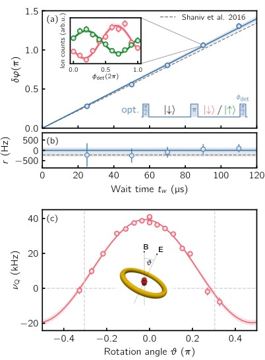
Three ceilings. Lifetime: τ(D₅/₂, ⁴⁰Ca⁺) = 1.168(7) s D[253], so T2 ≤ 2τ ≈ 2.3 s; decay from m = −1/2 may land in S₁/₂, m = +1/2, outside the qubit pair — leakage G. The Sr ³P₀ level outlives the >3 s atomic coherence measured in a tweezer clock D[378]. Field: ⁴⁰Ca⁺ has no hyperfine structure, hence no field-insensitive line; with g(D₅/₂) = 6/5 and g(S₁/₂) ≈ 2.002 the qubit line moves 0.40 μB B ≈ 5.6 kHz per µT, so 0.1 µT of noise shifts it 560 Hz, a radian in 0.3 ms S. Mitigations: shielding, mains feed-forward, dynamical decoupling, decoherence-free pairs. The J = 0 → J = 0 clock line has no first-order electronic Zeeman shift G. Laser: every gate references the laser phase, so T2 is the laser's coherence over the circuit. AQT measured Ramsey T2 = 90(30) ms on the optical qubit against 18(1) ms on the ground-state Zeeman qubit, naming magnetic noise from mains and neighbouring magnets beyond 25 ms D[253] — 26× below the lifetime bound S.
Engineering state of the art
table
| Year | Figure | Who | Tag+key |
|---|---|---|---|
| 2003-03 | Cirac–Zoller CNOT on two ⁴⁰Ca⁺ S–D qubits | Innsbruck | D[376] |
| 2019 | Sr tweezer clock, >3 s coherence, duty cycle up to 96 % | JILA | D[378] |
| 2021-06 | τ(D₅/₂) 1.168(7) s; T2 90(30) ms; 24-ion GHZ fidelity 0.544(7) | AQT/Innsbruck | D[253] |
| 2022-08 | Sr clock-qubit Bell state 92.8(2.0) % SPAM-corrected; Bell coherence 4.2(6) s | JILA | D[380] |
| 2024-10 | ⁸⁸Sr clock-qubit entangling gate 99.62(3) %; ancilla readout | Caltech | D[381] |
| 2026-05 | LYNX QV 32,768; first units Q4 2026 | AQT | C[128] |
The shipped figure: IBEX Q1, 12 qubits, 1Q 99.97(1) %, 2Q 98.7(3) % over all pairs, QV 128 C[382]; MARMOT, 20 qubits, 2Q (98.47 ± 0.3) % on an 11-qubit register C[383]. Atoms lead on fidelity, ions on deployment.
Manufacturing, materials & supply chain
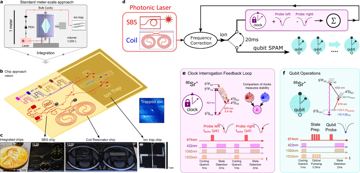
No fabricated part; the item is the narrow-line laser — 729 nm (Ca⁺), 674 nm (Sr⁺), 698 nm (Sr) — locked to a high-finesse reference cavity G. AQT's demonstrator uses seven wavelengths (375, 397, 423, 515, 729, 854, 866 nm); the 854 nm quench laser exists only because the qubit level is metastable D[253]. IBEX Q1 fills two 19-inch racks, 2 m², <2 kW, at (22.0 ± 1.5) °C C[382].
Control, readout & I/O burden
One phase-stable laser per species, split into individually addressed 729 nm beams on the ion chain D[255]; fibre and modulator phase noise lands directly on the qubit S. Readout is electron shelving — D₅/₂ stays dark on the 397 nm cycling line — by camera or photodiode, ~99.9 % in 300 µs D[253]; atoms add ancilla-based readout with non-destructive conditional reset D[381].
Role in the stack
Slot 2 of Trapped ions — linear Paul trap with individual laser addressing, and of Rydberg tweezer array — alkaline-earth(-like) (Yb/Sr), erasure-native, beside enc_hf and enc_omg. It requires either ion (S–D quadrupole transition) or ae_atom (¹S₀–³P₀ of Sr/Yb). It is replaced by enc_hf, whose field-insensitive ground-state pair trades the one-laser drive for Raman or microwave control. It provides single-laser universality and shelving readout, and the metastable manifold that the omg erasure scheme reuses S[333]; it defines the channel metric τ(D₅/₂) = 1.17 s. Register: IBEX Q1 (Marmot / PINE / LYNX) ✅ and University of Innsbruck / IQOQI research trap ✅; PIAST-Q 🔎 (20 AQT qubits, species unnamed — consistent with MARMOT); MAQCS and DiNAQC 🔎. Gap G-enc-clock is answered: the ledger's 10–100 ms is planqc's range in a press profile P[247], 30–300× below published clock-qubit arrays D[380], so it measures a laser, not the encoding.
Evidence — how the numbers were measured
AQT's 98.7(3) % is an all-pairs product average C[382]; a secondary 97.7 % in the register stays unreconciled. The demonstrator's 0.997(6) is a two-ion Bell-state fidelity, not randomised benchmarking D[253]. Caltech's 99.62(3) % is averaged over symmetric input states D[381]. LYNX publishes QV without qubit count or fidelity C[128]. No vendor reports T2 beside τ, as of 2026-09-26.
Not published: planqc's computing species and transition — its technology and LRZ pages name neither strontium nor the clock transition — and the species and product of PIAST-Q.
Actors & economics
Who.
| Organisation | Role | Country | What exactly they do with this technology | Evidence |
|---|---|---|---|---|
| AQT | developer | Austria | IBEX Q1, MARMOT, LYNX on ⁴⁰Ca⁺ | C[383] |
| University of Innsbruck | research | Austria | Origin; fault-tolerant gates on ⁴⁰Ca⁺ | D[255] |
| planqc | developer | Germany | Sr clock-transition qubits; MAQCS at LRZ | P[247] |
| JILA / Kaufman group | research | US | Sr clock-qubit Bell states | D[380] |
| Caltech / Endres group | research | US | ⁸⁸Sr clock-qubit gates, ancilla readout | D[381] |
Money.
- 2024-07 · planqc · Series A · €50 M · closed P[247]
- 2026-09-09 · planqc / LRZ · MAQCS, first hardware delivered · almost €20 M (BMFTR) · under construction C[161]
Market & supply chain. One ultrastable laser and cavity per species is the concentration point. Pays into G2, G3 and G7.
IP & standards. No patent search was run; no standard defines reporting of laser-limited T2, as of 2026-09-26.
Roadmaps & track record. (AQT · LYNX first units · Q4 2026) C[128]; (planqc · MAQCS co-processor · end-2027, TRL 5 today, 6–7 targeted) R[161].
Strategic reading. On ions the encoding is AQT's legacy, its depth capped by τ; on atoms it is the best-gated clock qubit, and a clock-grade laser on a processor is the prize.
Outlook & open questions
Confirm the atomic branch if planqc publishes clock-qubit T2 and CZ fidelity on MAQCS hardware by 2027-12-31; demote it to metrology if not. Confirm the ion branch if LYNX ships in Q4 2026 with per-pair 2Q figures. Open questions. (1) What laser linewidth would bring ⁴⁰Ca⁺ T2 to its 2.3 s bound? (2) Is planqc's 10–100 ms the lattice, the laser or the field? (3) How much D₅/₂ decay leaks versus flips? (4) Will AQT move to a hyperfine or omg species? (5) Can one clock laser serve 10³ sites?
References
- [128] Alpine Quantum Technologies GmbH, “AQT Sets New European Industry Standard: Introducing the ‘LYNX’ Series with Record-Breaking Quantum Volume,” AQT, May 5, 2026. [Online]. Available: https://www.aqt.eu/
lynx-quantum-volume-record/ C - [161] planqc, “MAQCS takes shape as first quantum computing hardware arrives at LRZ,” Sep. 9, 2026. [Online]. Available: https://planqc.eu/
news/ Cmaqcs-takes-shape-as-first-quantum-computing-hardware-arrives-at-lrz - [247] M. Ivezic, “Planqc,” PostQuantum, May 22, 2025. [Online]. Available: https://postquantum.com/
quantum-computing-companies/ Pplanqc/ - [253] I. Pogorelov et al., “Compact Ion-Trap Quantum Computing Demonstrator,” PRX Quantum, vol. 2, no. 2, Art. no. 020343, Jun. 2021, doi: 10.1103/PRXQuantum.2.020343. arXiv:2101.11390. D
- [255] L. Postler et al., “Demonstration of fault-tolerant universal quantum gate operations,” Nature, vol. 605, pp. 675–680, 2022, doi: 10.1038/s41586-022-04721-1. arXiv:2111.12654. D
- [333] D. T. C. Allcock et al., “omg blueprint for trapped ion quantum computing with metastable states,” Appl. Phys. Lett., vol. 119, no. 21, Art. no. 214002, Nov. 2021, doi: 10.1063/5.0069544. arXiv:2109.01272. S
- [376] F. Schmidt-Kaler et al., “Realization of the Cirac–Zoller controlled-NOT quantum gate,” Nature, vol. 422, pp. 408–411, Mar. 2003, doi: 10.1038/nature01494. D
- [377] V. Letchumanan, M. A. Wilson, P. Gill, and A. G. Sinclair, “Lifetime measurement of the metastable 4d ²D₅/₂ state in ⁸⁸Sr⁺ using a single trapped ion,” Phys. Rev. A, vol. 72, Art. no. 012509, Jul. 2005, doi: 10.1103/PhysRevA.72.012509. D
- [378] M. A. Norcia et al., “Seconds-scale coherence on an optical clock transition in a tweezer array,” Science, vol. 366, p. 93, 2019. arXiv:1904.10934. D
- [379] I. S. Madjarov et al., “High-fidelity entanglement and detection of alkaline-earth Rydberg atoms,” Nat. Phys., vol. 16, pp. 857–861, May 2020, doi: 10.1038/s41567-020-0903-z. arXiv:2001.04455. D
- [380] N. Schine, A. W. Young, W. J. Eckner, M. J. Martin, and A. M. Kaufman, “Long-lived Bell states in an array of optical clock qubits,” Nat. Phys., vol. 18, pp. 1067–1073, Aug. 2022, doi: 10.1038/s41567-022-01678-w. arXiv:2111.14653. D
- [381] R. Finkelstein et al., “Universal quantum operations and ancilla-based read-out for tweezer clocks,” Nature, vol. 634, pp. 321–327, Oct. 2024, doi: 10.1038/s41586-024-08005-8. D
- [382] Alpine Quantum Technologies, “19-inch rack-mounted quantum computer,” AQT. [Online]. Available: https://www.aqt.eu/
products/ Cibex-q1/ - [383] Alpine Quantum Technologies (AQT), “Quantum computer products built for performance,” AQT. [Online]. Available: https://www.aqt.eu/
products/ C