Squeezed light mode (CV) squeezed
A continuous-variable optical mode with one quadrature below vacuum noise; the carrier for GKP and cluster-state photonics, where integration loss, not nonlinearity, sets the ceiling.
Squeezed light mode (CV)
Continuous-variable modes for GKP/cluster states; needs ~10 dB *effective* squeezing for FT (0.62 dB on chip today); raw on-chip squeezing is a different quantity (1.4 dB measured on TFLN).
Brief →Key references
Design space — attributes
- (a) carrier affinity
- photon (natural particle, engineered modes)
- (b) time · entangling
- 1.0 µs · probabilistic / heralded
- (c) readout
- single-photon detection · 10 ns · destructive · no mid-circuit
- (d) mobility
- flying qubits (photons)
- (e) control
- electro-optic @ room temperature
- (f) error structure
- Gaussian (small-shift), loss (erasure)
- (g) manufacturing
- photonic IC foundry
Evaluation space — dated attributes
Xanadu's 0.62 dB is GKP *effective* squeezing, not raw quadrature squeezing — the two are not comparable. The readout attribute is kept as single-photon detection, but CV practice is homodyne detection.
Standard records
Actors & goals — annotations
Edges
Used by 7 machines (7 primary · 0 alternate)
- photonics 7
- PT-2 ORCA Computing product page press ▤ §2.2 Physical devices ✅
- Jiuzhang (1.0) USTC (Pan Jianwei group) press ▤ Abstract ('50 input single-mode squeezed states') ✅
- Jiuzhang 2.0 USTC (Pan Jianwei group) paper press ▤ Abstract ✅
- Jiuzhang 3.0 USTC (Pan Jianwei group) paper press ▤ Abstract ('Gaussian boson sampling experiments') ✅
- Jiuzhang 4.0 USTC (Pan Jianwei group) paper press ▣ Fig. 1 (experimental setup); Extended Data Fig. 2 (single-/cross-OPO indistinguishability) ✅
- Aurora Xanadu paper press link ▣ Fig. 2 (sources chips); Fig. 1 (GBS cells); Methods: Sources array ✅
- Borealis Xanadu paper link ▣ Fig. 1 (pulse train of single-mode squeezed states from pulsed OPO); Methods: Pulsed squeezed-light source ✅
Pictures
Every picture carries the story of what it shows and its credit line.
Squeezed light mode (CV)
A continuous-variable optical mode with one quadrature below vacuum noise; the carrier for GKP and cluster-state photonics, where integration loss, not nonlinearity, sets the ceiling.
Verdict. Real: 1.4 dB directly measured on TFLN, 15 dB in bulk optics. Unproven: GKP effective squeezing beyond 0.62 dB on chip against ~9.75 dB needed. Demote if no on-chip GKP figure above 2 dB by 2028.
Λ = error-suppression factor per code-distance step; QBI = DARPA Quantum Benchmarking Initiative (Stage A concept → B R&D plan → C government V&V); G1–G7 = the report's goal classes (see Actors & economics).
Identity & lineage
An optical mode whose vacuum fluctuations are redistributed between conjugate quadratures by a parametric process — down-conversion in a χ⁽²⁾ medium or four-wave mixing in a χ⁽³⁾ one (SiN): one quadrature drops below vacuum noise, the other rises. Predicted in the 1970s, first observed in 1985; the lineage that matters is waveguide squeezers feeding CV cluster states and GKP encoding. Attributes: flying carrier, heralded generation at ~1 µs; readout by single-photon detection at ~10 ns, destructive, not mid-circuit; electro-optic room-temperature control, Gaussian-plus-loss errors, photonic-IC fabrication.
Physics & limits
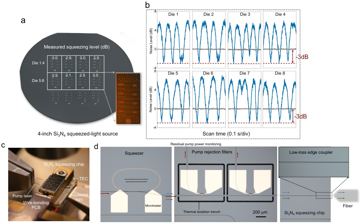
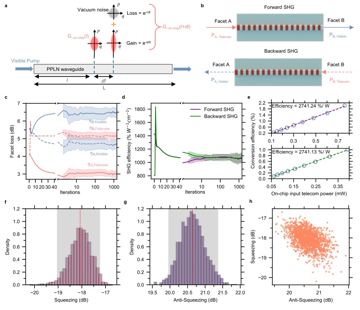
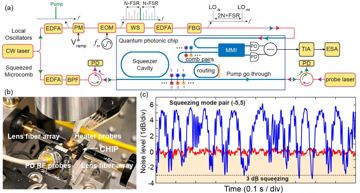
Squeezing is a loss thermometer: the medium can produce arbitrarily strong quadrature reduction, but every dB of loss between generation and detection pulls the measured value toward vacuum, so the number describes the optical path, not the squeezer. Hence 15 dB in bulk optics D[344] against 1.4 dB measured on chip, over 10 dB once a 4 dB homodyne loss budget is subtracted D[345]. Do not conflate raw quadrature squeezing with the effective squeezing of a GKP grid state, which folds in non-Gaussian preparation fidelity as well as loss: fault tolerance prices the latter at ~9.75 dB against 0.62 dB on chip D[174]. Only lower loss, better coupling and higher detection efficiency move it.
The molecular vibronic-spectrum application of Gaussian boson sampling with squeezed light is a linear statistic of the output; the characteristic function of displaced squeezed vacuum is computable exactly in polynomial time, so the spectrum is classically estimable to the experiment's additive accuracy P[889].
Engineering state of the art
table
| Date | Figure | Who | Tag |
|---|---|---|---|
| 2016 | 15 dB squeezing, bulk optics | Vahlbruch et al., Hannover | D[344] |
| 2025-06 | On-chip GKP effective squeezing 0.62 dB vs ~9.75 dB required | Xanadu | D[174] |
| 2025-08 | 1.4 dB measured on poled TFLN, >10 dB inferred at 62 mW pump | Shi et al. | D[345] |
| 2026-08 | Loss 24.1× above threshold, 1.0× targeted 2030 | Xanadu | R[178]fact |
The on-chip-to-bulk gap is ~13 dB, the GKP gap ~9 dB.
Shi et al.'s 1.4 dB, measured on PPLN TFLN [345], is an independent on-chip squeezing figure; the 0.62 dB GKP effective squeezing rests on Xanadu alone. The >10 dB TFLN figure is loss-corrected, not measured, and stated at one pump power, so it is not comparable with the 15 dB bulk-optics measurement. The ~9.75 dB fault-tolerance requirement, rounded to ~10 dB in the main report, has no single primary source. Xanadu's CAD 195 M and USD 686 M both come from its 2026-08-31 release, not an audited filing.
Manufacturing, materials & supply chain
Squeezers ride the CV photonic-IC line — SiN and thin-film lithium niobate with periodic poling. Merchant TFLN supply is thin: HyperLight (USD 37 M Series B, 2024-09) and Lightium (USD 7 M seed) Pfact, plus the PIXEurope pilot line fact. Xanadu builds rather than buys; no cost per squeezer is public. Poling uniformity and waveguide loss are the yield-limiting defects, both acting on the headline dB. I/O is one pump and one homodyne chain per mode plus phase locking; Aurora ran 35 chips at 12 modes on a 1 MHz cycle D[173]. At 10³ modes the wall is pump distribution and phase stability; at 10⁴–10⁶, detector and DAC channel count. No ECCN names squeezers; 4A906 catches the machine fact.
Role in the stack
Architectures: the continuous-variable photonic GKP architecture and the boson sampler, primary carrier in both. The register lists 7 machines using it, among them Aurora, Borealis and the Jiuzhang line up to 4.0. Requires a photonic-IC foundry; provides the modes for CV Gaussian gates with GKP-assisted non-Gaussian operations and for GKP grid encoding on Xanadu's architecture. It replaces discrete photons as carrier — DV trades erasure-dominated errors for Gaussian-plus-loss ones, and switching costs the whole detector chain. Squeezing level sets the error floor of every CV operation, bounding the derived clock indirectly rather than contributing a gate time. Verification: 0.62 dB is single-source and unreplicated; the independent TFLN result measures raw squeezing, and its ">10 dB" is inferred by subtracting detection loss D[345].
Actors & economics
Who.
| Organisation | Role | Country | What they do | Evidence |
|---|---|---|---|---|
| Xanadu | developer | CA | Only actor fielding on-chip CV/GKP systems | D[174] |
| HyperLight, Lightium | supplier | US, CH | TFLN chips and foundry service | Pfact |
| DARPA | investor | US | QBI Stage B, up to USD 15 M | fact |
| Government of Canada | investor | CA | CAD 195 M, Toronto factory | fact |
Money.
2025-11-06 · Xanadu · DARPA QBI Stage B · up to USD 15 M · announced fact
2026-03-26 · Xanadu · SPAC with Crane Harbor · ~USD 302 M gross, ~40% below plan · closed Cfact
2026-08-28 · Xanadu · Canadian factory funding · CAD 195 M · confirmed fact
Market & supply chain. No merchant squeezer exists; upstream the tradable goods are TFLN wafers and poling from two small vendors — concentration risk for anyone not vertically integrated. Only G3/G4 pay for squeezing quality.
IP & standards. No dated patent family specific to on-chip squeezers as of 4 Sep 2026, and no standard defines how effective squeezing is reported.
Roadmaps & track record. (2026-08-31 · loss 24.1× → 1.0× by 2030 · not due); (2026-08-31 · 200 logical qubits by 2029 · not due). Good disclosure record, but every squeezing promise is forward-dated.
Strategic reading. Squeezing quality, not mode count, gates the CV bet: if the on-chip GKP figure does not move, the 2030 target fails and CV loses to DV fusion, having no alternative carrier. If it moves, TFLN and poling suppliers become strategic.
Outlook & open questions
Confirm by 2028: on-chip GKP effective squeezing above 2 dB with its loss budget; demote if still below 1 dB. Best case 2029: a second group publishes a competing GKP figure. Worst case: integration loss pins it near 1 dB and CV/GKP stays a research architecture. Open: does loss fall as the roadmap claims; can poled TFLN reach GKP-grade fidelity.
References
- [173] H. A. Rad et al., “Scaling and networking a modular photonic quantum computer,” Nature, vol. 638, no. 8052, pp. 912–919, Jan. 2025, doi: 10.1038/s41586-024-08406-9. D
- [174] M. V. Larsen et al., “Integrated photonic source of Gottesman–Kitaev–Preskill qubits,” Nature, vol. 642, no. 8068, pp. 587–591, Jun. 2025, doi: 10.1038/s41586-025-09044-5. D
- [178] Xanadu Quantum Technologies Limited, “Xanadu Charts Path to Over 1,000 Logical Qubits by 2031,” GlobeNewswire, Aug. 31, 2026. [Online]. Available: https://www.globenewswire.com/
news-release/ R2026/ 08/ 31/ 3353211/ 0/ en/ xanadu-charts-path-to-over-1-000-logical-qubits-by-2031.html - [344] H. Vahlbruch, M. Mehmet, K. Danzmann, and R. Schnabel, “Detection of 15 dB Squeezed States of Light and their Application for the Absolute Calibration of Photoelectric Quantum Efficiency,” Phys. Rev. Lett., vol. 117, no. 11, Art. no. 110801, Sep. 2016, doi: 10.1103/PhysRevLett.117.110801. D
- [345] X. Shi et al., “Squeezed Light Generation in Periodically Poled Thin-Film Lithium Niobate Waveguides,” arXiv:2508.08599, Aug. 2025. D
- [889] B. Seron, H. Thomas, E. Araujo, A. Arkhipov, C. Oh, and L. Novo, “Efficient classical algorithm for estimating linear statistics of Boson Sampling,” arXiv:2609.35447, Sep. 2026. P