CV Gaussian gates + GKP-assisted non-Gaussian operations g_cv
Beamsplitters, squeezers and homodyne feed-forward on optical modes, with GKP grid states supplying the non-Gaussian resource fault tolerance requires.
CV Gaussian gates + GKP-assisted non-Gaussian operations
Beamsplitters, squeezers and homodyne feed-forward on optical modes at 1 MHz clock (Aurora).
Brief →Key references
Design space — attributes
- (a) carrier affinity
- photon (natural particle, engineered modes)
- (b) time · entangling
- 1.0 µs · deterministic
- (c) readout
- —
- (d) mobility
- flying qubits (photons)
- (e) control
- electro-optic @ room temperature
- (f) error structure
- Gaussian (small-shift), loss (erasure)
- (g) manufacturing
- photonic IC foundry
Evaluation space — dated attributes
Time-domain-multiplexed CV cluster states originate with Yokoyama et al. (University of Tokyo, 2013, > 10,000 modes); Xanadu's Aurora is the first modular chip-based networked version, not the first such state.
Standard records
Actors & goals — annotations
Edges
Used by 3 machines (1 primary · 2 alternate)
- photonics 3
- Aurora Xanadu paper press link ▣ Fig. 3c,d (adaptive homodyne basis with feed-forward); Fig. 1 (QPU) ✅
- Jiuzhang 4.0 USTC (Pan Jianwei group) paper press ▣ Extended Data Fig. 3 (cascaded interferometers interconnected by delay loops) ✅ (alternate)
- Borealis Xanadu paper link ▤ Methods: Programmable photonic processor (VBS transfer matrix, loops l=0,1,2) ✅ (alternate)
Pictures
Every picture carries the story of what it shows and its credit line.
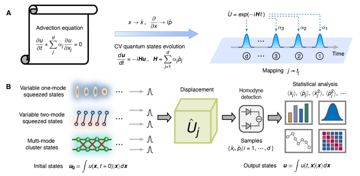
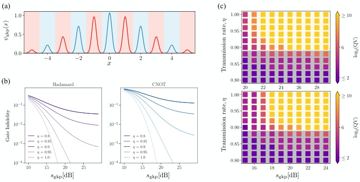
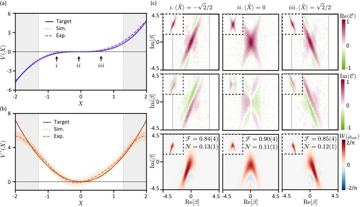
CV Gaussian gates + GKP-assisted non-Gaussian operations
Beamsplitters, squeezers and homodyne feed-forward on optical modes, with GKP grid states supplying the non-Gaussian resource fault tolerance requires.
Verdict. On-chip GKP effective squeezing is 0.62 dB against the ~10 dB the architecture needs — an ~8.7× grid-noise-variance gap. If Xanadu's 2028–29 fault-tolerance milestone slips, this is the slowest photonic track.
Λ = error-suppression factor per code-distance step; QBI = DARPA Quantum Benchmarking Initiative (Stage A concept → B R&D plan → C government V&V); G1–G7 = the report's goal classes (see Actors & economics).
Identity & lineage
Gates act on optical quadratures — beamsplitters, phase shifts, squeezers — closed by homodyne feed-forward. Gaussian operations with homodyne detection are classically simulable, so universality needs a non-Gaussian resource: the Gottesman–Kitaev–Preskill grid state, 2001 S[413]. Time-domain multiplexing predates the companies — the University of Tokyo entangled over 10,000 modes in 2013 D[821]; Xanadu added the modular chip version D[173] and the first integrated GKP source D[174]. Attributes: flying carrier, partly fabricated, ~1 µs deterministic step, Gaussian-noise and loss-dominated error; electro-optic control at room temperature, photonic-IC fabrication.
Physics & limits
Loss acts as a Gaussian random-displacement channel on the grid, blurring the GKP peaks until modular-quadrature measurement cannot resolve the logical value; the floor is effective squeezing, not gate count. Xanadu's on-chip source reports 0.62 dB D[174] — grid-noise variance ~0.87 of vacuum against ~0.10 at the ~10 dB assumed, an ~8.7× reduction still to find S, a different quantity from Xanadu's 24.1× loss factor above threshold C[178]. Only lower per-element loss, better sources and deeper multiplexing move it. Feed-forward adds a second floor: electronics must act inside the ~1 µs clock, and the published CV loop is 196 ns P[822].
Engineering state of the art
table
No GKP logical qubit exists; Aurora ran two hours without error correction and reported no logical fidelity, so it shows stability, not computation D[173].
The date, platform and room-temperature operation of the 0.62 dB GKP result come from the publisher's press coverage [642], and no independent group has replicated it. Published GKP threshold estimates vary with decoder and architecture, so the ~10 dB figure is not a single authoritative value. The 0.87→0.10 variance conversion is derived, not quoted. Xanadu's 24.1× loss factor and the 0.62 dB effective squeezing are different quantities that no source reconciles.
Manufacturing, materials & supply chain
Fabrication is silicon-nitride lithography on 300 mm-class wafers, shared with the discrete-variable sector; the CV-specific additions are squeezers and high-efficiency homodyne receivers rather than switches, and the GKP source runs at room temperature D[174]. Packaging is Corning fibre arrays and DISCO singulation C[172]. Control is the heavy part: every mode needs a homodyne receiver, an ADC and a loop closing inside the clock, scaling linearly with no published shortcut. At 10³ modes that is a rack of receivers, at 10⁴ the analogue front end dominates, and nothing addresses 10⁶. ECCN 4A906 applies to the machine fact.
Role in the stack
The continuous-variable architecture's gate layer, requiring squeezed sources and room-temperature feed-forward. It substitutes for rather than complements discrete-variable fusion: CV measures quadratures where fusion detects single photons, so switching architectures replaces sources, detectors and decoders together. Derived clock 1.0 MHz D[173]. Verification is thin: the 0.62 dB is single-group, unreplicated, and routinely confused with raw quadrature squeezing — the 1.4 dB in periodically poled TFLN P[345] is a different quantity.
Actors & economics
Who.
Money.
2025-11-06 · Xanadu · DARPA QBI Stage B selection · up to USD 15 M · DARPA · announced fact
2026-03-26 · Xanadu · SPAC merger with Crane Harbor · ~USD 302 M gross, ~40% below plan · closed Cfact
2026-08-28 · Xanadu · Toronto factory funding · CAD 195 M · Government of Canada · announced C[178]
2026-08-31 · Xanadu · liquidity · ~USD 686 M at 2026-06-30 · reported Cfact
Market & supply chain. One commercial actor, so no market — only Xanadu's supply relationships and the packaging concentration it shares with photonics generally. CV pays for G1 today; G3/G4 only if squeezing closes, G6 the natural adjacency.
IP & standards. No dated CV/GKP patent count from a named database as of 2026-09-04; Strawberry Fields/Blackbird is the only CV-native open-source stack, used by no other vendor.
Roadmaps & track record. The 2026-08-31 release is Xanadu's first quantified schedule (promised 2026-08: fault tolerance 2028–29, 200 logical qubits 2029, 1,000+ by 2031) — too new to score C[178]; against it stands one miss, the SPAC closing ~40% below plan Cfact. Its physics claims are self-critical; its financing claims are not.
Strategic reading. If effective squeezing improves an order of magnitude, CV's flying room-temperature carrier is the natural networking substrate and G6 is Xanadu's to lose. If not, no second actor exists to inherit the track, and its suppliers are worth more than its architecture.
Outlook & open questions
Confirm by 2027: effective squeezing above 3 dB on chip; demote the 2028–29 milestone if it stays below 1 dB. Best case 2029: a small GKP logical qubit at low distance. Worst case: uncorrected demonstrations continue and the schedule slips as the financing did. Open: how much of the gap is loss versus fabrication; do homodyne front-ends scale.
References
- [172] Xanadu, “Xanadu sets new industry benchmark in photonic chip packaging,” PR Newswire, Jun. 10, 2026. [Online]. Available: https://www.prnewswire.com/
news-releases/ Cxanadu-sets-new-industry-benchmark-in-photonic-chip-packaging-302796562.html - [173] H. A. Rad et al., “Scaling and networking a modular photonic quantum computer,” Nature, vol. 638, no. 8052, pp. 912–919, Jan. 2025, doi: 10.1038/s41586-024-08406-9. D
- [174] M. V. Larsen et al., “Integrated photonic source of Gottesman–Kitaev–Preskill qubits,” Nature, vol. 642, no. 8068, pp. 587–591, Jun. 2025, doi: 10.1038/s41586-025-09044-5. D
- [178] Xanadu Quantum Technologies Limited, “Xanadu Charts Path to Over 1,000 Logical Qubits by 2031,” GlobeNewswire, Aug. 31, 2026. [Online]. Available: https://www.globenewswire.com/
news-release/ C2026/ 08/ 31/ 3353211/ 0/ en/ xanadu-charts-path-to-over-1-000-logical-qubits-by-2031.html - [345] X. Shi et al., “Squeezed Light Generation in Periodically Poled Thin-Film Lithium Niobate Waveguides,” arXiv:2508.08599, Aug. 2025. P
- [413] D. Gottesman, A. Kitaev, and J. Preskill, “Encoding a qubit in an oscillator,” Phys. Rev. A, vol. 64, no. 1, Art. no. 012310, Jun. 2001, doi: 10.1103/PhysRevA.64.012310. arXiv:quant-ph/0008040. S
- [642] Xanadu, “Xanadu Unveils 1st On-Chip Error-Resistant Photonic Qubit,” HPCwire, Jun. 5, 2025. [Online]. Available: https://www.hpcwire.com/
off-the-wire/ Pxanadu-unveils-1st-on-chip-error-resistant-photonic-qubit/ - [821] S. Yokoyama et al., “Ultra-large-scale continuous-variable cluster states multiplexed in the time domain,” Nat. Photon., vol. 7, no. 12, pp. 982–986, Dec. 2013, doi: 10.1038/nphoton.2013.287. D
- [822] D. Duggan et al., “FPGA Based Feedforward System for Photonic Quantum Computing Applications,” arXiv:2606.03500, Jun. 2026. P