Linear-optical fusion (heralded) g_fusion
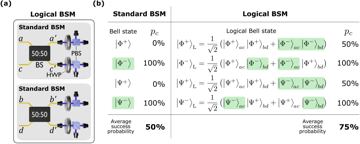
Probabilistic Bell-basis measurement on two photons — 50% unboosted, 75% with ancillae — whose failure is heralded and erases one of the two measured outcomes; the entangling primitive of fusion-based photonics.
Linear-optical fusion (heralded)
Probabilistic Bell measurement on photons (50%, 75% boosted); failure is heralded → erasure.
Brief →Key references
Design space — attributes
- (a) carrier affinity
- photon (natural particle, engineered modes)
- (b) time · entangling
- 100 ns · probabilistic / heralded
- (c) readout
- —
- (d) mobility
- flying qubits (photons)
- (e) control
- electro-optic @ room temperature
- (f) error structure
- loss (erasure)
- (g) manufacturing
- photonic IC foundry
Evaluation space — dated attributes
Standard records
Actors & goals — annotations
Edges
Used by 6 machines (6 primary · 0 alternate)
- photonics 6
- ETRI 8-photon silicon-photonic qubit chip ETRI (with KAIST and the University of Trento) paper ▨ 🔎
- Omega chipset (Moreton Bay / Chicago systems unnamed) PsiQuantum paper product page press ▣ Fig. 3d,h (two-qubit fusion); Fig. 3c,f (HOM) ✅
- Belenos Quandela product page press ▣ §III Benchmarking logic gates; SI §S-V + Fig. S9 (post-selected CNOT circuit) ✅
- Quandela Canopus Quandela product page product page press ◌ 🔎
- Lucy Quandela press ▦ 🔎
- Carina QuiX Quantum ▨ 🔎
Pictures
Every picture carries the story of what it shows and its credit line.
Linear-optical fusion (heralded)
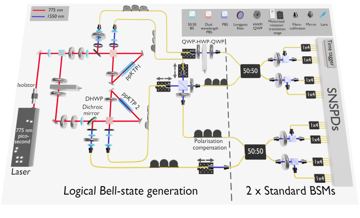
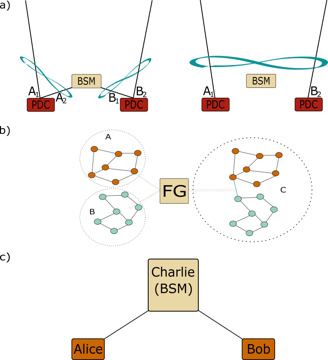
Probabilistic Bell-basis measurement on two photons — 50% unboosted, 75% with ancillae — whose failure is heralded and erases one of the two measured outcomes; the entangling primitive of fusion-based photonics.
Verdict. Real: single fusions at 99.22% Bell fidelity on chip, 99.72% chip-to-chip (PsiQuantum, 2025-02). Unproven: any chained fusion network with an end-to-end success rate. Demote if no multi-fusion result is published by 2028.
Λ = error-suppression factor per code-distance step; QBI = DARPA Quantum Benchmarking Initiative (Stage A concept → B R&D plan → C government V&V); G1–G7 = the report's goal classes (see Actors & economics).
Identity & lineage
A Bell-basis measurement — beamsplitter, phase shifters, number-resolving detectors — projecting two photons onto a Bell state or destroying both and saying so, handing the code erasure rather than Pauli error. Browne and Rudolph introduced type-I/II fusion in 2005 to grow cluster states without a deterministic gate S[451]; linear optics caps unambiguous discrimination at 50%, unentangled ancillae lift it to 75% S[419]. Attributes: flying photons, heralded entangling at ~100 ns; electro-optic room-temperature control, loss-dominated errors, photonic-IC fabrication.
Physics & limits
The 50% ceiling is a linear-optics bound (Calsamiglia & Lütkenhaus 2001): passive optics with vacuum ancillae distinguishes at most two of the four Bell states, and the ancilla photons that raise it to 75% and beyond must themselves survive. The operating figure is success probability × transmission²; loss turns a success into heralded failure at best, an undetected error at worst. The gate is not the problem: 99.22 ± 0.12% on chip, 99.72 ± 0.04% chip-to-chip over 42 m at ~2 K D[169]fact. The floor is the path around it — SiN 1.8 ± 0.2 dB/m, BTO switch 100 mdB, fibre-to-chip 52 mdB, on-chip SNSPD 93.4% median D[169] — and failure itself: a 2026 re-analysis puts a logical-error floor at zero loss, so all-linear-optics designs need very large distance, while emitter-mediated fusion tolerates 7.0–7.3% S[264]fact.
Engineering state of the art
table
| Date | Figure | Who | Tag |
|---|---|---|---|
| 2005 | Type-I/II fusion, 50% success, proposed | Browne & Rudolph | S[451] |
| 2014 | 75% Bell measurement with unentangled ancillae | Ewert & van Loock | S[419] |
| 2025-02 | Bell fidelity 99.22 ± 0.12% on chip; 99.72 ± 0.04% chip-to-chip, 42 m | PsiQuantum | D[169] |
| 2026-06 | Fusion-failure noise floor at zero loss; 7.0–7.3% threshold | Sparrow | S[264] |
Every dated fidelity is one fusion measured alone; no chained-fusion success rate is public.
No second group has replicated PsiQuantum's 99.22%/99.72% fusion fidelities as of 4 Sep 2026. Quandela's Lucy is described by its sources only as a 12-photonic-qubit machine, not as a fusion-based system. The main report's PsiQuantum waveguide loss of 0.5 dB/m conflicts with the Nature paper's 1.8 ± 0.2 dB/m for single-mode SiN, the figure used here.
Manufacturing, materials & supply chain
No fusion-specific materials: the gate reuses the platform stack — SiN waveguides, BTO switches, on-chip SNSPDs on 300 mm silicon at GlobalFoundries Cfact. Manufacturing decides loss per element, and every element sits inside the attempt: switch 100 mdB, fibre-to-chip 52 mdB D[169]; best packaged coupling is Xanadu's 0.085 dB/facet Cfact. I/O is channels and latency: 2–4 number-resolving detectors per fusion plus feed-forward within the photon's flight time; Aurora runs 12 modes on a 1 MHz cycle D[173]. At 10³ fusions/s the constraint is accumulated switch loss; at 10⁴–10⁶, cryogenic channel count and GHz feed-forward, unbuilt. ECCN 4A906 covers the machine, 3A901 sub-4.5 K electronics fact.
Role in the stack
Requires single photons, single-photon detection for heralding and electro-optic switching for feed-forward; provides the fusion measurements consumed by resource-state generation and fusion-based fault tolerance (PsiQuantum, Quandela, QuiX). It replaces CV Gaussian combination on the continuous-variable photonic GKP architecture (Xanadu), where it is an alternate — switching changes detectors, encoding and error model together. Clock contribution ~1.0 × 10⁻⁷ s per attempt, divided by success probability and multiplexing depth, so generation, not the gate, dominates the derived clock. Verification: the headline numbers are tomography of one fusion; no protocol reports success-at-depth, and no second group has replicated them.
Actors & economics
Who.
| Organisation | Role | Country | What they do | Evidence |
|---|---|---|---|---|
| PsiQuantum | developer | US | Highest published fusion fidelity, 300 mm line | Dfact |
| Quandela | developer | FR | Fielded linear-optical hardware | Cfact |
| QuiX Quantum | developer | NL | MBQC hardware at DLR | Cfact |
| Sparrow Quantum | research | DK | Threshold case against linear-optics fusion | Sfact |
| DARPA | investor | US | Funds PsiQuantum Stage C, Quandela QBIT | fact |
Money.
2025-09-10 · PsiQuantum · Series E · USD 1 B at USD 7 B · BlackRock, Temasek · closed fact
2026-06-16 · Quandela · DARPA QBIT Stage A · undisclosed · announced fact
2026-07-22 · PsiQuantum · DARPA QBI Stage C expansion · USD 125 M · definitive fact
Market & supply chain. No separate market: fusion ships inside a photonic IC, so the foundry and packaging house set its usable success probability. Concentration risk sits with GlobalFoundries; only G3/G4 pay.
IP & standards. No dated patent family specific to the fusion gate as of 4 Sep 2026; nearest is ORCA's US 12,437,225 fact.
Roadmaps & track record. (2025-02 · Omega component metrics · delivered); (2026-07 · Stage C V&V of switches, packaging, cryogenics · in progress, funding validation not publication). Component credibility good, system-level fusion untested.
Strategic reading. Component fidelity is table stakes; the contest is success rate at depth, where the 2026 threshold argument favours emitter-mediated fusion — a challenge to PsiQuantum and QuiX, an opening for quantum-dot vendors. If linear optics holds, foundries capture the value.
Outlook & open questions
Confirm by 2027: a published network of ≥3 chained fusions with end-to-end success rate and erasure statistics; demote if only single-fusion figures exist by 2028. Best case 2029: boosted fusion above 75% on chip. Worst case: the zero-loss failure floor holds and linear-optical fusion survives only inside emitter hybrids. Open: how correlated failures are across a chip; whether 93%-efficient number resolution supports boosting.
References
- [169] K. Alexander et al., “A manufacturable platform for photonic quantum computing,” Nature, vol. 641, no. 8064, pp. 876–883, Feb. 2025, doi: 10.1038/s41586-025-08820-7. D
- [173] H. A. Rad et al., “Scaling and networking a modular photonic quantum computer,” Nature, vol. 638, no. 8052, pp. 912–919, Jan. 2025, doi: 10.1038/s41586-024-08406-9. D
- [264] M. C. Löbl, L. A. M. Pettersson, J. Dragašević, S. X. Chen, and O. A. D. Sandberg, “The subthreshold issue of fusion-based quantum computing,” arXiv:2606.28490, Jun. 2026. S
- [419] F. Ewert and P. van Loock, “3/4-Efficient Bell Measurement with Passive Linear Optics and Unentangled Ancillae,” Phys. Rev. Lett., vol. 113, no. 14, Art. no. 140403, Sep. 2014, doi: 10.1103/PhysRevLett.113.140403. arXiv:1403.4841. S
- [451] D. E. Browne and T. Rudolph, “Resource-Efficient Linear Optical Quantum Computation,” Phys. Rev. Lett., vol. 95, no. 1, Art. no. 010501, Jun. 2005, doi: 10.1103/PhysRevLett.95.010501. S