Measurement-based Majorana gate g_mbq
Clifford gates generated by sequences of joint fermion-parity measurements instead of physical braiding; specified since 2008, never operated.
Measurement-based Majorana gate
Braiding by sequences of parity measurements — nothing demonstrated; single-wire readout only.
Key references
Design space — attributes
- (a) carrier affinity
- fabricated
- (b) time · entangling
- — · deterministic
- (c) readout
- —
- (d) mobility
- static nearest-neighbour wiring
- (e) control
- low-frequency electrical @ room temperature
- (f) error structure
- unknown / contested
- (g) manufacturing
- III-V MBE heterostructures
Evaluation space — dated attributes
Standard records
Actors & goals — annotations
Edges
Used by 2 machines (2 primary · 0 alternate)
- topological 2
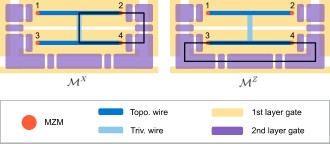
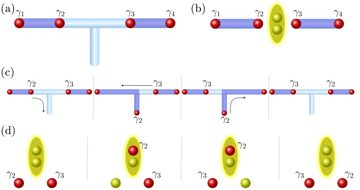
- Majorana 1 Microsoft paper press ▣ Fig. 3 (measurement sequence = braid of MZMs 1,2); §III Measurement-based braiding transformations ✅
- Majorana 2 Microsoft blog blog press ▥ 'Measurement-based operations are executed by determining the parity of topoconductor wires' ✅
Pictures
Every picture carries the story of what it shows and its credit line.
Measurement-based Majorana gate
Clifford gates generated by sequences of joint fermion-parity measurements instead of physical braiding; specified since 2008, never operated.
Verdict. Falsified as a gate mechanism unless a joint (X-basis) parity measurement with a stated error and any two-tetron operation both appear by end-2027; as of 4 Sep 2026 the count of gate operations is zero.
Λ = error-suppression factor per code-distance step; QBI = DARPA Quantum Benchmarking Initiative (Stage A concept → B R&D plan → C government V&V); G1–G7 = the report's goal classes (see Actors & economics).
Identity & lineage
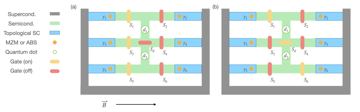
Braiding is replaced by a schedule of projective joint fermion-parity measurements. Bonderson, Freedman and Nayak showed in 2008 that an anyonic teleportation identity lets topological-charge measurements produce the braiding transformations S[475]; Karzig et al. made it hardware in 2017 — Cliffords read as differential-capacitance shifts of dots tunnel-coupled to Majorana zero modes (MZMs) S[421]. Every published measurement here is single-wire (Z-type); the two-wire joint measurement that is the gate has never been reported D[21].
a fabricated (1.0) · b gate time unmeasured, deterministic by intent · c no readout of its own
d static · e low-frequency control at room temperature · f error structure unknown · g MBE wire stack
Physics & limits
Fidelity is joint-measurement time over the lifetime of the basis projected, and that ratio is where the mechanism fails. The tetron's Z-loop parity lives 12.4 ms, the X loop, which a gate repeatedly projects, 14.5 µs, ~1000× shorter D[20], attributed to the larger quasiparticle-capture cross-section of the two-loop configuration: poisoning, not dephasing. At SNR 1 in 3.6 µs D[13] one X projection eats a fifth of that window, so a Clifford sequence has no margin. Operation is adaptive (next basis from last outcome), so feed-forward must close inside the same window; none has been published. Over trivial Andreev levels, meanwhile, a measurement sequence implements no braid at all D[23].
Engineering state of the art
table
No row is a gate: the 2026 result measured one nanowire of a multi-tetron array: no braid, no joint parity, no two-qubit operation, no entanglement, no T1/T2 D[21].
The arXiv HTML of [20] also gives an X loop of ~4 µs and a Z loop of ~9.3 ms for other tunings; the ~1000× ratio holds for both readings, the 14.5 µs / 12.4 ms point values do not. Not published: a dollar figure for DARPA's US2QC award to Microsoft, and any feed-forward latency, dot–wire coupling switching time or projected gate time for this mechanism.
Manufacturing, materials & supply chain
Nothing is fabricated for this mechanism alone: it consumes the InAs–Pb stack and the readout below it. The unbuilt part is control: per-tetron tunable dot–wire couplings, an rf loop per measurable parity, and a demodulator-to-bias path that must resolve inside the X window. At 10³ tetrons the line budget resembles transmon readout; the wall is latency, unquantified because no adaptive sequence has been attempted.
Role in the stack
Requires the Majorana-parity carrier (two wires per tetron) and quantum-capacitance readout; it would supply the topological architecture's entire Clifford layer. The only substitute is braiding in T-junction networks, geometry nobody is building. No derived clock: with no gate operated and no code on the architecture, sum of the syndrome round: gate layers + transport + readout + reset reduces to its readout term, ~3.6 µs D[13], reset unpublished. Verification is telegraph statistics, not benchmarks: no randomised benchmarking, tomography or Bell test exists. QuTech's independent single-shot parity readout (Nature 650, 2026-02-11) replicates the method on InSb dot chains, limited protection stated D[216]; Legg's Matters Arising (2026-06-24) argues the readout regions are disordered and gapless, so the signals may be trivial, and Microsoft's same-day reply concedes nothing D[23].
Actors & economics
Who.
| Organisation | Role | Country | What they do | Evidence |
|---|---|---|---|---|
| Microsoft Quantum | developer | US | Sole builder; tetrons, no gate | D[21] |
| DARPA | investor | US | US2QC final Validation & Co-Design stage since 2025-02-06, AFRL and Johns Hopkins APL evaluating; not a QBI Stage B performer | fact |
| QuTech | research | NL | Independent parity readout, not this gate | D[216] |
Money. 2025-02-06 · Microsoft · US2QC advances to its final Validation & Co-Design stage · undisclosed · DARPA · announced fact. 2026-01-23 · Microsoft · Quantum Pioneers Program · ≤ USD 200,000 per academic proposal for measurement-based topological computing · announced Pfact.
Market & supply chain. No market and no unit economics; only G3/G4 fault tolerance would pay, and only after a two-qubit result. Supply is internal to one company: concentration risk is total.
IP & standards. Microsoft's own published lineage S[421]; no dated patent count specific to this gate found as of 4 Sep 2026.
Roadmaps & track record. ("years not decades", promised 2025-02, for fault tolerance → restated as 2029 in 2026-06; status 4 Sep 2026: no joint measurement, no gate) C[215]; DARPA's utility-scale horizon is 2033 fact. Every annual Microsoft result has been readout; 2029 carries no X-measurement milestone.
Strategic reading. If measurement-only Cliffords work, Microsoft skips T-junction fabrication and owns the architecture; if not, the encoding, readout and epitaxy nodes below lose their only consumer.
Outlook & open questions
Falsifiable in 12–24 months: a first joint (X-basis) parity measurement with a stated assignment error; any operation or entanglement between two tetrons; a published X/Z ratio below 100×. Confirm on the first two; demote to theory if none lands by end-2027. Best case 2029, measurement-only Cliffords on a small array; worst case, X-basis poisoning is intrinsic to the two-loop geometry and the line closes. Open: is the asymmetry geometric or material; does anyone outside Microsoft attempt a joint measurement.
References
- [13] Microsoft Azure Quantum, “Interferometric single-shot parity measurement in InAs–Al hybrid devices,” Nature, vol. 638, no. 8051, pp. 651–655, Feb. 2025, doi: 10.1038/s41586-024-08445-2. D
- [20] M. Aghaee et al., “Distinct Lifetimes for X and Z Loop Measurements in a Majorana Tetron Device,” arXiv:2507.08795, Jul. 2025. D
- [21] M. Aghaee et al., “20 Second Parity Lifetime in an InAs–Pb Tetron Device,” arXiv:2606.03884, Jun. 2026. D
- [23] Microsoft Quantum, “Reply to: On the robustness of topological gap detection via transport,” Nature, vol. 654, no. 8120, pp. E27–E28, Jun. 2026, doi: 10.1038/s41586-026-10568-7. D
- [215] C. Nayak, “Majorana 2 – Microsoft's Scalable Quantum Processor With Reliable, Long-Lasting Qubits,” Microsoft Quantum. [Online]. Available: https://quantum.microsoft.com/
en-us/ Cinsights/ blogs/ majorana-2-scalable-quantum-processor - [216] N. van Loo et al., “Single-shot parity readout of a minimal Kitaev chain,” Nature, vol. 650, no. 8101, pp. 334–339, Feb. 2026, doi: 10.1038/s41586-025-09927-7. D
- [421] T. Karzig et al., “Scalable designs for quasiparticle-poisoning-protected topological quantum computation with Majorana zero modes,” Phys. Rev. B, vol. 95, no. 23, Art. no. 235305, Jun. 2017, doi: 10.1103/PhysRevB.95.235305. arXiv:1610.05289. S
- [475] P. Bonderson, M. Freedman, and C. Nayak, “Measurement-Only Topological Quantum Computation,” Phys. Rev. Lett., vol. 101, no. 1, Art. no. 010501, Jun. 2008, doi: 10.1103/PhysRevLett.101.010501. arXiv:0802.0279. S