Analogue Rydberg Hamiltonian evolution g_rydanalog
Global laser fields drive a programmable Rydberg Ising Hamiltonian on a whole tweezer array at once: the waveforms Ω(t), Δ(t), a fixed local-detuning pattern and the atom geometry are the program, and there is no discrete gate.
Analogue Rydberg Hamiltonian evolution
Global laser fields drive a programmable Ising/XY Hamiltonian on the whole array at once — no discrete entangling gate, no circuit; the geometry of the tweezer pattern is the program.
Brief →Key references
Design space — attributes
- (a) carrier affinity
- natural
- (b) time · entangling
- —
- (c) readout
- —
- (d) mobility
- —
- (e) control
- optical @ room temperature
- (f) error structure
- coherent / calibration, loss (erasure)
- (g) manufacturing
- optical / mechanical assembly
Evaluation space — dated attributes
no dated attribute
Figures of merit are the many-body coherence time, the number of atoms and the range of programmable geometries, not a gate fidelity.
Actors & goals — annotations
Edges
Used by 3 machines (2 primary · 1 alternate)
- neutral atoms 3
- Fresnel / Fresnel 2 Pasqal ▣ Fig. 6b (analog processing under a global laser beam); Fig. 6a-b (digital vs analog processing); §2.2.2 Analog quantum processing ✅
- Aquila QuEra paper press ▣ Fig. 1.7 (example analog program defined by Ω(t), Δ(t) etc.); Fig. 1.8 (Rydberg blockade mechanism); §1.3 The Rydberg Hamiltonian; §Key ingredient: Photonics, lasers, and analog control ✅
- Orion Alpha / Beta ("Ruby") / Gamma Pasqal product page press press ▦ §AnalogDevice 🔎 (alternate)
Pictures
Every picture carries the story of what it shows and its credit line.
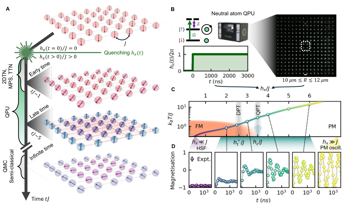
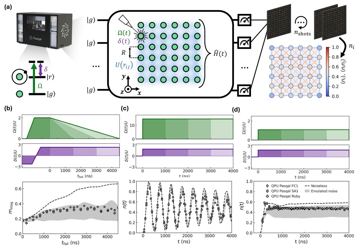
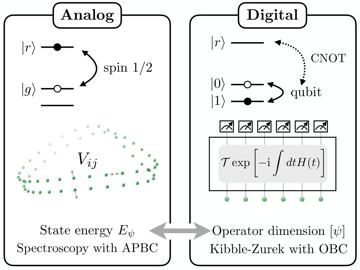
Analogue Rydberg Hamiltonian evolution
Global laser fields drive a programmable Rydberg Ising Hamiltonian on a whole tweezer array at once: the waveforms Ω(t), Δ(t), a fixed local-detuning pattern and the atom geometry are the program, and there is no discrete gate.
Verdict. Demonstrated to 256–289 atoms and productive for many-body physics, but graded by observables, not gate error: the reference many-body fidelity benchmark reports 0.095 at 60 atoms on an academic Sr machine, the register holds no fidelity figure for Aquila or Fresnel as of 2026-09-26, and the mode admits no error correction.
Λ = error-suppression factor per code-distance step; MIS = maximum independent set; SA = simulated annealing; Fd = cross-entropy-type many-body fidelity estimator; MPS = matrix-product state (χ = bond dimension); AHS = analog Hamiltonian simulation, Amazon Braket's program type; G1–G7 = the report's goal classes (see Actors & economics).
Identity & lineage
The array evolves under one Hamiltonian, H/ℏ = Σᵢ (Ω(t)/2) σˣᵢ − Σᵢ [Δ(t) + hᵢ Δ_loc(t)] nᵢ + Σ_{i<j} C₆ r_ij⁻⁶ nᵢ nⱼ: global waveforms, one static site pattern hi, couplings fixed by atom positions C[262]C[429]. Technology g_ryd uses the same blockade for a two-atom CZ inside a circuit; here it acts on all pairs for the whole run, and the output is a bit-string sample. Technology g_anneal, the rf-SQUID flux annealer, sets couplings with programmable on-chip couplers D[430]; here geometry is the coupling matrix, and blockade confines the dynamics to independent sets of a unit-disk graph, the basis of MIS encoding D[431]. Lineage: 51 atoms in 1D, Harvard/MIT, 2017 D[384]; Pasqal's 2020 architecture naming analogue "Hamiltonian sequences" beside circuits D[385]; Aquila on Amazon Braket C[262].
Attributes: natural carrier; no step time (one evolution, ≤4 µs on Aquila); readout inherited; no mobility during the program; optical control at room temperature; coherent and loss errors; optics manufacturing.
Physics & limits
Aquila: Ω ≤ 15.8 rad/µs, |Δ| ≤ 125 rad/µs, C6 = 5,420,503 µm⁶ rad/µs (70S), spacing ≥4 µm, program ≤4 µs, T2* 5.8 µs, driven T2 7.5 µs C[262]: a blockade radius (C6/Ω)1/6 ≈ 8.4 µm at full drive, and a program of ~half the driven T2, ~10 Rabi periods S. Named error terms: laser amplitude and phase noise; thermal motion (Doppler, 0.200 µm position spread); scattering via the intermediate state, which continues with the drive off; detuning inhomogeneity, 0.37 rad/µs RMS across the field and 0.18 rad/µs shot-to-shot C[262]. Via r⁻⁶ the position spread gives ~30% shot-to-shot spread of a 5.5 µm bond (δV/V = 6δr/r) S — harmless deep in blockade, decisive where V ≈ Ω, which selects the ordered phase. Local detuning is a fixed pattern with a waveform ≤0, and programs using it decohere faster than the listed T2 C[429]. Errors integrate coherently over a run with no point to measure a syndrome, so no code acts S; erasure detection on Sr raised a Bell-pair fidelity bound from ≥0.9971 to ≥0.9985 by discarding flagged shots D[143] — post-selection, not correction.
Interaction time, not atom number, caps analog Rydberg programs at a few microseconds. Two laser-trapped circular Rydberg atoms (long-lived states of maximal angular momentum) at Laboratoire Kastler Brossel, Paris, sustained spin exchange for more than 60 µs and 40 oscillation periods, with a decay time of 59 µs, about ten times the previous record; the oscillation contrast is post-selected (79% against 33% raw) P[899].
Engineering state of the art
table
| Year | Figure | Who | Tag+key |
|---|---|---|---|
| 2017-11 | 51 atoms, 1D; Z₂ order, oscillations after quench | Harvard/MIT | D[384] |
| 2021-07 | 64–256 atoms, 2D; (2+1)D Ising transition | Harvard/MIT | D[432] |
| 2021-07 | Up to 196 atoms, square and triangular antiferromagnets | Institut d'Optique | D[433] |
| 2021-12 | 219 atoms on kagome links; topological spin liquid | Harvard/MIT | D[434] |
| 2022-06 | Up to 289 atoms; MIS, superlinear speed-up vs SA | Harvard-led | D[435] |
| 2024 | 60 Sr atoms; Fd = 0.095(11) at saturated entanglement | Caltech | D[436] |
| 2025-06-04 | (2+1)D string breaking on Aquila | QuEra et al. | D[226] |
Above ~100 atoms nothing is checked exactly: the 196-atom work matched numerics only to ~100 D[433]. The 2022 speed-up did not survive: classical solvers reach optimality on the same Union-Jack-like instances to thousands of nodes within minutes D[431]. Pasqal offers a 100-qubit analogue QPU on Google Cloud (2025-05-13) C[437]; no Fresnel datasheet like Aquila's was found as of 2026-09-26.
Manufacturing, materials & supply chain
No wafer; optical assembly shared with the digital atom architectures. Orion Gamma: 140 qubits, room temperature, 3 kW average, 5 µm minimum spacing C[438]. The analogue-specific addition is a site-resolved detuning field whose hardware QuEra has not described C[439]; nothing else in the sources separates the analogue bill of materials from the digital one S.
Control, readout & I/O burden
Control is independent of N: a few waveforms, one pattern and a geometry C[262]. The cost moves to readout and repetition. Aquila misreads 8% of Rydberg and 1% of ground atoms and leaves 0.7% of sites empty C[262], so a 256-site snapshot, half excited, reads error-free with probability 0.92¹²⁸×0.99¹²⁸ ≈ 6×10⁻⁶, and ~17% of shots have a defect-free register S. Shots run below 10 Hz on Aquila C[262] and at ≥0.25 Hz effective on Orion Gamma C[438]: 10⁴ shots take ≥17 min to ~11 h S.
Role in the stack
Slot 3 of the "Neutral-atom analogue simulator (Rydberg arrays, lattice gases)" architecture (alkali atom → ground–Rydberg analogue qubit → this technology → AOD transport → laser + AOD/SLM control → fluorescence imaging; layers 7–9 empty; optical assembly), serving G1. It requires the alkali atom, the ground–Rydberg encoding and global Rydberg lasers; it provides nothing upward; it replaces nothing and is replaced by g_ryd when a machine turns digital. Register: Aquila (QuEra, 256 sites) and Fresnel/Fresnel 2 (Pasqal, 100 qubits) carry it as primary, both ✅; Pasqal's Orion line carries it as alternate on the "Rydberg tweezer array — alkali (Rb/Cs)" architecture, 🔎. The gap ledger proposed the alkali and alkaline-earth(-like) array architectures; the technology got its own architecture, and no alkaline-earth(-like) register machine runs it, though the fidelity benchmark above used Sr D[436] — the requires-alkali edge is narrower than the physics.
Evidence — how the numbers were measured
With no gate error, fidelity comes from observables: order parameters against numerics, valid to ~100 atoms D[433]; Fd, which weights measured bit-strings by simulated probabilities — 0.095(11) at 60 atoms, where a lightcone MPS at χ* = 3400 (~110 GB, ~180 core-days) keeps pace D[436]; and problem output such as MIS size, cheap to validate but not to prove optimal D[431]. Fd needs classical probabilities, so what it certifies can be simulated. Λ is undefined. The Orion cell stays 🔎: its cited page (2026-01-29) mentions local detuning for materials simulation and a 2026 Vela with over 256 qubits, but not analogue mode, MIS, Orion or ≤100 qubits C[390].
Aquila's continued Braket service is inferred from QuEra's 2026-06-15 release, which does not state it. Not published: the hardware mechanism of Aquila's local detuning (light-shift beam or otherwise), whose magnitude, resolution and per-site calibration error appear only as Braket SDK device properties; a Rydberg lifetime or atom-loss rate during evolution for Aquila; and a Fresnel datasheet (Ω, Δ, T2, detection errors).
Actors & economics
Who.
| Organisation | Role | Country | What exactly they do with this technology | Evidence |
|---|---|---|---|---|
| QuEra Computing | developer | US | Aquila, 256 sites, on Braket since 2022 | C[162] |
| Pasqal | developer | FR | 100-qubit analogue QPU; analogue mode on Orion | C[437] |
| Amazon Web Services | cloud channel | US | Aquila local detuning by request, 2024-04-11 | C[440] |
| Harvard/MIT | research | US | 51- to 289-atom experiments | D[435] |
| Caltech | research | US | Fd benchmark, 60 Sr atoms | D[436] |
Money.
- 2025-09-09 · QuEra · Series B extended, NVentures joins · USD 230 M · announced; aimed at fault tolerance C[153]
- 2026-08-28 · Pasqal · SPAC merger, Nasdaq PSQL · ~USD 360 M cash · closed P[156]
Market & supply chain. Two vendors, two cloud channels. Pasqal reports seven QPUs deployed and markets its platform as analogue today P[156]; QuEra's analogue offer is one machine. It pays into G1 only.
IP & standards. No analogue-specific patent count as of 2026-09-26; the program format is cloud-defined (Braket AHS) C[429]; no standards body.
Roadmaps & track record. Pasqal promised 10,000 physical qubits for 2026 (2024-03-13) R[167]; its 2026 launch is Vela, over 256 qubits R[390] — ~39× short S — and its brochure says delivery 2027, 200+ C[438]. QuEra's Libra (2028) is digital, with no analogue specification R[162].
Strategic reading. Analogue is both vendors' revenue bridge while g_ryd matures. With certified advantage above ~100 atoms it stays a G1 instrument; without, it becomes a mode of digital machines, as on Orion.
Outlook & open questions
Confirm if, by 2027-12-31, a commercial analogue machine publishes a many-body fidelity at ≥60 atoms, or an analogue result survives a year of classical challenge; demote if Vela and QuEra's next systems ship without analogue specifications. Open questions. (1) Can Fd certify beyond the size where MPS keeps pace? (2) What are per-site local-detuning calibration errors? (3) How does driven-T2 loss split between phase noise, Doppler and scattering? (4) Can erasure excision post-select many-body runs at tolerable shot cost? (5) Will the requires-alkali edge survive alkaline-earth(-like) analogue machines?
A benchmark that needs no per-atom addressing has been proposed for it: prepare U†AU with a global y-rotation A and probe with a collective z-rotation; the quantum Fisher information (how sharply the output responds to the probe angle) grows with the number of atoms for Haar-random-like dynamics and is exactly zero for Clifford circuits, so circuit randomness can be graded without computing ideal output probabilities, provided the evolution can also be run backwards (U†) P[892]. It is a theory proposal, not yet run on an analog array.
References
- [143] P. Scholl, A. L. Shaw, R. B.-S. Tsai, R. Finkelstein, J. Choi, and M. Endres, “Erasure conversion in a high-fidelity Rydberg quantum simulator,” Nature, vol. 622, p. 273, 2023, doi: 10.1038/s41586-023-06516-4. arXiv:2305.03406. D
- [153] QuEra Computing, “QuEra Expands $230 Million Financing Round Advancing Quantum-Accelerated Supercomputing,” Sep. 9, 2025. [Online]. Available: https://www.quera.com/
press-releases/ Cquera-expands-230-million-financing-round-advancing-quantum-accelerated-supercomputing - [156] M. Swayne, “Pasqal Completes SPAC Merger With $360 Million in Cash,” The Quantum Insider, Aug. 28, 2026. [Online]. Available: https://thequantuminsider.com/
2026/ P08/ 28/ pasqal-completes-spac-merger-with-360-million-in-cash/ - [162] QuEra Computing, “QuEra Announces 2028 Fault-Tolerant Quantum Computer and Expanded Multi-Year Strategic Collaboration with AWS,” Jun. 15, 2026. [Online]. Available: https://www.quera.com/
press-releases/ Cquera-announces-2028-fault-tolerant-quantum-computer-and-expanded-multi-year-strategic-collaboration-with-aws - [167] J. Russell, “PASQAL Issues Roadmap to 10,000 Qubits in 2026 and Fault Tolerance in 2028,” HPCwire, Mar. 13, 2024. [Online]. Available: https://www.hpcwire.com/
2024/ R03/ 13/ pasqal-issues-roadmap-to-10000-qubits-in-2026-and-fault-tolerance-in-2028/ - [226] D. González-Cuadra et al., “Observation of string breaking on a (2 + 1)D Rydberg quantum simulator,” Nature, vol. 642, no. 8067, pp. 321–326, Jun. 2025, doi: 10.1038/s41586-025-09051-6. D
- [262] J. Wurtz et al., “Aquila: QuEra's 256-qubit neutral-atom quantum computer,” arXiv:2306.11727, Jun. 2023. C
- [384] H. Bernien et al., “Probing many-body dynamics on a 51-atom quantum simulator,” Nature, vol. 551, pp. 579–584, Nov. 2017, doi: 10.1038/nature24622. arXiv:1707.04344. D
- [385] L. Henriet et al., “Quantum computing with neutral atoms,” Quantum, vol. 4, Art. no. 327, Sep. 2020, doi: 10.22331/q-2020-09-21-327. arXiv:2006.12326. D
- [390] L. Garbini, “Inside Pasqal's 2026 Vision on Quantum for Industry and Research,” Pasqal, Jan. 29, 2026. [Online]. Available: https://www.pasqal.com/
blog/ Cinside-pasqals-2026-vision-on-quantum-for-industry-and-research/ - [429] Amazon Web Services, “Explore Experimental Capabilities - Amazon Braket,” Amazon Braket Developer Guide. [Online]. Available: https://docs.aws.amazon.com/
braket/ Clatest/ developerguide/ braket-access-local-detuning.html - [430] P. I. Bunyk et al., “Architectural considerations in the design of a superconducting quantum annealing processor,” arXiv:1401.5504, Jan. 2014. D
- [431] R. S. Andrist et al., “Hardness of the Maximum Independent Set Problem on Unit-Disk Graphs and Prospects for Quantum Speedups,” Phys. Rev. Research, vol. 5, no. 4, Art. no. 043277, 2023, doi: 10.1103/PhysRevResearch.5.043277. arXiv:2307.09442. D
- [432] S. Ebadi et al., “Quantum Phases of Matter on a 256-Atom Programmable Quantum Simulator,” Nature, vol. 595, p. 227, Jul. 2021, doi: 10.1038/s41586-021-03582-4. arXiv:2012.12281. D
- [433] P. Scholl et al., “Programmable quantum simulation of 2D antiferromagnets with hundreds of Rydberg atoms,” Nature, vol. 595, p. 233, Jul. 2021, doi: 10.1038/s41586-021-03585-1. arXiv:2012.12268. D
- [434] G. Semeghini et al., “Probing Topological Spin Liquids on a Programmable Quantum Simulator,” Science, vol. 374, p. 1242, Dec. 2021, doi: 10.1126/science.abi8794. arXiv:2104.04119. D
- [435] S. Ebadi et al., “Quantum Optimization of Maximum Independent Set using Rydberg Atom Arrays,” Science, vol. 376, p. 1209, Jun. 2022, doi: 10.1126/science.abo6587. arXiv:2202.09372. D
- [436] A. L. Shaw et al., “Benchmarking highly entangled states on a 60-atom analog quantum simulator,” Nature, vol. 628, pp. 71–77, 2024, doi: 10.1038/s41586-024-07173-x. arXiv:2308.07914. D
- [437] Pasqal, “Pasqal's Neutral-Atom Quantum Computer Available on Google Cloud Marketplace,” May 13, 2025. [Online]. Available: https://www.pasqal.com/
newsroom/ Cpasqals-neutral-atom-quantum-computer-available-on-google-cloud-marketplace/ - [438] Pasqal and O. Q.-C. P. brochure, “The Power of Neutral Atom Quantum Processors by Pasqal — Unlock Quantum Computing for Real-World Solutions,” Pasqal, product brochure (PDF). [Online]. Available: https://www.pasqal.com/
wp-content/ Cuploads/ 2025/ 11/ 2509_Pasqal_Quantum-Computing-Processor_Brochure-RVB-V8.pdf - [439] QuEra Computing, “Local Qubit Control Brings New Capabilities to QuEra's Quantum Computer,” Apr. 17, 2024. [Online]. Available: https://www.quera.com/
press-releases/ Clocal-qubit-control-brings-new-capabilities-to-queras-quantum-computer - [440] Amazon Web Services, “Local detuning now available on QuEra's Aquila device with Braket Direct,” AWS What's New, Apr. 11, 2024. [Online]. Available: https://aws.amazon.com/
about-aws/ Cwhats-new/ 2024/ 04/ amazon-braket-experimental-capabilities-quera-device-braket-direct/ - [892] S. Cavazzoni and C. Oh, “Metrological benchmarking of random quantum circuits,” arXiv:2609.39226, Sep. 2026. P
- [899] A. Durán-Hernández et al., “Spin-exchange interactions between circular Rydberg atoms over long times,” arXiv:2609.37766, Sep. 2026. P