Laser + AOD/SLM optical control (atoms) ct_laser
Free-space lasers, holographic modulators and acousto-optic deflectors generate, move, image and drive the optical-tweezer arrays that hold neutral-atom qubits.
Laser + AOD/SLM optical control (atoms)
SLM-generated tweezer arrays (12,000 sites), AOD moves, Rydberg lasers; 33 W for 18,225 tweezers; the binding constraint above 10⁴ sites is the AOD time–bandwidth product, not an SLM refresh rate.
Brief →Key references
Design space — attributes
- (a) carrier affinity
- natural
- (b) time · entangling
- —
- (c) readout
- —
- (d) mobility
- —
- (e) control
- optical @ room temperature
- (f) error structure
- coherent / calibration
- (g) manufacturing
- optical / mechanical assembly
Evaluation space — dated attributes
The '~10 MHz SLM refresh' sometimes quoted is unsourced: LCOS panels frame at tens of hertz, and deflector reconfiguration is bounded by acoustic transit. The only end-to-end vendor loop figure is QuEra Gemini: one shot per second at 260 qubits.
Standard records
Actors & goals — annotations
Edges
Used by 25 machines (25 primary · 0 alternate)
- neutral atoms 25
- Magne Atom Computing + Microsoft, for QuNorth press press ▨ 🔎
- Phoenix (Gen-1) and Gen-2 Atom Computing press press ▤ §II (register/interaction zones); SM §SII (1Q gates) 🔎
- 6,100-qubit tweezer array Caltech (Endres group) paper paper press ▣ Fig. 1c (SLM/objective schematic); Fig. 4d (global RB, Clifford fidelity 0.999834(2)); Methods: Tweezer generation ✅
- Hanyuan-1 Zhongke Kuyuan (Wuhan, CAS) press press ▨ 🔎
- Hanyuan-2 Zhongke Kuyuan (Wuhan, CAS) press press ▨ 🔎
- 448-atom fault-tolerant processor Harvard / MIT / QuEra paper press ▤ Methods: System overview ✅
- continuously reloaded 3,000-atom machine Harvard / MIT paper paper ▣ Extended Data Fig. 3a (optical beam paths for tweezer generation and single-atom imaging); Methods: Tweezer Generation; Methods: Control System and Timing ✅
- QUIONE ICFO - Institut de Ciencies Fotoniques press ▤ abstract ✅
- Infleqtion Illinois neutral-atom quantum computer (IQMP, Chicago) Infleqtion press ◌ 🔎
- Sqale Infleqtion press ▤ Methods: Qubit array generation (AODs driven by OPX+ multi-tone RF) 🔎
- 72-qubit neutral-atom (Rb) quantum computer prototype (50 qubits in Dec 2024) Lomonosov Moscow State University with the Russian Quantum Center ▨ 🔎
- Pasqal Centaurus Pasqal product page press ▦ 🔎
- Fresnel / Fresnel 2 Pasqal ▣ Fig. 3a (trapping laser shaped by SLM; moving tweezers via 2D AOD and PBS); Fig. 2 (register actuators and processing actuators) ✅
- Pasqal Lyra Pasqal press ▦ 🔎
- Orion Alpha / Beta ("Ruby") / Gamma Pasqal product page press press ▤ § The Neutral Atom Architecture 🔎
- Vela Pasqal blog ▦ §Next-Gen of Pasqal's Quantum Computers (local detuning; no cryogenics; HPC integration) ✅
- DiNAQC planqc, for the DLR Quantum Computing Initiative product page press link ▦ project description ✅
- MAQCS planqc press ▨ 🔎
- metastable Yb-171 erasure array Princeton (Thompson group) paper paper paper ▣ Fig. 1a (SLM static traps, orthogonal AODs, FPGA, 302 nm Rydberg beam); §II ✅
- Qinghe-1 (Qinghe No. 1, 清河一号) Zhongqi Wuliang (Shanghai, CAS SIOM spin-off) press press ▨ 🔎
- Aquila QuEra paper press ▣ Fig. 1.2 (functional block diagram: six laser wavelengths focused on the vacuum cell); Fig. 1.1 (optical elements, lasers, cameras); §Key ingredient: Photonics, lasers, and analog control ✅
- Gemini-class QuEra paper product page ▣ Extended Data Fig. 2 (SLM/AOD trap arrays); Methods: System overview ✅
- Libra QuEra press ▨ 🔎
- Quantum X Labs neutral-atom platform (50+ qubits, claimed) Quantum X Labs Inc. (Nasdaq: QXL) press link ▨ 🔎
- neutral-ytterbium QPU Yaqumo (+ Fujitsu) press press ▨ 🔎
Pictures
Every picture carries the story of what it shows and its credit line.

Laser + AOD/SLM optical control (atoms)
Free-space lasers, holographic modulators and acousto-optic deflectors generate, move, image and drive the optical-tweezer arrays that hold neutral-atom qubits.
Verdict. This layer, not the 270 ns gate, sets the neutral-atom clock: imaging plus transport keep the QEC round at 1–4.5 ms as of 4 Sep 2026, and trap power scales linearly at ~0.67 mW per site.
Λ = error-suppression factor per code-distance step; QBI = DARPA Quantum Benchmarking Initiative (Stage A concept → B R&D plan → C government V&V); G1–G7 = the report's goal classes (see Actors & economics).
Identity & lineage
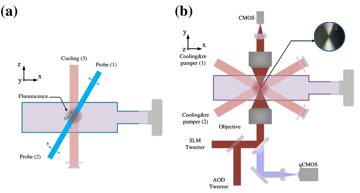
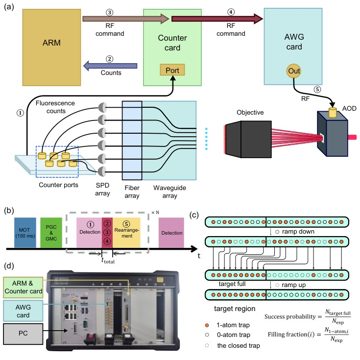
A holographic modulator splits one beam into a static lattice of tweezer foci; crossed acousto-optic deflectors, driven by multi-tone rf, steer individual traps; further lasers cool, image and drive the hyperfine and Rydberg transitions. Modulators frame at tens of hertz, static within a shot, so fast motion belongs to the deflectors or to optical-lattice conveyors. Endres set the pattern in 2016 — real-time control of 100 tweezers building defect-free arrays of over 50 atoms in under 400 ms D[577] — and that measure-decide-move-verify loop is still the clock.
- e/f: entirely optical, room temperature, outside the vacuum cell; errors are coherent — pointing, hologram phase, rf intermodulation.
- d/g: connectivity comes from deflector transport, built of free-space optics.
Physics & limits
Two hard laws govern this layer. Trap power is linear in site count: Tsinghua's 18,225-site array takes 33 W incident, 12.2 W effective, ~0.67 mW per trap D[145], so 10⁶ sites implies about a kilowatt of trapping light before any imaging or Rydberg beam. And a deflector's resolvable-spot count is its rf bandwidth times the acoustic transit across the beam, while that transit lower-bounds how fast a trap is re-pointed: more sites and faster moves pull against each other in one device. Neither is a "refresh rate". The consequence is the clock: imaging at 0.5–1 ms and transport at hundreds of µs give QEC rounds of 1–4.5 ms against 270 ns gates D[4]. Failure modes are systematic: trap-depth non-uniformity, pointing drift, tone intermodulation. Faster imaging moves the floor — 17.6 µs readout at 99.89(5)% discrimination on ytterbium P[261], ~50× off the dominant term.
Engineering state of the art
Largest array: 11,022 rubidium atoms in an 18,225-site grid from a 19.8 mm metasurface outside the vacuum cell — no gates, no coherence, 60.5% filling before rearrangement D[145]. Best sustained operation: 3,217 atoms at 99.3% filling beyond two hours, reloading 300,000 atoms per second for 30,000 initialised qubits per second, moved by optical-lattice conveyors, not deflectors D[144]. Typical at scale is far smaller: the 448-atom architecture, where imaging and transport set a 1–4.5 ms round D[4]. Dominant limit: measurement and motion latency, not trap count or power.
table
| Year | Figure | Who | Tag+key |
|---|---|---|---|
| 2025-09 | 3,217 atoms, >2 h, 30,000 initialised qubits/s | Harvard | D[144] |
| 2026-06 | 18,225 metasurface traps, 11,022 atoms, 0.67 mW/site | Tsinghua | D[145] |
| 2026-07 | 2,000 tweezers from 20 W, 3.5 µm pitch, sub-100 nm | Fraunhofer ILT | P[578] |
| 2026-08 | 17.6 µs imaging, 99.89(5)% discrimination, 98.80(44)% survival | Kyoto | P[261] |
A chip-scale alternative to the frequency-reference chain was shown in 2026: a 780 nm Si₃N₄ microcomb (a chip resonator that turns one pump laser into a comb of evenly spaced, mutually coherent lines) locked to an ⁸⁵Rb transition held its pump drift to the 100 kHz level over 2,000 s, and because the comb is coherent the lock disciplines every line at once. One line, amplified to 102 mW and delivered through free space, formed an optical lattice 4.2 recoil energies deep and a Raman coupling of 0.7 recoil energies on an ⁸⁷Rb Bose–Einstein condensate P[886]. One channel was demonstrated; sharing the reference across many channels is the authors' projection.
Manufacturing, materials & supply chain
No wafer: commodity and semi-custom free-space optics integrated by hand — yet the concentration is severe. Only two deflector vendors appear in the sourced literature, AA Opto-Electronic (DTSX-400, in the 448-atom system) and Gooch & Housego Dfact, and Hamamatsu supplies both modulator and camera with no alternative identified Cfact — the two real single points of failure. A June-2026 alliance of Hamamatsu, NKT Photonics and Yaqumo is the first attempt to industrialise the tier, aimed at a sensing market projected at $3.5–7.9B P[335]. Tsinghua's metasurface points the other way: a lithographic element replacing the objective is the one step that could become semiconductor manufacturing D[145]. No export-control category names tweezer optics; exposure runs via ECCN 4A906 fact.
Control, readout & I/O burden
One optics chain serves the whole array, so the burden is bandwidth and optical power, not lines per qubit — the inverse of the superconducting problem, and why atom counts scale while clocks do not. At 10³ sites full fault-tolerant loops run today D[4]. At 10⁴ the binding constraint is the measure-rearrange-verify cycle: 11,022 atoms trapped against 448 under logical control. Nothing exists at 10⁶. The only end-to-end control-loop figure a vendor publishes is QuEra's Gemini repetition rate: one shot per second at 260 qubits C[137].
Role in the stack
This layer underlies all three neutral-atom architectures — the alkali (QuEra, Pasqal, Infleqtion, Google) and alkaline-earth(-like) (Atom Computing/Microsoft, Caltech) Rydberg tweezer arrays and the neutral-atom analogue simulator — supplying the Rydberg drive and deflector transport that the gate and zoned-connectivity mechanisms consume. It replaces photonic-integrated trap control, trading chip-scale integration for free-space flexibility. Nearly every neutral-atom mechanism sits on it. Derived clock = sum of the syndrome round: gate layers + transport + readout + reset ≈ 1.31 ms, transport 0.80 ms of it, against a measured 1–4.5 ms round — set entirely here. Empty neighbouring slot: an integrated optical control plane keeping deflector flexibility.
Evidence — how the numbers were measured
Trap counts and filling come from direct fluorescence imaging and are not disputed, but they are compared across incompatible boundaries: 11,022 trapped atoms and 448 qubits under fault-tolerant control measure different things, and filling is quoted before rearrangement (60.5% D[145]) or after (99.3% D[144]) unlabelled. Latency figures are architectural, measured inside one group's system and never reproduced, and the metasurface and 2,000-tweezer results are each single-group.
The €65k-per-atom figure is derived from one order, not a price list. Not published: named customers of the Hamamatsu, NKT Photonics and Yaqumo alliance; the vacuum lifetime and any coherence measurement for the 18,225-site metasurface array; and any cost breakdown below system level.
Actors & economics
Who.
| Organisation | Role | Country | What exactly they do with this technology | Evidence |
|---|---|---|---|---|
| QuEra Computing | developer | USA | Sells Gemini: 260 atoms, one shot per second | C[137] |
| Atom Computing | developer | USA | Ytterbium platform; builds Magne with Microsoft | C[154] |
| Pasqal | developer | France | Rydberg tweezer systems; SPAC-listed Aug 2026 | P[156] |
| Hamamatsu Photonics | supplier | Japan | Modulators and qCMOS cameras | P[335] |
| AA Opto-Electronic | supplier | France | Crossed AODs for tweezer transport | Dfact |
Money.
| Date | Actor | Event | Amount | Programme / lead | Status |
|---|---|---|---|---|---|
| 2025-07-17 | QuNorth | Magne order, 1,225 physical | €80M | Atom Computing, Microsoft | ordered Cfact |
| 2025-09-09 | QuEra | financing round | $230M+ | Google, SoftBank Vision Fund 2 | closed C[153] |
| 2025-11-06 | DARPA | QBI Stage B: Atom Computing, QuEra | ≤$15M | QBI | official fact |
| 2026-06-16 | Atom Computing | Series C plus CHIPS LOI | $100M + $100M | Third Point; US Commerce | closed+LOI C[154] |
| 2026-08-28 | Pasqal | SPAC close | ~$360M cash, 2025 revenue €16.5M | — | closed P[156] |
Market & supply chain. Two deflector vendors and one camera-and-modulator vendor against a laser field with real alternatives (NKT, TOPTICA, Coherent): the concentration sits in deflectors and cameras, small unlisted businesses under four venture-funded platforms. Unit economics are quotable at system level — QuNorth's €80M for 1,225 atoms is ~€65k per atom, two orders below a trapped-ion delivery per ion Pfact, because tweezer optics amortise across sites. It pays for G1, is a prerequisite for G3, blocks G4 until the millisecond cycle falls.
IP & standards. No patent family specific to tweezer control surfaced: the technique descends from open literature and the entrants are spin-outs of the groups that published it. Vendor IP sits in the deflector and modulator products, not quantum-specific; PatSnap's counts are not disaggregated here Pfact. No litigation, no standards body.
Roadmaps & track record. QuEra (2024, for 100 logical in 2026) — retargeted to "Libra" in 2028, a two-year slip, no control-hardware change announced. Atom Computing with Microsoft (2025-07, for 50 logical in Magne at the turn of 2026/27) — installing as of 4 Sep 2026, the field's only firm delivery date. Pasqal (2024, for 10,000 physical in 2026) — slipped to 2028, now funded. Infleqtion (2025-09, for 1,000 logical by 2030) — capitalised, no latency figure. Google (2026-03) — staffed, no milestone.
Strategic reading. If this layer industrialises the winner is whoever consolidates the optics tier, not a platform company: a supplier owning deflectors, modulators and cameras prices against every neutral-atom vendor at once, which is what the Hamamatsu alliance is positioned to become. The platforms' counter is integration — metasurfaces and trap chips pulling optics onto a wafer. If the millisecond cycle holds they lose together: atom counts already exceed what anyone can control, so latency is the differentiator, and superconducting rivals hold three orders on clock.
Outlook & open questions
Confirm/demote in 12–24 months: a QEC round below 1 ms above 10³ sites; a second group replicating the metasurface array or the 17.6 µs imaging; Magne benchmarked at 50 logical qubits. Best case 2029: fast imaging and conveyor transport cut the round to ~100 µs, removing the clock disadvantage. Worst case: latency stays at milliseconds, arrays large, cheap and slow. Open: is the deflector bandwidth-transit trade engineering or a hard limit; can fast imaging survive at 10⁴ sites; will anyone second-source the deflectors. Watch Magne's acceptance tests.
References
- [4] D. Bluvstein et al., “A fault-tolerant neutral-atom architecture for universal quantum computation,” Nature, vol. 649, no. 8095, pp. 39–46, Nov. 2025, doi: 10.1038/s41586-025-09848-5. arXiv:2506.20661. D
- [137] QuEra Computing Inc., “Gemini-Class Gate-Model Quantum Computer.” [Online]. Available: https://www.quera.com/
gemini C - [144] N.-C. Chiu et al., “Continuous operation of a coherent 3,000-qubit system,” Nature, vol. 646, no. 8087, pp. 1075–1080, Sep. 2025, doi: 10.1038/s41586-025-09596-6. D
- [145] Y. Wang et al., “Trapping 11,000 Atoms in a Tweezer Array Generated by a Single Metasurface,” arXiv:2606.02715, Jun. 2026. D
- [153] QuEra Computing, “QuEra Expands $230 Million Financing Round Advancing Quantum-Accelerated Supercomputing,” Sep. 9, 2025. [Online]. Available: https://www.quera.com/
press-releases/ Cquera-expands-230-million-financing-round-advancing-quantum-accelerated-supercomputing - [154] Atom Computing, “Atom Computing Raises More Than $300 Million to Accelerate Deployment of Fault-Tolerant, Neutral-Atom Quantum Computers,” PR Newswire, Jun. 16, 2026. [Online]. Available: https://www.prnewswire.com/
news-releases/ Catom-computing-raises-more-than-300-million-to-accelerate-deployment-of-fault-tolerant-neutral-atom-quantum-computers-302800832.html - [156] M. Swayne, “Pasqal Completes SPAC Merger With $360 Million in Cash,” The Quantum Insider, Aug. 28, 2026. [Online]. Available: https://thequantuminsider.com/
2026/ P08/ 28/ pasqal-completes-spac-merger-with-360-million-in-cash/ - [261] R. Yokoyama et al., “Minimally Destructive Fast Imaging of Single Atoms in an Optical Tweezer Array with Coherent Excitation,” arXiv:2605.24175, Jun. 2026. Also https://arxiv.org/
abs/ . P2605.24175 - [335] M. Abdel-Kareem, “Hamamatsu Photonics, NKT Photonics, and Yaqumo Form Alliance to Industrialize Cold-Atom Quantum Core Components,” Quantum Computing Report, Jun. 4, 2026. [Online]. Available: https://quantumcomputingreport.com/
hamamatsu-photonics-nkt-photonics-and-yaqumo-form-alliance-to-industrialize-cold-atom-quantum-core-components/ P - [577] M. Endres et al., “Cold Matter Assembled Atom-by-Atom,” arXiv:1607.03044, Jul. 2016. D
- [578] M. Swayne, “Fraunhofer ILT Develops Laser System for 2,000-Qubit Neutral-Atom Quantum Computer,” The Quantum Insider, Jul. 8, 2026. [Online]. Available: https://thequantuminsider.com/
2026/ P07/ 08/ fraunhofer-ilt-develops-laser-system-for-2000-qubit-neutral-atom-quantum-computer/ - [886] W. Sun et al., “A photonic integrated comb engine for ultracold quantum gases,” arXiv:2609.28294, Sep. 2026. P