Room-temperature electronics + per-qubit coax/flex ct_rt
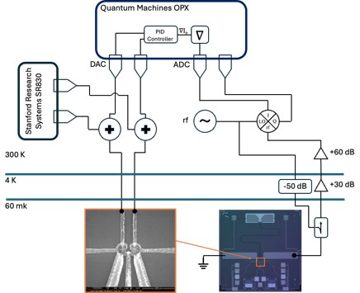
One coherent line per drive, flux and readout port runs from room-temperature racks through attenuated coax or flex cable into the mixing chamber.
Room-temperature electronics + per-qubit coax/flex
One rf line per qubit through the fridge; the I/O wall: > 4,000 rf lines (KIDE), 1,121 qubits (Condor).
Brief →Key references
Design space — attributes
- (a) carrier affinity
- fabricated
- (b) time · entangling
- —
- (c) readout
- —
- (d) mobility
- —
- (e) control
- microwave @ room temperature
- (f) error structure
- coherent / calibration
- (g) manufacturing
- superconducting lithography
Evaluation space — dated attributes
Standard records
Actors & goals — annotations
Edges
Used by 89 machines (82 primary · 7 alternate)
- superconducting circuits 88
- Academia Sinica 20-qubit superconducting quantum computer Academia Sinica press ▨ 🔎
- Alice & Bob Boson 4 Alice & Bob press ▣ App. A2 (room-temperature setup); Fig. A1 (wiring diagram) ✅
- Alice & Bob Graphene Alice & Bob press ▥ 🔎
- Alice & Bob Helium (on-premise system) Alice & Bob whitepaper press ▥ §The Hardware Behind Cat Qubits (72 ports, microwave delivery, 10 mK dilution refrigerator) 🔎
- Alice & Bob Helium 2 ("Galvanic Cat") Alice & Bob press ▨ 🔎
- IBM Quantum System Two at Amaravati Quantum Valley Tech Park IBM with TCS and the Government of Andhra Pradesh ◌ 🔎
- Anyon MonarQ Anyon Systems product page press ▦ §How does a quantum computer like MonarQ work? (microwave pulses manipulate qubits; helium cryostat) 🔎
- AWS dual-rail transmon erasure line AWS Center for Quantum Computing (named Amazon Center for Quantum Computing in the Apr 2026 paper) paper ▤ 🔎
- AWS Ocelot AWS Center for Quantum Computing ▤ App. B (Control lines and fridge setup) 🔎
- Baihua (Quafu platform) Beijing Academy of Quantum Information Sciences paper ▣ Fig. 1b (high-density wiring for the QCP); Fig. 1a (dilution refrigerator) ✅
- Dongling (Quafu platform) Beijing Academy of Quantum Information Sciences ▨ 🔎
- Haituo (Quafu platform) Beijing Academy of Quantum Information Sciences ▨ 🔎
- ScQ-136 "Baiwang" Beijing Academy of Quantum Information Sciences ▨ 🔎
- Shenglian (BAQIS) Beijing Academy of Quantum Information Sciences paper ◌ 🔎
- IBM Quantum System Two, Donostia-San Sebastian Basque Government (BasQ) - IBM-Euskadi Quantum Computational Center press ◌ 🔎
- Quantum Spain quantum computer at BSC Barcelona Supercomputing Center (Quantum Spain; installed by Qilimanjaro-GMV) press ◌ 🔎
- WACQT quantum computer (Chalmers 25-qubit flip-chip processor) Chalmers University of Technology (WACQT) ◌ 🔎
- Tianyan-176 / Tianyan-176 II (and Tianyan-24 sibling) China Telecom Quantum Group + QuantumCTek paper paper paper ▨ 🔎
- Tianyan-287 China Telecom Quantum Group / QuantumCTek / CAS paper docs docs ▤ 🔎
- Tianyan-504 / "Xiaohong" chip China Telecom Quantum Group + CAS + QuantumCTek paper docs docs ▨ 🔎
- 6-qubit superconducting quantum processor DRDO DYSL-QT with TIFR and TCS ▨ ✅
- D-Wave gate-model dual-rail system D-Wave Quantum press ▨ 🔎
- Surface-17 ETH Zurich (Quantum Device Lab) paper paper ▣ Appendix D (Fig. 9) ✅
- IBM Quantum System One, Ehningen Fraunhofer-Gesellschaft ◌ 🔎
- Sycamore Google Quantum AI paper ▣ SI Fig. S2 (control electronics, DAC module); Fig. S3 (cryogenic wiring); Fig. S4 (chassis); SI §III.1 ✅
- Sycamore-class 72-qubit processor Google Quantum AI paper paper ▤ 🔎
- Willow Google Quantum AI paper paper product page ▤ SI §III.D.1 (real-time decoding system: technical requirements); SI §II ✅
- IBM Quantum Blue Jay IBM blog ▦ 🔎
- IBM Quantum Cockatoo IBM press ▥ 🔎
- IBM Quantum Condor IBM blog press ▥ §Breaking the 1,000-qubit barrier with Condor (over a mile of cryogenic flex IO wiring, one dilution fridge) ✅
- IBM Quantum Eagle r1-r3 IBM paper paper paper ▤ §III.5 (Eagle) ✅
- IBM Quantum Egret IBM docs ▦ 🔎
- IBM Quantum Falcon r5.11 IBM paper blog ▤ 🔎
- IBM Quantum Flamingo (l-coupler proof of concept) IBM blog ◌ 🔎
- IBM Quantum Heron r1 IBM paper blog press ▤ §III.7 (Heron) ✅
- IBM Quantum Heron r2 IBM paper paper press ▦ ✅
- IBM Quantum Heron r3 (ibm_pittsburgh) IBM blog press ▨ 🔎
- IBM Quantum Kookaburra IBM docs ▥ 🔎
- IBM Quantum Loon IBM blog ▨ 🔎
- IBM Quantum Nighthawk r1 IBM docs blog blog ▨ 🔎
- IBM Quantum Nighthawk r2 IBM blog ▤ § Accelerating computations with independent, high-speed qubit reset ✅
- IBM Quantum Osprey IBM blog press ▥ §Increasing performance, value... (Osprey multi-level wiring + integrated filtering; flex wiring +70% density) 🔎
- IBM Quantum Starling IBM blog ▨ 🔎
- IBM Quantum System Two at CSCS (Swiss Quantum Innovation Hub) IBM with ETH Zurich (CSCS) and Lockheed Martin press ▦ Heron section (high-density flex cabling); Nighthawk section (Heron signal delivery) 🔎
- IQCC superconducting facility Israeli Quantum Computing Center (Quantum Machines + QuantWare + Qolab + ORCA) product page product page press ▦ §High-End Technical Specifications (Quantum Machines OPX1000 modular high-density hybrid control platform; QDAC II; Bluefors LD250) ✅
- IQM Emerald (IQM Crystal 54) IQM Quantum Computers blog ▣ Appendix A Fig. S1 (experimental setup schematic) ✅
- IQM Garnet (IQM Crystal 20) IQM Quantum Computers paper ▣ Fig. 4 (cryogenic components inside the host dilution refrigerator); Fig. 6 (subrack of IQM QCS electronics); §3.2 QPU control electronics; §2.5 Control routing ✅
- IQM Halocene IQM Quantum Computers press press link ▥ 🔎
- IQM Spark at Eldorado Research Institute IQM Quantum Computers with Instituto de Pesquisas Eldorado press ◌ 🔎
- IQM Star 24 IQM Quantum Computers link ▥ 🔎
- IQM six-qubit star QPU (Deneb-class) IQM Quantum Computers paper paper docs ◌ 🔎
- VLQ IT4Innovations National Supercomputing Center (VSB - Technical University of Ostrava) press ◌ 🔎
- KRISS domestic superconducting QPU Korea Research Institute of Standards and Science press press ▨ 🔎
- KRISS 50-qubit-class superconducting system Korea Research Institute of Standards and Science press ◌ 🔎
- Advanced Quantum Testbed (AQT) Lawrence Berkeley National Laboratory ▦ ✅
- Nord Quantique single-mode GKP Nord Quantique paper press ▤ 🔎
- Nord Quantique Tesseract Nord Quantique product page press ▤ App. A.1 Experimental device 🔎
- Origin Wukong 102 Origin Quantum ▤ 🔎
- Origin Wukong-180 (4th gen) Origin Quantum press ▨ 🔎
- Origin Wukong (3rd gen) Origin Quantum paper ▤ 🔎
- Aqumen Seeker Quantum Circuits Inc. (acquired by D-Wave, Jan 2026) press ▤ 🔎
- Qolab devices at the IQCC Qolab ▦ §Core Capabilities (direct access to microwave and flux pulses; packaging, wiring, filtering, shielding) 🔎
- QpiAI Indus QpiAI press ▨ ✅
- QpiAI Kaveri QpiAI press ▨ 🔎
- QuantWare Contralto-A17 QuantWare press ◌ §Introducing Contralto-A 🔎
- QuantWare Tenor-D64 QuantWare product page ◌ §D-line; §Tenor-D64 🔎
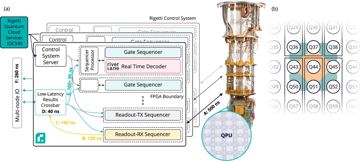
- Rigetti Ankaa-2 Rigetti Computing paper paper ▣ Fig. 1a (QPU + control system with FPGA decoder); Methods: Description of control system ✅
- Rigetti Ankaa-3 Rigetti Computing blog press press ▨ 🔎
- Rigetti Cepheus-1-108Q Rigetti Computing blog ▤ §II.B Multi-chip tunable coupler assembly (flux-bias and readout lines integrated into the carrier chip) ✅
- Rigetti Cepheus-1-36Q Rigetti Computing blog press ▤ §II.B Multi-chip tunable coupler assembly (flux-bias and readout lines integrated into the carrier chip) ✅
- Rigetti Novera Rigetti Computing product page press ▦ system requirements (control hardware) ✅
- SpinQ Ursa Major (25 q / 103 q) SpinQ Technology product page press press ▦ page text (independent control lines per qubit) 🔎
- SUSTech biased-erasure cavity qubit Southern University of Science and Technology paper ▣ Fig. S1 (measurement setup: HDAWG/UHFQA electronics, JPA chain, microwave routing); SI §I.A ✅
- SUSTech four-dual-rail-qubit processor Southern University of Science and Technology (Huang et al.) paper paper ▤ Supplementary §I (measurement setup) ✅
- Toshiba double-transmon coupler Toshiba + RIKEN RQC + University of Tokyo paper press ▣ Fig. 6 (schematic diagram of the measurement setup); Appendix B Measurement setup; Fig. 2 (Z-pulse on coupler loop) ✅
- Kunlun Tsinghua University IIIS (D.-L. Deng) with Zhejiang University (H. Wang, C. Song groups) paper paper ▤ 🔎
- Zuchongzhi 2.1 USTC / Hefei National Laboratory paper ▣ Fig. 1a (second chip carries all control lines) ✅
- Zuchongzhi 3.0 USTC / Hefei National Laboratory paper paper press ▣ Fig. 1a (control lines on second chip); §II (wiring attenuators) ✅
- Zuchongzhi 3.2 USTC / Hefei National Laboratory ▤ ✅
- VTT Q50 VTT Technical Research Centre of Finland product page ◌ 🔎
- Zhuangzi 2.0 (Chuang-tzu 2.0) CAS / Peking University paper paper press ▣ Suppl. Fig. 7 (room-temperature and cryogenic wiring); §S2 Experimental setup; §S4 Device control ✅
- Zhejiang University 125-qubit surface-code processor Zhejiang University + Graduate School of China Academy of Engineering Physics (Beijing) paper ▤ 🔎
- Fujitsu 1,000-qubit machine Fujitsu (+ RIKEN) link ▨ 🔎 (alternate)
- OQC GENESIS Oxford Quantum Circuits product page product page press ▨ 🔎 (alternate)
- OQC Toshiko Oxford Quantum Circuits product page ▣ Fig. 4A (qubit control line selectivity); §IV.A 🔎 (alternate)
- QuantWare Bass-A10K (VIO-40K) QuantWare press ▨ 🔎 (alternate)
- RIKEN 64-qubit superconducting processor RIKEN with AIST, NICT, Osaka University, Fujitsu, NTT press press ▥ Fig. 3 (qubit controller: microwave oscillator + receiver; 96 input / 16 output wires) ✅ (alternate)
- RIKEN-Fujitsu 256-qubit superconducting quantum computer RIKEN RQC + Fujitsu press press ▨ 🔎 (alternate)
- semiconductor spins 1
- Tunnel Falls Intel paper press press ▨ 🔎 (alternate)
Pictures
Every picture carries the story of what it shows and its credit line.

Room-temperature electronics + per-qubit coax/flex
One coherent line per drive, flux and readout port runs from room-temperature racks through attenuated coax or flex cable into the mixing chamber.
Verdict. Line count and mixing-chamber heat, not gate physics, cap qubits per fridge; falsifiable if one fridge runs >2,000 qubits on RT lines.
Λ = error-suppression factor per code-distance step; QBI = DARPA Quantum Benchmarking Initiative (Stage A concept → B R&D plan → C government V&V); G1–G7 = the report's goal classes (see Actors & economics).
Identity & lineage
The incumbent control architecture for essentially every gate-model superconducting qubit: microwave drive, flux bias and readout tones synthesised at room temperature, carried down the dilution refrigerator on coax or flex cable, attenuated at each stage, reaching the chip at 10–20 mK. Every control degree of freedom is a conductor crossing a 300 K → 10 mK gradient — a thermal and mechanical problem, not a quantum one. In use since the first transmon setups (2007). Attributes: e = microwave control placed entirely at room temperature, no cryogenic amplification or demultiplexing; f = coherent error as the code sees it — crosstalk, phase noise, amplitude drift.
Physics & limits
The binding constraint is the cooling budget, not coherence. Each line carries a passive conduction load plus an active load from the ~60 dB of attenuation that brings 300 K Johnson noise down to the 10 mK photon floor, most of it dumped at 4 K and the still. Cooling power per stage is fixed — a Bluefors XLD400 gives roughly 1 W at 4 K, microwatts at the mixing chamber — so lines scale O(N) against a constant. Krinner et al.'s measured budget supports 50 qubits at 14 mK in that fridge, about 150 at most D[522]; every gain since is thinner cable and denser packing, not new physics. Failure is coherent — crosstalk and phase drift appear as control error, so these machines degrade by needing recalibration rather than by decohering. What moves the floor: multiplexing qubits per conductor, or moving synthesis into the fridge.
Engineering state of the art
table
| Year | Figure | Who | Tag+key |
|---|---|---|---|
| 2019 | 50 qubits per XLD400 measured; ~150 thermal upper bound | ETH Zürich | D[522] |
| 2023-12 | 1,121 qubits on one fridge (Condor), largest ever wired this way | IBM | C[292] |
| 2025-11-10 | 8 channels per flex, +50% per port, 1,536 lines per XLDsl | Delft Circuits | C[523] |
| 2026-06-16 | KIDE specified at >4,000 rf lines, >1,000 qubits | Bluefors | C[303] |
Wiring sets the N at which errors are worth correcting, not the floor: the dominant term is still two-qubit infidelity — Willow, 105 qubits at 99.88% mean 2Q, 1.1 µs cycle D[1].
Manufacturing, materials & supply chain
Yield here is mechanical (connectors per port, flex delamination, thermal anchoring) and thermal, not lithographic; racks are near-COTS. Cryogenic wiring is the thin layer — Delft Circuits is the leading independent flex supplier and ships inside Bluefors systems C[523]. Refrigerators concentrate the risk: Bluefors absorbed Cryomech's pulse tubes and helium plants in 2023, taking the stage beneath the dilution unit in-house at combined revenue above EUR 160 M C[524]; Oxford Instruments is the only comparable merchant alternative, ULVAC a Japanese third source since 2025 C[525]. Export control cuts asymmetrically: refrigerators past the BIS threshold (≥600 µW at 0.1 K, 48 h) fall under ECCN 3A904, and 3A901.a controls CMOS designed to run at ≤4.5 K — catching the cryo-CMOS alternative — while RT racks are uncontrolled G[301].
Control, readout & I/O burden
Two to four lines per qubit: drive, flux, and readout feedlines multiplexing 5–10 qubits each. At 10³ the architecture works and fills most of a large fridge; KIDE's >4,000 lines is specified for >1,000 qubits, about four each C[303]. At 10⁴ the flex roadmap (40,000+ lines by 2029) is a projection with no interim demonstration R[523], and multiplexing depth rather than cable count becomes the limit. At 10⁶ no RT path exists; every roadmap past ~10⁴ assumes in-fridge control or multi-fridge partitioning. The RT round trip also adds cable delay plus rack processing at µs scale C[526] against Willow's 1.1 µs cycle D[1].
Role in the stack
Serves the transmon, bosonic cat/GKP and dual-rail erasure architectures — the whole superconducting tree — and requires nothing upstream, its commercial strength. It is also the alternate control of the silicon/germanium quantum-dot, silicon-donor and colour-centre spin architectures. Its substitutes (4 K cryo-CMOS, millikelvin SFQ, on-chip flux DACs) each cost a fresh cryogenic qualification burden, and none has displaced it at scale: SEEQC's millikelvin SFQ module reaches 1Q fidelity above 99% and up to 99.9% on five qubits D[304]; HRL's 4 K controller runs 18 silicon spin qubits at Λ₅/₃ = 4.7 D[190]; IBM reports cryo-CMOS flux ASICs at parity with RT electronics on a 156-qubit Heron R2, but as conference abstracts only C[527]. RT wiring adds no gate or readout time, so the derived round stays 0.65 µs, inside the measured 1.1 µs QEC cycle D[1]. Neighbouring empty slot: a multiplexed cryogenic control layer proven at array scale.
Evidence — how the numbers were measured
Every line count above 1,536 is product literature, not a wired system: Bluefors' >4,000 and Delft Circuits' 40,000-by-2029 have no named installation, and neither publishes crosstalk or phase-stability data at high channel count. No independent measurement of aggregate crosstalk above ~1,000 simultaneous lines exists as of 4 Sep 2026 — the gap that matters, since crosstalk is how this architecture fails.
The qubit itself can measure the control chain's noise. On one Jülich transmon line with 56 dB of attenuation, the modelled excitation rate was dominated by classical noise from the room-temperature drive instrument (−146 dBm/Hz above 4.6 GHz) and from the 1 K attenuator stage, while relaxation was set by quantum noise; the qubit's excitation spectrum served as an in-situ spectrometer of that noise P[890]. The result describes one set-up, not every line.
Bluefors' >4,000-line and Delft Circuits' 40,000-by-2029 figures are not demonstrated at system level. IBM's cryo-CMOS flux-bias parity result exists only as APS conference abstracts, with no preprint or paper as of 2026-09-04. No dated ECCN determination covers RT control racks; their uncontrolled status is read from the absence of a matching entry in the 2024 rule, not from an explicit BIS statement. Not published: a per-line or per-loom cost, and the revenue and customer counts of Delft Circuits and Zurich Instruments.
Actors & economics
Who.
| Organisation | Role | Country | What exactly they do with this technology | Evidence |
|---|---|---|---|---|
| Bluefors | supplier | Finland | Refrigerators with integrated looms; KIDE at >4,000 lines | C[303] |
| Delft Circuits | supplier | Netherlands | Cri/oFlex ribbon, 8 channels per flex, inside Bluefors XLDsl | C[523] |
| Quantum Machines | supplier | Israel | OPX control racks and controller software | C[528] |
| Zurich Instruments | supplier | Switzerland | ZQCS racks on Fujitsu/RIKEN's 256-qubit system | C[526] |
| Qblox | supplier | Netherlands | Modular control stacks, lower price point | C[529] |
| IBM | developer | USA | Condor, 1,121 qubits on one fridge; cryo-CMOS challenger | C[292] |
| SEEQC | developer | USA | Millikelvin SFQ control, an in-fridge alternative | D[304] |
Money.
2023-03-28 · Bluefors · M&A, Cryomech · undisclosed, combined revenue > EUR 160 M · closed C[524]
2024-06-20 · Qblox · Series A · USD 26 M · Quantonation, Invest-NL Deep Tech · closed C[529]
2025-02-25 · Quantum Machines · Series C · USD 170 M · PSG Equity lead · USD 280 M cumulative · closed C[528]
2025-12-03 · Delft Circuits · Series A extension · EUR 8 M · DeepTech XL, HTGF, QuVest · EUR 15 M cumulative · closed P[530]
2026-06-17 · Quantum Machines · M&A, PCB Engineering (Hungary) · undisclosed · closed C[528]
Market & supply chain. Racks are competitive and commoditising: five vendors qualified for NVQLink C[531], Quantum Machines best capitalised at USD 280 M cumulative C[528], Qblox an order of magnitude smaller C[529]. Fridges and their wiring are concentrated, and Delft Circuits at EUR 15 M cumulative P[530] is the one significant independent flex supplier — a single point of failure. Pays for G2, G3, G7; not G4.
IP & standards. No dated patent-family count for cryogenic rf cabling or RT control was found in a named database — no dated fact found. No formal standard; the closest is NVQLink, which since 2025-10-28 defines a common GPU-side interface across five control vendors C[531] while each pulse stack stays proprietary.
Roadmaps & track record. Delft Circuits (2025-11-10, for 2029): 40,000+ lines per fridge, no interim milestone R[523]. Bluefors (2026-06-16, undated): KIDE at >4,000 lines, product page only C[303]. Zurich Instruments (2026-03-09, undated): "several thousand qubits" C[526]. Both cabling vendors have shipped every density step they announced; 2029 is nonetheless a straight-line projection.
Strategic reading. If RT wiring reaches 10⁴ qubits, the rack vendors and Bluefors keep the control budget and cryo-CMOS or SFQ control stays a research programme. If density stalls near 4,000–5,000 lines, bargaining power moves inside the fridge, where no RT vendor owns IP — and the strongest cryo-CMOS results sit with IBM and HRL, one company since 2026-08-26 fact. Export control favours the incumbent G[301].
Outlook & open questions
Confirm by end-2027 if one fridge runs >2,000 qubits on RT lines with published fidelity at that density; demote after another year of line-count specifications without a wired system. Best case by 2029: flex density plus deeper multiplexing reaches 10⁴ qubits, stack unchanged. Worst case: density plateaus near 4,000–5,000 lines while roadmaps beyond assume undelivered cryo-CMOS or SFQ. Open questions: does crosstalk grow faster than linearly past ~1,000 lines; do flex density and multiplexing compound or hit independent walls; will any vendor commit to in-fridge control before RT wiring visibly fails; does multi-fridge partitioning make the per-fridge ceiling irrelevant.
References
- [1] Google Quantum AI and Collaborators, “Quantum error correction below the surface code threshold,” Nature, vol. 638, no. 8052, pp. 920–926, Dec. 2024, doi: 10.1038/s41586-024-08449-y. D
- [190] Members of the HRL Quantum Team and Collaborators, “A digitally controlled silicon quantum processing unit,” arXiv:2604.16216, Apr. 2026. D
- [292] J. Gambetta, “The hardware and software for the era of quantum utility is here,” IBM Quantum Computing Blog, Dec. 4, 2023. [Online]. Available: https://www.ibm.com/
quantum/ Cblog/ quantum-roadmap-2033 - [301] US Department of Commerce, Bureau of Industry and Security, “Commerce Control List Additions and Revisions; Implementation of Controls on Advanced Technologies Consistent With Controls Implemented by International Partners,” Federal Register, vol. 89, p. 72926, Sep. 6, 2024. [Online]. Available: https://www.federalregister.gov/
documents/ G2024/ 09/ 06/ 2024-19633/ commerce-control-list-additions-and-revisions-implementation-of-controls-on-advanced-technologies - [303] Bluefors, “KIDE Cryogenic Platform — For Large-Scale Quantum Computing,” Jun. 16, 2026. [Online]. Available: https://bluefors.com/
products/ Ckide-cryogenic-platform/ - [304] C. Jordan et al., “A quantum computer controlled by superconducting digital electronics at millikelvin temperature,” Nat. Electron., vol. 9, no. 3, pp. 287–294, Mar. 2026, doi: 10.1038/s41928-026-01576-6. D
- [522] S. Krinner et al., “Engineering cryogenic setups for 100-qubit scale superconducting circuit systems,” EPJ Quantum Technology, vol. 6, no. 1, Art. no. 2, Dec. 2019, doi: 10.1140/epjqt/s40507-019-0072-0. arXiv:1806.07862. D
- [523] Physics World (IOP Publishing), “Delft Circuits, Bluefors: the engine-room driving joined-up quantum innovation,” Nov. 10, 2025. [Online]. Available: https://physicsworld.com/
a/ Cdelft-circuits-bluefors-the-engine-room-driving-joined-up-quantum-innovation/ - [524] Bluefors, “Bluefors closes the acquisition of Cryomech,” Mar. 28, 2023. [Online]. Available: https://bluefors.com/
press-releases/ Cbluefors-closes-the-acquisition-of-cryomech/ - [525] ULVAC, “ULVAC Developing Next-Generation Dilution Refrigerator for Quantum Computing by 2026,” Nasdaq (JCN Newswire), Mar. 20, 2025. [Online]. Available: https://www.nasdaq.com/
press-release/ Culvac-developing-next-generation-dilution-refrigerator-quantum-computing-2026-2025-03 - [526] Zurich Instruments, “Zurich Instruments Launches the ZQCS Quantum Control System to Master the Long-Lived Logical Qubit Challenge,” Mar. 9, 2026. [Online]. Available: https://www.zhinst.com/
americas/ Cen/ news/ zurich-instruments-launches-zqcs-quantum-control-system-master-long-lived-logical-qubit/ - [527] A. Noori et al., “A Cryo-CMOS Control System for Large-Scale Superconducting Qubit Quantum Computing: Part 2,” IBM Research, Mar. 16, 2026. [Online]. Available: https://research.ibm.com/
publications/ Ca-cryo-cmos-control-system-for-large-scale-superconducting-qubit-quantum-computing-part-2 - [528] Quantum Machines, “Quantum Machines Raises $170M as Its Customer Base Exceeds 50% of Companies Developing Quantum Computers,” Feb. 25, 2025. [Online]. Available: https://www.quantum-machines.co/
press-release/ Cquantum-machines-raises-170-million-in-series-c-funding/ - [529] E. Flipse, “Qblox secures series A funding to accelerate quantum control stack development,” Qblox Newsroom, Jun. 20, 2024. [Online]. Available: https://qblox.com/
newsroom/ Cqblox-secures-series-a-funding-quantum-control-stack-development - [530] M. U. Rehman, “Delft Circuits Names Martin Danoesastro CEO and Extends Funding Round,” The Quantum Insider, Dec. 3, 2025. [Online]. Available: https://thequantuminsider.com/
2025/ P12/ 03/ delft-circuits-new-ceo-financing/ - [531] NVIDIA, “NVIDIA Introduces NVQLink — Connecting Quantum and GPU Computing for 17 Quantum Builders and Nine Scientific Labs,” Oct. 28, 2025. [Online]. Available: https://nvidianews.nvidia.com/
news/ Cnvidia-nvqlink-quantum-gpu-computing - [890] J. R. Guimarães et al., “Quantum environment afterglow from broadband excitation spectroscopy in superconducting qubits,” arXiv:2609.31280, Sep. 2026. P