Cross-resonance (fixed-frequency, all-microwave) g_cr
All-microwave entangling gate driving one fixed-frequency transmon at its neighbour's frequency through a static bus; no flux line, no tunable coupler.
Cross-resonance (fixed-frequency, all-microwave)
Microwave-only entangling gate on fixed-frequency transmons; 180–500 ns; superseded by tunable couplers in IBM Heron.
Brief →Key references
Design space — attributes
- (a) carrier affinity
- fabricated
- (b) time · entangling
- 316 ns · deterministic
- (c) readout
- —
- (d) mobility
- static nearest-neighbour wiring
- (e) control
- microwave @ room temperature
- (f) error structure
- coherent / calibration, stochastic Pauli
- (g) manufacturing
- superconducting lithography
Evaluation space — dated attributes
Kandala 2021 suppresses the static ZZ intrinsically (two fixed coupling elements retuning the dressed levels), not by an active cancellation drive; the pulse is 180 ns, not 320 ns. CR stayed IBM's native gate through Condor; Heron introduced the tunable-coupler CZ.
Standard records
Actors & goals — annotations
Edges
Used by 6 machines (6 primary · 0 alternate)
- superconducting circuits 6
- IBM Quantum System One, Ehningen Fraunhofer-Gesellschaft ◌ 🔎
- IBM Quantum Condor IBM blog press ▥ §Breaking the 1,000-qubit barrier with Condor (cross-resonance gate technology) ✅
- IBM Quantum Eagle r1-r3 IBM paper paper paper ▤ §III.5 (native gates incl. ECR); Fig. 4 caption (median ECR error) ✅
- IBM Quantum Falcon r5.11 IBM paper blog ▤ Methods: Leakage in the system (cross-resonance frequency collisions) 🔎
- IBM Quantum Osprey IBM blog press ▨ IBM statement quoted: 413 of 433 qubits, exploratory technical demonstration, consistent with Eagle R1 🔎
- Advanced Quantum Testbed (AQT) Lawrence Berkeley National Laboratory ▦ ✅
Pictures
Every picture carries the story of what it shows and its credit line.

Cross-resonance (fixed-frequency, all-microwave)
All-microwave entangling gate driving one fixed-frequency transmon at its neighbour's frequency through a static bus; no flux line, no tunable coupler.
Verdict. Superseded on IBM's own fleet at Heron (2023-12) yet still the only two-qubit gate needing zero coupler control; it returns only if post-fabrication frequency trimming beats a flux DAC per coupler on cost.
Λ = error-suppression factor per code-distance step; QBI = DARPA Quantum Benchmarking Initiative (Stage A concept → B R&D plan → C government V&V); G1–G7 = the report's goal classes (see Actors & economics).
Identity & lineage
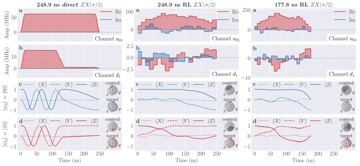
Driving a control transmon at its neighbour's frequency through a fixed bus produces a ZX interaction (Z on the control, X on the target); Chow, Córcoles, Gambetta et al. (IBM), 2011 D[425]. Kandala et al. reached CNOT 99.77(2)% in a single 180 ns pulse in 2021 by suppressing the static ZZ intrinsically, two fixed-frequency coupling elements retuning the dressed levels rather than extra cancellation drives D[287].
Attributes: fabricated carrier, static connectivity, microwave control at room temperature; deterministic entangling at 10^-6.5 s (~320 ns typical, 180 ns best).
Coherent plus Pauli error; standard superconducting lithography, no added process.
Physics & limits
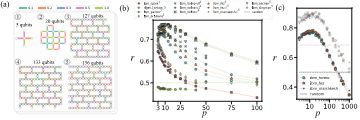
The ZX rate is second order, ∝ JΩ/(Δ(Δ+α)), fastest in the straddling regime −α < Δ < 0, so the detuning must sit inside a band of order the anharmonicity, ~300 MHz. The static ZZ, ∝ 2J²α/(Δ(Δ+α)), never switches off, so coherent error dominates the budget. The floor is not one pair but frequency targeting: every neighbour adds a collision constraint inside that band, and junction spread as fabricated is of order a per cent, so collision-free yield collapses with lattice size. What moves the floor is post-fabrication trimming — annealing junctions to target, 97.4% success D[294] — not better pulses.
Engineering state of the art
table
No fleet-average cross-resonance (CR) number was ever published; IBM's EPLG today (3.7×10⁻³ D[34]) is Heron hardware, which replaced CR in 2023-12 C[72]. The painful reference is Oxford/OQC's fixed-coupling CZ, 99.8% in 25 ns C[423] — no coupler control either, seven times faster.
The PRL by Kandala et al. reports intrinsic ZZ suppression through two fixed-frequency coupling elements, not active cancellation. Not published: a fleet-average CR fidelity for IBM's pre-Heron generations (Falcon to Condor), beside the isolated-pair 99.77(2)%, and a dated CR-specific patent count.
Manufacturing, materials & supply chain
No process of its own. The cost lands in binning and trimming: a collision cannot be detuned away after fabrication, only masked in software or annealed out, so frequency targeting — laser annealing at IBM, alternating-bias annealing at Rigetti D[294] — is the supply-chain item CR drives. Its advantage is the I/O ledger: one drive line per qubit and nothing per coupler, where tunable couplers add a flux line and a DAC channel each, roughly 1.5–2× the lines. At 10³ that is a crowded fridge against an impossible one; at 10⁴–10⁶ it is the whole wiring budget. Export exposure is the carrier's (ECCN 3A901).
Role in the stack
The fixed-frequency branch of the transmon-lattice architecture — IBM Falcon through Condor, 2019–2023 C[72], and Lawrence Berkeley National Laboratory's Advanced Quantum Testbed (AQT) to date — providing entanglement with no coupler control; its alternative is the tunable coupler, and switching is a chip redesign, not firmware. On the derived clock it loses: 180–500 ns against ~50 ns for a tunable-coupler CZ, so every QEC cycle pays 3–7× on the gate layer. Verification: 99.77% is interleaved RB on an isolated pair, blind to spectators; CR error is coherent, so RB understates it and gate-set tomography is the honest measurement.
Actors & economics
Who.
| Organisation | Role | Country | What exactly they do | Evidence |
|---|---|---|---|---|
| IBM | developer (ex-user) | US | Invented and scaled CR to Condor; retired it at Heron | D[287] |
| Hanyang University | research | KR | Fixed-frequency lattice-patch design reviving CR | S[426] |
| OQC | developer | UK | Fixed-frequency coaxmons with a fixed-coupling CZ, not CR | C[423] |
Money.
2026-06-02 · IBM · investment commitment · > $10 B over five years · announced G[57]fact
2026-06-03 · OQC · Series C · £260 M · Bullhound lead · closed C[60]fact
No funding event or QBI stage names cross-resonance.
Market & supply chain. No incremental supplier: the same lithography, cryostat and coax chain, minus per-coupler flux electronics. It paid for G1 and early G2 only.
IP & standards. IBM holds the foundational family (Chow 2011, Kandala 2021); no dated CR-specific patent count was found as of 2026-09-04. Qiskit still ships CR as a native two-qubit template.
Roadmaps & track record. IBM (2022-05-10 · no long-term CR commitment · retired on schedule at Heron, 2023-12 fact). Hanyang (2026-06-25 · simulation only · nothing fabricated). IBM's record is good precisely because it dropped CR when yield turned.
Strategic reading. Nobody wins from CR's supersession except tunable-coupler and cryogenic-control vendors. Its residual value is cheap wiring: if annealing reaches near-unity frequency-targeting yield, a fixed-frequency chiplet undercuts a tunable-coupler chip on cost. Power now sits with the control-electronics vendors — what CR was designed to avoid.
Outlook & open questions
Confirm by 2028: a fabricated fixed-frequency processor above eight qubits with CR fidelity published under simultaneous operation, or the Hanyang patch measured above 98%; else demote to legacy. Best case 2029: a cheap fixed-frequency chiplet; worst case, CR survives only as a Qiskit compilation target. Does anyone outside IBM run CR in production? Does frequency targeting reach collision-free yield past ~100 qubits? Would a foundry pick CR on cost rather than physics?
References
- [34] IBM Quantum, “What's new at IBM Quantum - Q2 2026.” [Online]. Available: https://www.ibm.com/
quantum/ Dblog/ whats-new-q2-2026 - [57] IBM Quantum, “Why IBM is investing $10 billion into quantum computing,” Jun. 2, 2026. [Online]. Available: https://www.ibm.com/
quantum/ Gblog/ 10-billion-investment-faq - [60] A. Curbison, “OQC raises £260m in Europe's largest ever private quantum computing funding round,” OQC, Jun. 2, 2026. [Online]. Available: https://oqc.tech/
company/ Cnewsroom/ series-c - [72] IBM, “Quantum Roadmap.” [Online]. Available: https://www.ibm.com/
roadmaps/ Cquantum/ - [287] A. Kandala et al., “Demonstration of a High-Fidelity CNOT Gate for Fixed-Frequency Transmons with Engineered ZZ Suppression,” Phys. Rev. Lett., vol. 127, no. 13, Art. no. 130501, Sep. 2021, doi: 10.1103/PhysRevLett.127.130501. D
- [294] D. P. Pappas et al., “Alternating-bias assisted annealing of amorphous oxide tunnel junctions,” Communications Materials, vol. 5, no. 1, Art. no. 150, Aug. 2024, doi: 10.1038/s43246-024-00596-z. D
- [423] A. Curbison, “Oxford research group demonstrate fundamental speed-up of two-qubit gate,” OQC, Mar. 21, 2025. [Online]. Available: https://oqc.tech/
company/ Cnewsroom/ oxford-research-group-demonstrate-fundamental-speed-up-of-two-qubit-gate - [425] J. M. Chow et al., “Simple All-Microwave Entangling Gate for Fixed-Frequency Superconducting Qubits,” Phys. Rev. Lett., vol. 107, no. 8, Art. no. 080502, Aug. 2011, doi: 10.1103/PhysRevLett.107.080502. D
- [426] C. Kim, J. Kang, and Y. Kwon, “Lattice patch structure for fixed-frequency transmon quantum computer with high-fidelity CNOT gates,” arXiv:2606.27017, Jun. 2026. S