Transmon transmon
Capacitively shunted Josephson junction (Koch 2007); the carrier behind Willow, Heron/Nighthawk and Zuchongzhi, with the fastest deterministic gate and QEC cycle of any demonstrated qubit.
Transmon
Anharmonic LC oscillator; ~200–300 MHz anharmonicity bounds gates at ~10 ns; T1 ~70–100 µs.
Brief →Key references
Design space — attributes
- (a) carrier affinity
- fabricated
- (b) time · entangling
- 10 ns · deterministic
- (c) readout
- dispersive microwave · 316 ns · non-destructive · mid-circuit
- (d) mobility
- static nearest-neighbour wiring
- (e) control
- microwave @ room temperature
- (f) error structure
- leakage, stochastic Pauli, correlated bursts, coherent / calibration
- (g) manufacturing
- superconducting lithography
Evaluation space — dated attributes
Willow 105 q; IBM Heron/Nighthawk 156/120 q; Zuchongzhi 3.x 105–107 q.
Standard records
Actors & goals — annotations
Edges
Used by 84 machines (84 primary · 0 alternate)
- superconducting circuits 84
- Academia Sinica 20-qubit superconducting quantum computer Academia Sinica press ▨ ✅
- IBM Quantum System Two at Amaravati Quantum Valley Tech Park IBM with TCS and the Government of Andhra Pradesh ◌ 🔎
- Anyon MonarQ Anyon Systems product page press ▦ §Qube (24-qubit integrated superconducting quantum computer, deployed at Calcul Québec) ✅
- AWS dual-rail transmon erasure line AWS Center for Quantum Computing (named Amazon Center for Quantum Computing in the Apr 2026 paper) paper ▣ Fig. 1a-b (two coupled transmons); §II ✅
- Baihua (Quafu platform) Beijing Academy of Quantum Information Sciences paper ▣ Fig. 1d (156-qubit processor photograph); Fig. 1c (processor schematic) ✅
- Dongling (Quafu platform) Beijing Academy of Quantum Information Sciences ▣ FIG. 11 (topological structure of superconducting chip Dongling) ✅
- Haituo (Quafu platform) Beijing Academy of Quantum Information Sciences ▨ 🔎
- ScQ-136 "Baiwang" Beijing Academy of Quantum Information Sciences ▤ §III.E Backends (ScQ-P136) ✅
- Shenglian (BAQIS) Beijing Academy of Quantum Information Sciences paper ▣ §I; App. B, Fig. S2 (optical image of the processor) ✅
- IBM Quantum System Two, Donostia-San Sebastian Basque Government (BasQ) - IBM-Euskadi Quantum Computational Center press ▨ 🔎
- Quantum Spain quantum computer at BSC Barcelona Supercomputing Center (Quantum Spain; installed by Qilimanjaro-GMV) press ▨ 🔎
- WACQT quantum computer (Chalmers 25-qubit flip-chip processor) Chalmers University of Technology (WACQT) ▤ abstract ✅
- Tianyan-176 / Tianyan-176 II (and Tianyan-24 sibling) China Telecom Quantum Group + QuantumCTek paper paper paper ▤ §II Tianyan high-performance quantum cloud services; Fig. 1a ✅
- Tianyan-287 China Telecom Quantum Group / QuantumCTek / CAS paper docs docs ▣ Fig. 1b (processor layout heat map, Zuchongzhi 3.0-like); Fig. S1 (parameters of 104 working qubits) ✅
- Tianyan-504 / "Xiaohong" chip China Telecom Quantum Group + CAS + QuantumCTek paper docs docs ▨ 🔎
- 6-qubit superconducting quantum processor DRDO DYSL-QT with TIFR and TCS ▨ 🔎
- Surface-17 ETH Zurich (Quantum Device Lab) paper paper ▣ Fig. 1b-c; Methods A; Table I ✅
- IBM Quantum System One, Ehningen Fraunhofer-Gesellschaft ▨ 🔎
- Fujitsu >10,000 physical / ~250 logical (STAR) Fujitsu + AIST + RIKEN press ▨ 🔎
- Fujitsu 1,000-qubit machine Fujitsu (+ RIKEN) link ▨ closing paragraph (1,000-qubit plan) 🔎
- Sycamore Google Quantum AI paper ▣ Fig. 1a-b (54-qubit layout; chip photograph); SI §II Fabrication and layout ✅
- Sycamore-class 72-qubit processor Google Quantum AI paper paper ▣ Fig. 1a (72-qubit Sycamore device, d=5 embedding) ✅
- Willow Google Quantum AI paper paper product page ▣ Fig. 1a (105-qubit processor, d=7 layout); SI §IV.B (qubit lifetime) ✅
- IBM Quantum Blue Jay IBM blog ▦ 🔎
- IBM Quantum Cockatoo IBM press ▥ 🔎
- IBM Quantum Condor IBM blog press ▥ §Breaking the 1,000-qubit barrier with Condor (1,121 superconducting qubits) ✅
- IBM Quantum Eagle r1-r3 IBM paper paper paper ▣ Fig. 4 (ibm_sherbrooke layout + readout error map); §III.5 ✅
- IBM Quantum Egret IBM docs ▦ 🔎
- IBM Quantum Falcon r5.11 IBM paper blog ▣ Fig. 4 (Falcon qubit numbering, static ZZ); Methods: IBM_Peekskill and experimental details ✅
- IBM Quantum Flamingo (l-coupler proof of concept) IBM blog ▥ 🔎
- IBM Quantum Heron r1 IBM paper blog press ▤ §III.7 (Heron) ✅
- IBM Quantum Heron r2 IBM paper paper press ▤ Methods: IBM hardware 🔎
- IBM Quantum Heron r3 (ibm_pittsburgh) IBM blog press ▨ ✅
- IBM Quantum Kookaburra IBM docs ▥ 🔎
- IBM Quantum Loon IBM blog ▥ Fig. (chip photos: 'IBM Quantum Loon (Credit: IBM)', 3 images); §Building our fault-tolerant architecture ✅
- IBM Quantum Nighthawk r1 IBM docs blog blog ▥ Fig. (chip photo: 'IBM Quantum Nighthawk chip'); text: 120-qubit Nighthawk unveiled ✅
- IBM Quantum Nighthawk r2 IBM blog ▤ § IBM Quantum Nighthawk r2—more circuits faster ✅
- IBM Quantum Osprey IBM blog press ▥ Fig. (chip photo: 'IBM introduced the 433-qubit IBM Osprey quantum processor') ✅
- IBM Quantum Starling IBM blog ▨ ✅
- IBM Quantum System Two at CSCS (Swiss Quantum Innovation Hub) IBM with ETH Zurich (CSCS) and Lockheed Martin press ◌ 🔎
- IQCC superconducting facility Israeli Quantum Computing Center (Quantum Machines + QuantWare + Qolab + ORCA) product page product page press ▨ 🔎
- IQM Emerald (IQM Crystal 54) IQM Quantum Computers blog ▣ Fig. 1a (quasi-lumped circuit: two transmons + floating coupler) ✅
- IQM Garnet (IQM Crystal 20) IQM Quantum Computers paper ▣ Fig. 1b (20-qubit crystal QPU topology: computational qubits (blue) with tunable couplers (green)); §2 QPU Architecture ✅
- IQM Halocene IQM Quantum Computers press press link ▨ ✅
- IQM Spark at Eldorado Research Institute IQM Quantum Computers with Instituto de Pesquisas Eldorado press ▦ education section (transmon qubit, multi-level nature) ✅
- IQM Star 24 IQM Quantum Computers link ▣ Fig. 1a (QPU schematic: 4 data + 2 ancilla qubits around central resonator); App. G (qubit specifications) ✅
- IQM six-qubit star QPU (Deneb-class) IQM Quantum Computers paper paper docs ▤ §II (QPU description) ✅
- VLQ IT4Innovations National Supercomputing Center (VSB - Technical University of Ostrava) press ▨ 🔎
- KRISS domestic superconducting QPU Korea Research Institute of Standards and Science press press ▨ 🔎
- KRISS 50-qubit-class superconducting system Korea Research Institute of Standards and Science press ▨ 🔎
- Advanced Quantum Testbed (AQT) Lawrence Berkeley National Laboratory ▦ ✅
- OQC ATHENA Oxford Quantum Circuits product page ▥ 🔎
- OQC ATLAS Oxford Quantum Circuits product page ▥ 🔎
- OQC GENESIS Oxford Quantum Circuits product page product page press ▣ Fig. 1b (multimode qubit in coaxial cQED unit cell); §II ✅
- OQC TITAN Oxford Quantum Circuits product page ▥ 🔎
- OQC Toshiko Oxford Quantum Circuits product page ▣ Fig. 1D-F (four-qubit coaxmon circuit in enclosure; transmon + spiral resonator); §II Device architecture ✅
- Origin Wukong 102 Origin Quantum ▣ Fig. 1 (8-qubit 2×4 region of Wukong); SI Fig. S1 (processor topology); SI 'Device' ✅
- Origin Wukong-180 (4th gen) Origin Quantum press ▨ ✅
- Origin Wukong (3rd gen) Origin Quantum paper ▣ Fig. 1 (8 physical qubits in 2×4 region of Wukong) ✅
- Qolab devices at the IQCC Qolab ▦ §Component integration (140 mm x 140 mm qubit die, up to 20,000 qubits); §Window-junction process 🔎
- QpiAI Indus QpiAI press ▨ 🔎
- QpiAI Kaveri QpiAI press ▨ ✅
- QuantWare Contralto-A17 QuantWare press ▦ §Introducing Contralto-A (up to 17 flux-tunable transmon qubits); chip photo ✅
- QuantWare Tenor-D64 QuantWare product page ▦ §Tenor-D64 'Shipping in 2026 | 64 qubits' (octagonal chip-board photo); §D-line (tunable transmon qubits) ✅
- QuantWare Bass-A10K (VIO-40K) QuantWare press ▦ §VIO-40K announcement (QPUs with 10 KiloQubits) 🔎
- Rigetti Ankaa-2 Rigetti Computing paper paper ▤ Methods: Ankaa-2 device specifications ✅
- Rigetti Ankaa-3 Rigetti Computing blog press press ▨ 🔎
- Rigetti Cepheus-1-108Q Rigetti Computing blog ▣ Fig. 1a-c (circuit diagrams: qubits Q1/Q2 on separate chips joined by floating multi-chip coupler); Fig. 3 (photomicrograph of assembled test device) ✅
- Rigetti Cepheus-1-36Q Rigetti Computing blog press ▣ Fig. 1a-c (circuit diagrams: qubits Q1/Q2 on separate chips joined by floating multi-chip coupler); Fig. 3 (photomicrograph of assembled test device) ✅
- Rigetti Novera Rigetti Computing product page press ▦ specifications ('3x3 array of tunable transmons') ✅
- RIKEN 64-qubit superconducting processor RIKEN with AIST, NICT, Osaka University, Fujitsu, NTT press press ▥ Fig. 1 (64-qubit two-dimensional integrated circuit chip; 16 basic units of 4 qubits) ✅
- RIKEN-Fujitsu 256-qubit superconducting quantum computer RIKEN RQC + Fujitsu press press ▨ 🔎
- RIKEN RQC-Fujitsu 64-qubit superconducting quantum computer RIKEN RQC + Fujitsu press ▨ paragraph on the 64-qubit iteration 🔎
- SEEQC SFQ-controlled 5-qubit system SEEQC paper press ▤ Supp. §A Device Design and Fabrication; Fig. 1 (system-level overview) ✅
- SpinQ Ursa Major (25 q / 103 q) SpinQ Technology product page press press ▦ §Principles of superconducting quantum chips (Josephson-junction nonlinear LC circuits); spec table C25/C103 ✅
- SUSTech four-dual-rail-qubit processor Southern University of Science and Technology (Huang et al.) paper paper ▣ §II, Fig. 1b (logical qubit = transmons Q_iA, Q_iB + ancilla A_i) ✅
- Toshiba double-transmon coupler Toshiba + RIKEN RQC + University of Tokyo paper press ▣ Fig. 1a-b (circuit schematic: data qubits Q1, Q2 + coupler transmons C3, C4; false-color device picture); §II Device setup ✅
- Kunlun Tsinghua University IIIS (D.-L. Deng) with Zhejiang University (H. Wang, C. Song groups) paper paper ▣ Fig. 1a (Kunlun 32-qubit layout: 18 data + 14 check qubits); SI: Device Information; Fig. S4 ✅
- Zuchongzhi 2.1 USTC / Hefei National Laboratory paper ▣ Fig. 1a (66-qubit, 110-coupler flip-chip processor schematic); Fig. 1b (qubit circuit) ✅
- Zuchongzhi 3.0 USTC / Hefei National Laboratory paper paper press ▣ Fig. 1a (flip-chip device, 105 qubits); §II ✅
- Zuchongzhi 3.2 USTC / Hefei National Laboratory ▣ Fig. 1b (patches mapped onto superconducting-qubit lattice) 🔎
- VTT Q50 VTT Technical Research Centre of Finland product page ▨ 🔎
- Zhuangzi 2.0 (Chuang-tzu 2.0) CAS / Peking University paper paper press ▣ Fig. 1a (optical micrograph, 78-qubit processor Chuang-tzu 2.0); Suppl. Fig. 8; §S3.B Device performance ✅
- Zhejiang University 125-qubit surface-code processor Zhejiang University + Graduate School of China Academy of Engineering Physics (Beijing) paper ▣ Fig. 1a (qubit lattice); §II Overview of the setup ✅
Pictures
Every picture carries the story of what it shows and its credit line.
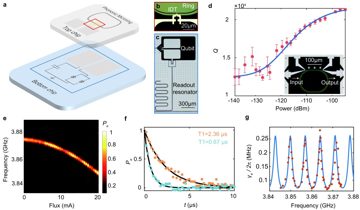
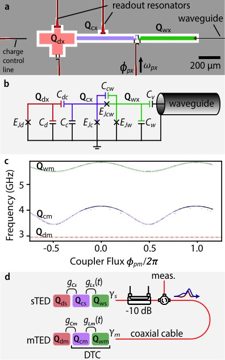
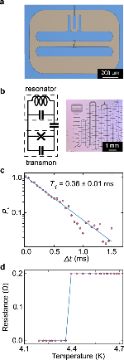
Transmon
Capacitively shunted Josephson junction (Koch 2007); the carrier behind Willow, Heron/Nighthawk and Zuchongzhi, with the fastest deterministic gate and QEC cycle of any demonstrated qubit.
Verdict. Best-funded and fastest carrier, capped by ~10⁻³ two-qubit and ~10⁻² readout errors at scale and hourly correlated bursts. Confirm if a ≥100-qubit lattice shows Λ ≥ 3 with median 2Q error < 10⁻³ by 2028; otherwise demote to component status.
Λ = error-suppression factor per code-distance step; QBI = DARPA Quantum Benchmarking Initiative (Stage A concept → B R&D plan → C government V&V); G1–G7 = the report's goal classes (see Actors & economics).
Identity & lineage
A transmon is an Al/AlOx/Al Josephson junction shunted by a large capacitor so that EJ/E_C ≈ 50–100 D[282]. Charge dispersion falls exponentially in √(8E_J/E_C), removing 1/f charge noise at the price of a weak anharmonicity α ≈ −EC ≈ −200 to −300 MHz; the qubit is the lowest two levels of a 4–6 GHz oscillator D[282]. Koch et al. proposed it in 2007 D[282]; the 3D transmon (2011) D[283] and the UCSB/Google Xmon (2014) D[284] fixed the two lineages still in use, fixed-frequency (IBM) and flux-tunable (Google, IQM, USTC).
Attributes (technology graph):
- a: affinity 1.0, fabricated (no natural counterpart).
- b: characteristic time 10⁻⁸ s, deterministic entangling; the 1/α leakage bound puts the pulse floor near 10 ns.
- c: readout dispersive microwave, ≈ 320 ns (10^−6.5 s), non-destructive, mid-circuit capable.
- d: mobility static, nearest-neighbour wiring.
- e: control microwave from room-temperature electronics; cold-stage variants (cryo-CMOS or SFQ) at ≤ 5 qubits.
- f: error structure leakage + stochastic Pauli + correlated bursts + coherent/calibration.
- g: manufacturing superconducting lithography.
Physics & limits
Residual thermal population (0.1% at 35 mK in a 3D transmon D[285], ≈ 1% at 40–60 mK for a 5 GHz qubit S[285]) makes reset and readout the SPAM floor. Anharmonicity bounds single-qubit gates at 10–25 ns and tunable-coupler CZ at 25–50 ns D[1], [37]P[286]; cross-resonance takes ≈ 200–500 ns D[287].
The floor is decoherence over gate time: with Willow's mean T1 = 68 µs D[1] a 40 ns CZ carries ≈ 6×10⁻⁴ of incoherent error S[1]; at the record T1 = 1.68 ms of a single Ta-on-Si test transmon D[288] it falls below 5×10⁻⁵ S[288]. Loss is dominated by two-level systems (TLS) in amorphous interface oxides D[288], with quasiparticles, Purcell decay and flux noise below.
Most of the twirled channel is stochastic Pauli, so Willow's Λ = 2.14 D[1] matches theory. Leakage to |2⟩ accumulates under QEC unless removed each cycle (USTC's all-microwave reset cut it 72×, to 6.4×10⁻⁴, on 107 qubits D[3]). Coherent errors (residual ZZ, TLS drift) forced reinforcement-learning recalibration inside Google's 2026-07 QEC run D[2]. Correlated bursts (ionising particles flooding the chip with quasiparticles) hit all qubits at once — roughly one per 10 s on Sycamore in 2021 D[289], about one per hour on Willow after gap engineering D[1], [290] — truncating long memory runs by bursts, not distance. Moving the floor means new materials (Ta, encapsulated Nb), fluxonium-scale anharmonicity, radiation management or erasure conversion (dual-rail).
Long-lived TLS are not specific to fluxonium junction chains: a flux-tunable transmon at Forschungszentrum Jülich showed 44 of them per GHz, spread uniformly over 3–4.5 GHz and each blocking about 2 MHz, so about 9% of the tunable band is affected; the memory they give the environment spans 20 µs to 1 ms, and 58% of them outlive the qubit P[890]. Energy stored in them re-excites the qubit after it is driven, an error that T1 and relaxation spectroscopy do not show.
Engineering state of the art
Best isolated devices: T1 1.68 ms, Q 2.5×10⁷, 1Q 99.994% D[288]; CZ 99.93% and 280 ns readout at 99.94% on a two-qubit IQM chip D[38]; Toshiba's double-transmon coupler CZ 99.90% in 48 ns D[37].
Typical at ≥ 100 qubits: Willow, 105 q — mean T1 68 µs, CZ error 0.33%, readout 99.5%, QEC cycle 1.1 µs D[1]C[32]; IBM fleet error-per-layered-gate 3.7×10⁻³ typical, 1.9×10⁻³ best (2026-07) C[34]; Zuchongzhi 3.0, 105 q — 2Q 99.62%, readout 99.13% D[35]; Rigetti Cepheus-1-108Q, twelve 9-qubit chiplets C[36] — median 2Q 99.1% Cfact.
table
At scale the two-qubit gate is the largest error term (~40% of Google's colour-code budget) D[41], then readout (~10⁻² on fleets C[34]) and leakage; the lattice tail matters more than the median.
Manufacturing, materials & supply chain
Process: Nb or Ta on high-resistivity Si or sapphire; shadow-evaporated Al/AlOx/Al junctions; flip-chip 3D integration. On 300 mm CMOS tooling imec/KU Leuven reported 393 of 400 working transmons (98.25%), median T1 ≈ 75 µs (42–113 µs) D[293]fact: uniformity, not coherence. Fixed-frequency lattices must also hit frequency targets (junction scatter becomes collisions) by laser annealing (IBM), alternating-bias annealing (Rigetti, 97.4% success) D[294] or tunable couplers.
Cost and energy: no vendor publishes $/qubit; proxies are IQM's €33 M LUMI contract P[295] and IBM's 14 nm cryo-controller at 23 mW per qubit at 4 K D[296] — tens of watts at 10³ qubits; SFQ control claims nW per qubit C[54].
Supply chain: dilution refrigerators from Bluefors (FI), Oxford Instruments (UK), FormFactor and Maybell (US); ³He from tritium decay in state inventories (US: NNSA G[297]), no merchant producer; 4 K HEMT (high-electron-mobility transistor) amplifiers effectively one vendor (Low Noise Factory, SE); control electronics competitive (Quantum Machines, Qblox, Zurich Instruments); merchant QPUs from QuantWare (NL) P[298]; foundries Anderon (IBM Albany spin-off, 2026-05; $1 B CHIPS letter of intent, $1 B IBM cash stated separately) P[299]G[300] and GlobalFoundries ($375 M LOI) G[300].
Export controls: the BIS interim final rule of 2024-09-06 covers dilution refrigerators ≥ 600 µW at 0.1 K for 48 h (3A904), cryogenic wafer probers (3B904), parametric amplifiers (3A901.b) and quantum computers (4A906) only where qubit count and C-NOT error fall in the same band — 34–99 qubits at ≤ 10⁻⁴, 100–199 at ≤ 10⁻³, the ceiling rising to 6 × 10⁻³ below 2,000 qubits, any error from 2,000 on G[301]fact; Chinese vendors therefore build 10 mK refrigerators domestically (2026-05-15) P[302].
Control, readout & I/O burden
A tunable lattice needs one XY and one Z line per qubit plus one per coupler (Sycamore: ≈ 3.6 control lines per qubit before readout D[291]); readout multiplexes ≈ 6–10 qubits per feedline D[1]; each line is a DAC channel plus attenuated coax, so cost and heat scale with N.
Latency: the QEC cycle is 1.1 µs; Google's real-time decoder ran at 63 µs mean latency for d=5 D[1]; IBM's Relay-BP targets < 1 µs per cycle in simulation S[48] for the gross code (IBM's [[144,12,12]] bivariate bicycle qLDPC code, 12 logical qubits in 288 physical D[248]).
Walls: 10³ reached (Condor, 1,121 qubits C[292]); Bluefors' KIDE (> 4,000 RF lines, > 1,000 qubits; product page, 2026-06) C[303] is one cryostat's ceiling. 10⁴ needs 4 K cryo-CMOS (HRL: d=5 repetition code from a ≤ 3.5 W controller D[190]fact) or millikelvin SFQ (SEEQC: 1Q up to 99.9% on ≤ 5 qubits D[304]fact) plus multi-cryostat modules (IBM coupled two cells, 2026-08 C[50]). 10⁶ has no closed design: on-chip flux DACs, cold decoding and inter-fridge links (ETH: 30 m at 80.4% Bell fidelity D[305]) are sub-scale.
Role in the stack
Architectures: the transmon lattice with tunable couplers and the dual-rail erasure architecture (transmon as ancilla or one rail). Requires superconducting lithography; provides the carrier for tunable-coupler and cross-resonance gates, the ancilla for bosonic-cavity gates, the bare-qubit subspace, the dispersive shift for microwave readout and the microwave side of the optical transducer. Replaced by fluxonium, which buys anharmonicity and T1 for a flux bias per qubit, sub-GHz control and redesigned readout. Conflicts with SFQ control: switching photons poisoned qubits with quasiparticles in the 2023 multi-chip module (0.96 of 1.2% error per Clifford) D[249]; SEEQC claims it engineered away C[54], so the conflict stands until an independent lattice-scale check. Derived clock of the transmon-lattice architecture ≈ 6.5×10⁻⁷ s (651 ns; derived clock = sum of the syndrome round: gate layers + transport + readout + reset for the architecture), readout 282 ns of it and readout-plus-reset two-thirds, against the measured 1.1 µs Willow cycle D[1] — the fastest demonstrated architecture, which G4 (large-scale fault tolerance) pays for. Bordering empty slots: the microwave–optical transducer (≈ 3 orders of magnitude short of remote gates S[306]) and cryogenic decoding.
Evidence — how the numbers were measured
Headline numbers come from Clifford RB/IRB, simultaneous XEB (Google), IBM's layer fidelity/EPLG and readout assignment matrices; Λ is a fit of logical error vs distance under one decoder. Missed here: isolated vs simultaneous operation (record chips are isolated); coherent errors averaged into a depolarising number; leakage, invisible to RB and often post-selected away; drift between calibration and use; and conventions (Rigetti quotes medians, IBM its best device, IQM a two-qubit chip). IBM's 2026-07 "70 logical qubits" is an error-detecting, post-selected result D[46], not fault tolerance.
Replication: below-threshold scaling reproduced by USTC on 107 qubits with Λ = 1.40 D[3]. Disputes: 2019 supremacy sampling reproduced by tensor networks D[307]; the 2023 IBM "utility" experiment simulated classically within weeks D[308], [309]; Google's 2026-07 paper reports no Λ for the d=7 run D[2]. Value conflict: imec's 300 mm T1 is often quoted as "> 100 µs"; the paper's median is ≈ 75 µs D[293]fact, used here.
The ≈ 200–500 ns cross-resonance gate time is a fleet-typical range inferred from a single-device paper [287]. That 4 K HEMT amplifiers come effectively from one vendor (Low Noise Factory) is a market observation without a database source. Not published: a launch date for Bluefors KIDE (> 4,000 RF lines / > 1,000 qubits), whose product page was revised 2026-06-16.
Actors & economics
Who.
| Organisation | Role | Country | Activity | Evidence |
|---|---|---|---|---|
| Google Quantum AI | developer | US | Willow 105 q, Λ = 2.14; d=7 memory | D[1], [2] |
| IBM | developer | US | Heron/Nighthawk fleet; Starling roadmap; Anderon spin-out | C[34], [67]P[299] |
| Rigetti | developer | US | Cepheus-1-108Q chiplets; own fab | C[61] |
| IQM | developer | FI | 26 systems sold, 17 installed | C[58]fact |
| USTC | research | CN | Zuchongzhi 3.x, 105 q; Λ = 1.40 | D[3], [35] |
Money.
- 2025-11-06 · DARPA · QBI Stage B (up to $15 M each) · IBM the only transmon-lattice vendor of eleven; Google and Rigetti stayed at Stage A G[65]factfact
- 2026-01-20 · D-Wave · M&A, Quantum Circuits (dual-rail cavities on transmon ancillae) · $550 M (stock + cash) · closed C[14]factfact
- 2026-05-05 · QuantWare (merchant QPUs; VIO-40K roadmap — VIO is its vertical-wiring architecture Rfact) · Series B · $178 M (€152 M) · Intel Capital, In-Q-Tel, ETF Partners (new investors, no lead) · > $210 M cumulative · closed P[298]
- 2026-05-18 · Nord Quantique · growth-equity financing · $30 M at a $1.4 B valuation · closed C[89]fact
- 2026-05-21 · US Dept of Commerce · CHIPS letters of intent ($2.013 B, nine companies) · IBM/Anderon $1 B, GlobalFoundries $375 M, Rigetti ≤ $100 M, D-Wave $100 M · non-binding LOI G[300]fact
- 2026-06-02 · IBM · commitment · > $10 B over five years, the $1 B cash into Anderon stated separately · announced C[310]fact
- 2026-06-03 · OQC (coaxmon developer D[311]) · Series C · £260 M (~$350 M) · led by Bullhound · valuation undisclosed · closed C[60]fact
- 2026-07-02 · IQM · listing, Nasdaq and Helsinki · pro-forma cash €337 M · closed Cfact
- 2026-08-04 · IQM · H1-2026 results · revenue €8.9 M (+47%), cash €309 M · reported P[295]
- 2026-08-06 · Rigetti · Q2-2026 results · revenue $5.1 M, GAAP loss $52.6 M, cash $541.3 M · reported C[61]
Market & supply chain. Enabling equipment is more concentrated than the QPU market. Unit economics are unpublished; the €33 M IQM contract P[295] and the $550 M Quantum Circuits price Cfact are the only quotable points. Paying goals: G7 (deployable systems) and G2 (error-mitigated utility) today; G3 (early fault tolerance) via QBI-style programmes from 2027 fact; G4 (large-scale fault tolerance) after 2029 Rfact; G1 (analogue simulation), G5 (optimisation) and G6 (networking) bring no transmon-specific revenue.
IP & standards. PatSnap's landscape published on 2026-06-30: IBM 4,388 quantum patent families, Google 2,385, Microsoft 1,175; superconducting devices (H10N 60) IBM 783, Google 357 P[312]fact. No litigation found; no transmon-specific family verified. Open stacks commoditise the layer above: Qiskit (IBM claims ≈ 70% of developers C[310]), Cirq/Stim, OpenQASM 3, NVQLink Cfact.
Roadmaps & track record.
- IBM Kookaburra (2022-05-10 · 2025, as a 1,386-qubit multi-chip processor C[313]; re-promised 2025-06-10 · 2026, as the first qLDPC module R[67] · not delivered as of 2026-09-03 R[72]fact).
- IBM Nighthawk (2025-06-10 · 2025 · delivered 2025-12) and Starling (2025-06-10 · 2029, 200 logical / 10⁸ gates · open) Rfact.
- Google milestone 3, 10⁻⁶ logical error (undated · no Willow successor published; neutral-atom track opened 2026-03-24) R[2]fact.
- Rigetti 108 q at 99.5% (promised for end-2025 · GA 2026-04-07 at median 99.1%; 99.5% moved to "later 2026") Cfact.
- Fujitsu/RIKEN 1,000 qubits (promised 2025-04-22 · fiscal 2026 · not launched as of 2026-09-03) R[75]fact.
Credibility: IBM high on cadence, weak on its first qLDPC module and on "advantage" claims; Google high on physics, opaque on schedule; Rigetti chronic slips; Fujitsu unproven.
Strategic reading. If transmons win, foundry owners and cryogenic suppliers win regardless of vendor; fabless transmon start-ups lose — consolidation (Atlantic Quantum → Google, 2025-10-03 P[55]fact; Quantum Circuits → D-Wave) is visible. Substitution threats: fluxonium in the same fab, dual-rail/bosonic encodings that demote the transmon to an ancilla, atoms and spins for density. ³He, HEMT and fridge suppliers hold bargaining power; platform vendors escape by vertical integration.
Outlook & open questions
Milestones, 12–24 months: (1) Kookaburra runs a gross-code memory below break-even — confirm; nothing by end-2027 demotes IBM's 2029 date Rfact. (2) Google publishes Λ ≥ 3 or a 10⁻⁶ logical memory at d ≥ 9 — confirm; a second year without a Willow successor demotes D[2]. (3) QBI Stage C (expected around Q4 2026 factP[314]) promotes a transmon vendor. (4) cryo-CMOS or SFQ drives ≥ 50 transmons without a fidelity penalty D[190], [304]. Best case 2029: a Starling-class 200-logical machine Rfact and a d ≥ 11 Google memory; worst: Λ near 2, readout at 10⁻², bursts cap distance, the transmon survives only as an ancilla and capital rotates to atoms and spins. Open questions: does millisecond Ta/Si coherence survive a 100-qubit process with couplers; is the at-scale 2Q floor coherent (calibration) or incoherent; can readout reach 10⁻³ in < 300 ns across a lattice. Watch: Google's next paper, Kookaburra, the Stage C list.
References
- [1] Google Quantum AI and Collaborators, “Quantum error correction below the surface code threshold,” Nature, vol. 638, no. 8052, pp. 920–926, Dec. 2024, doi: 10.1038/s41586-024-08449-y. D
- [2] V. Sivak et al., “Reinforcement learning control of quantum error correction,” Nature, vol. 655, no. 8124, pp. 879–884, Jul. 2026, doi: 10.1038/s41586-026-10759-2. D
- [3] T. He et al., “Experimental Quantum Error Correction below the Surface Code Threshold via All-Microwave Leakage Suppression,” Phys. Rev. Lett., vol. 135, no. 26, Art. no. 260601, Dec. 2025, doi: 10.1103/rqkg-dw31. D
- [14] D-Wave Quantum Inc., “D-Wave Announces Agreement to Acquire Quantum Circuits Inc., Establishing World's Leading Quantum Computing Company,” Jan. 7, 2026. [Online]. Available: https://www.dwavequantum.com/
company/ Cnewsroom/ press-release/ d-wave-to-acquire-quantum-circuits-inc-establishing-world-s-leading-quantum-computing-company/ - [32] Y. Chen and M. Devoret, “Our quantum hardware: the engine for verifiable quantum advantage,” Google Blog, Oct. 22, 2025. [Online]. Available: https://blog.google/
innovation-and-ai/ Ctechnology/ research/ quantum-hardware-verifiable-advantage/ - [34] IBM Quantum, “What's new at IBM Quantum - Q2 2026.” [Online]. Available: https://www.ibm.com/
quantum/ Cblog/ whats-new-q2-2026 - [35] D. Gao et al., “Establishing a New Benchmark in Quantum Computational Advantage with 105-qubit Zuchongzhi 3.0 Processor,” Phys. Rev. Lett., vol. 134, Art. no. 090601, Mar. 2025, doi: 10.1103/PhysRevLett.134.090601. arXiv:2412.11924. D
- [36] Rigetti Computing, Inc., “Rigetti Announces General Availability of 108-Qubit System,” Apr. 7, 2026. [Online]. Available: https://investors.rigetti.com/
news-releases/ Cnews-release-details/ rigetti-announces-general-availability-108-qubit-system - [37] R. Li, K. Kubo, Y. Ho, Z. Yan, Y. Nakamura, and H. Goto, “Realization of High-Fidelity CZ Gate Based on a Double-Transmon Coupler,” Phys. Rev. X, vol. 14, no. 4, Art. no. 041050, Nov. 2024, doi: 10.1103/PhysRevX.14.041050. arXiv:2402.18926. D
- [38] F. Marxer et al., “Above 99.9% Fidelity Single-Qubit Gates, Two-Qubit Gates, and Readout in a Single Superconducting Quantum Device,” PRX Quantum, vol. 7, Art. no. 020333, 2026, doi: 10.1103/n86s-2b88. arXiv:2508.16437. D
- [41] N. Lacroix et al., “Scaling and logic in the color code on a superconducting quantum processor,” Nature, vol. 645, no. 8081, pp. 614–619, May 2025, doi: 10.1038/s41586-025-09061-4. arXiv:2412.14256. D
- [46] S. Martiel et al., “Sampling hard circuits with verifiably high fidelity,” arXiv:2607.25941, Jul. 2026. D
- [48] T. Maurer et al., “Real-time decoding of the gross code memory with FPGAs,” arXiv:2510.21600, Oct. 2025. S
- [50] C. Dundon, S. Hall, M. Hollister, and A. Lindler, “IBM's new modular architecture for cryogenic systems,” IBM Quantum Computing Blog, Aug. 19, 2026. [Online]. Available: https://www.ibm.com/
quantum/ Cblog/ modular-cryogenics - [54] M. Abdel-Kareem, “SEEQC and IBM Collaborate on SFQ Control Integration Under DARPA's Quantum Benchmarking Initiative,” Quantum Computing Report, Jun. 12, 2025. [Online]. Available: https://quantumcomputingreport.com/
seeqc-and-ibm-collaborate-on-sfq-control-integration-under-darpas-quantum-benchmarking-initiative/ C - [55] M. Swayne, “Atlantic Quantum Joins Google Quantum AI,” The Quantum Insider, Oct. 3, 2025. [Online]. Available: https://thequantuminsider.com/
2025/ P10/ 03/ atlantic-quantum-joins-google-quantum-ai/ - [58] IQM Quantum Computers, “IQM Quantum Computers Becomes First European Quantum Computing Company Listed on a Major U.S. Exchange,” Jul. 2, 2026. [Online]. Available: https://iqm.tech/
press-releases/ Ciqm-quantum-computers-becomes-first-european-quantum-computing-company-listed-on-a-major-u-s-exchange/ - [60] A. Curbison, “OQC raises £260m in Europe's largest ever private quantum computing funding round,” OQC, Jun. 2, 2026. [Online]. Available: https://oqc.tech/
company/ Cnewsroom/ series-c - [61] Rigetti Computing, “Rigetti Computing Reports Second Quarter 2026 Financial Results,” Rigetti Investor Relations, Aug. 6, 2026. [Online]. Available: https://investors.rigetti.com/
news-releases/ Cnews-release-details/ rigetti-computing-reports-second-quarter-2026-financial-results - [65] DARPA, “Stage B selection,” Nov. 6, 2025. [Online]. Available: https://www.darpa.mil/
research/ Gprograms/ quantum-benchmarking-initiative/ stage-b-selection - [67] IBM, “IBM Sets the Course to Build World's First Large-Scale, Fault-Tolerant Quantum Computer at New IBM Quantum Data Center,” Jun. 10, 2025. [Online]. Available: https://newsroom.ibm.com/
2025-06-10-IBM-Sets-the-Course-to-Build-Worlds-First-Large-Scale,-Fault-Tolerant-Quantum-Computer-at-New-IBM-Quantum-Data-Center C - [72] IBM, “Quantum Roadmap.” [Online]. Available: https://www.ibm.com/
roadmaps/ Rquantum/ - [75] Fujitsu, “Fujitsu Quantum.” [Online]. Available: https://global.fujitsu/
en-global/ Rtechnology/ research/ quantum - [89] Nord Quantique, “Nord Quantique Reaches $1.4 Billion USD Valuation with Latest Investment,” Business Wire, May 18, 2026. [Online]. Available: https://www.businesswire.com/
news/ Chome/ 20260518358351/ en/ Nord-Quantique-Reaches-$1.4-Billion-USD-Valuation-with-Latest-Investment - [190] Members of the HRL Quantum Team and Collaborators, “A digitally controlled silicon quantum processing unit,” arXiv:2604.16216, Apr. 2026. D
- [248] S. Bravyi et al., “High-threshold and low-overhead fault-tolerant quantum memory,” Nature, vol. 627, no. 8005, pp. 778–782, Mar. 2024, doi: 10.1038/s41586-024-07107-7. arXiv:2308.07915. D
- [249] C. Liu et al., “Single Flux Quantum-Based Digital Control of Superconducting Qubits in a Multichip Module,” PRX Quantum, vol. 4, no. 3, Art. no. 030310, Jul. 2023, doi: 10.1103/PRXQuantum.4.030310. D
- [282] J. Koch et al., “Charge-insensitive qubit design derived from the Cooper pair box,” Phys. Rev. A, vol. 76, no. 4, Art. no. 042319, Oct. 2007, doi: 10.1103/PhysRevA.76.042319. arXiv:cond-mat/0703002. D
- [283] H. Paik et al., “Observation of High Coherence in Josephson Junction Qubits Measured in a Three-Dimensional Circuit QED Architecture,” Phys. Rev. Lett., vol. 107, no. 24, Art. no. 240501, Dec. 2011, doi: 10.1103/PhysRevLett.107.240501. arXiv:1105.4652. D
- [284] R. Barends et al., “Superconducting quantum circuits at the surface code threshold for fault tolerance,” Nature, vol. 508, no. 7497, pp. 500–503, Apr. 2014, doi: 10.1038/nature13171. arXiv:1402.4848. D
- [285] X. Y. Jin et al., “Thermal and Residual Excited-State Population in a 3D Transmon Qubit,” Phys. Rev. Lett., vol. 114, no. 24, Art. no. 240501, Jun. 2015, doi: 10.1103/PhysRevLett.114.240501. arXiv:1412.2772. D
- [286] C. Choucair, “Oxford Researchers Demonstrate Fast, 99.8% Fidelity Two-Qubit Gate Using Simplified Circuit Design,” The Quantum Insider, Mar. 26, 2025. [Online]. Available: https://thequantuminsider.com/
2025/ P03/ 26/ oxford-researchers-demonstrate-fast-99-8-fidelity-two-qubit-gate-using-simplified-circuit-design/ - [287] A. Kandala et al., “Demonstration of a High-Fidelity CNOT Gate for Fixed-Frequency Transmons with Engineered ZZ Suppression,” Phys. Rev. Lett., vol. 127, no. 13, Art. no. 130501, Sep. 2021, doi: 10.1103/PhysRevLett.127.130501. D
- [288] M. P. Bland et al., “2D transmons with lifetimes and coherence times exceeding 1 millisecond,” arXiv:2503.14798, Mar. 2025. D
- [289] M. McEwen et al., “Resolving catastrophic error bursts from cosmic rays in large arrays of superconducting qubits,” Nat. Phys., vol. 18, no. 1, pp. 107–111, Dec. 2021, doi: 10.1038/s41567-021-01432-8. arXiv:2104.05219. D
- [290] M. McEwen et al., “Resisting High-Energy Impact Events through Gap Engineering in Superconducting Qubit Arrays,” Phys. Rev. Lett., vol. 133, no. 24, Art. no. 240601, Dec. 2024, doi: 10.1103/PhysRevLett.133.240601. arXiv:2402.15644. D
- [291] F. Arute et al., “Quantum supremacy using a programmable superconducting processor,” Nature, vol. 574, no. 7779, pp. 505–510, Oct. 2019, doi: 10.1038/s41586-019-1666-5. D
- [292] J. Gambetta, “The hardware and software for the era of quantum utility is here,” IBM Quantum Computing Blog, Dec. 4, 2023. [Online]. Available: https://www.ibm.com/
quantum/ Cblog/ quantum-roadmap-2033 - [293] J. Van Damme et al., “Advanced CMOS manufacturing of superconducting qubits on 300 mm wafers,” Nature, vol. 634, no. 8032, pp. 74–79, Oct. 2024, doi: 10.1038/s41586-024-07941-9. D
- [294] D. P. Pappas et al., “Alternating-bias assisted annealing of amorphous oxide tunnel junctions,” Communications Materials, vol. 5, no. 1, Art. no. 150, Aug. 2024, doi: 10.1038/s43246-024-00596-z. D
- [295] Investing.com, “IQM Q2 2026 slides: backlog surges 52%, revenue up 47% in H1,” Aug. 4, 2026. [Online]. Available: https://www.investing.com/
news/ Pcompany-news/ iqm-q2-2026-slides-backlog-surges-52-revenue-up-47-in-h1-93CH-4834587 - [296] D. Underwood et al., “Using Cryogenic CMOS Control Electronics to Enable a Two-Qubit Cross-Resonance Gate,” PRX Quantum, vol. 5, no. 1, Art. no. 010326, Feb. 2024, doi: 10.1103/PRXQuantum.5.010326. D
- [297] U.S. Government Accountability Office, “Managing Critical Isotopes: Weaknesses in DOE's Management of Helium-3 Delayed the Federal Response to a Critical Supply Shortage,” U.S. Government Accountability Office, May 2011. [Online]. Available: https://www.gao.gov/
products/ Ggao-11-472 - [298] M. Ivezic, “QuantWare Raises $178M Series B — What It Means for Quantum Open Architecture,” PostQuantum.com, May 6, 2026. [Online]. Available: https://postquantum.com/
industry-news/ Pquantware-178m-series-b-qoa/ - [299] L. James, “IBM spins off America's first quantum chip foundry with $2 billion in federal and private funding — newly-minted 'Anderon' foundry to offer 300mm quantum wafer fab and manufacturing services,” Tom's Hardware, May 26, 2026. [Online]. Available: https://www.tomshardware.com/
tech-industry/ Pquantum-computing/ ibm-spins-off-americas-first-quantum-chip-foundry-with-2-billion-in-federal-and-private-funding - [300] National Institute of Standards and Technology, “Department of Commerce Announces Letters of Intent With 9 Companies for $2 Billion to Accelerate U.S. Leadership in Quantum Computing,” NIST News, May 21, 2026. [Online]. Available: https://www.nist.gov/
news-events/ Gnews/ 2026/ 05/ department-commerce-announces-letters-intent-9-companies-2-billion - [301] US Department of Commerce, Bureau of Industry and Security, “Commerce Control List Additions and Revisions; Implementation of Controls on Advanced Technologies Consistent With Controls Implemented by International Partners,” Federal Register, vol. 89, p. 72926, Sep. 6, 2024. [Online]. Available: https://www.federalregister.gov/
documents/ G2024/ 09/ 06/ 2024-19633/ commerce-control-list-additions-and-revisions-implementation-of-controls-on-advanced-technologies - [302] M. U. Rehman, “Top Chinese Quantum Computing Companies in 2026,” The Quantum Insider, May 15, 2026. [Online]. Available: https://thequantuminsider.com/
2026/ P05/ 15/ 10-plus-companies-leading-the-quantum-technologies-race-in-china/ - [303] Bluefors, “KIDE Cryogenic Platform — For Large-Scale Quantum Computing,” Jun. 16, 2026. [Online]. Available: https://bluefors.com/
products/ Ckide-cryogenic-platform/ - [304] C. Jordan et al., “A quantum computer controlled by superconducting digital electronics at millikelvin temperature,” Nat. Electron., vol. 9, no. 3, pp. 287–294, Mar. 2026, doi: 10.1038/s41928-026-01576-6. D
- [305] S. Storz et al., “Loophole-free Bell inequality violation with superconducting circuits,” Nature, vol. 617, no. 7960, pp. 265–270, May 2023, doi: 10.1038/s41586-023-05885-0. D
- [306] N. Dirnegger et al., “Distilled remote entanglement between superconducting qubits across optical channels,” arXiv:2503.10842, Mar. 2025. S
- [307] F. Pan, K. Chen, and P. Zhang, “Solving the Sampling Problem of the Sycamore Quantum Circuits,” Phys. Rev. Lett., vol. 129, no. 9, Art. no. 090502, Aug. 2022, doi: 10.1103/PhysRevLett.129.090502. arXiv:2111.03011. D
- [308] Y. Kim et al., “Evidence for the utility of quantum computing before fault tolerance,” Nature, vol. 618, no. 7965, pp. 500–505, Jun. 2023, doi: 10.1038/s41586-023-06096-3. D
- [309] J. Tindall, M. Fishman, M. Stoudenmire, and D. Sels, “Efficient Tensor Network Simulation of IBM's Eagle Kicked Ising Experiment,” PRX Quantum, vol. 5, no. 1, Art. no. 010308, Jan. 2024, doi: 10.1103/PRXQuantum.5.010308. arXiv:2306.14887. D
- [310] IBM, “IBM Commits More Than $10 Billion to Quantum Computing, Funding Its Roadmap from Today's Leading Systems to the World's First Fault-Tolerant Quantum Computers,” Jun. 2, 2026. [Online]. Available: https://newsroom.ibm.com/
2026-06-02-ibm-commits-more-than-10-billion-to-quantum-computing,-funding-its-roadmap-from-todays-leading-systems-to-the-worlds-first-fault-tolerant-quantum-computers C - [311] O. W. Kennedy et al., “Design and Operation of Wafer-Scale Packages Containing >500 Superconducting Qubits,” arXiv:2602.12773, Feb. 2026. D
- [312] PatSnap, “Quantum Computing Patent Landscape 2026,” Jun. 30, 2026. [Online]. Available: https://www.patsnap.com/
resources/ Pblog/ rd-blog/ quantum-computing-patent-landscape/ - [313] J. Gambetta, “Expanding the IBM Quantum roadmap to anticipate the future of quantum-centric supercomputing,” IBM Quantum Blog, May 10, 2022. [Online]. Available: https://www.ibm.com/
quantum/ Cblog/ ibm-quantum-roadmap-2025 - [314] Quantum Ledger, “DARPA QBI Tracker.” [Online]. Available: https://quantumledger.report/
darpa-qbi P - [890] J. R. Guimarães et al., “Quantum environment afterglow from broadband excitation spectroscopy in superconducting qubits,” arXiv:2609.31280, Sep. 2026. P