SFQ digital control (4 K / mK) ct_sfq
Quantised flux pulses from a niobium digital chip flip-chipped onto the qubit die drive gates at millikelvin, replacing per-qubit microwave coax.
SFQ digital control (4 K / mK)
Single-flux-quantum (superconducting-electronics) digital circuits either at the mK stage — pulse trains drive qubits from a flip-chip (1Q > 99 %, 99.9 % peak; nW/qubit claimed) — or at the 4 K stage as an in-fridge controller (DigiQ, 2022: the largest designs fit the few-watt budget of the 4 K stage); the same circuit family loads D-Wave's on-chip flux DACs.
Key references
Design space — attributes
- (a) carrier affinity
- fabricated
- (b) time · entangling
- —
- (c) readout
- —
- (d) mobility
- —
- (e) control
- microwave @ 4 K stage / millikelvin stage
- (f) error structure
- stochastic Pauli
- (g) manufacturing
- superconducting lithography
Evaluation space — dated attributes
SEEQC–IBM integration under DARPA QBI (since Jun 2025).
Standard records
Actors & goals — annotations
Edges
Used by 1 machine (1 primary · 0 alternate)
- superconducting circuits 1
- SEEQC SFQ-controlled 5-qubit system SEEQC paper press ▣ Fig. 1 (RT vs 4K cryo-CMOS vs integrated SFQ control); Fig. 3 (SFQ demultiplexer); Fig. S3 (SFQ Circuit Schematics); §Demultiplexer (DMX) Results; §Power Dissipation ✅
Pictures
Every picture carries the story of what it shows and its credit line.
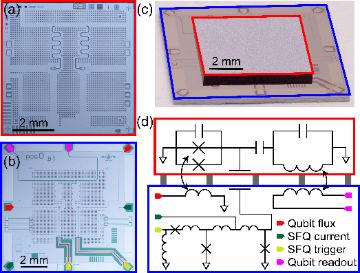
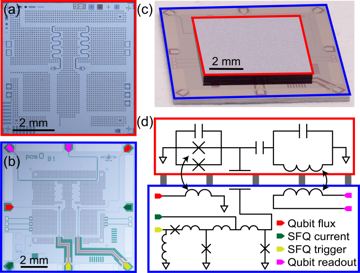
SFQ digital control (4 K / mK)
Quantised flux pulses from a niobium digital chip flip-chipped onto the qubit die drive gates at millikelvin, replacing per-qubit microwave coax.
Verdict. Real: one five-qubit module at 1Q > 99%. Unproven: two-qubit gates, readout, flux bias, robustness to quasiparticle poisoning beyond five qubits. Demote if no >20-qubit SFQ module by 2028.
Λ = error-suppression factor per code-distance step; QBI = DARPA Quantum Benchmarking Initiative (Stage A concept → B R&D plan → C government V&V); G1–G7 = the report's goal classes (see Actors & economics).
Identity & lineage
Single-flux-quantum (SFQ) logic stores a bit as one flux quantum Φ₀ = h/2e in a superconducting loop; a switching junction emits a pulse of area Φ₀, about 1 mV for 2 ps. Rapid single-flux-quantum (RSFQ; Likharev & Semenov, 1991) logic was built for classical computing at 4 K. For qubit control, a pulse train locked to the qubit period adds coherently into a Rabi rotation S[565]. In the 2026 form the controller is flip-chipped to the qubits at 10 mK D[304]. The wider superconductor-electronics field is tracked in the Superconductor Electronics Monitor P[56].
Attributes. Carrier affinity: fully fabricated control layer. Time / entangling: not applicable. Readout: none demonstrated C[53]. Mobility: none, bump-bonded. Control modality @ placement: microwave drive synthesised digitally at millikelvin. Error structure as the code sees it: Pauli plus correlated poisoning bursts D[249]. Manufacturing: multi-layer niobium lithography.
Physics & limits
Each Φ₀ pulse gives the qubit a fixed phase kick, so gate angle is set by pulse count, not analogue amplitude. Switching costs only ~I_cΦ₀ ≈ 10⁻¹⁹ J per event; within a mixing-chamber budget of tens of µW at 20 mK, RSFQ's static bias power and bias distribution bind first.
The floor is pair-breaking: switching junctions radiate photons above the aluminium gap (2Δ ≈ 90 GHz) that break Cooper pairs in the qubit film — quasiparticle poisoning — causing T1 decay and correlated bursts. Limiting the driver's pulse bandwidth is projected to remove it, bringing gate error toward 0.1% for resonant sequences D[249]. Other levers: quasiparticle traps, gap engineering, millimetre-wave absorbers.
Engineering state of the art
Best demonstrated (3 Sep 2026): SEEQC's five-qubit module at 10 mK, single-qubit fidelity above 99%, one digital input demultiplexed to several qubits D[304]C[53]. No SFQ result exceeds five qubits or includes a two-qubit gate or a QEC cycle.
table
| Year | Figure | Who | Tag+key |
|---|---|---|---|
| 2014 | 4,544 on-chip flux DACs for 512 qubits via 56 wires | D-Wave | D[430] |
| 2019 | First SFQ gate on a transmon, ≈ 95% | Wisconsin / Syracuse | D[566] |
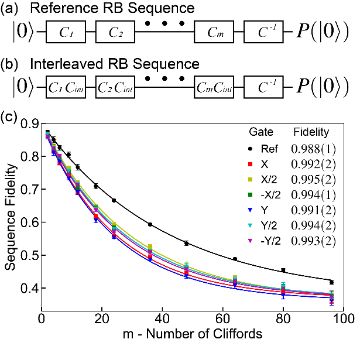
| 2023 | Separate-die driver: 1.2(1)% error/Clifford, 0.96(2)% from poisoning | Wisconsin, Syracuse, NIST | D[249] |
| 2026-03 | Five qubits, SFQ control at 10 mK; 1Q > 99%, peak 99.9% | SEEQC | D[304] |
| 2026-03 | Fluxon time-delay readout, no fidelity reported | preprint | S[568] |
Dominant error term: quasiparticle poisoning in the 2023 module D[249]; undisclosed for SEEQC's.
Manufacturing, materials & supply chain
The control die is multi-layer Nb/AlOx/Nb — eight or more planarised niobium layers, 10⁴–10⁶ junctions — unlike the aluminium qubit process D[569]. Foundries are few: MIT Lincoln Laboratory (SFQ5ee line, SQUILL qubit foundry) C[570], AIST's niobium process and cell libraries D[571], and SEEQC's commercial foundry in Elmsford, NY C[572]. Yield needs critical-current spreads of a few per cent across thousands of junctions. Export exposure (BIS rule of 2024-09-06): ECCNs 3A904, 3B904 and 4A906; 3A901.a, read literally, covers cryogenic CMOS only G[301]. Single points of failure: dilution refrigerators, indium-bump bonding, niobium sputter and CMP tools.
Superconductor electronics integrate 1–10 million junctions per cm² against more than 10 billion transistors per cm² in advanced CMOS (figures from the MIT Lincoln Laboratory process papers the authors cite). Design gains such as clock-free xSFQ cells with built-in fan-out amplifiers — 2.7–3.4× fewer junctions on standard benchmark circuits, one cell fabricated in MIT Lincoln Laboratory's SFQ5ee process (critical current density 10 kA/cm²) and verified at 4.2 K — raise functional density, not integration density P[897].
Control, readout & I/O burden
Room-temperature control needs about one drive coax and one flux line per transmon, so fridge cross-section and heat load set its limit; a KIDE-class platform offers > 4,000 rf lines for "over 1000 qubits" Cfact. SFQ control needs a clock plus a low-rate instruction stream D[304]. SFQ readout exists only as a preprint scheme S[568]; SEEQC lists flux bias as future work C[53].
Role in the stack
Architecture: the superconducting transmon lattice. It requires superconducting-qubit lithography and flip-chip modules; it provides cold digital logic for a cryogenic decoder and D-Wave's flux DACs D[430]. The cold routes for control are cryo-CMOS or SFQ: cryo-CMOS reuses commercial foundries and design tools; SFQ needs a niobium ecosystem whose commercial tools stop at physical verification. The conflict with the transmon — switching photons poisoning the qubit — is open: its mitigation is projected D[249], and SEEQC's 2026 report of no detectable poisoning is press coverage C[53]. Contribution to the derived clock: neutral — the syndrome round stays at 0.65 µs against the measured 1.1 µs QEC cycle D[1]. Neighbouring empty slots: SFQ flux bias, SFQ readout.
Evidence — how the numbers were measured
Every headline number is a randomised-benchmarking (RB) Clifford average D[566]D[249]D[304]. RB assumes Markovian, gate-independent errors, so rare correlated bursts average into a slightly worse mean, and a module can pass at 99.9% yet emit correlated errors that decoders do not model. SEEQC's "absence of detectable quasiparticle poisoning" is reported only in press C[53]. Not reported: charge parity under continuous clocking, T1 with the clock on and off. No independent replication: the 2026 authors are all from SEEQC D[304]. Conflicts: "exceeding 99%" in the abstract D[304] against "exceeding 99.5%" in press C[53]; "nanowatts per qubit" C[53] against ~1.6 µW per qubit in a 2026 estimate S[550]fact.
The five-qubit count, 10 mK and "nanowatts per qubit" come from press [53], not from the paper's abstract [304]. SEEQC's S-1 filings give $4.2 M revenue in 2025 and $18.1 M cash at 2026-06-30 fact; its enterprise value comes from trade press. SkyWater's superconducting capability is inferred from mentions in D-Wave's 10-K [492]. Not published: a dated 2025–26 Chinese SFQ qubit-control result, an SFQ-control patent-family count, and SEEQC's offering size (blank in the S-1 amendment of 2026-09-11).
Actors & economics
Who.
| Organisation | Role | Country | What they do with it | Evidence |
|---|---|---|---|---|
| SEEQC | developer / foundry | US | mK SFQ control module; commercial Nb foundry | D[304]C[572] |
| IBM | integrator | US | SFQ integration with SEEQC (QBI); own cryo-CMOS control | P[54]C[527] |
| Wisconsin–Madison, Syracuse, NIST Boulder | research | US | Resonant SFQ control; poisoning study | S[565]D[249] |
| MIT Lincoln Laboratory | foundry | US | SFQ5ee process; SQUILL qubit foundry | C[570] |
| D-Wave | developer (adjacent) | CA | On-chip SFQ flux DACs in annealers | D[430] |
| AIST, NEC | research / foundry | JP | Nb cell libraries; 4.2 K multiplexed controller | D[571]C[567] |
Money.
- 2020-09-16 · SEEQC · Series A · $22.4 M · EQT Ventures (lead) · closed C[572]
- 2025-01-16 · SEEQC · growth round · $30 M · SIP Global and others · closed P[573]
- 2025-06-12 · SEEQC + IBM · SFQ integration under DARPA QBI, IBM the performer G[65] · undisclosed · announced P[54]fact
- 2026-06-29 · SEEQC · S-1 for a Nasdaq IPO, alongside an Allegro Merger Corp SPAC agreement ($1 B enterprise value) · filed C[556]fact
- 2026-08-25 · SEEQC / Allegro · SPAC merger ended by settlement: Allegro gets $6 M in stock at a $1.3 B pre-money valuation on a future IPO, sale or ≥ $100 M raise · terminated G[574]
Market & supply chain. No SFQ control market exists yet: one vendor, one demonstration. SkyWater, the merchant foundry named in D-Wave's 10-K filings G[492], has belonged to IonQ since July 2026 C[19]. G3 and G4 pay for it; G7 secondarily.
IP & standards. SEEQC holds the Hypres RSFQ and niobium-process patents, transferred at its 2019 spin-out C[572]. No SFQ-control standards exist; shared design bases are AIST's cell library D[571] and MIT-LL's kits C[570].
Roadmaps & track record. SEEQC: millikelvin SFQ control (promised 2021–22 · delivered 2026-03 at five qubits) D[304]; on-die flux control and readout (announced 2026-03 · undated) C[53].
Strategic reading. Niobium process capability sits with SEEQC and, via Lincoln Laboratory, the US government. Of the cold routes, cryo-CMOS or SFQ, cryo-CMOS has the stronger record: a QEC demonstration under a 4 K cryo-CMOS controller D[190] and parity with warm electronics on an IBM processor C[527]; SFQ has single-qubit gates on five qubits from one group D[304].
Outlook & open questions
Confirm if by end-2027 a group publishes an SFQ-driven two-qubit gate below 1% error, an SFQ-controlled device above ten qubits, or hours of charge-parity data free of clock-correlated bursts. Demote if by end-2028 no SFQ module exceeds twenty qubits, or a decomposition shows poisoning above 0.1% per Clifford. Open questions: does "no detectable poisoning" survive continuous clocking at QEC duty cycles? Can SFQ flux bias hold the DC stability transmons need?
References
- [1] Google Quantum AI and Collaborators, “Quantum error correction below the surface code threshold,” Nature, vol. 638, no. 8052, pp. 920–926, Dec. 2024, doi: 10.1038/s41586-024-08449-y. D
- [19] IonQ, “IonQ Completes Acquisition of SkyWater Technology,” Jul. 31, 2026. [Online]. Available: https://www.ionq.com/
news/ Cionq-completes-acquisition-of-skywater-technology - [53] M. Abdel-Kareem, “SEEQC Reports Integrated Qubit Control Logic Operating at Millikelvin Temperatures,” Quantum Computing Report, Mar. 21, 2026. [Online]. Available: https://quantumcomputingreport.com/
seeqc-reports-integrated-qubit-control-logic-operating-at-millikelvin-temperatures/ C - [54] M. Abdel-Kareem, “SEEQC and IBM Collaborate on SFQ Control Integration Under DARPA's Quantum Benchmarking Initiative,” Quantum Computing Report, Jun. 12, 2025. [Online]. Available: https://quantumcomputingreport.com/
seeqc-and-ibm-collaborate-on-sfq-control-integration-under-darpas-quantum-benchmarking-initiative/ P - [56] R. Neeman, “Superconductor Electronics Monitor,” Qodeh, 2026, doi: 10.5281/zenodo.21860767. [Online]. Available: https://qodeh.com/
publications/ Psuperconductor-electronics-monitor-2026/ - [65] DARPA, “Stage B selection,” Nov. 6, 2025. [Online]. Available: https://www.darpa.mil/
research/ Gprograms/ quantum-benchmarking-initiative/ stage-b-selection - [190] Members of the HRL Quantum Team and Collaborators, “A digitally controlled silicon quantum processing unit,” arXiv:2604.16216, Apr. 2026. D
- [249] C. Liu et al., “Single Flux Quantum-Based Digital Control of Superconducting Qubits in a Multichip Module,” PRX Quantum, vol. 4, no. 3, Art. no. 030310, Jul. 2023, doi: 10.1103/PRXQuantum.4.030310. D
- [301] US Department of Commerce, Bureau of Industry and Security, “Commerce Control List Additions and Revisions; Implementation of Controls on Advanced Technologies Consistent With Controls Implemented by International Partners,” Federal Register, vol. 89, p. 72926, Sep. 6, 2024. [Online]. Available: https://www.federalregister.gov/
documents/ G2024/ 09/ 06/ 2024-19633/ commerce-control-list-additions-and-revisions-implementation-of-controls-on-advanced-technologies - [304] C. Jordan et al., “A quantum computer controlled by superconducting digital electronics at millikelvin temperature,” Nat. Electron., vol. 9, no. 3, pp. 287–294, Mar. 2026, doi: 10.1038/s41928-026-01576-6. D
- [430] P. I. Bunyk et al., “Architectural considerations in the design of a superconducting quantum annealing processor,” arXiv:1401.5504, Jan. 2014. D
- [492] U.S. Securities and Exchange Commission, “EDGAR full-text search: ‘SkyWater’ in D-Wave Quantum Inc. 10-K filings,” SEC EDGAR Full-Text Search, Feb. 26, 2026. [Online]. Available: https://efts.sec.gov/
LATEST/ Gsearch-index?q=%22SkyWater%22&forms=10-K&ciks=0001907982 - [527] A. Noori et al., “A Cryo-CMOS Control System for Large-Scale Superconducting Qubit Quantum Computing: Part 2,” IBM Research, Mar. 16, 2026. [Online]. Available: https://research.ibm.com/
publications/ Ca-cryo-cmos-control-system-for-large-scale-superconducting-qubit-quantum-computing-part-2 - [550] S. Kawabata, “Integration and Resource Estimation of Cryoelectronics for Superconducting Fault-Tolerant Quantum Computers,” arXiv:2601.03922, Jan. 2026. S
- [556] SEEQC, “SEEQC Files Registration Statement for Proposed Initial Public Offering,” Business Wire, Jun. 29, 2026. [Online]. Available: https://www.businesswire.com/
news/ Chome/ 20260629077919/ en/ SEEQC-Files-Registration-Statement-for-Proposed-Initial-Public-Offering - [565] R. McDermott and M. G. Vavilov, “Accurate Qubit Control with Single Flux Quantum Pulses,” Phys. Rev. Appl., vol. 2, no. 1, Art. no. 014007, Jul. 2014, doi: 10.1103/PhysRevApplied.2.014007. S
- [566] E. Leonard et al., “Digital Coherent Control of a Superconducting Qubit,” Phys. Rev. Appl., vol. 11, no. 1, Art. no. 014009, Jan. 2019, doi: 10.1103/PhysRevApplied.11.014009. arXiv:1806.07930. D
- [567] AIST; Yokohama National University; Tohoku University; NEC, “Successful demonstration of a superconducting circuit for qubit control within large-scale quantum computer systems,” NEC Press Releases, Jun. 3, 2024. [Online]. Available: https://www.nec.com/
en/ Cpress/ 202406/ global_20240603_02.html - [568] S. Kamimura, A. Taguchi, M. Tanaka, and T. Yamamoto, “Fluxon Time-Delay Readout of a Superconducting Qubit Protected by a Spectral Gap in a Josephson Transmission Line,” arXiv:2603.13175, Mar. 2026. S
- [569] S. K. Tolpygo, “Superconductor Digital Electronics: Scalability and Energy Efficiency Issues,” arXiv:1602.03546, Feb. 2016. D
- [570] MIT Lincoln Laboratory, “SQUILL Foundry.” [Online]. Available: https://www.ll.mit.edu/
r-d/ Cprojects/ squill-foundry - [571] T. Yamae et al., “Rapid single-flux-quantum and adiabatic quantum-flux-parametron cell libraries using a 1 kA/cm2 niobium fabrication process,” Scientific Reports, vol. 15, Art. no. 41429, Nov. 2025, doi: 10.1038/s41598-025-20666-7. D
- [572] SEEQC, “SEEQC Secures $22.4 Million In Series A Round; Strategic Investment Led By EQT Ventures,” Sep. 16, 2020. [Online]. Available: https://seeqc.com/
resources/ Cseeqc-secures-22.4-million-in-series-a-round-strategic-investment-led-by-eqt-ventures - [573] SIP Global Partners, “SIP Global Partners Participates in $30M Round for SEEQC, Developer of the World's First Full-Stack Processor for Quantum Computers,” PRWeb, Jan. 16, 2025. [Online]. Available: https://www.prweb.com/
releases/ Psip-global-partners-participates-in-30m-round-for-seeqc-developer-of-the-worlds-first-full-stack-processor-for-quantum-computers-302352970.html - [574] Allegro Merger Corp.; SeeQC, Inc., “Settlement, Termination and Release Agreement,” U.S. Securities and Exchange Commission (EDGAR), Aug. 2026. [Online]. Available: https://www.sec.gov/
Archives/ Gedgar/ data/ 1779977/ 000121390026095175/ ea028847004ex2-2.htm - [897] P. Papanikolaou, A. Vanasse, H. Jin, G. Tzimpragos, and J. Volk, “Duplication-aware retiming and cell interface redesign for superconductor circuit minimization,” arXiv:2610.02333, Oct. 2026. P