Ancilla-mediated bosonic gates (cat CX, dual-rail CZ, beamsplitter) g_bos
Driven SQUID/SNAIL couplers and transmon ancillas mediate beamsplitter and entangling gates between superconducting bosonic cavity modes, for cat, GKP and dual-rail encodings.
Ancilla-mediated bosonic gates (cat CX, dual-rail CZ, beamsplitter)
Transmon ancilla, or a differentially driven DC-SQUID beamsplitter coupler between modes; ~500 ns.
Brief →Key references
Design space — attributes
- (a) carrier affinity
- fabricated
- (b) time · entangling
- 501 ns · deterministic
- (c) readout
- —
- (d) mobility
- shared bus (motional / cavity)
- (e) control
- microwave @ room temperature
- (f) error structure
- erasure-convertible, biased, stochastic Pauli
- (g) manufacturing
- 3D machined cavities
Evaluation space — dated attributes
The beamsplitter coupler of arXiv:2303.00959 is a differentially driven DC-SQUID, not a SNAIL. Quantum Circuits was never in DARPA QBI; Alice & Bob reached Stage A only.
Standard records
Actors & goals — annotations
Edges
Used by 12 machines (10 primary · 2 alternate)
- superconducting circuits 12
- Alice & Bob Boson 4 Alice & Bob press ▣ §III (Zeno gates); Fig. 4 (Z-gate fidelity with squeezing) ✅
- Alice & Bob Helium (on-premise system) Alice & Bob whitepaper press ▥ §MILESTONE 2 Challenge 1: Mirror the Phase (CNOT); §MILESTONE 1 Challenge 3: Run Cat Qubit Operations; §MILESTONE 4 Challenge 1: Create Magic States (Toffoli) ✅
- Alice & Bob Helium 2 ("Galvanic Cat") Alice & Bob press ▨ ✅
- AWS dual-rail transmon erasure line AWS Center for Quantum Computing (named Amazon Center for Quantum Computing in the Apr 2026 paper) paper ▤ §V (Continuous Parallel Erasure Detection); App. F ✅
- AWS Ocelot AWS Center for Quantum Computing ▣ Fig. 2 (noise-biased CX gate); §III ✅
- D-Wave gate-model dual-rail system D-Wave Quantum press ▣ Fig. 1b (Swap-Wait-Swap CZ sequence); §The SWS CZ gate; Fig. 2 (gate benchmarking) ✅
- Nord Quantique single-mode GKP Nord Quantique paper press ▣ Fig. 1e (sBs conditional displacements + aux rotations); App. A.2 Hamiltonian, A.5 ECD gate ✅
- Nord Quantique Tesseract Nord Quantique product page press ▣ Fig. 1e (sBs conditional displacements + auxiliary rotations); App. A.5 ECD gate ✅
- Aqumen Seeker Quantum Circuits Inc. (acquired by D-Wave, Jan 2026) press ▣ Fig. 1b (SWS CZ gate sequence via flux-pumped SQUID coupler); §The SWS CZ gate; Fig. 2 ✅
- SUSTech biased-erasure cavity qubit Southern University of Science and Technology paper ▣ Fig. 4 (logical RB, residual error 2.86e-3/gate); Fig. S9 (X_L/2 process matrix); SI §IV ✅
- Alice & Bob Graphene Alice & Bob press ▥ 🔎 (alternate)
- OQC GENESIS Oxford Quantum Circuits product page product page press ▦ 🔎 (alternate)
Pictures
Every picture carries the story of what it shows and its credit line.
Ancilla-mediated bosonic gates (cat CX, dual-rail CZ, beamsplitter)
Driven SQUID/SNAIL couplers and transmon ancillas mediate beamsplitter and entangling gates between superconducting bosonic cavity modes, for cat, GKP and dual-rail encodings.
Verdict. Dual-rail cavity CZ reaches 0.029% post-selected Pauli error at 500 ns with ~80% of gate error heralded as erasure; no bias-preserving cat-cat entangling gate exists as of 4 Sep 2026.
Λ = error-suppression factor per code-distance step; QBI = DARPA Quantum Benchmarking Initiative (Stage A concept → B R&D plan → C government V&V); G1–G7 = the report's goal classes (see Actors & economics).
Identity & lineage
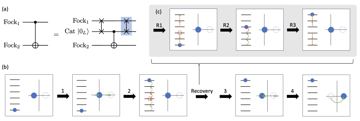
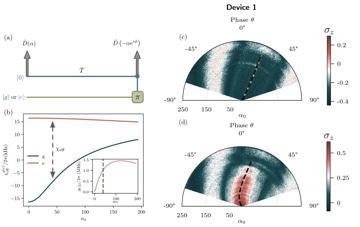
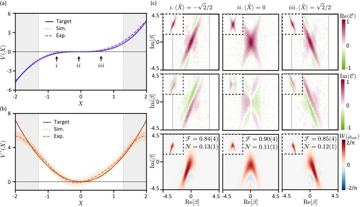
Two bosonic cavity modes are never coupled directly. A nonlinear element between them — a driven DC-SQUID or SNAIL (superconducting nonlinear asymmetric inductive element) coupler, or a dispersively coupled transmon ancilla — is pumped at the mode-frequency difference, turning pump photons into a bilinear exchange (beamsplitter) or a conditional phase. Yale set the pattern in 2018 with an rf-driven 50:50 beamsplitter between two microwave memories D[471]; gate fidelities follow from 2023 D[472].
- b/e: entangling time ≈500 ns (10⁻⁶·³ s), deterministic; microwave drives from room-temperature electronics.
- d/g: modes linked through a shared coupler acting as a bus; 3D-machined cavity hardware, not planar chips.
Physics & limits
The parametric beamsplitter rate reaches a few MHz, hence ~100 ns swaps D[472]; a conditional phase accumulates through a dispersive shift χ/2π ≈ 0.1–1 MHz, hence ~500 ns entangling gates D[84]. The floor is the ancilla, not the cavity: at ancilla T1 ≈ 50–100 µs against a 0.5-µs gate, ancilla error is ~10⁻² unless it is kept virtual or relabelled. Relabelling is the point: dual-rail does not lower total gate error but moves ~80% of it into heralded erasure (0.400(4)% control, 0.096(4)% target), leaving 0.029(6)% unheralded Pauli error and bit-flips at 2.8(4)×10⁻⁶ D[84]; located erasures buy ~5× more tolerable Pauli error at code level than depolarising noise P[402]. Failure modes: ancilla decay mid-gate (an erasure in dual-rail, a phase error elsewhere), ancilla dephasing, higher-Fock leakage no check sees, and for cats any gate term failing to commute with the two-photon dissipation. Moving the floor needs higher-coherence ancillas, virtual-ancilla or dissipative coupling, or a bias-preserving cat Hamiltonian — still theory P[81].
Engineering state of the art
Best demonstrated: dual-rail cavity CZ, ~500 ns, erasure ≈0.5%/gate, post-selected Pauli 0.029(6)%, SPAM ≈0.02% D[84]fact. D-Wave markets it as "approximately 99.9%" C[473], neither the raw nor the post-selected value. Typical at scale lags: AWS's transmon check runs 384 ns, erasure 2.54(1)×10⁻²/check, residual 6.0(2)×10⁻⁴, bias 42(1) D[85]. No cat–cat CNOT exists on hardware P[81]. Dominant error term: unheralded Pauli error surviving post-selection, plus the check's false negatives.
table
| Year | Figure | Who | Tag+key |
|---|---|---|---|
| 2018-02 | RF-driven 50:50 beamsplitter between two cavity memories | Yale | D[471] |
| 2023-03 | Cavity swap >99.98%, ~100 ns, DC-SQUID coupler | Yale | D[472] |
| 2026-04 | Erasure check 384 ns, residual 6.0(2)×10⁻⁴, bias 42(1) | AWS | D[85] |
| 2026-08 | Dual-rail cavity CZ ~500 ns, post-selected Pauli 0.029(6)% | Quantum Circuits | D[84] |
Trapped ions realise the same qubit-conditioned bosonic primitive outside circuit QED: driving the red and blue motional sidebands together gives a spin-dependent conditional displacement of a motional mode, and free-boson rotations are applied as laser phase shifts; a three-ion ¹⁷¹Yb⁺ chain used them to simulate the dynamics of a Yukawa field model D[884].
Manufacturing, materials & supply chain
Ancilla and coupler are aluminium-junction circuits in aluminium or tantalum films on silicon or sapphire; at Yale the modes are machined high-purity aluminium 3D cavities, etched to 10⁷–10⁸ Q, at D-Wave/Quantum Circuits 3D λ/4 coaxial cavities whose material and making are not published, while AWS's Ocelot holds its modes in thin-film coplanar-waveguide resonators on chip and Alice & Bob in thin-film tantalum circuits on sapphire D[80]fact. No merchant cavity supplier exists — Yale machines its own, D-Wave/Quantum Circuits name no supplier — so surface treatment is lab craft, not a qualified process. Below that, the generic superconducting chain: Bluefors, which absorbed pulse-tube maker Cryomech in 2023, and Oxford Instruments fact. Export exposure is the 2024 BIS rule: ECCN 4A906 (machines whose qubit count and C-NOT error fall in the same band, from 34–99 qubits at ≤ 10⁻⁴ to any error from 2,000 qubits fact), 3A904 (refrigerators ≥600 µW at 0.1 K), 3A901 (cryogenic amplifiers) G[301]. No per-cavity cost or yield is public.
Control, readout & I/O burden
Each cell needs a cavity drive, an ancilla drive and a dispersive ancilla readout, so lines run ahead of mode count. Erasure conversion adds latency: AWS resolves a check in 384 ns D[85], the cavity gate in ≈0.4–1 µs D[84]. That fits an FPGA-local loop but nothing off-chassis: NVQLink's 3.84 µs round trip suits syndrome processing, not heralding Cfact. The wall is geometric before electrical: a machined cavity is a cubic-centimetre object, so 10³ modes is a fridge-volume problem and 10⁶ needs planar or transmon variants.
Role in the stack
The shared entangling primitive of two competing superconducting architectures, cat/GKP encoding and dual-rail erasure encoding. It requires a cavity mode plus an ancilla and replaces ancilla-free cat-CNOT schemes: hardware bought for erasure-convertibility or bias, a trade only dual-rail has cashed. It reaches the superconducting branch only. Derived clock = sum of the syndrome round: gate layers + transport + readout + reset ≈ 1.44 µs on the cat-and-GKP architecture, whose largest term is two 500 ns gate layers, and ≈ 2.8 µs on the dual-rail one, with four. Empty neighbouring slots: a bias-preserving cat entangling gate, a merchant high-Q cavity process.
Evidence — how the numbers were measured
Headline figures come from randomised benchmarking on the composite two-mode system with post-selection on ancilla readout; the erasure fraction comes from that same readout, so false negatives fold into the "residual Pauli" bucket. A transmon-qutrit erasure design reports false positives ~2%, false negatives 6–8% P[405] — the order of what may be misattributed here. Theory keeps the surface-code threshold at least twice the Pauli value under imperfect checks, but only when the check is short against the cycle D[395]. Conflict: 0.029(6)% vs the 0.12% bound at depth D[84] vs "≈99.9%" C[473]; of the three, the measured decomposition is the best supported. SUSTech replicates the architecture, not the fidelity D[406]. Discard rates go unreported.
Not published: the amount of Alice & Bob's May-2026 Series B extension, and the post-selection discard rates of the dual-rail CZ and the beamsplitter swap.
Actors & economics
Who.
| Organisation | Role | Country | What exactly they do with this technology | Evidence |
|---|---|---|---|---|
| Quantum Circuits Inc. | developer | USA | Built the 500-ns dual-rail CZ; ships 8-qubit Seeker | D[84] |
| D-Wave Quantum | developer | USA | Owner since Jan 2026; funds and markets it | C[14] |
| Yale University | research | USA | Originated ancilla-mediated cavity gates | D[471] |
| AWS | developer | USA | Transmon erasure checks; Ocelot; CNOT theory | D[85] |
| Alice & Bob | developer | France | Cat gates; 18-cat Helium, no logical data | C[87] |
| Nord Quantique | developer | Canada | GKP bosonic gates; QBI Stage B | C[89] |
Money.
| Date | Actor | Event | Amount | Programme / lead | Status |
|---|---|---|---|---|---|
| 2025-01-28 | Alice & Bob | Series B (extension 2026-05-22, undisclosed) | €100M | AVP, Bpifrance | closed Cfact |
| 2025-11-04 | US DOE | centre renewal naming dual-rail | $125M | C2QA/NQISRC | awarded G[474] |
| 2025-11-06 | DARPA | Stage B, 11 teams, Alice & Bob cut | ≤$15M | QBI | official G[65] |
| 2026-01-20 | D-Wave | M&A: Quantum Circuits | $550M | — | closed C[14] |
| 2026-05-18 | Nord Quantique | equity at $1.4B valuation | $30M | — | closed C[89] |
| 2026-08-06 | D-Wave | H1-2026 revenue | $5.9M (−67% YoY) | — | reported C[15] |
Market & supply chain. Nobody sells into this mechanism: it rides the refrigerator and junction chains common to all superconducting qubits, plus one unshared step, 3D cavity machining, which is the single point of failure. Helium's ~40 kW is the family's only public power figure C[87]. It pays for G2 and is a credible G3 candidate via dual-rail, not G4: the cat resource case rests on a phase-flip rate two orders below measurement, and D-Wave's Λ = 27 is a simulation of its own error model Sfact.
IP & standards. Amazon Technologies holds US 11,748,652 B1 (heralding of amplitude-damping decay, granted 2023-09-05), reading directly on heralded-decay dual-rail embodiments G[336] — awkward for rivals, since AWS alone needs no licence. No Yale or Quantum Circuits family surfaced in a dual-rail patent search fact. No litigation, no standards body.
Roadmaps & track record. D-Wave/Quantum Circuits (2026-06, for 2032: 100 logical at Λ = 10, via 17 qubits in 2026) — gate published, no system delivered as of 4 Sep 2026 Pfact; best physics, unproven as product. Alice & Bob (2023, for 2030: 2,000 cats, 100 logical, 10⁻⁶) — Helium shipped without logical data, no Stage B slot; unverified. Nord Quantique (2024, for 2029: 100+ logical at 1:1) — capitalised, unproven. AWS — Ocelot delivered, cat–cat CNOT still theory; claims have not outrun measurements.
Strategic reading. If erasure conversion scales the winners own large superconducting fabs, not bosonic specialities: the mechanism is portable, and IBM, Google or Rigetti could bolt an ancilla check onto existing transmons without 3D cavities P[405]. That is the substitution threat to D-Wave's $550M purchase, which concentrates Yale-lineage IP but buys no fab moat. Losers if it fails: the cat roadmaps, whose economics rest on a 100× resource reduction the measured phase-flip rate does not support.
Outlook & open questions
Confirm/demote in 12–24 months: a cat–cat CX on hardware; a dual-rail gate below 0.01% post-selected Pauli outside Quantum Circuits; a delivered 17-qubit system with its promised 2× logical-versus-physical error reduction; a published discard rate. Best case 2029: erasure conversion becomes a standard transmon add-on. Worst case: cat–cat gates stay theory and 3D cavities stall on volume. Open: does the erasure fraction hold at depth 10³; the true false-negative rate; can it be planarised without losing Q; does D-Wave fund Quantum Circuits through 2028 on $5.9M half-year revenue. Watch QBI Stage C.
References
- [14] D-Wave Quantum Inc., “D-Wave Announces Agreement to Acquire Quantum Circuits Inc., Establishing World's Leading Quantum Computing Company,” Jan. 7, 2026. [Online]. Available: https://www.dwavequantum.com/
company/ Cnewsroom/ press-release/ d-wave-to-acquire-quantum-circuits-inc-establishing-world-s-leading-quantum-computing-company/ - [15] D-Wave Quantum Inc., “D-Wave Reports Second Quarter 2026 Results,” Aug. 6, 2026. [Online]. Available: https://www.dwavequantum.com/
company/ Cnewsroom/ press-release/ d-wave-reports-second-quarter-2026-results/ - [65] DARPA, “Stage B selection,” Nov. 6, 2025. [Online]. Available: https://www.darpa.mil/
research/ Gprograms/ quantum-benchmarking-initiative/ stage-b-selection - [80] H. Putterman et al., “Hardware-efficient quantum error correction via concatenated bosonic qubits,” Nature, vol. 638, no. 8052, pp. 927–934, Feb. 2025, doi: 10.1038/s41586-025-08642-7. D
- [81] Y. Ye et al., “Bias-preserving cat-cat CNOT gate via vacuum-conditional beam-splitter,” arXiv:2607.22852, Jul. 2026. P
- [84] N. Mehta et al., “An entangling gate for dual-rail erasure qubits,” Nature, vol. 656, no. 8126, pp. 47–53, Aug. 2026, doi: 10.1038/s41586-026-10822-y. arXiv:2503.10935. D
- [85] J. S.-C. Hung et al., “Fast, High-Fidelity Erasure Detection of Dual-Rail Qubits with Symmetrically Coupled Readout,” arXiv:2604.16292, Apr. 2026. D
- [87] N. Coppola, “Alice & Bob Unveils First Quantum System, Helium,” Alice & Bob, Jun. 10, 2026. [Online]. Available: https://alice-bob.com/
newsroom/ Calice-bob-unveils-first-quantum-system/ - [89] Nord Quantique, “Nord Quantique Reaches $1.4 Billion USD Valuation with Latest Investment,” Business Wire, May 18, 2026. [Online]. Available: https://www.businesswire.com/
news/ Chome/ 20260518358351/ en/ Nord-Quantique-Reaches-$1.4-Billion-USD-Valuation-with-Latest-Investment - [301] US Department of Commerce, Bureau of Industry and Security, “Commerce Control List Additions and Revisions; Implementation of Controls on Advanced Technologies Consistent With Controls Implemented by International Partners,” Federal Register, vol. 89, p. 72926, Sep. 6, 2024. [Online]. Available: https://www.federalregister.gov/
documents/ G2024/ 09/ 06/ 2024-19633/ commerce-control-list-additions-and-revisions-implementation-of-controls-on-advanced-technologies - [336] A. M. Kubica and A. Retzker, “Heralding of amplitude damping decay noise for quantum error correction,” Google Patents, Sep. 5, 2023. [Online]. Available: https://patents.google.com/
patent/ GUS11748652B1/ en - [395] K. Chang et al., “Surface Code with Imperfect Erasure Checks,” PRX Quantum, vol. 6, no. 4, Art. no. 040355, Dec. 2025, doi: 10.1103/d1v7-nctj. D
- [402] M. Violaris et al., “Developments in superconducting erasure qubits for hardware-efficient quantum error correction,” arXiv:2601.02183, Jan. 2026. P
- [405] B.-J. Liu et al., “Hardware-Efficient Erasure Qubits With Superconducting Transmon Qutrits,” arXiv:2604.08672, Apr. 2026. P
- [406] W. Huang et al., “Logical multi-qubit entanglement with dual-rail superconducting qubits,” Nat. Phys., vol. 22, no. 4, pp. 591–597, Mar. 2026, doi: 10.1038/s41567-026-03211-9. arXiv:2504.12099. D
- [471] Y. Y. Gao et al., “Programmable interference between two microwave quantum memories,” Phys. Rev. X, vol. 8, no. 2, Art. no. 021073, Jun. 2018, doi: 10.1103/PhysRevX.8.021073. arXiv:1802.08510. D
- [472] Y. Lu et al., “High-fidelity parametric beamsplitting with a parity-protected converter,” arXiv:2303.00959, Mar. 2023. D
- [473] K. Chou, J. Teoh, and N. Mehta, “Why D-Wave's New Two-Qubit Gate is a Breakthrough for Quantum Error Correction,” D-Wave Quantum Blog, Aug. 5, 2026. [Online]. Available: https://www.dwavequantum.com/
learn/ Cblog/ posts/ why-d-wave-s-new-two-qubit-gate-is-a-breakthrough-for-quantum-error-correction/ - [474] US Department of Energy, “Energy Department Announces $625 Million to Advance the Next Phase of National Quantum Information Science Research Centers,” Energy.gov, Nov. 4, 2025. [Online]. Available: https://www.energy.gov/
articles/ Genergy-department-announces-625-million-advance-next-phase-national-quantum-information - [884] A. T. Than et al., “Quantum field theory dynamics on a spin–phonon quantum computer,” Nat. Phys., Sep. 2026, doi: 10.1038/s41567-026-03402-4. arXiv:2509.11477. D