Bias-preserving cat–cat CNOT g_catcnot
A direct entangling gate between two dissipative cat qubits that keeps the exponential bit-flip suppression intact through the interaction — theory only.
Bias-preserving cat–cat CNOT
Required by every cat-qubit resource estimate; proposed since 2019 (Guillaud–Mirrahimi) and 2020 (Puri et al.), the first unitary scheme in July 2026; no demonstration.
Key references
Design space — attributes
- (a) carrier affinity
- fabricated
- (b) time · entangling
- — · deterministic
- (c) readout
- —
- (d) mobility
- shared bus (motional / cavity)
- (e) control
- microwave @ room temperature
- (f) error structure
- biased
- (g) manufacturing
- superconducting lithography
Evaluation space — dated attributes
Standard records
Actors & goals — annotations
Edges
Used by 1 machine (1 primary · 0 alternate)
- superconducting circuits 1
- Alice & Bob Graphene Alice & Bob press ▤ Table I (ε_CNOT=1.6e-2); §V (current state of the art) ✅
Pictures
Every picture carries the story of what it shows and its credit line.
Bias-preserving cat–cat CNOT
A direct entangling gate between two dissipative cat qubits that keeps the exponential bit-flip suppression intact through the interaction — theory only.
Verdict. Undemonstrated as of 2026-09-04; demote every cat-code qubit-count estimate if no two-cat gate shows measured bias preservation by 2028.
Λ = error-suppression factor per code-distance step; QBI = DARPA Quantum Benchmarking Initiative (Stage A concept → B R&D plan → C government V&V); G1–G7 = the report's goal classes (see Actors & economics).
Identity & lineage
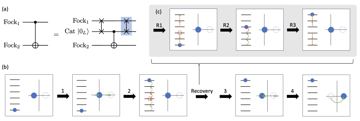
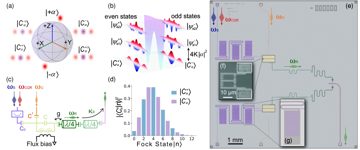
An entangling gate acting directly between two dissipative cat qubits, no transmon ancilla in the middle, preserving the bit-flip/phase-flip asymmetry through the interaction. Every cat CX in hardware is cat–transmon; the cat–cat version is what cat-code resource estimates silently assume. The first coherent (unitary) scheme, a "vacuum-conditional beam-splitter", was posted 2026-07-24 by Ye et al. (AWS Center for Quantum Computing / Caltech) S[81]. Entangling is intended deterministic, gate time unmeasured; control is room-temperature microwave, bus connectivity.
Physics & limits
The difficulty is geometric: a cat CNOT rotates the target's coherent amplitude through π conditioned on the control, briefly leaving the stabilised two-lobe manifold; any non-adiabatic drive term then leaks population between lobes as plain bit-flips, no longer exponentially suppressed in photon number. Dissipative schemes pin the state but pay in gate-induced phase-flips. The unitary scheme drops the dissipator and claims logical memory below 10⁻⁶ from a distance-7 repetition code of 13 cats — from assumed lifetimes and nonlinearity precision, not measurement S[81]. The floor is structural: one residual bias-breaking term turns the exponential into a polynomial and takes the qubit-count case with it S[95].
Engineering state of the art
No cat–cat entangling gate exists in hardware as of 2026-09-04.
table
| Date | Figure | Who | Tag |
|---|---|---|---|
| 2025-02 | Cat–transmon CX at n̄ = 2: bit-flip 3.5(4)×10⁻³, phase-flip 9.6(4)×10⁻² → bias > 25 under the gate, > 30 idle | AWS/Caltech (Ocelot) | D[80] |
| 2026-07 | Unitary cat–cat CNOT proposed; <10⁻⁶ logical memory claimed, distance 7 / 13 cats | Ye et al. | S[81] |
| 2030 | 2,000 cats → 100 logical at 10⁻⁶, requiring ≥13-min bit-flip during a CNOT | Alice & Bob | R[412] |
The neighbour shows the budget's shape: Ocelot's 2.8 µs cycle moved logical error only from 1.75(2)% at distance 3 to 1.65(3)% at distance 5, because per-CX phase-flip is already ~10⁻¹ D[80].
The <10⁻⁶ logical-memory claim in [81] rests on assumed component lifetimes and nonlinearity precision, with no independent replication and no measured gate as of 2026-09-04. The roadmap page [412] attaches the "13 minutes" bit-flip requirement to the Graphene chip without saying whether it holds idle or under a gate. No experimental group has reported an attempt at a cat–cat entangling gate.
Manufacturing, materials & supply chain
No dedicated process: the gate reuses existing cavity bodies, junction lithography and room-temperature microwave stacks. Dropping the ancilla removes one transmon and readout chain per gate pair — Ocelot spends four ancillas on five cats — but adds a parametric tone per cat: lines per qubit are re-allocated, not reduced. At 10³ cats the wall is coax density and pump crosstalk in one dilution unit; at 10⁴–10⁶ it is the generic microwave wiring wall, no cryogenic-CMOS multiplexing of cat pump tones having been demonstrated.
Role in the stack
On the superconducting bosonic (cat/GKP) architecture; requires two cat-encoded qubits and provides nothing downstream until it exists. It replaces the ancilla-mediated bosonic CX, trading a non-bias-preserving transmon channel for an unproven direct interaction; not switching leaves the ancilla's bit-flips setting the code floor. It does not move the derived clock, a 1.44 µs round here inside the measured 2.8 µs cycle, set by CX plus dispersive ancilla readout D[80]. Verification: the sole evidence is a proposal — no replication, no hardware attempt, and <10⁻⁶ is a code-level projection, not a measured fidelity S[81].
Actors & economics
Who.
| Organisation | Role | Country | What exactly they do | Evidence |
|---|---|---|---|---|
| AWS | developer | US | Authored the unitary scheme; owns the cat CX hardware | S[81] |
| Alice & Bob | developer | FR | 2030 rung, 2,000 cats → 100 logical, presumes it | R[412] |
| DARPA | investor | US | Stage B funds Nord Quantique, not Alice & Bob | fact |
Money.
2025-01-28 · Alice & Bob · Series B · €100 M · — · closed fact
2026-05-22 · Alice & Bob · Series B extension · undisclosed · NVentures lead · closed C[88]
2026-06-17 · GENCI · buys first "Helium" · undisclosed · French HPC agency · closed C[87]
2025-11-06 · Nord Quantique · QBI Stage B · $5 M, up to $15 M · DARPA · announced G[65]
Market & supply chain. No supplier is specific to this gate; it reuses cat vendors' fabrication and pays for G3 alone.
IP & standards. No dated patent family specific to a bias-preserving cat–cat gate was found as of 2026-09-04.
Roadmaps & track record. AWS: promised 2026-07, no experimental date S[81]. Alice & Bob: promised on the live roadmap, for 2030 — Boson 4 (2024) and Helium (2026-06) landed, but every rung past Lithium (48 cats, 4 logical, 10⁻³) presumes this gate R[412].
Strategic reading. If measured, cat codes keep their qubit-count argument and surface-code transmon vendors lose; if still theory past 2028, dual-rail erasure takes the hardware-efficient slot.
Outlook & open questions
Confirm by 2028 if a measured two-cat gate holds bit-flip time within 10× of idle; demote if 2028 passes with only ancilla-mediated gates, since the 2030 rung and the 126,133-cat class of estimates lose their premise S[95]. Best case 2029: bias above 10³ under drive. Worst case: cat logic runs through ancillas indefinitely. Open: does the scheme survive junction-nonlinearity spread; can the gate be characterised without ancilla contamination; who attempts hardware first? Watch Ocelot follow-ups and the Lithium chip.
References
- [65] DARPA, “Stage B selection,” Nov. 6, 2025. [Online]. Available: https://www.darpa.mil/
research/ Gprograms/ quantum-benchmarking-initiative/ stage-b-selection - [80] H. Putterman et al., “Hardware-efficient quantum error correction via concatenated bosonic qubits,” Nature, vol. 638, no. 8052, pp. 927–934, Feb. 2025, doi: 10.1038/s41586-025-08642-7. D
- [81] Y. Ye et al., “Bias-preserving cat-cat CNOT gate via vacuum-conditional beam-splitter,” arXiv:2607.22852, Jul. 2026. S
- [87] N. Coppola, “Alice & Bob Unveils First Quantum System, Helium,” Alice & Bob, Jun. 10, 2026. [Online]. Available: https://alice-bob.com/
newsroom/ Calice-bob-unveils-first-quantum-system/ - [88] N. Coppola, “Alice & Bob announces Series B Extension,” Alice & Bob, May 22, 2026. [Online]. Available: https://alice-bob.com/
newsroom/ Calice-bob-announces-series-b-extension/ - [95] É. Gouzien, D. Ruiz, F.-M. Le Régent, J. Guillaud, and N. Sangouard, “Performance Analysis of a Repetition Cat Code Architecture: Computing 256-bit Elliptic Curve Logarithm in 9 Hours with 126133 Cat Qubits,” Phys. Rev. Lett., vol. 131, Art. no. 040602, Jul. 2023, doi: 10.1103/PhysRevLett.131.040602. arXiv:2302.06639. S
- [412] Alice & Bob, “Roadmap,” Jun. 23, 2026. [Online]. Available: https://alice-bob.com/
roadmap/ R