Multi-photon resource-state generator (RSG; 6-ring etc.) src_resource
The source-plus-fusion subsystem that must mass-produce encoded multi-photon graph states at code rate to feed fusion-based fault tolerance; nothing runs near that rate.
Multi-photon resource-state generator (RSG; 6-ring etc.)
Fusion-based FT needs 24–168-photon encoded resource states at high rate; largest fused deterministic-emitter graph states are 8 photons at < 1 Hz.
Key references
Design space — attributes
- (a) carrier affinity
- photon (natural particle, engineered modes)
- (b) time · entangling
- — · probabilistic / heralded
- (c) readout
- —
- (d) mobility
- flying qubits (photons)
- (e) control
- electro-optic @ room temperature
- (f) error structure
- loss (erasure)
- (g) manufacturing
- photonic IC foundry
Evaluation space — dated attributes
Quandela's Lucy was delivered to CEA in 2025-10 and launched on the Joliot-Curie HPC system on 2026-04-14 — delivery and integration, two dates for two events.
Standard records
Actors & goals — annotations
Edges
Used by 2 machines (0 primary · 2 alternate)
- photonics 2
- Omega chipset (Moreton Bay / Chicago systems unnamed) PsiQuantum paper product page press ▨ 🔎 (alternate)
- Belenos Quandela product page press ▦ 🔎 (alternate)
Pictures
Every picture carries the story of what it shows and its credit line.
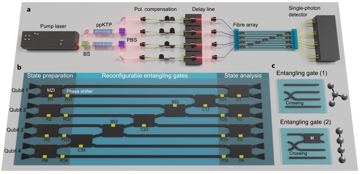
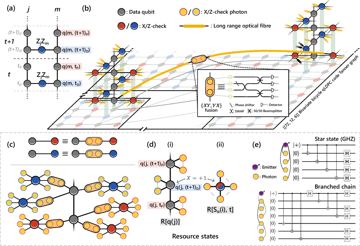
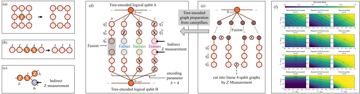
Multi-photon resource-state generator (RSG; 6-ring etc.)
The source-plus-fusion subsystem that must mass-produce encoded multi-photon graph states at code rate to feed fusion-based fault tolerance; nothing runs near that rate.
Verdict. Real: 8 photons fused into 6-rings and 7-trees at 0.4–2.3 coincidences/minute. Unproven: any generator within nine orders of magnitude of the needed rate. Demote if no fused state above 16 photons by 2029.
Λ = error-suppression factor per code-distance step; QBI = DARPA Quantum Benchmarking Initiative (Stage A concept → B R&D plan → C government V&V); G1–G7 = the report's goal classes (see Actors & economics).
Identity & lineage
The source-plus-fusion subsystem that must manufacture, at code rate, the encoded graph states — canonically the 6-ring — that fusion-based fault tolerance consumes and destroys. Browne–Rudolph type-II fusion (2005) made it possible; Bartolucci et al. fixed the 6-ring as reference resource and set its loss budget S[179]. Best instance: MPQ Garching fused deterministically emitted photons into 6-rings and 7-trees, 8 photons, 0.4–2.3 coincidences/minute D[688]. Attributes: flying photons from fabricated emitters, heralded entangling, no fixed clock; electro-optic room-temperature control, pure-loss errors, photonic-IC fabrication.
Physics & limits
An n-photon graph from k-photon primitives costs ~n/k fusions, each 50% unboosted or 75% boosted; failure is heralded and erases one of the two measured outcomes, but every attempt burns a photon that must be indistinguishable and lossless. Yield is brightness × indistinguishability × fusion success × transmission over the whole state — the exponent is photon count, not depth. Hence the code's tolerance: 2.7% loss per photon with 6-rings, ~17% only with 168-photon states nobody can build S[179]. A 2026 re-analysis sharpens this: fusion failure alone sets a logical-error floor at zero loss, forcing very large distance for 10⁻¹⁰, while emitter-mediated fusion raises the threshold to 7.0–7.3% against an unencoded 6-ring's 0.38–0.82% S[264]fact.
Engineering state of the art
table
| Date | Figure | Who | Tag |
|---|---|---|---|
| 2024-05 | 8 photons fused into 6-ring/7-tree graphs, 0.4–2.3/min, fidelity 0.34–0.85 | MPQ | D[688] |
| 2025-02 | Fusion Bell fidelity 99.22% (component only) | PsiQuantum | D[169]fact |
| 2025-05 | Reconfigurable 4-photon graph states, one QD, ~0.5 Hz | C2N Paris-Saclay | D[824] |
| 2026-06 | Emitter-fusion loss threshold 7.0–7.3% vs 0.38–0.82% | Sparrow | S[264] |
Rate is the gap: components clear 99%, but optical fusion has not passed eight photons since 2024.
In the microwave domain, fusion is already deterministic: a superconducting circuit fused on-demand time-bin cluster states by non-destructive Bell projection of flying microwave photons, with qubit reset and reuse, into graph states with genuine multipartite entanglement across 13 photonic qubits D[885]. Those photons cannot leave the cryostat without a microwave–optical transducer, itself an empty slot, so the result does not fill this optical slot.
Quandela's 12-qubit Belenos/Lucy delivery to CEA is dated 2025-10 and the Lucy/Joliot-Curie HPC launch 2026-04-14; no single source reconciles the two. No independent group has replicated the 2024 MPQ 8-photon record as of 4 Sep 2026.
Manufacturing, materials & supply chain
No commercial resource-state generator exists; the nearest base is 300 mm photonic IC — GlobalFoundries' Quantum Technology Solutions Cfact and PIXEurope fact. Deterministic sources are the single point of failure: Sparrow Quantum, sole merchant vendor as of 4 Sep 2026, ships 20–35% system efficiency against its own 55.3% best device and USTC's 71.2% record Dfact; no cost or yield per state is public. I/O scales with photon count, not qubit count: a pump, switch tree and detectors per source, feed-forward within the photon's flight time per fusion — ~0.1–0.2 dB per switch against a ~0.5 dB budget at multiplexing depth ~10 D[169]. At 10³ states/s the wall is switch loss; at 10⁶, thousands of cryogenic detector channels under GHz feed-forward. ECCN 4A906 catches the machine; none names photon sources fact.
Role in the stack
In the photonic fusion-based architecture (PsiQuantum, Quandela, QuiX): requires linear-optical fusion and single photons, provides the only input fusion-based fault tolerance accepts. It sets the architecture's clock — on a fusion architecture there is no syndrome round (gate layers + transport + readout + reset); its place is taken by generation at ~0.4–2.3 min⁻¹ D[688] against the ~10⁹ s⁻¹ a teraquop machine (10¹² reliable operations) needs; the 24–168-photon slot next door is empty. Verification: the record is coincidence-counted tomography with fidelity 0.34–0.85 by graph type, unreplicated; nearest independent work is 4-photon states D[824]. Every threshold quoted is simulation.
Actors & economics
Who.
| Organisation | Role | Country | What they do | Evidence |
|---|---|---|---|---|
| PsiQuantum | developer | US | In-house fusion and generation | Dfact |
| Quandela | developer | FR | QD sources; Lucy on Joliot-Curie, running post-selected gates, not resource states | Cfact |
| Sparrow Quantum | supplier | DK | Sole merchant source vendor | Dfact |
| MPQ Garching | research | DE | Holds the 8-photon record | D[688] |
Money.
2025-04-10 · Sparrow Quantum · Series A · EUR 21.5 M · lead undisclosed · closed Pfact
2025-09 · PsiQuantum · Series E · USD 1 B at USD 7 B · closed Pfact
2026-07-22 · PsiQuantum · DARPA QBI Stage C expansion · USD 125 M · definitive fact
Market & supply chain. No merchant product; money goes to the inputs — source chips (Sparrow, a chokepoint) and fusion-capable PICs. Unit economics unquotable; only G3/G4 pay.
IP & standards. No dated patent family specific to resource-state generation as of 4 Sep 2026; the adjacent grant is ORCA's US 12,437,225 fact. No throughput standard exists.
Roadmaps & track record. (2025-07 · QuiX error-corrected generation 2027 · pending); (2025 · Quandela first logical qubit · missed; QBIT Stage A entered 2026-06-16 fact). No dated rate milestone exists.
Strategic reading. Generation rate, not fidelity, decides fusion photonics; a source vendor that also owns fusion gains leverage over integrators building sources in-house. If it fails, the architecture loses to CV/GKP and to matter qubits.
Outlook & open questions
Confirm by 2028: a fused state above 16 photons published with fidelity and rate; demote if still single digits. Best case 2029: merchant emitters plus on-chip fusion reach ≥10³ states/s. Worst case: the subthreshold floor holds and all-linear-optics 6-rings are abandoned. Open: can multiplexed sources beat emitters per useful state; does Sparrow close its 20–35%-to-55% gap. Watch: any rate figure in DARPA Stage C V&V.
References
- [169] K. Alexander et al., “A manufacturable platform for photonic quantum computing,” Nature, vol. 641, no. 8064, pp. 876–883, Feb. 2025, doi: 10.1038/s41586-025-08820-7. D
- [179] S. Bartolucci et al., “Fusion-based quantum computation,” Nat. Commun., vol. 14, Art. no. 912, Feb. 2023, doi: 10.1038/s41467-023-36493-1. arXiv:2101.09310. S
- [264] M. C. Löbl, L. A. M. Pettersson, J. Dragašević, S. X. Chen, and O. A. D. Sandberg, “The subthreshold issue of fusion-based quantum computing,” arXiv:2606.28490, Jun. 2026. S
- [688] P. Thomas, L. Ruscio, O. Morin, and G. Rempe, “Fusion of deterministically generated photonic graph states,” Nature, vol. 629, no. 8012, pp. 567–572, May 2024, doi: 10.1038/s41586-024-07357-5. D
- [824] H. Huet et al., “Deterministic and reconfigurable graph state generation with a single solid-state quantum emitter,” Nat. Commun., vol. 16, no. 1, Art. no. 4337, May 2025, doi: 10.1038/s41467-025-59693-3. D
- [885] Y. Li et al., “Deterministic and programmable fusion for the scalable generation of photonic graph states,” Nat. Phys., Sep. 2026, doi: 10.1038/s41567-026-03471-5. D