Fusion-based fault tolerance code_fusion
A fault-tolerant code assembled from destructive linear-optical fusions on pre-made photonic resource states, tolerating 2.7–17.4% photon loss in theory and never run end-to-end.
Fusion-based fault tolerance
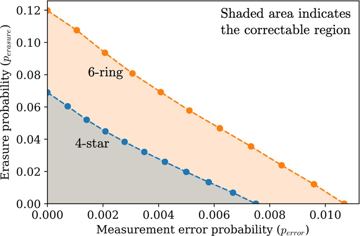
Resource states + fusions; loss threshold 2.7%/photon (boosted 6-ring), 17.4% only for a {7,4}-encoded resource state of ~168 photons; no demonstration.
Brief →Key references
Design space — attributes
- (a) carrier affinity
- photon (natural particle, engineered modes)
- (b) time · entangling
- —
- (c) readout
- —
- (d) mobility
- flying qubits (photons)
- (e) control
- —
- (f) error structure
- loss (erasure)
- (g) manufacturing
- —
Evaluation space — dated attributes
FBQC framework = Bartolucci et al., Nat. Commun. 14, 912 (2023-02). The 2.7% (boosted 6-ring) and Sparrow's 0.38–0.82% (unencoded 6-ring, arXiv:2606.28490, 2026) assume different boosting, bias models and decoders and remain unreconciled.
Standard records
Actors & goals — annotations
Edges
Used by 2 machines (2 primary · 0 alternate)
- photonics 2
- Omega chipset (Moreton Bay / Chicago systems unnamed) PsiQuantum paper product page press ▦ ✅
- Carina QuiX Quantum ▨ ✅
Pictures
Every picture carries the story of what it shows and its credit line.
Fusion-based fault tolerance
A fault-tolerant code assembled from destructive linear-optical fusions on pre-made photonic resource states, tolerating 2.7–17.4% photon loss in theory and never run end-to-end.
Verdict. Real: loss thresholds derived in simulation, 2.7% (boosted 6-ring) to 17.4% ({7,4} encoded). Unproven: any hardware run of the scheme; only components exist. Demote if no fusion-lattice demonstration by 2029.
Λ = error-suppression factor per code-distance step; QBI = DARPA Quantum Benchmarking Initiative (Stage A concept → B R&D plan → C government V&V); G1–G7 = the report's goal classes (see Actors & economics).
Identity & lineage
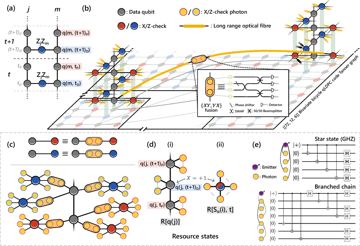
A fault-tolerant architecture with no deterministic two-qubit gate: pre-made photonic resource states are consumed by destructive linear-optical fusions, and the code lives in the pattern of which fusions succeeded, failed or reported loss. Bartolucci, Birchall, Bombín and colleagues at PsiQuantum formalised it with thresholds in 2023 S[179]. It replaces GKP-bosonic concatenation as photonics' route to fault tolerance. Attributes: flying photons, no native control modality and no clock of its own; pure-loss errors, no manufacturing precursor beyond fusion and resource-state generation.
Physics & limits
Loss is the design variable: a lost photon turns a fusion into a heralded erasure at a known location; an intrinsic failure erases one of its two outcomes, and the decoder routes around both. Hence unusually high tolerances — 2.7% loss per photon with a boosted 6-ring, 17.4% with a {7,4}-encoded state of ~168 photons nobody can make S[179]. The catch sits below threshold. A 2026 re-analysis shows fusion failure alone, at zero physical loss, leaves a logical-error floor shrinking only with code distance, so being under threshold says nothing about the overhead for 10⁻¹⁰; emitter-mediated fusion raises the threshold to 7.0–7.3% against an unencoded 6-ring's 0.38–0.82% S[264]fact. Moving the floor takes lower-loss photonics, boosted fusion, or emitters.
Engineering state of the art
table
| Date | Figure | Who | Tag |
|---|---|---|---|
| 2023-02 | FBQC framework and thresholds derived | Bartolucci et al., PsiQuantum | S[179] |
| 2025-02 | Component fusion Bell fidelity 99.22% | PsiQuantum | D[169] |
| 2025-06 | Loss threshold 2.7% (boosted 6-ring) to 17.4% ({7,4}) | theory | S[179] |
| 2026-06 | Fusion-failure floor at zero loss; 7.0–7.3% emitter threshold | Sparrow | S[264] |
On the report's cross-platform table photonics scores zero on every fault-tolerance primitive: no below-threshold scaling, no logical qubit past break-even, no logical two-qubit gate, detection-only decoding D[687].
The 6-ring loss thresholds are not comparable: 2.7% per photon for a boosted 6-ring [179] against 0.38–0.82% (static bias) for an unencoded 6-ring [264], under different boosting, bias models and decoders. Every fusion threshold is a simulation, none is measured, and no independent group has reproduced them. As of 4 Sep 2026 PsiQuantum has published no response to the 2026-06 subthreshold critique and no 2026 hardware result; its progress is visible only through DARPA V&V contracting.
Manufacturing, materials & supply chain
Nothing is manufactured for this code; it inherits the photonic-IC stack of its inputs (300 mm silicon at GlobalFoundries) Cfact. No yield, cost or energy figure exists because nothing runs it. The burden it imposes is synchronisation: a {7,4}-encoded state means ~168 photons per round, each with a source, switch path and detector channel, against a record of 8 fused photons at 0.4–2.3 per minute D[688]. At 10³ fusions/s the constraint is switch loss; at the 10⁶ a useful machine needs, cryogenic detector channels and GHz feed-forward, neither built. ECCN 4A906 covers the assembled machine fact.
Role in the stack
Requires linear-optical fusion and a resource-state generator (RSG), neither at code-relevant scale, and provides nothing downstream — it tops the photonic fusion architecture (PsiQuantum, Quandela, QuiX). It replaces GKP-bosonic concatenation, and the switch is total: different carrier, detectors, error model. Its MHz cycle is a design claim, not a measurement: the real cycle is resource-state supply, ~0.4–2.3 per minute D[688]. Verification: the thresholds are decoder simulations under stated noise models, never measured or independently reproduced; the 2026 re-analysis is the first published challenge to the framework's relevance, unanswered as of 4 Sep 2026.
Actors & economics
Who.
| Organisation | Role | Country | What they do | Evidence |
|---|---|---|---|---|
| PsiQuantum | developer | US | Originated FBQC; sole roadmap bet on it | S[179] |
| Quandela | developer | FR | Fields compatible linear-optical hardware | Cfact |
| Sparrow Quantum | research | DK | Published the 2026 subthreshold critique | Sfact |
| DARPA | investor | US | QBI Stage C V&V of PsiQuantum's stack | fact |
Money.
2024-04 · PsiQuantum · Australian federal and Queensland commitment · A$940 M · announced Pfact
2025-09-10 · PsiQuantum · Series E · USD 1 B at USD 7 B · closed fact
2026-05-21 · PsiQuantum · US CHIPS letter of intent · USD 100 M · non-binding fact
2026-07-22 · PsiQuantum · DARPA QBI Stage C expansion · USD 125 M · definitive fact
Market & supply chain. No product, no market: the asset is a roadmap plus government commitments; the suppliers that matter sit upstream. Pays for G3/G4 alone.
IP & standards. No dated patent family specific to the fusion-lattice code as of 4 Sep 2026; nearest is ORCA's US 12,437,225 fact.
Roadmaps & track record. (2024-04 · Brisbane machine useful by end-2027 · at risk: site moved to Moreton Bay, groundbreaking slipped to 2026-06, Linde cryoplant not due for delivery until 2H 2027 Cfact) Pfact. Strong paper record, weak schedule.
Strategic reading. If the subthreshold critique holds, the largest privately funded photonics bet needs a far lower-loss network or a pivot to emitter hybrids — a redesign for a company already late. Winners if it works: PsiQuantum, its foundry, detector vendors; losers: bosonic GKP and anyone selling a fast gate rather than cheap erasure.
Outlook & open questions
Confirm by 2028: an end-to-end fusion-lattice demonstration at any code distance with measured loss and logical error; demote if only component numbers persist. Best case 2029: a small working lattice. Worst case: it stays a paper and emitter hybrids inherit it. Open: does anyone rebut the 2026 critique; which threshold survives hardware; does Stage C publish a code-level number.
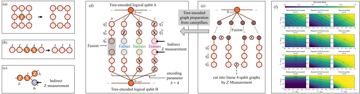
Fusion networks need not carry a whole computation: a 2026 construction confines them to the seam of distributed surface-code lattice surgery between matter-qubit processors, where 'hybrid checks' combine local ancilla readouts with the fusion outcomes of photonic resource states P[893]. In simulation with no local noise, the seam tolerates erasure of 50% of fusion outcomes (38% and 32% with resource chains truncated to eight and five qubits) and the merge observable's interface distance rises from d + 1 to 2d + 1; at circuit and resource-state error rates of 10⁻³, local errors largely mask that advantage, and resource-state generation is not modelled P[893].
References
- [169] K. Alexander et al., “A manufacturable platform for photonic quantum computing,” Nature, vol. 641, no. 8064, pp. 876–883, Feb. 2025, doi: 10.1038/s41586-025-08820-7. D
- [179] S. Bartolucci et al., “Fusion-based quantum computation,” Nat. Commun., vol. 14, Art. no. 912, Feb. 2023, doi: 10.1038/s41467-023-36493-1. arXiv:2101.09310. S
- [264] M. C. Löbl, L. A. M. Pettersson, J. Dragašević, S. X. Chen, and O. A. D. Sandberg, “The subthreshold issue of fusion-based quantum computing,” arXiv:2606.28490, Jun. 2026. S
- [687] R. Neeman, “Quantum Technology Atlas,” ed. 2026.09, Qodeh, Sep. 2026, §3.2. D
- [688] P. Thomas, L. Ruscio, O. Morin, and G. Rempe, “Fusion of deterministically generated photonic graph states,” Nature, vol. 629, no. 8012, pp. 567–572, May 2024, doi: 10.1038/s41586-024-07357-5. D
- [893] F. Burt et al., “Loss-tolerant distributed lattice surgery using fusion networks,” arXiv:2610.01923, Oct. 2026. P