Error mitigation in the code slot (ZNE, PEC) — not a code code_mitig
Classical post-processing of many noisy runs — zero-noise extrapolation, probabilistic error cancellation or amplification, readout twirling, tensor-network noise inversion — that removes bias from expectation values without encoding, detecting or correcting a single error.
Error mitigation in the code slot (ZNE, PEC) — not a code
Zero-noise extrapolation, probabilistic error cancellation and tensor-network post-processing: what actually occupies the code slot of a utility-scale NISQ machine. They reduce the bias of an expectation value at exponential sampling cost and correct nothing — the honest name for a stack without a code.
Brief →Key references
Design space — attributes
- (a) carrier affinity
- intermediate / carrier-agnostic
- (b) time · entangling
- —
- (c) readout
- —
- (d) mobility
- static nearest-neighbour wiring
- (e) control
- —
- (f) error structure
- stochastic Pauli
- (g) manufacturing
- —
Evaluation space — dated attributes
no dated attribute
Sampling overhead grows exponentially with circuit volume; no logical qubit exists.
Actors & goals — annotations
Edges
Used by 3 machines (0 primary · 3 alternate)
- superconducting circuits 3
- IBM Quantum Eagle r1-r3 IBM paper paper paper ▤ 🔎 (alternate)
- IBM Quantum Heron r3 (ibm_pittsburgh) IBM blog press ▤ Abstract; §Experiments ('ibm_boston Heron r3 processor'); also arXiv:2607.25998 ✅ (alternate)
- IBM Quantum Nighthawk r2 IBM blog ▤ § Quantum advantage and other early results on Nighthawk r2 ✅ (alternate)
Pictures
Every picture carries the story of what it shows and its credit line.
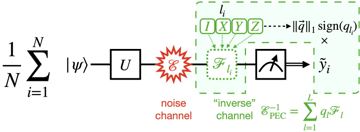
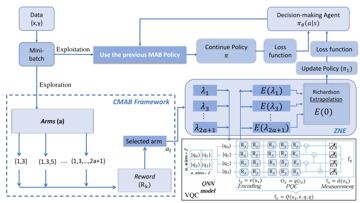
Error mitigation in the code slot (ZNE, PEC) — not a code
Classical post-processing of many noisy runs — zero-noise extrapolation, probabilistic error cancellation or amplification, readout twirling, tensor-network noise inversion — that removes bias from expectation values without encoding, detecting or correcting a single error.
Verdict. The only error handling in most utility-scale superconducting experiments, including two of IBM's three July-2026 advantage claims; it buys bias reduction at a shot cost exponential in the circuit's error mass and yields no logical qubit, so as of 2026-09-26 it is a placeholder for a code, not a step towards one.
ZNE = zero-noise extrapolation; PEC = probabilistic error cancellation; PEA = probabilistic error amplification; TREX = twirled readout error extinction; TEM = tensor-network error mitigation; γ = norm of the signed mixture that inverts the noise; P = summed Pauli error probability in an observable's backward light cone (the gates that can affect it); CZ = controlled-Z; G1–G7 = the report's goal classes (see Actors & economics).
Identity & lineage
Error mitigation estimates an observable's noiseless expectation value from many noisy runs and classical post-processing; nothing is encoded, no syndrome is measured, no error corrected G[693]. Temme, Bravyi and Gambetta proposed extrapolation to zero noise by Richardson's method and cancellation by quasi-probability resampling in 2016 D[694]; Li and Benjamin independently extrapolated boosted errors to zero D[695]. Hardware ZNE followed in 2019 D[696]; then PEA, amplifying a learned noise model with injected Pauli errors D[308], TREX for readout C[693] and TEM, a tensor-network inverse of the global noise S[697]. Attributes: platform-agnostic, static, no transport or control modality; Pauli error class after twirling.
Physics & limits
PEC writes each layer's inverse noise as a signed mixture of implementable operations of norm γ ≥ 1; the estimate is unbiased, but shots grow as γ² and γ exponentially with depth C[693]. For Pauli noise γ ≈ e^(2P), so shots multiply by ≈ e^(4P) S. At Heron r3's median CZ error of 0.15% D[698], 1,000 CZs in the light cone give P ≈ 1.5 and ≈ 400× the shots, 7,500 give ~10¹⁹× S; today's 10²–10³× budgets cap P near 1.2–1.7 S. ZNE samples at amplified noise — by default three factors, nominally ~3× C[693] — and extrapolates; it is biased by its fit and must resolve a signal attenuated by up to e^(−2P), so its cost grows comparably S. TEM claims the square root of PEC's overhead S[697], still exponential S. The limit is general: overhead grows exponentially with depth for any protocol under local depolarising noise D[699], nonlinear post-processing included D[700], and worst-case estimation needs superpolynomially many samples at shallow depth D[701]. Only lower physical error moves the exponent.
Under local depolarising noise, a circuit's noisy expectation value is the Laplace transform of its reactivity function — the contribution of Pauli paths sorted by weight (the number of qubits a Pauli operator acts on non-trivially); inverting it exactly is ill-conditioned, with coefficients growing exponentially in weight, and only smoothed features in weight are recoverable, at a sampling cost exponential in the ratio of weight to resolution P[891]. The Atlas's reading, not derived in the paper: noise-scaling mitigation attempts the same inversion, so its cost is set by the circuit's high-weight Pauli content, not by the error rate alone.
Engineering state of the art
table
| Year | Figure | Who | Tag+key |
|---|---|---|---|
| 2019-03-27 | ZNE by stretched pulses; variational chemistry and magnetism | IBM, Kandala et al. | D[696] |
| 2023-05-08 | PEC with a learned sparse Pauli–Lindblad model, crosstalk included, 20 qubits | IBM, van den Berg et al. | D[702] |
| 2023-06-14 | 127 qubits, up to 60 layers, 2,880 CNOTs; ZNE with PEA | IBM Eagle, Kim et al. | D[308] |
| 2023-06/08 | Classical reproductions: tensor network more accurate than the hardware; Pauli dynamics on one laptop core; converged to <0.01 | Tindall et al.; Begušić, Chan; Begušić, Gray, Chan | D[309]D[703]D[704] |
| 2025-11-12 | "samplomatic" cuts PEC sampling overhead 100× | IBM | C[486] |
| 2026-07-27 | QESEM (PEC- and ZNE-based) on Heron r3, 51–74 qubits, up to 30 Floquet cycles; tensor networks fail to converge | Qedma, RIKEN, BlueQubit | D[233] |
| 2026-07-28 | PEC on 56 qubits, circuits up to ~1,000 CZs: ~1.5 h and ~4 h of QPU time at two depths | Algorithmiq et al., ibm_boston | D[698] |
| 2026-08-31 | PEA observable estimation on 7,500-gate circuits | IBM Nighthawk r2 | C[601] |
The 2023 claim of accuracy "beyond brute-force classical computation" D[308] was matched classically within weeks, and converged values exposed bias in its extrapolation D[704]; the 2026 claims rest on classical heuristics disagreeing, not on proven hardness D[698]. Dominant term: P. Faster shots — Nighthawk r2's 100,000 circuits per second, 25× Heron — shorten wall-clock time, not the exponent C[601].
Manufacturing, materials & supply chain
Nothing is fabricated; the bill is QPU time and classical compute — 3.2 million shots, ~45 min of QPU time per point for Algorithmiq's rescaled estimate D[698]. Supply is the vendor runtime C[693] plus Qedma's QESEM, which learns device noise, adapts circuits and post-processes C[705], and Algorithmiq's TEM in IBM's Qiskit Functions Catalog C[706].
Control, readout & I/O burden
The requirement is a calibrated, stable noise model: PEA and PEC learn a sparse Pauli–Lindblad model per layer of entangling gates under random Pauli twirling D[308]D[702]; every circuit is compiled in many randomised instances S. TREX randomises measurements with X gates and classical bit flips, diagonalising the readout matrix for inversion C[693]. Drift is the failure mode: a model learned before a four-hour PEC run is wrong by whatever drifts during it S. There is no feed-forward, and the output is expectation values, not samples G[693].
Role in the stack
Slot 7 of the Transmon lattice with tunable couplers architecture, beside code_surface, code_color, code_qldpc, code_magic and code_detect. It requires ct_rt, for calibrated noise models; it provides nothing downstream — no logical qubit, no syndrome for slot 8's decoders; it is replaced by code_surface, and the open conflict edge (2023-06) lists no remedy for its exponential overhead. code_detect discards flagged runs at a cost of 1/acceptance, also exponential in circuit size; mitigation keeps every run and reweights, removing bias only on average S. The gap ledger's "all three IBM July-2026 advantage claims" is two of three — QESEM on Heron r3 D[233] and PEC on ibm_boston D[698]; IBM–UChicago's post-selects on spacetime codes, a code_detect result C[45]. The ledger's ion placement was not taken, though Qedma repeated cycles on Quantinuum H2 and Helios D[233]. Register: IBM Eagle r1–r3 (primary, retired); Heron r3 and Nighthawk r2 (alternate).
Evidence — how the numbers were measured
PEC is unbiased, with error bars, if its noise model is right, so verification becomes validating the model C[45]. Of the register's three cells, Heron r3's and Nighthawk r2's are verified ✅ — the first by the July-2026 ibm_boston preprints D[233], [698], the second by a section of the r2 blog C[601] — and Eagle's is 🔎, though its source supports it D[308]. Heron r1 and Nighthawk r1 hold no code: no primary source shows a named mitigation method run on r1 itself, and the press article on r3 that its cell cites names none P[707]. Zuchongzhi 3.0 and Tianyan-287 run random-circuit sampling scored on raw fidelity; their abstracts mention neither mitigation nor correction D[35]D[708], so as of 2026-09-26 their code slot is empty, not mitigated.
IBM's 100× PEC-overhead reduction by samplomatic (2025-11-12) is a blog claim. Not published: its baseline and circuit class, and the shot count, QPU time and observable of Nighthawk r2's 7,500-gate PEA run. The e^(4P) shot scaling and the P values are derived from the PEC construction and published error rates, not quoted from a source.
Actors & economics
Who.
| Organisation | Role | Country | What exactly they do with this technology | Evidence |
|---|---|---|---|---|
| IBM | developer | US | TREX, ZNE, PEA, PEC in Qiskit Runtime; 2023 utility experiment; PEA at 7,500 gates | C[693]D[308]C[601] |
| Qedma | software vendor | IL | QESEM: noise learning, PEC- and ZNE-based estimators | D[233] |
| Algorithmiq | software vendor | IT (formerly FI) | TEM in IBM's catalogue; PEC in the Loschmidt-echo claim | C[706]D[698] |
| Flatiron Institute | research | US | Contributor to the open advantage tracker | C[486] |
Money.
- 2025-07-03 · Qedma · Series A led by Glilot Capital Partners, IBM participating · USD 26 M · announced C[705]
- 2026-05-11 · Algorithmiq · round led by United Ventures, with CDP and Inventure · EUR 18 M (EUR 36 M in total) · announced C[709]
Market & supply chain. Sold as runtime options and third-party functions on the hardware vendor's cloud, with IBM holding equity in Qedma: a vertically tied market. It pays into G2 only; G3–G4 need a code.
IP & standards. No standard defines a figure of merit for mitigated estimates or a noise-model disclosure format; no dated patent count from a named database, as of 2026-09-26.
Roadmaps & track record. IBM promised Nighthawk revisions at 5,000, 7,500, 10,000 and 15,000 gates R[486]; the 7,500-gate step, its 2026 milestone, shipped on 2026-08-31 with PEA C[601].
Strategic reading. Mitigation makes the noise model the product and keeps value inside the hardware vendor's stack. Only noise learning carries over to fault tolerance; when a code runs, the technology empties.
Outlook & open questions
Confirm if an unbiased PEC estimate on ≥5,000 gates appears with error bars by 2027-12-31, or a July-2026 claim survives to 2027-07-31 without converged classical reproduction; demote those claims to utility if converged tensor-network or Pauli-propagation values match them, as in 2023.
Open questions. (1) How stable is a learned Pauli–Lindblad model over a multi-hour run at 10³–10⁴ gates? (2) Does TEM's quadratic saving survive model error on hardware? (3) At what size does a detection code plus mitigation beat mitigation alone in shots? (4) Can a mitigated expectation-value task be proven classically hard? (5) What shot multiplier did Nighthawk r2's 7,500-gate PEA run spend?
References
- [35] D. Gao et al., “Establishing a New Benchmark in Quantum Computational Advantage with 105-qubit Zuchongzhi 3.0 Processor,” Phys. Rev. Lett., vol. 134, Art. no. 090601, Mar. 2025, doi: 10.1103/PhysRevLett.134.090601. arXiv:2412.11924. D
- [45] A. Kandala, A. Javadi-Abhari, and J. Gambetta, “Researchers demonstrate quantum advantage through trusted quantum computation,” IBM Quantum Computing Blog, Jul. 30, 2026. [Online]. Available: https://www.ibm.com/
quantum/ Cblog/ quantum-advantage - [233] E. Leviatan et al., “Resolving Structure in Prethermal Floquet Dynamics with Precision Quantum Computation,” arXiv:2607.24937, Jul. 2026. D
- [308] Y. Kim et al., “Evidence for the utility of quantum computing before fault tolerance,” Nature, vol. 618, no. 7965, pp. 500–505, Jun. 2023, doi: 10.1038/s41586-023-06096-3. D
- [309] J. Tindall, M. Fishman, M. Stoudenmire, and D. Sels, “Efficient Tensor Network Simulation of IBM's Eagle Kicked Ising Experiment,” PRX Quantum, vol. 5, no. 1, Art. no. 010308, Jan. 2024, doi: 10.1103/PRXQuantum.5.010308. arXiv:2306.14887. D
- [486] R. Mandelbaum, “Scaling for quantum advantage and beyond,” IBM Quantum Computing Blog, Nov. 12, 2025. [Online]. Available: https://www.ibm.com/
quantum/ Cblog/ qdc-2025 - [601] H. Haas, D. McKay, and R. Davis, “IBM Quantum Nighthawk r2—more circuits, faster,” IBM Quantum Computing Blog, Aug. 31, 2026. [Online]. Available: https://www.ibm.com/
quantum/ Cblog/ nighthawk-r2 - [693] IBM, “Error mitigation and suppression techniques.” [Online]. Available: https://quantum.cloud.ibm.com/
docs/ Cen/ guides/ error-mitigation-and-suppression-techniques - [694] K. Temme, S. Bravyi, and J. M. Gambetta, “Error mitigation for short-depth quantum circuits,” Phys. Rev. Lett., vol. 119, Art. no. 180509, 2017, doi: 10.1103/PhysRevLett.119.180509. arXiv:1612.02058. D
- [695] Y. Li and S. C. Benjamin, “Efficient Variational Quantum Simulator Incorporating Active Error Minimization,” Phys. Rev. X, vol. 7, no. 2, Art. no. 021050, Jun. 2017, doi: 10.1103/PhysRevX.7.021050. arXiv:1611.09301. D
- [696] A. Kandala et al., “Error mitigation extends the computational reach of a noisy quantum processor,” Nature, vol. 567, pp. 491–495, Mar. 2019, doi: 10.1038/s41586-019-1040-7. arXiv:1805.04492. D
- [697] S. Filippov, M. Leahy, M. A. C. Rossi, and G. García-Pérez, “Scalable tensor-network error mitigation for near-term quantum computing,” arXiv:2307.11740, Jul. 2023. S
- [698] S. V. Barron et al., “Observable Estimation in the Absence of Classical Verification,” arXiv:2607.25998, Jul. 2026. D
- [699] R. Takagi, S. Endo, S. Minagawa, and M. Gu, “Fundamental limits of quantum error mitigation,” npj Quantum Inf., vol. 8, Art. no. 114, 2022, doi: 10.1038/s41534-022-00618-z. arXiv:2109.04457. D
- [700] R. Takagi, H. Tajima, and M. Gu, “Universal Sampling Lower Bounds for Quantum Error Mitigation,” Phys. Rev. Lett., vol. 131, Art. no. 210602, 2023, doi: 10.1103/PhysRevLett.131.210602. arXiv:2208.09178. D
- [701] Y. Quek, D. S. França, S. Khatri, J. J. Meyer, and J. Eisert, “Exponentially tighter bounds on limitations of quantum error mitigation,” Nat. Phys., vol. 20, p. 1648, 2024, doi: 10.1038/s41567-024-02536-7. arXiv:2210.11505. D
- [702] E. van den Berg, Z. K. Minev, A. Kandala, and K. Temme, “Probabilistic error cancellation with sparse Pauli–Lindblad models on noisy quantum processors,” Nat. Phys., vol. 19, no. 8, pp. 1116–1121, May 2023, doi: 10.1038/s41567-023-02042-2. arXiv:2201.09866. D
- [703] T. Begušić and G. K.-L. Chan, “Fast classical simulation of evidence for the utility of quantum computing before fault tolerance,” arXiv:2306.16372, Jun. 2023. D
- [704] T. Begušić, J. Gray, and G. K.-L. Chan, “Fast and converged classical simulations of evidence for the utility of quantum computing before fault tolerance,” Sci. Adv., Art. no. eadk4321, 2024, doi: 10.1126/sciadv.adk4321. arXiv:2308.05077. D
- [705] QEDMA, “QEDMA raises $26M with participation from IBM to tackle quantum computing errors and accelerate pace to quantum advantage,” PR Newswire, Jul. 3, 2025. [Online]. Available: https://www.prnewswire.com/
news-releases/ Cqedma-raises-26m-with-participation-from-ibm-to-tackle-quantum-computing-errors-and-accelerate-pace-to-quantum-advantage-302497701.html - [706] Algorithmiq, “Algorithmiq Launches High-Performing Error Mitigation Solution in IBM's Qiskit Functions Catalog,” Sep. 16, 2024. [Online]. Available: https://www.algorithmiq.fi/
news/ Cpress-release-tem-ibm-qiskit-functions/ - [707] M. Ivezic, “IBM Launches Heron R3 (ibm_pittsburgh): ~350 uS T2 and a Quality Upgrade for Its 156-Qubit Platform,” PostQuantum.com, Aug. 1, 2025. [Online]. Available: https://postquantum.com/
industry-news/ Pibm-heron-r3-pittsburgh/ - [708] T. Q. Group, “Tianyan: Cloud services with quantum advantage,” arXiv:2512.10504, Dec. 2025. D
- [709] Algorithmiq, “Algorithmiq Establishes Milan Headquarters and raises €18m to Position Europe as the Future of Quantum Software,” May 11, 2026. [Online]. Available: https://algorithmiq.fi/
news/ Calgorithmiq-establishes-milan-headquarters-and-raises-18m-to-position-europe-as-the-future-of-quantum-software/ - [891] T. Schuster and A. Elben, “Probing the classical complexity of quantum dynamics experiments,” arXiv:2609.31830, Sep. 2026. P