MWPM / Sparse Blossom (+ correlated matching) dec_mwpm
Graph-matching decoder turning the syndrome history — detection events across rounds — into the likeliest error chain; the accuracy reference and the shipped real-time decoder for surface codes.
MWPM / Sparse Blossom (+ correlated matching)
Matching decoder; < 1 µs/round at d=17 on one core (throughput), 0.8 µs FPGA latency at d=13 (Micro Blossom); Λ=2.04 on Willow vs 2.14 neural.
Brief →Key references
Design space — attributes
- (a) carrier affinity
- intermediate / carrier-agnostic
- (b) time · entangling
- —
- (c) readout
- —
- (d) mobility
- —
- (e) control
- —
- (f) error structure
- stochastic Pauli
- (g) manufacturing
- —
Evaluation space — dated attributes
Micro Blossom's published figure is 0.8 µs at d=13 (ASPLOS 2025, arXiv:2502.14787); the repository's 367 ns appears in no paper. Willow's real-time decoder is a parallelised Sparse Blossom variant built by Google, not stock PyMatching.
Standard records
Actors & goals — annotations
Edges
Used by 15 machines (11 primary · 4 alternate)
- superconducting circuits 7
- AWS Ocelot AWS Center for Quantum Computing ▤ App. H (Repetition Code Data Analysis) 🔎
- Surface-17 ETH Zurich (Quantum Device Lab) paper paper ▤ Abstract; Appendix L ✅
- Fujitsu >10,000 physical / ~250 logical (STAR) Fujitsu + AIST + RIKEN press ▤ §VI.A (logical error of surface-code patch) ✅
- Sycamore-class 72-qubit processor Google Quantum AI paper paper ▤ §Decoding and logical error probabilities ✅
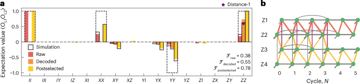
- Willow Google Quantum AI paper paper product page ▣ Fig. 4 (real-time streaming decoder, latency); §V; SI §III.D.2 ✅
- IBM Quantum Falcon r5.11 IBM paper blog ▣ Fig. 6 (four decoding methods); Methods: MWPM edge probabilities; Maximum likelihood ✅
- Zhejiang University 125-qubit surface-code processor Zhejiang University + Graduate School of China Academy of Engineering Physics (Beijing) paper ▤ §III (belief-matching decoding of Bell-state data) 🔎
- trapped ions 2
- Maryland / Duke Quantum Center (EURIQA lineage) University of Maryland / Duke University paper paper ▤ Methods: Error Correction Protocol ✅
- Helios Quantinuum paper paper paper ▤ 🔎 (alternate)
- neutral atoms 4
- neutral-ytterbium QPU Yaqumo (+ Fujitsu) press press ▨ ✅
- Magne Atom Computing + Microsoft, for QuNorth press press ▨ 🔎 (alternate)
- Phoenix (Gen-1) and Gen-2 Atom Computing press press ▤ SM §SIV 🔎 (alternate)
- Gemini-class QuEra paper product page ▤ 🔎 (alternate)
- photonics 2
- Omega chipset (Moreton Bay / Chicago systems unnamed) PsiQuantum paper product page press ▦ ✅
- Aurora Xanadu paper press link ▣ Fig. 3c,d; Fig. 2 (real-time decoder feedback) ✅
Pictures
Every picture carries the story of what it shows and its credit line.
MWPM / Sparse Blossom (+ correlated matching)
Graph-matching decoder turning the syndrome history — detection events across rounds — into the likeliest error chain; the accuracy reference and the shipped real-time decoder for surface codes.
Verdict. Matching stays the surface-code default through 2026 — Google's own below-threshold run decodes with Sparse Blossom. Demote if a live-hardware, same-syndrome test shows a non-matching decoder beating it on accuracy and latency together by end-2027.
Λ = error-suppression factor per code-distance step; QBI = DARPA Quantum Benchmarking Initiative (Stage A concept → B R&D plan → C government V&V); G1–G7 = the report's goal classes (see Actors & economics).
Identity & lineage
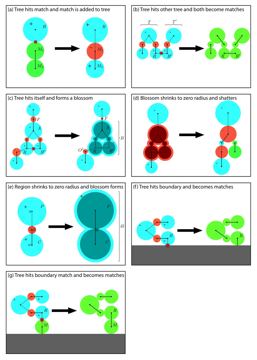
MWPM makes each detection event (a check whose outcome changed between rounds) a vertex on a weighted graph whose edges are the errors flipping two detectors; the lowest-weight pairing explaining the set is the most probable single error chain under independent errors — not the maximum-likelihood decoding, which sums over all chains in a class and is what the tensor-network and BP-based decoders approximate. Dennis, Kitaev, Landahl and Preskill introduced it (2002) D[650]; Fowler showed in 2015 that below threshold it can be solved exactly in average O(1) parallel time per round — on a 2D array of classical processors, each serving a fixed number of qubits, independent of lattice size D[725]. Correlated matching reweights edges so a Y error is not charged twice. The engine is Higgott and Gidney's Sparse Blossom (Quantum 9, 1600, 2025-01-20) D[726], a sparse reformulation of Edmonds' 1965 blossom algorithm, shipped as PyMatching v2.
a = 0.5 — classical post-processing, no carrier; b, c, d, e do not apply [graph].
f = Pauli chain on a matching graph; g = none — software, no fabrication [graph].
Physics & limits
Throughput must exceed syndrome production or the backlog diverges and the machine stalls: Sparse Blossom clears ~10⁶ errors per core-second, under 1 µs per round at d=17 D[726], inside Willow's 1.1 µs cycle D[1]. Latency binds only where a logical measurement gates the next operation: 63 µs at d=5 is ~57 cycles of dead time D[1]. The accuracy floor is structural: matching finds the most probable single chain only when every error flips at most two detectors, and it never sums over the chains of one class as a maximum-likelihood decoder does, so hyperedges (Y errors, correlated measurement errors, leakage, loss) must be projected onto a matchable graph. That projection is the whole gap to a decoder modelling them — Λ = 2.04 ± 0.02 for matching against 2.14 ± 0.02 for the neural decoder on Willow's syndromes D[1], AlphaQubit ~25% better at simulated d=11 D[657]. What moves the floor is the graph: fitted edge weights, soft readout, leakage edges.
Engineering state of the art
table
| Year | Figure | Who | Tag+Key |
|---|---|---|---|
| 2023-03 | <1 µs/round at d=17, ~10⁶ errors/core-second, simulated | Google Quantum AI | D[726] |
| 2024-12 | 63 µs real-time latency at d=5 over 10⁶ cycles | Google Quantum AI | D[1]fact |
| 2025-03 | 0.8 µs FPGA latency at d=13, p=0.1%, 62 MHz | Yale University | D[727]fact |
Dominant term: the decoding graph — mis-calibrated weights, unrepresented leakage — not the matcher D[1].
Manufacturing, materials & supply chain
No fabrication: MIT-licensed software [728] on general compute, acceleration the paid, single-sourced layer. Every published real-time QEC decoder runs on AMD/Xilinx logic — Riverlane's on a VU19P at ≈6% of LUTs (lookup tables) for d≤17 D[238], Micro Blossom on a Versal VMK180 D[727], the Shenzhen neural decoder on a Kintex-7 D[729], IBM's Relay-BP on AMD parts P[48] — and GPU decoding is NVIDIA-only. No MWPM ASIC exists (4 Sep 2026). Export exposure is on that hardware: the BIS rule of 2024-09-06 controls quantum computers (4A906) and sub-4.5 K control ICs (3A901.a) G[301]; published decoder source is outside the EAR under 15 CFR §734.7.
Control, readout & I/O burden
At 10³ qubits one core suffices. At 10⁴ the binding term is syndrome bandwidth, not compute — d² detectors per logical qubit per 1.1 µs — hence cryogenic pre-compression, claimed at up to 3,780× below 0.56 mW at 4 K but not fabricated Sfact. At 10⁶ the interconnect decides: NVQLink's 3.84 µs round trip C[324] exceeds a transmon cycle, so GPU matching runs windowed there.
Role in the stack
Default real-time decoder for surface- and colour-code memories, shared across five families [graph]: all three superconducting architectures, all three trapped-ion architectures, both Rydberg tweezer arrays, the fusion-based and continuous-variable photonic architectures, and both spin architectures — primary on six of the twelve (cat and GKP, dual-rail, the linear Paul trap, fusion photonics, quantum-dot and donor spins), alternate on the rest; it needs the near-planar graph a static nearest-neighbour lattice supplies free. It replaces neural and belief-propagation decoders, which win once checks stop being matchable; switching is asymmetric — leaving costs a hardware implementation and a new verification story, returning costs nothing. Clock contribution ≈1.0 µs per round at d=17 D[726] against a derived clock of 0.65 µs for the transmon surface-code architecture (derived clock = sum of the syndrome round: gate layers + transport + readout + reset for the architecture). Empty slot nearby: no real-time matcher consumes soft readout or leakage flags.
Evidence — how the numbers were measured
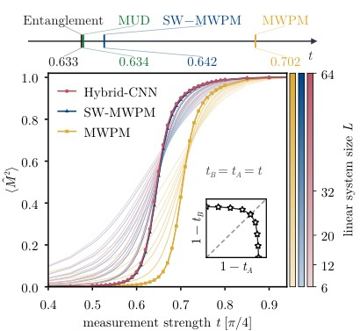
Sparse Blossom's throughput comes from simulated Stim streams D[726]. The one hardware-integrated figure, Willow's 63 µs at d=5, used a specialised parallel Sparse Blossom built by Google, not stock PyMatching D[1]. Micro Blossom's 0.8 µs at d=13 is peer-reviewed (ASPLOS 2025) but replays syndromes D[727]; the repository's 367 ns appears in no paper Cfact. The much-quoted threshold spread is no conflict: 0.7% (PyMatching), 0.65% and 0.55% (Riverlane's software and hardware clustering decoders) come from one comparison under one noise model D[238]. Every challenger publishes MWPM as baseline; none replicates its speed.
Quantum X Labs' claim that its transformer decoder outperforms MWPM carries no quantitative figure and no peer review [730]. Not published: a separate description, hardware platform or resource figure for the specialised Sparse Blossom variant that decodes Willow in real time, so its 63 µs cannot be attributed to a named part.
Actors & economics
Who.
| Organisation | Role | Country | What they do | Evidence |
|---|---|---|---|---|
| Google Quantum AI | Developer/user | US | Co-authored Sparse Blossom; runs it in Willow | D[1], [726] |
| Riverlane | Supplier | UK | Sells Deltaflow QEC hardware; quotes MWPM as reference | Cfact |
| Yale University | Research | US | Micro Blossom exact-MWPM FPGA accelerator | D[727] |
| AMD | Supplier | US | Its parts carry every published real-time decoder | D[238], [727] |
| NVIDIA | Supplier | US | CUDA-Q QEC and the NVQLink GPU–QPU bus | C[324] |
Money. 2024-08-06 · Riverlane · Series C · $75 M (its roadmap says $85 M) · Planet First Partners lead · >$120 M cumulative · closed C[661]. 2025-11-17 · NVIDIA · NVQLink launch · undisclosed · Quantinuum first QPU partner Cfact. 2026-07-24 · Quantum X Labs · result · none disclosed · NVIDIA, Quantum Machines/IQCC · unquantified C[730]. No decoder-specific DARPA award exists; QBI funds eleven Stage B teams, each needing one fact. No later Riverlane round located as of 4 Sep 2026.
Market & supply chain. Nobody sells MWPM: the algorithm is free and the reference MIT-licensed [728], so value accrues to the box that runs it — Deltaflow, CUDA-Q QEC/NVQLink, in-house firmware. Concentration is one-deep twice: AMD for logic, NVIDIA for GPUs. The one public resource figure, ≈6% of a VU19P for d≤17 D[238], implies ~16 patches per part. Pays into G3 and G4.
IP & standards. No MWPM patent family — Edmonds (1965) via Dennis–Kitaev–Landahl–Preskill (2002) D[650]; PyMatching and Micro Blossom are MIT-licensed [727], [728]. The IP is on hardware decoders: Riverlane GB 2641501 A (published 2025-12-10), Google US 12,518,194 (granted 2026-01-06) fact. PatSnap counted 12 QEC patents in April 2026 (Google 6, IBM 4, Tencent 2), no decoder cluster P[668]. De facto interfaces: Stim detector-error models, NVQLink.
Roadmaps & track record. Higgott and Gidney (2023-03 · sub-µs decoding at scale · met, and inside Willow's loop) D[726]. Yale (2025-03 · d=13 at 0.8 µs on FPGA · met; the repository's 367 ns is not) D[727]. Riverlane (2026-03-12 · megaquop before 2030, teraquop from 2033 · no interim milestone due) R[658]. Google's claims track delivery and are the only ones measured live; Riverlane's roadmap is unfalsifiable before 2029.
Strategic reading. If matching holds, AMD and every surface-code builder win: the reference stays free and differentiation collapses to firmware. Riverlane's hardware decoder trades threshold (0.55% vs 0.7%) for latency and area D[238], so its moat is "under the cycle time" — which Micro Blossom now offers for exact MWPM, MIT-licensed D[727]. If matching loses it loses to belief propagation on qLDPC: decoder, code and connectivity change together.
Outlook & open questions
Confirm/demote in 12–24 months: a same-qubit, same-calibration comparison of matching against a challenger (all current ones are simulated, offline or self-refereed); an FPGA matcher closing a live loop at d≥7. Best case 2029: matching stays default past 10⁴ physical qubits, reaction time down from 63 µs to ~1 µs. Worst case: qLDPC memories carry the machines and belief propagation owns the socket. Open questions: does matching extend to loss-dominated atom syndromes; will anyone fund a decoder ASIC when 6% of an FPGA suffices; will QBI Stage C fix a decoder-agnostic benchmark.
References
- [1] Google Quantum AI and Collaborators, “Quantum error correction below the surface code threshold,” Nature, vol. 638, no. 8052, pp. 920–926, Dec. 2024, doi: 10.1038/s41586-024-08449-y. D
- [48] T. Maurer et al., “Real-time decoding of the gross code memory with FPGAs,” arXiv:2510.21600, Oct. 2025. P
- [238] A. B. Ziad et al., “Local clustering decoder as a fast and adaptive hardware decoder for the surface code,” Nat. Commun., vol. 16, no. 1, Art. no. 11048, Dec. 2025, doi: 10.1038/s41467-025-66773-x. D
- [301] US Department of Commerce, Bureau of Industry and Security, “Commerce Control List Additions and Revisions; Implementation of Controls on Advanced Technologies Consistent With Controls Implemented by International Partners,” Federal Register, vol. 89, p. 72926, Sep. 6, 2024. [Online]. Available: https://www.federalregister.gov/
documents/ G2024/ 09/ 06/ 2024-19633/ commerce-control-list-additions-and-revisions-implementation-of-controls-on-advanced-technologies - [324] S. Caldwell et al., “NVIDIA NVQLink Architecture Integrates Accelerated Computing with Quantum Processors,” NVIDIA Technical Blog, Nov. 17, 2025. [Online]. Available: https://developer.nvidia.com/
blog/ Cnvidia-nvqlink-architecture-integrates-accelerated-computing-with-quantum-processors/ - [650] E. Dennis, A. Kitaev, A. Landahl, and J. Preskill, “Topological quantum memory,” Journal of Mathematical Physics, vol. 43, no. 9, pp. 4452–4505, 2002, doi: 10.1063/1.1499754. arXiv:quant-ph/0110143. D
- [657] J. Bausch et al., “Learning high-accuracy error decoding for quantum processors,” Nature, vol. 635, no. 8040, pp. 834–840, Nov. 2024, doi: 10.1038/s41586-024-08148-8. D
- [658] Riverlane, “Riverlane publishes QEC Technology Roadmap that can accelerate quantum computing's path to utility scale by 3–5 years,” Mar. 12, 2026. [Online]. Available: https://www.riverlane.com/
press-release/ Rriverlane-publishes-qec-technology-roadmap - [661] Riverlane, “Riverlane raises $75 million to meet surging global demand for quantum error correction technology,” Aug. 6, 2024. [Online]. Available: https://www.riverlane.com/
press-release/ Criverlane-raises-75-million-to-meet-surging-global-demand-for-quantum-error-correction-technology - [668] PatSnap, “Quantum Error Correction Technology Landscape 2026,” Apr. 22, 2026. [Online]. Available: https://www.patsnap.com/
resources/ Pblog/ articles/ quantum-error-correction-patent-landscape-2026/ - [725] A. G. Fowler, “Minimum weight perfect matching of fault-tolerant topological quantum error correction in average O(1) parallel time,” Quantum Inf. Comput., vol. 15, no. 1&2, pp. 145–158, Jan. 2015, doi: 10.26421/QIC15.1-2-9. arXiv:1307.1740. D
- [726] O. Higgott and C. Gidney, “Sparse Blossom: correcting a million errors per core second with minimum-weight matching,” Quantum, vol. 9, Art. no. 1600, Jan. 2025, doi: 10.22331/q-2025-01-20-1600. arXiv:2303.15933. Also https://arxiv.org/
abs/ . D2303.15933 - [727] Y. Wu, N. Liyanage, and L. Zhong, “Micro Blossom: Accelerated Minimum-Weight Perfect Matching Decoding for Quantum Error Correction,” Proc. 30th ACM Int. Conf. Architectural Support for Programming Languages and Operating Systems (ASPLOS '25), vol. 2, Mar. 2025, doi: 10.1145/3676641.3716005. arXiv:2502.14787. Also https://github.com/
yuewuo/ . Dmicro-blossom - [728] O. Higgott, “PyMatching,” GitHub. [Online]. Available: https://github.com/
oscarhiggott/ GPyMatching - [729] X. Yang et al., “Real-time Surface-Code Error Correction Using an FPGA-based Neural-Network Decoder,” arXiv:2605.04892, May 2026. Also https://arxiv.org/
html/ . D2605.04892 - [730] Quantum X Labs, “Quantum X Labs Reports Meaningful Error Correction Decoder Results with NVIDIA CUDA-Q QEC,” GlobeNewswire, Jul. 24, 2026. [Online]. Available: https://www.globenewswire.com/
news-release/ C2026/ 07/ 24/ 3332879/ 0/ en/ quantum-x-labs-reports-meaningful-error-correction-decoder-results-with-nvidia-cuda-q-qec.html