Colour code (transversal Cliffords) code_color
Triangular 2D stabiliser code whose whole Clifford group acts transversally, skipping lattice surgery, at roughly 1.9× the surface code's teraquop footprint (physical qubits per logical qubit for 10¹² reliable operations).
Colour code (transversal Cliffords)
Triangular 2D code with transversal H/S/CNOT; ~1.9× the surface-code footprint; hosts distillation and injection.
Brief →Key references
Design space — attributes
- (a) carrier affinity
- intermediate / carrier-agnostic
- (b) time · entangling
- —
- (c) readout
- —
- (d) mobility
- static nearest-neighbour wiring
- (e) control
- —
- (f) error structure
- stochastic Pauli
- (g) manufacturing
- —
Evaluation space — dated attributes
Standard records
Actors & goals — annotations
Edges
Used by 10 machines (3 primary · 7 alternate)
- superconducting circuits 3
- Willow Google Quantum AI paper paper product page ▤ ✅ (alternate)
- IBM Quantum Heron r3 (ibm_pittsburgh) IBM blog press ▤ abstract; colour-code results ✅ (alternate)
- IQM Halocene IQM Quantum Computers press press link ▨ article text 🔎 (alternate)
- trapped ions 5
- Forte / Forte Enterprise IonQ paper product page press ▤ abstract; results ✅
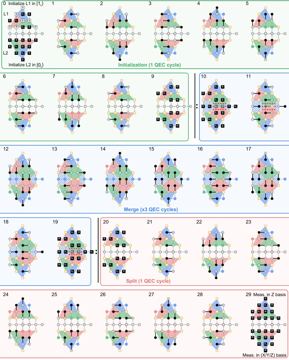
- University of Innsbruck trapped-ion demonstrator (Institut für Experimentalphysik) University of Innsbruck paper paper paper ▣ Fig. 1a (7-qubit color code); Figs. 2-3 (FT prep, logical CNOT) ✅
- System Model H1 (H1-1) Quantinuum blog press ▣ Fig. 1 ([[7,1,3]] color code); Fig. 3 (logical fidelities) ✅ (alternate)
- System Model H2 (H2-1, H2-2) Quantinuum paper paper paper ▣ Fig. 3 (transversal teleport), Fig. 4 (lattice surgery), Fig. 7 (Steane code) ✅ (alternate)
- Helios Quantinuum paper paper paper ▤ 🔎 (alternate)
- neutral atoms 2
- Gemini-class QuEra paper product page ▣ Fig. 2b (d=3 colour-code stabilizers); Fig. 4a,b (d=5) ✅
- 448-atom fault-tolerant processor Harvard / MIT / QuEra paper press ▣ Fig. 6 (2D cluster state from Steane codes, up to 27 layers) ✅ (alternate)
Pictures
Every picture carries the story of what it shows and its credit line.
Colour code (transversal Cliffords)
Triangular 2D stabiliser code whose whole Clifford group acts transversally, skipping lattice surgery, at roughly 1.9× the surface code's teraquop footprint (physical qubits per logical qubit for 10¹² reliable operations).
Verdict. The colour code's future is as the magic-state factory feeding surface-code memory, not as the memory. Demote the memory case if no platform reports a colour-code logical memory beating the surface code on total qubits for a fixed logical target by 2028.
Λ = error-suppression factor per code-distance step; QBI = DARPA Quantum Benchmarking Initiative (Stage A concept → B R&D plan → C government V&V); G1–G7 = the report's goal classes (see Actors & economics).
Identity & lineage
A 2D topological stabiliser code on a three-colourable trivalent lattice, each plaquette carrying an X and a Z stabiliser of weight 6. Because the two types share support, the entire Clifford group — H, S, CNOT — is transversal, where the surface code gets only CNOT natively and pays lattice surgery for the rest. Bombín and Martín-Delgado introduced it in 2006 D[663]; the first full hardware demonstration is Google's, submitted December 2024 D[41]. The price is density: ~1.9× the surface code's teraquop footprint, 1,250 against 650 physical per logical at 0.1% noise S[655]fact.
d = static triangular lattice, no transport; e = inherits the host's control modality and placement [graph].
f = Pauli stabilisers only; a = 0.5 — identical on fabricated and natural carriers, needing only a static nearest-neighbour lattice [graph].
Physics & limits
The transversal gate needs no merge/split: Google puts a logical Hadamard at ~20 ns against ~1,000× longer through lattice surgery C[664]. Weight-6 checks mean deeper extraction and hook errors that cut the effective distance unless the schedule avoids them — a 2026 construction avoids all malign bulk hook errors with one auxiliary per plaquette S[665]. Errors also fire three detectors, so the syndrome is a hypergraph: matching does not apply and decoders must project or search. Hence the gap: Λ₃/₅ = 1.56(4) D[41] against 2.14 for the surface code on the same processor family D[1], and Google's 2026 d=5 colour-code memory reached 8.19(14)×10⁻³ per cycle only with the search-based Tesseract decoder D[2]. What moves the floor is circuit scheduling and decoders, not the code.
Engineering state of the art
table
| Year | Figure | Who | Tag+Key |
|---|---|---|---|
| 2024-12 | Λ₃/₅ = 1.56(4); transversal Clifford adds 0.0027(3) | Google Quantum AI | D[41] |
| 2025-07 | first logical 5-to-1 distillation, d=3 and d=5 patches | QuEra | D[147] |
| 2026-07 | distance-5 colour-code memory, 8.19(14)×10⁻³ per cycle | Google Quantum AI | D[2] |
Dominant term: the syndrome round, not the transversal gate — weight-6 extraction and hypergraph decoding leave Λ at 1.56 against 2.14 D[1], [41].
Manufacturing, materials & supply chain
No fabrication of its own: it inherits the host's chip, trap or tweezer array, tiled hexagonally rather than square, and brings no new supplier D[41]. Export exposure is the host's: ECCN 4A906 (BIS, 2024-09-06) controls a quantum computer only when its qubit count and C-NOT error fall in the same band — from 34–99 qubits at ≤ 10⁻⁴ to any error from 2,000 qubits on fact — while the code is published mathematics from 2006 D[663].
Control, readout & I/O burden
Control and readout per qubit match the host's surface-code burden. The difference is per round: each data qubit sits in six weight-6 checks against the surface code's four weight-4 checks, so a round costs about 1.5× the two-qubit gates on a deeper schedule, and that is where the threshold goes. Against it, a logical Clifford needs no merge/split rounds at all. Decoding is the harder item: hypergraph syndromes rule out a stock matching engine, and the only published d=5 hardware decode is Google's Tesseract search decoder D[2].
Role in the stack
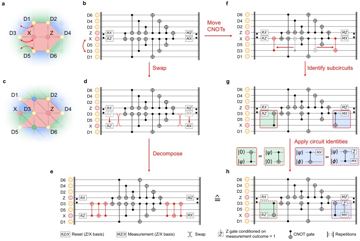
Sits, as an alternate code, in four architectures — the transmon lattice with tunable couplers, trapped-ion QCCD, the linear Paul trap with individual laser addressing and the alkali Rydberg tweezer array [graph]; requires the same static nearest-neighbour lattice as the surface code and hosts magic-state factories. All three 2025–26 magic-state milestones ran in colour codes: cultivation to 0.9999(1) at 8% acceptance before code-switching out D[42], Quantinuum's [[15,1,3]]→[[7,1,3]] switching at ≤5.1(2.7)×10⁻⁴ D[666], QuEra's 5-to-1 distillation D[147]. It replaces the surface code where transversal Cliffords beat the ~1.9× footprint; switching costs a decoder and a layout, not hardware. Clock contribution ~20 ns per logical Hadamard C[664]; the code does set d₂, the gate-layer count summed into the round (derived clock = sum of the syndrome round: gate layers + transport + readout + reset for the architecture), 0.65 µs derived against the measured 1.1 µs host cycle. Neighbouring empty slot: no hardware colour-code decoder.
Evidence — how the numbers were measured
Λ₃/₅ = 1.56(4) and the 0.0027(3) transversal-Clifford error are Google's own, one processor, unreplicated by a second vendor D[41]. Two framings of that paper conflict: it reports 86.5(1)–90.7(1)% teleported-state fidelities for lattice surgery, while Google's blog presents 86–91% as "two-qubit gate fidelity" C[664] — trust the paper. Magic injection exceeds 99% only with post-selection keeping ~75% of runs D[41]. The footprint claims are not comparable either: "fewer physical qubits per code distance" C[664] against total qubits for a fixed logical target S[655]. Nothing published separates code error from decoder error in the transversal figure.
Not published: a quantified Monte Carlo improvement for the hook-error-free colour-code circuit [665].
Actors & economics
Who.
| Organisation | Role | Country | What they do | Evidence |
|---|---|---|---|---|
| Google Quantum AI | Developer/user | US | Only superconducting colour-code memory; cultivation host | D[41], [42] |
| Quantinuum | Developer/user | US | Colour-code code switching; tesseract [[16,6,4]] on Helios | D[666], [667] |
| Microsoft Quantum | Developer | US | Co-authored the tesseract colour-code result | D[667] |
| QuEra | Developer/user | US | First logical 5-to-1 distillation on colour-code patches | D[147] |
Money. 2025-07-14 · QuEra · publication (first logical 5-to-1 distillation) · no figure · funded from its $230 M+ 2025 round C[153] · published D[147]. 2025-11-06 · DARPA QBI Stage B · up to $15 M per team · eleven teams, Quantinuum and QuEra among them G[65]. 2026-06-03 · Quantinuum · IPO · $1.68 B gross at $60/share, Nasdaq QNT; Q2-2026 revenue $8.0 M, cash $2.1 B · closed G[123]. No round, grant or acquisition is specific to the colour code: it is a line item inside platform programmes.
Market & supply chain. No dedicated supply chain; it rides the host's fab and the general classical stack. The market it moves is decoding: hypergraph syndromes need search or projection decoders (FPGA/GPU work from AMD and NVIDIA), and no vendor ships a colour-code hardware decoder as of 4 Sep 2026. Pays into G3 and G4 through magic-state factories: every logical magic-state milestone since 2025 ran in a colour code D[42], [147], [666].
IP & standards. The code is published mathematics from 2006 D[663]. PatSnap's April 2026 landscape counts 12 QEC patents — Google 6, IBM 4, Tencent 2 — with no colour-code cluster P[668]. Google's granted surface-code patent covers gauge operators, not this code fact. No standards body; the de facto interface is a Stim detector-error model.
Roadmaps & track record. Google (2025-06-23 · colour code a "workhorse configuration", no dated milestone · a d=5 memory followed in July 2026) C[664]D[2]. Quantinuum (2024-09 · Helios 2025 → Sol 2027 → Apollo 2029 · Helios shipped 2025-11-05 and carried the tesseract result) Rfact. QuEra (2026-06 · Libra, >256 logical, 2028 · its January-2024 roadmap promised 100 logical in 2026, undelivered) Rfact. Google's claims have been measurements, not promises; Quantinuum's schedule has held; QuEra's research runs ahead of its product roadmap.
Strategic reading. The colour code favours platforms where qubits are cheap and logical time expensive — superconducting and neutral atoms — over trapped ions, where a 1.9× premium falls on the scarce resource. Its likeliest 2029 position is not memory but the T-state factory feeding surface-code memory: cultivation cut magic-state cost ~40× inside a colour code and then switched out D[42], making it a component of a surface-code machine rather than a competitor. Substitution threats: high-rate qLDPC blocks with transversal gates, and algorithmic fault tolerance replacing O(d) rounds per logical gate. Losers: toolchains built only around lattice surgery.
Outlook & open questions
Confirm/demote in 12–24 months: a colour-code memory beyond d=5 with Λ approaching 2.14; a second vendor reproducing transversal Cliffords. Best case 2029: cultivation makes it the standard magic-state substrate, the footprint premium confined to factory patches. Worst case: hook-error and decoder overheads keep Λ near 1.5 and it survives only as a distillation substrate. Open questions: does the one-auxiliary-per-plaquette circuit S[665] recover a competitive threshold on hardware; do planar non-Clifford circuits S[669] beat distillation; will anyone publish a total-footprint comparison.
References
- [1] Google Quantum AI and Collaborators, “Quantum error correction below the surface code threshold,” Nature, vol. 638, no. 8052, pp. 920–926, Dec. 2024, doi: 10.1038/s41586-024-08449-y. D
- [2] V. Sivak et al., “Reinforcement learning control of quantum error correction,” Nature, vol. 655, no. 8124, pp. 879–884, Jul. 2026, doi: 10.1038/s41586-026-10759-2. D
- [41] N. Lacroix et al., “Scaling and logic in the color code on a superconducting quantum processor,” Nature, vol. 645, no. 8081, pp. 614–619, May 2025, doi: 10.1038/s41586-025-09061-4. arXiv:2412.14256. D
- [42] E. Rosenfeld et al., “Magic state cultivation on a superconducting quantum processor,” arXiv:2512.13908, Dec. 2025. D
- [65] DARPA, “Stage B selection,” Nov. 6, 2025. [Online]. Available: https://www.darpa.mil/
research/ Gprograms/ quantum-benchmarking-initiative/ stage-b-selection - [123] Quantinuum, “Quantinuum Announces Pricing of Upsized Initial Public Offering,” Jun. 3, 2026. [Online]. Available: https://www.quantinuum.com/
press-releases/ Gquantinuum-announces-pricing-of-upsized-initial-public-offering - [147] P. S. Rodriguez et al., “Experimental demonstration of logical magic state distillation,” Nature, vol. 645, no. 8081, pp. 620–625, Jul. 2025, doi: 10.1038/s41586-025-09367-3. D
- [153] QuEra Computing, “QuEra Expands $230 Million Financing Round Advancing Quantum-Accelerated Supercomputing,” Sep. 9, 2025. [Online]. Available: https://www.quera.com/
press-releases/ Cquera-expands-230-million-financing-round-advancing-quantum-accelerated-supercomputing - [655] C. Gidney and C. Jones, “New circuits and an open source decoder for the color code,” arXiv:2312.08813, Dec. 2023. S
- [663] H. Bombín and M. A. Martin-Delgado, “Topological Quantum Distillation,” Phys. Rev. Lett., vol. 97, Art. no. 180501, 2006, doi: 10.1103/PhysRevLett.97.180501. arXiv:quant-ph/0605138. D
- [664] A. Bourassa and K. Satzinger, “A colorful quantum future,” Google Research Blog, Jun. 23, 2025. [Online]. Available: https://research.google/
blog/ Ca-colorful-quantum-future/ - [665] G. Kishony and A. Fowler, “Color code off-the-hook: avoiding hook errors with a single auxiliary per plaquette,” arXiv:2603.28852, Mar. 2026. S
- [666] L. Daguerre, R. Blume-Kohout, N. C. Brown, D. Hayes, and I. H. Kim, “Experimental Demonstration of High-Fidelity Logical Magic States from Code Switching,” Phys. Rev. X, vol. 15, no. 4, Art. no. 041008, Oct. 2025, doi: 10.1103/dck4-x9c2. arXiv:2506.14169. D
- [667] A. Paetznick et al., “Improved quantum processor logical error rates via correction and detection,” Nature, vol. 654, no. 8118, pp. 349–355, Jun. 2026, doi: 10.1038/s41586-026-10628-y. D
- [668] PatSnap, “Quantum Error Correction Technology Landscape 2026,” Apr. 22, 2026. [Online]. Available: https://www.patsnap.com/
resources/ Pblog/ articles/ quantum-error-correction-patent-landscape-2026/ - [669] A. Bauer and J. C. M. de la Fuente, “Planar Fault-Tolerant Circuits for Non-Clifford Gates on the 2D Color Code,” PRX Quantum, vol. 7, no. 2, Art. no. 020367, Jun. 2026, doi: 10.1103/p7c9-x1m9. arXiv:2505.05175. S