Algorithmic FT / transversal architectures code_aft
Replacing O(d) syndrome-extraction rounds per logical gate with a constant number, via transversal block-to-block gates plus correlated decoding.
Algorithmic FT / transversal architectures
Constant syndrome rounds per logical gate via transversal gates + correlated decoding; amortises slow cycles (> 10× spacetime).
Brief →Key references
Design space — attributes
- (a) carrier affinity
- natural
- (b) time · entangling
- —
- (c) readout
- —
- (d) mobility
- physical transport
- (e) control
- —
- (f) error structure
- stochastic Pauli
- (g) manufacturing
- —
Evaluation space — dated attributes
'RSA-2048 with ~10⁴ atoms' is what neither paper says: arXiv:2603.28627 is Shor/P-256, and the RSA-2048 point on the same trade curve is 19 M qubits for 5.6 days (ISCA 2025). Transversal architectures are not atoms-only — Quantinuum ran the tesseract [[16,6,4]] on trapped ions (Nature 654, 2026-06).
Standard records
Actors & goals — annotations
Edges
Used by 2 machines (2 primary · 0 alternate)
- neutral atoms 2
- 448-atom fault-tolerant processor Harvard / MIT / QuEra paper press ▣ Fig. 4 (universal FT gate set, arbitrary rotations); Fig. 6 (27-layer deep circuits) ✅
- Libra QuEra press ▨ ✅
Pictures
Every picture carries the story of what it shows and its credit line.
Algorithmic FT / transversal architectures
Replacing O(d) syndrome-extraction rounds per logical gate with a constant number, via transversal block-to-block gates plus correlated decoding.
Verdict. The transversal half is measured on atoms and ions; the correlated-decoding half is a proof plus simulation. No run has closed transversal gate, correlated decode and feed-forward in real time.
Λ = error-suppression factor per code-distance step; QBI = DARPA Quantum Benchmarking Initiative (Stage A concept → B R&D plan → C government V&V); G1–G7 = the report's goal classes (see Actors & economics).
Identity & lineage
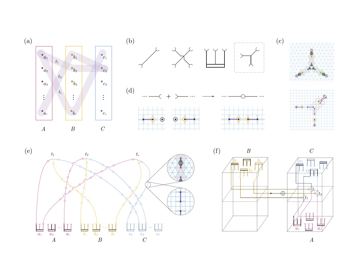
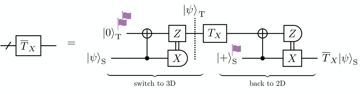
Algorithmic fault tolerance, introduced by Zhou, Bluvstein, Kubica, Lukin and co-workers as a preprint in June 2024 and published in Nature in 2025 D[152], runs logical gates transversally between code blocks and decodes the algorithm's whole syndrome history jointly, so a logical gate costs a constant number of extraction rounds rather than the O(d) lattice surgery needs.
Mobility: it presumes a machine that can bring any two blocks into register — tweezer transport or ion shuttling — not a fixed lattice. Error structure: no new channel — the code's own Pauli and erasure noise, atom loss dominant, with physical-cycle overhead traded for classical decoding overhead.
Physics & limits
The d-round rule exists because one round cannot distinguish a measurement error from a data error; repeating the syndrome circuit d times makes the detector graph's spacetime distance equal the code distance. That redundancy is only needed when each block is decoded alone: a transversal CNOT maps a fault in one block to its partner in the other, so the joint graph across blocks and time still has distance d after O(1) rounds — if the decoder uses it. The proof bounds deviation from the ideal logical measurement distribution as exponentially small D[152].
The cost moves to the classical side, structurally. The joint graph does not factorise, so the sliding window that keeps per-block decoding local in time is no longer exact: the decoder spans several logical gates, cannot close its window until the next feed-forward point, and its work grows with the blocks entangled since the last measurement, not with d.
Engineering state of the art
table
| Year | Figure | Who | Tag+key |
|---|---|---|---|
| 2024-06 | O(d) → O(1) rounds per logical gate, >10× spacetime reduction (proof, simulation) | Harvard/QuEra | D[152] |
| 2025-05 | RSA-2048 in 5.6 days on 19 M atoms at a 1 ms cycle, ~50× faster than comparable | Harvard/QuEra | S[31] |
| 2025-11 | 448 atoms: transversal CNOTs, hundreds of teleportations, 96 logical qubits | Harvard/QuEra | D[4] |
| 2026-03 | Shor with 10,000 atoms (26,000 for speed): P-256 in days, RSA-2048 far longer | Harvard/Caltech | S[30] |
| 2026-06 | [[16,6,4]] tesseract code, transversal logical Cliffords, on trapped ions | Quantinuum | D[667] |
Every reported gain is simulation or an offline decode of stored syndromes: no published run closes the loop — transversal gate, correlated decode, feed-forward — in real time.
Manufacturing, materials & supply chain
An architecture and decoding layer with no process, yield or unit cost. Its supply-chain exposure is second-hand but specific: crossed acousto-optic deflectors, where AA Opto-Electronic and Gooch & Housego are the only vendors named in the 448-atom work D[4], and the classical hardware running the decode. NVIDIA's NVQLink sets the yardstick at 3.84 µs round trip and 67 µs median decode with BP+OSD (belief propagation plus ordered-statistics decoding) — on the far easier per-block problem C[324].
Control, readout & I/O burden
No new laser, control line or detector; the burden is classical and real-time. A correlated decoder must ingest syndromes from every block touched by a transversal gate and return a correction before the next feed-forward point — within milliseconds on atoms, on a graph 10²–10³× larger than the single-block problem GPUs handle now. At 10³ logical qubits the evidence is simulation; at 10⁴–10⁶ no latency model has been published, and both resource estimates assume decoding keeps up S[31]S[30]. That assumption, not atom count, is where this fails if it fails.
Role in the stack
It applies on any architecture that can move qubits: the alkali Rydberg tweezer array (QuEra, Pasqal, Infleqtion) and — though the graph record models it on that array alone — Atom Computing's alkaline-earth(-like) arrays and the trapped-ion QCCD architecture, where Quantinuum runs the same [[16,6,4]] code transversally D[667]. It requires transport plus correlated, loss-aware decoding, and conflicts with fixed nearest-neighbour lattices, which cannot pair arbitrary blocks without a routing layer. It adds no term to the derived clock but multiplies it, cutting rounds per logical gate from ~d (at d=7 on atoms, ~9 ms per gate) to O(1). Neighbouring empty slot: a real-time correlated decoder.
Evidence — how the numbers were measured
Transversal gates and 96 active logical qubits are hardware measurements D[4]; the >10× reduction is a theorem plus simulation D[152], unreproduced outside the author group. The two resource estimates differ by three orders in space — a trade curve, not a contradiction: 19 M atoms buys RSA-2048 in 5.6 days S[31], while 10,000–26,000 atoms buys P-256 in days and RSA-2048 one to two orders slower S[30]; "RSA-2048 with 10,000 atoms" is what neither paper says. The sharpest counter-evidence is Atom Computing and Microsoft's toric code: Λ_Z ≈ 1.9 but Λ_X ≈ 1.2, average 1.30 over four cycles, and with reloading over 90 rounds suppression vanished (0.63% versus 0.64% per cycle) D[148]. Atoms have not shown sustained below-threshold memory, and constant-round fault tolerance is a claim about long algorithms.
Not published: a common assumption set (physical error rate, code distance, decoder model) for the 19 M-atom / 5.6-day and 10,000-atom estimates, and a real-time correlated-decoder latency above roughly 10² logical qubits. The >10× spacetime reduction has no replication outside the overlapping Harvard/QuEra/Caltech author group.
Actors & economics
Who.
| Organisation | Role | Country | What they do here | Evidence |
|---|---|---|---|---|
| Harvard | research | US | Originated the scheme; 448-atom transversal demo | D[4], [152] |
| QuEra | developer | US | Co-author and hardware; Libra 2028 needs the gain | Cfact |
| Quantinuum | developer | US/UK | Transversal logical Cliffords on ions, same code | D[667] |
| Atom Computing | developer | US | Zoned transport; published the counter-result | D[148] |
| Google Quantum AI | developer | US | Neutral-atom track since 2026-03, QEC-focused | C[9] |
| Pasqal | developer | FR | Transport architecture, 100 logical by 2029 | Cfact |
Money. 2025-09-09 · QuEra · round · $230 M+ · Google, SoftBank Vision Fund 2, NVentures · closed G[153]fact. 2025-11-06 · Atom Computing and QuEra · QBI Stage B · ≤$15 M each · active G[65]fact. 2026-02-17 · Infleqtion · IPO · >$550 M · NYSE INFQ G[155]. 2026-05-21 · Atom Computing and Infleqtion · CHIPS LOI · $100 M each · US Commerce · non-binding G[300]fact. 2026-06-16 · Atom Computing · Series C · $100 M, Third Point G[154]fact. 2026-08-28 · Pasqal · SPAC · ~$360 M cash · Nasdaq PSQL G[156]fact.
Market & supply chain. Nothing is sold under this name; it multiplies someone else's machine, so rent accrues to the transport optics and the decoder stack. It pays for G3, cutting physical-per-logical from ~10³ toward ~10², and for G4 if it holds; nothing for G1 or G5.
IP & standards. The founding work is peer-reviewed in Nature and open on arXiv, as is the ISCA resource analysis; no patent family specific to algorithmic fault tolerance or correlated decoding was found as of 2026-09-04.
Roadmaps & track record. QuEra: Libra promised 2026-06-15 for 2028 (>256 logical, 10⁻⁶) after a January 2024 promise of 100 logical qubits in 2026 — a two-year slip, so the schedule now leaning on constant-round fault tolerance has been reset once R[162]fact. Pasqal: 10,000 physical slipped 2026 to 2028 Rfact. Every atom roadmap past 2027 prices in this gain; none names it as a dependency.
Strategic reading. If it holds at scale, every transport-capable vendor's fault-tolerance date moves left at once and the millisecond atom cycle stops being disqualifying — the bet behind zoned architectures. Ions gain equally and are further along on transversal Cliffords, so the winner need not be an atom company. The losers are fixed nearest-neighbour superconducting lattices, which cannot claim the discount.
Outlook & open questions
Confirm/demote in 12–24 months: a group closes transversal gate, correlated decode and feed-forward on hardware; an atom system shows sustained below-threshold memory with reloading; QuEra restates Libra without the gain. Best case 2029: constant-round fault tolerance at 10³ logical qubits, compressing every transport-capable roadmap. Worst case: correlated decoding stalls at a few dozen blocks and stays a resource-estimation tool. Open: does decoder latency scale past 10⁴ blocks; does >10× survive loss-heavy noise. Watch: Libra milestones and any real-time correlated-decoder demonstration.
References
- [4] D. Bluvstein et al., “A fault-tolerant neutral-atom architecture for universal quantum computation,” Nature, vol. 649, no. 8095, pp. 39–46, Nov. 2025, doi: 10.1038/s41586-025-09848-5. arXiv:2506.20661. D
- [9] H. Neven, “Building superconducting and neutral atom quantum computers,” Google, Mar. 24, 2026. [Online]. Available: https://blog.google/
innovation-and-ai/ Ctechnology/ research/ neutral-atom-quantum-computers/ - [30] M. Cain et al., “Shor's algorithm is possible with as few as 10,000 reconfigurable atomic qubits,” arXiv:2603.28627, Mar. 2026. S
- [31] H. Zhou et al., “Resource Analysis of Low-Overhead Transversal Architectures for Reconfigurable Atom Arrays,” Proc. 52nd Annu. Int. Symp. Comput. Archit. (ISCA), 2025, doi: 10.1145/3695053.3731039. arXiv:2505.15907. S
- [65] DARPA, “Stage B selection,” Nov. 6, 2025. [Online]. Available: https://www.darpa.mil/
research/ Gprograms/ quantum-benchmarking-initiative/ stage-b-selection - [148] Atom Computing and Collaborators, “Quantum error correction with the toric code,” arXiv:2606.04079, Jun. 2026. D
- [152] H. Zhou et al., “Low-Overhead Transversal Fault Tolerance for Universal Quantum Computation,” Nature, vol. 646, no. 8084, pp. 303–308, 2025, doi: 10.1038/s41586-025-09543-5. arXiv:2406.17653. D
- [153] QuEra Computing, “QuEra Expands $230 Million Financing Round Advancing Quantum-Accelerated Supercomputing,” Sep. 9, 2025. [Online]. Available: https://www.quera.com/
press-releases/ Gquera-expands-230-million-financing-round-advancing-quantum-accelerated-supercomputing - [154] Atom Computing, “Atom Computing Raises More Than $300 Million to Accelerate Deployment of Fault-Tolerant, Neutral-Atom Quantum Computers,” PR Newswire, Jun. 16, 2026. [Online]. Available: https://www.prnewswire.com/
news-releases/ Gatom-computing-raises-more-than-300-million-to-accelerate-deployment-of-fault-tolerant-neutral-atom-quantum-computers-302800832.html - [155] L. Roady, “Infleqtion Becomes First Neutral-Atom Quantum Company to Go Public,” Infleqtion, Feb. 17, 2026. [Online]. Available: https://infleqtion.com/
infleqtion-becomes-first-neutral-atom-quantum-company-to-go-public/ G - [156] M. Swayne, “Pasqal Completes SPAC Merger With $360 Million in Cash,” The Quantum Insider, Aug. 28, 2026. [Online]. Available: https://thequantuminsider.com/
2026/ G08/ 28/ pasqal-completes-spac-merger-with-360-million-in-cash/ - [162] QuEra Computing, “QuEra Announces 2028 Fault-Tolerant Quantum Computer and Expanded Multi-Year Strategic Collaboration with AWS,” Jun. 15, 2026. [Online]. Available: https://www.quera.com/
press-releases/ Rquera-announces-2028-fault-tolerant-quantum-computer-and-expanded-multi-year-strategic-collaboration-with-aws - [300] National Institute of Standards and Technology, “Department of Commerce Announces Letters of Intent With 9 Companies for $2 Billion to Accelerate U.S. Leadership in Quantum Computing,” NIST News, May 21, 2026. [Online]. Available: https://www.nist.gov/
news-events/ Gnews/ 2026/ 05/ department-commerce-announces-letters-intent-9-companies-2-billion - [324] S. Caldwell et al., “NVIDIA NVQLink Architecture Integrates Accelerated Computing with Quantum Processors,” NVIDIA Technical Blog, Nov. 17, 2025. [Online]. Available: https://developer.nvidia.com/
blog/ Cnvidia-nvqlink-architecture-integrates-accelerated-computing-with-quantum-processors/ - [667] A. Paetznick et al., “Improved quantum processor logical error rates via correction and detection,” Nature, vol. 654, no. 8118, pp. 349–355, Jun. 2026, doi: 10.1038/s41586-026-10628-y. D