Ion shuttling (QCCD, junctions, grid traps) cx_qccd
Moving trapped ions between zones through junctions or grid traps so a small gate-able crystal inherits all-to-all connectivity.
Ion shuttling (QCCD, junctions, grid traps)
Ions moved between zones at m/s with sub-quantum heating; transport + cooling dominate runtime (55 ms per full layer on Helios).
Brief →Key references
Design space — attributes
- (a) carrier affinity
- natural
- (b) time · entangling
- 2.0 ms
- (c) readout
- —
- (d) mobility
- physical transport
- (e) control
- —
- (f) error structure
- coherent / calibration
- (g) manufacturing
- MEMS / surface-electrode traps
Evaluation space — dated attributes
A chip-to-chip matter link between two ion-trap modules exists (Universal Quantum, Nat. Commun. 14, 531, 2023); the empty slot here is a link across more than two modules, not chip-to-chip itself.
Standard records
Actors & goals — annotations
Edges
Used by 9 machines (7 primary · 2 alternate)
- trapped ions 9
- Apollo Quantinuum blog ▥ §What is Apollo? (2D array of trapping locations; all-to-all connectivity) ✅
- System Model H1 (H1-1) Quantinuum blog press ▣ Fig. 2 (QCCD surface trap); §Background (transport primitives) 🔎
- System Model H2 (H2-1, H2-2) Quantinuum paper paper paper ▣ Fig. 1 (racetrack trap); §II (transport, split/combine, swap) ✅
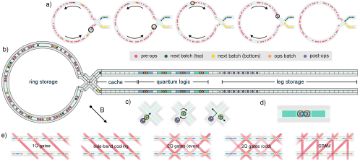
- Helios Quantinuum paper paper paper ▣ Fig. 2a–c (ring storage, cache, junction transport); Fig. 3 (time per layer) ✅
- Helix architecture on Helios Quantinuum paper ▣ Fig. 4 (SWAP-transversal logical gates); App. A.1 Logical Clifford gates ✅
- Sol Quantinuum blog ▥ §How do we get there? ('first commercially available 2D-grid-based quantum computer'; 'fully 2D-grid architecture is the scalability launching point') ✅
- iQPU / UQConnect Universal Quantum press ▣ Fig. 2 (section of a modular QCCD architecture); §Inter-module ion transport ✅
- QUARTET Oxford Ionics (IonQ) press ▣ Fig. 1 (repeating 2D grid of unit cells); §II Architecture ✅ (alternate)
- University of Innsbruck trapped-ion demonstrator (Institut für Experimentalphysik) University of Innsbruck paper paper paper ▤ 🔎 (alternate)
Pictures
Every picture carries the story of what it shows and its credit line.


Ion shuttling (QCCD, junctions, grid traps)
Moving trapped ions between zones through junctions or grid traps so a small gate-able crystal inherits all-to-all connectivity.
Verdict. Sorting, splitting and re-cooling — not the hop, not the gate — set the ion clock (~55 ms per full-width layer on Helios). Without a 10× cut by 2028 ion QCCD stays high-fidelity and low-throughput.
Λ = error-suppression factor per code-distance step; QBI = DARPA Quantum Benchmarking Initiative (Stage A concept → B R&D plan → C government V&V); G1–G7 = the report's goal classes (see Actors & economics).
Identity & lineage
QCCD, proposed by Kielpinski, Monroe and Wineland in 2002 D[499], splits the register into zones and uses time-varying electrode voltages to move ions between memory and interaction zones, so no chain need be both long and gate-able — routing bought with trap area. Junctions make it two-dimensional; grid traps permute ions like a sliding-tile puzzle.
Mobility and time: the carrier itself moves, at 1.7–4 m/s measured D[114], [117], so connectivity is a schedule, not a coupler map; move-plus-re-cool ~2 ms, entangling determinism inapplicable. Error and fabrication: coherent motional excitation plus ion loss, seen as raised two-qubit infidelity and leakage; MEMS surface-electrode chips on DC waveforms.
Physics & limits
Ramping neighbouring segment voltages drags a potential well, and its ion, along the axis — and the move need not be slow: NIST moved ⁹Be⁺ 370 µm in 8 µs, excitation peaking at 1.6 quanta and returning to 0.2 by waveform design D[500]. The millisecond cost is therefore not the hop but splitting and recombining crystals (two ions split in 55 µs kept ~2 quanta each D[500]) and the sideband cooling that restores the gate modes.
At a junction the rf null is discontinuous: the ion crosses a pseudopotential bump with excess micromotion, which sets transit speed and heating. Beneath that is anomalous heating from electrode-surface noise, steep as the ion nears the surface, so tighter confinement cannot buy adiabaticity. What moves the floor is a gate tolerant of a warm crystal: the electronic (laser-free, microwave-driven) gate reached 8.4×10⁻⁵ error without ground-state cooling D[102], deleting the re-cool term rather than shrinking it.
Engineering state of the art
table
| Year | Figure | Who | Tag+key |
|---|---|---|---|
| 2022-06 | X-junction round trip, 4 m/s average, 0.013(1)–0.030(2) quanta | Quantinuum | D[114] |
| 2023-02 | Chip-to-chip matter link, 2,424 transfers/s, loss infidelity < 7×10⁻⁸ | Universal Quantum | D[117] |
| 2024-03 | Grid-trap ion exchange at 2.5 kHz | Quantinuum | D[113] |
| 2025-11 | 55 ms per full-width layer, 98 ions, 8 zones | Quantinuum | D[97] |
The gap between primitive and product is the finding: a Helios two-qubit gate takes ~70 µs against ~55 ms per layer, and on H2 transport was ~60% of runtime D[97], [110]. The dominant term is the schedule — sorting, split/merge, re-cooling, serialisation across eight zones.
Manufacturing, materials & supply chain
Traps are segmented-electrode chips. Honeywell is Quantinuum's captive fab and made Sol's 2D grid chip, in validation as of Q2 2026 C[124]. Infineon Villach is the merchant line — 6–12 inch wafers, Generation-3 out-of-plane electrodes claimed to raise confinement ~10× — serving Oxford Ionics, eleQtron, Innsbruck and ETH at once C[320]. IonQ broke that duopoly by buying SkyWater for ~$1.8 B, closed 2026-07-31: the first ion vendor to own fabrication G[19]. Sandia's MESA stays research-only G[501]. No yield figure is public; the only price is AQT's EUR 9.8 M 20-qubit turnkey system, ≈ EUR 0.5 M per qubit C[323]. Single points of failure: Infineon's one line, and UV lasers, where TOPTICA dominates and 369 nm for Yb⁺ is constrained P[322]. No ECCN names ion traps, but a finished machine falls under 4A906, effective 2024-09-06 G[301].
Control, readout & I/O burden
A move is a synchronised DC waveform across tens of electrodes at µs update, then cooling and, for laser gates, beam re-addressing. Helios carries 1,228 electrodes for 98 ions D[97]: electrode count is what scales, and updates fit three orders inside the 55 ms layer, so electronics is not the wall. At 10³ ions it is ~10⁴ filtered DC channels, which Oxford Ionics would cut to ~200 external sources by putting switching electronics on-chip — a design study, no chip built S[325]. At 10⁴–10⁶ the constraint is routing cooling and gate light to many zones at once (Helios needs ≥7 wavelengths): none drives more than a few dozen concurrently.
Role in the stack
Shuttling serves two of the three trapped-ion architectures — QCCD (Quantinuum), where it is primary, and electronic qubit control (IonQ/Oxford Ionics, eleQtron), where it is the alternate — providing the arbitrary-pair connectivity that bivariate bicycle qLDPC memories and high-rate transversal codes assume: Quantinuum's [[80,48,4]] demonstration pays for it in transport, while IonQ's qLDPC break-even ran on a static 40-ion chain without it. It replaces the static long chain, whose mode spectrum crowds as ions are added; the price is that connectivity becomes scheduling and the clock moves from gate to move — derived clock = sum of the syndrome round: gate layers + transport + readout + reset ≈ 9.7 ms, transport 9.0 ms of it, against the measured ~55 ms full-width layer D[97]. Neighbouring empty slot: more than two linked modules — the two-module link exists D[117], nothing larger.
Evidence — how the numbers were measured
Transport has no stand-alone benchmark. It is inferred from sideband thermometry around a move — the 0.013(1)–0.030(2) quanta figures D[114] — and from two-qubit fidelity after a transport sequence, which folds transport into gate error. Neither captures cumulative heating over a deep circuit, junction loss at scale, or zone crosstalk. The 55 ms layer and 2.5 kHz exchange rate are vendor-reported and externally unreplicated as of 2026-09-04; AQT's quantum volume 32,768 is not a transport measurement and discloses no timing C[128].
The EUR 0.5 M per qubit figure is a 2023 turnkey system price, not a chip cost. Not published: the grid-site count of the grid trap [113]; AQT LYNX's architecture (junction or linear-only) and its transport and gate times; and the yield, uniformity or per-die cost of any ion-trap fab line.
Actors & economics
Who.
| Organisation | Role | Country | What they do here | Evidence |
|---|---|---|---|---|
| Quantinuum | developer | US/UK | Ring-junction QCCD, grid trap for Sol | D[97] |
| Honeywell | supplier | US | Captive fab, made Sol's chip | C[124] |
| IonQ | developer | US | Junction traps, owns SkyWater | G[19] |
| Infineon | supplier | AT | Merchant trap foundry, Gen-3 | C[320] |
| Universal Quantum | developer | UK | Only chip-to-chip matter link | D[117] |
| AQT | developer | AT | LYNX module, units Q4 2026; architecture undisclosed | C[128] |
| Quantum Art | developer | IL | Optical ion-array reconfiguration | P[125] |
Money. 2022-11-02 · Universal Quantum · DLR contract · EUR 67 M · undelivered P[328]. 2025-09-04 · Quantinuum · round · $600 M at $10 B pre-money · NVentures, Quanta, QED, JPMorgan · closed G[122]. 2025-11-06 · Quantinuum and IonQ · QBI Stage B · ≤$15 M each · active fact. 2026-05-05 · eleQtron · Series A · EUR 57 M G[129]. 2026-06-03 · Quantinuum · IPO · $1.68 B gross, Nasdaq QNT, cash $2.1 B G[124]. 2026-07-31 · IonQ · SkyWater M&A · ~$1.8 B, after Oxford Ionics at $1.075 B G[18], [19].
Market & supply chain. Trap fabrication was one captive plus one merchant line; SkyWater adds a vertically integrated third — the year's most consequential supply-chain event C[320]G[19]. UV lasers stay the harder chokepoint P[322]. Shuttling is paid for by G2 and is prerequisite to G3 and G4.
IP & standards. No shuttling-specific family count is published. Nearest dated: IonQ filed 9+ trapped-ion families across JP/EP/IL in 2025–26; Quantum Art holds two pending IL/KR patents on optical reconfiguration of ion arrays P[375]. No open-source shuttling stack exists.
Roadmaps & track record. Quantinuum: Helios (promised 2024-09-10, launched 2025-11-05 — met); Sol (2027, chip in validation Q2 2026 — on track); Apollo (2029 — unscored) R[118]C[124]; credible. IonQ: 10,000 physical on one chip by 2027, 2 M by 2030, no published 2D-trap heating or transport data, and a 2020 roadmap that missed 4,000 qubits by ~40× — intent, not plan R[132]. Universal Quantum has delivered nothing since 2022 P[502].
Strategic reading. Cut layer time 10× and ions convert a fidelity lead into throughput-competitive fault tolerance; fail, and they win logical-qubit headlines while losing on shots per second. Winners either way: Infineon and Honeywell, who sell the scarce object. Substitution threat: neutral-atom tweezers and superconducting long-range couplers — connectivity with no transport.
Outlook & open questions
Confirm/demote in 12–24 months: Sol ships in 2027 with a published per-layer time; any vendor publishes a full-width layer below 10 ms; Universal Quantum links more than two modules. Best case 2029: sub-10 ms layers put the ion logical clock within ~10× of superconducting. Worst case: layer time stays within 2× of 55 ms and ions stay a platform that demonstrates codes rather than running algorithms. Open: does anomalous heating force cryogenic traps at 10⁴ ions; can split/merge be made quanta-free by optimal control; do warm-crystal gates delete re-cooling; does a second merchant fab appear. Watch: Sol validation, Infineon capacity, IonQ's first SkyWater trap.
References
- [18] IonQ, “IonQ Completes Acquisition of Oxford Ionics, Rapidly Accelerating Its Quantum Computing Roadmap,” Sep. 17, 2025. [Online]. Available: https://www.ionq.com/
news/ Gionq-completes-acquisition-of-oxford-ionics-rapidly-accelerating-its-quantum - [19] IonQ, “IonQ Completes Acquisition of SkyWater Technology,” Jul. 31, 2026. [Online]. Available: https://www.ionq.com/
news/ Gionq-completes-acquisition-of-skywater-technology - [97] A. Ransford et al., “A 98-qubit trapped-ion quantum computer with all-to-all connectivity,” Nature, vol. 655, no. 8121, pp. 81–86, Jun. 2026, doi: 10.1038/s41586-026-10676-4. arXiv:2511.05465. D
- [102] A. C. Hughes et al., “Trapped-ion two-qubit gates with >99.99% fidelity without ground-state cooling,” arXiv:2510.17286, Oct. 2025. D
- [110] S. A. Moses et al., “A Race Track Trapped-Ion Quantum Processor,” Phys. Rev. X, vol. 13, Art. no. 041052, Dec. 2023, doi: 10.1103/PhysRevX.13.041052. arXiv:2305.03828. D
- [113] R. D. Delaney et al., “Scalable Multispecies Ion Transport in a Grid-Based Surface-Electrode Trap,” Phys. Rev. X, vol. 14, Art. no. 041028, Nov. 2024, doi: 10.1103/PhysRevX.14.041028. arXiv:2403.00756. D
- [114] W. C. Burton, B. Estey, I. M. Hoffman, A. R. Perry, C. Volin, and G. Price, “Transport of multispecies ion crystals through a junction in an RF Paul trap,” Phys. Rev. Lett., vol. 130, Art. no. 173202, Apr. 2023, doi: 10.1103/PhysRevLett.130.173202. arXiv:2206.11888. D
- [117] M. Akhtar et al., “A high-fidelity quantum matter-link between ion-trap microchip modules,” Nat. Commun., vol. 14, no. 1, Art. no. 531, Feb. 2023, doi: 10.1038/s41467-022-35285-3. D
- [118] Quantinuum, “Quantinuum Unveils Accelerated Roadmap to Achieve Universal, Fully Fault-Tolerant Quantum Computing by 2030,” Sep. 10, 2024. [Online]. Available: https://www.quantinuum.com/
press-releases/ Rquantinuum-unveils-accelerated-roadmap-to-achieve-universal-fault-tolerant-quantum-computing-by-2030 - [122] Honeywell, “Honeywell Announces $600 Million Capital Raise for Quantinuum at $10B Pre-Money Equity Valuation to Advance Quantum Computing at Scale,” Sep. 4, 2025. [Online]. Available: https://www.honeywell.com/
us/ Gen/ news/ press-releases/ 2025/ 09/ honeywell-announces-600-million-capital-raise-for-quantinuum-at-10b-pre-money-equity-valuation-to-advance-quantum-computing-at-scale - [124] Quantinuum, “Quantinuum Reports Second Quarter 2026 Results,” Aug. 11, 2026. [Online]. Available: https://www.quantinuum.com/
press-releases/ Cquantinuum-reports-second-quarter-2026-results - [125] M. Abdel-Kareem, “Quantum Art Extends Series A to $140M to Scale Trapped-Ion Architecture,” Quantum Computing Report, Apr. 27, 2026. [Online]. Available: https://quantumcomputingreport.com/
quantum-art-extends-series-a-to-140m-to-scale-trapped-ion-architecture/ P - [128] Alpine Quantum Technologies GmbH, “AQT Sets New European Industry Standard: Introducing the ‘LYNX’ Series with Record-Breaking Quantum Volume,” AQT, May 5, 2026. [Online]. Available: https://www.aqt.eu/
lynx-quantum-volume-record/ C - [129] A. Cordes, “Quantum computing scale-up eleQtron secures €57 million in one of the largest Series A funding rounds worldwide,” eleQtron, May 5, 2026. [Online]. Available: https://eleqtron.com/
en/ Gquantum-computing-scale-up-eleqtron-secures-57-million-in-one-of-the-largest-series-a-funding-rounds-worldwide/ - [132] IonQ, “IonQ's Accelerated Roadmap: Turning Quantum Ambition into Reality,” Jun. 13, 2025. [Online]. Available: https://www.ionq.com/
blog/ Rionqs-accelerated-roadmap-turning-quantum-ambition-into-reality - [301] US Department of Commerce, Bureau of Industry and Security, “Commerce Control List Additions and Revisions; Implementation of Controls on Advanced Technologies Consistent With Controls Implemented by International Partners,” Federal Register, vol. 89, p. 72926, Sep. 6, 2024. [Online]. Available: https://www.federalregister.gov/
documents/ G2024/ 09/ 06/ 2024-19633/ commerce-control-list-additions-and-revisions-implementation-of-controls-on-advanced-technologies - [320] Infineon Technologies AG, “Trapped ion quantum computing.” [Online]. Available: https://www.infineon.com/
promo/ Ctrapped-ions - [322] M. Ivezic, “The Optical Table's Hidden Supply Chain: Who Really Wins If Trapped-Ion Quantum Computing Wins,” PostQuantum.com, Oct. 1, 2025. [Online]. Available: https://postquantum.com/
quantum-ecosystem/ Ptrapped-ion-quantum-ecosystem/ - [323] AQT, “AQT lands million euro contract,” Dec. 5, 2023. [Online]. Available: https://www.aqt.eu/
aqt-lands-million-euro-contract/ C - [325] M. Malinowski, D. Allcock, and C. Ballance, “How to Wire a 1000-Qubit Trapped-Ion Quantum Computer,” PRX Quantum, vol. 4, no. 4, Art. no. 040313, Oct. 2023, doi: 10.1103/PRXQuantum.4.040313. arXiv:2305.12773. S
- [328] A. Ingall, “German government tasks Sussex spin-out with building a powerful quantum computer in €67M contract,” University of Sussex Broadcast, Nov. 2, 2022. [Online]. Available: https://www.sussex.ac.uk/
broadcast/ Pread/ 59206 - [375] PatSnap, “Trapped Ion Quantum Computing: Technology Landscape 2026,” Apr. 23, 2026. [Online]. Available: https://www.patsnap.com/
resources/ Pblog/ rd-blog/ trapped-ion-quantum-computing-2026-patsnap-eureka/ - [499] D. Kielpinski, C. Monroe, and D. J. Wineland, “Architecture for a large-scale ion-trap quantum computer,” Nature, vol. 417, no. 6890, pp. 709–711, Jun. 2002, doi: 10.1038/nature00784. D
- [500] R. Bowler et al., “Coherent Diabatic Ion Transport and Separation in a Multi-Zone Trap Array,” Phys. Rev. Lett., vol. 109, no. 8, Art. no. 080502, 2012, doi: 10.1103/PhysRevLett.109.080502. arXiv:1206.0780. D
- [501] T. Rummler, “In the Mountain West, a quantum computing collaboration announces major results,” Sandia Lab News, Aug. 27, 2026. [Online]. Available: https://www.sandia.gov/
labnews/ G2026/ 08/ 27/ in-the-mountain-west-a-quantum-computing-collaboration-announces-major-results/ - [502] M. Abdel-Kareem, “Universal Quantum and Atlas Copco Partner to Industrialize Vacuum Systems for Scalable Quantum Computers,” Quantum Computing Report, Dec. 18, 2025. [Online]. Available: https://quantumcomputingreport.com/
universal-quantum-and-atlas-copco-partner-to-industrialize-vacuum-systems-for-scalable-quantum-computers/ P