Ion-chain motional bus (all-to-all in chain) cx_bus
A shared collective motional mode entangles any pair in one trap, giving genuine all-to-all connectivity at the price of gate time growing with chain length.
Ion-chain motional bus (all-to-all in chain)
Shared motional modes give all-to-all within one chain; gates slow with chain length (median 672 µs on Forte's 30-ion chain).
Brief →Key references
Design space — attributes
- (a) carrier affinity
- natural
- (b) time · entangling
- —
- (c) readout
- —
- (d) mobility
- shared bus (motional / cavity)
- (e) control
- —
- (f) error structure
- coherent / calibration
- (g) manufacturing
- MEMS / surface-electrode traps
Evaluation space — dated attributes
IonQ Forte is a 30-ion chain (435 pairs), not 36; the 100-ion all-to-all Tempo chain is a company claim with no published gate time or per-pair fidelity.
Standard records
Actors & goals — annotations
Edges
Used by 18 machines (18 primary · 0 alternate)
- trapped ions 18
- IBEX Q1 (Marmot / PINE) Alpine Quantum Technologies product page ▣ Fig. 18 (pairwise fidelities over a 4-ion register via AOD addressing); Fig. 19 (24/50-ion chains); §IV.H ✅
- AQT LYNX Alpine Quantum Technologies press press ▨ 'all-to-all qubit connectivity'; 'no need for time-consuming reconfiguration or SWAP operations' ✅
- JION eleQtron + Forschungszentrum Julich press ▣ Fig. 2 (gradient-induced spin-spin coupling strengths J_ij across a 1-D chain) ✅
- QSea I (DLR QCI ion-trap demonstrator) eleQtron with NXP Semiconductors and ParityQC, for the DLR Quantum Computing Initiative press press link ▦ 'All qubits are coupled to one another using magnetic field gradients' ✅
- Aria IonQ product page ▣ Fig. 2a (all-to-all connectivity of the 11-qubit chain, 55 pairs colour-coded by XX fidelity) ✅
- 40-ion Ba-133 qLDPC testbed (IonQ: a Tempo engineering test system) IonQ press press ▣ Fig. 1 (Tanner graphs of required 2Q connectivity); App. F Qubit mapping ✅
- Forte / Forte Enterprise IonQ paper product page press ▤ §1; §3.1 Component-level benchmarking ✅
- QUARTET Oxford Ionics (IonQ) press ▤ §III Experiments (seven-zone single-layer linear trap, up to 10 qubits; probe ions shuttled to the central zone) ✅
- Superion 256 IonQ press press ▨ 🔎
- Tempo IonQ product page product page blog ▦ 🔎
- PIAST-Q Poznan Supercomputing and Networking Center (PCSS) ▨ ✅
- Montage (first-generation QaaS system, up to 50 qubits) Quantum Art product page ▣ Fig. 1 (optically segmented crystal, cells as near-independent registers); §II Proposed architecture ✅
- Perspective (1,000-qubit multi-core system) Quantum Art press ▣ Fig. 1 (optically segmented crystal, cells as near-independent registers); §II Proposed architecture ✅
- Aba|Qu 1.0 (Tiansuan-1, 天算1号) Qudoor (Guokaike) press press ▨ 🔎
- 70-qubit ion quantum computer (FIAN / Rosatom roadmap) Lebedev Physical Institute (FIAN) and the Russian Quantum Center, Rosatom roadmap ◌ 🔎
- QSCOUT (Quantum Scientific Computing Open User Testbed) Sandia National Laboratories paper paper product page ▦ ✅
- University of Innsbruck trapped-ion demonstrator (Institut für Experimentalphysik) University of Innsbruck paper paper paper ▣ Fig. 1c (any ion pair i,j addressable) ✅
- Maryland / Duke Quantum Center (EURIQA lineage) University of Maryland / Duke University paper paper ▣ Fig. 1 (9 data + 4 ancilla qubits mapped onto one 15-ion chain) ✅
Pictures
Every picture carries the story of what it shows and its credit line.
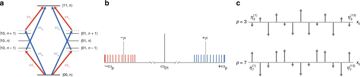

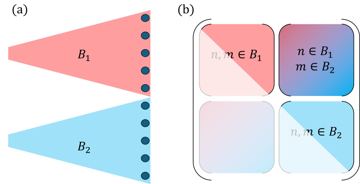
Ion-chain motional bus (all-to-all in chain)
A shared collective motional mode entangles any pair in one trap, giving genuine all-to-all connectivity at the price of gate time growing with chain length.
Verdict. Real all-to-all to ~30 benchmarked ions and ~100 claimed; IonQ's 10,000-ions-on-one-chip target for 2027 has no published heating, gate-time or mode-spectrum data behind it.
Λ = error-suppression factor per code-distance step; QBI = DARPA Quantum Benchmarking Initiative (Stage A concept → B R&D plan → C government V&V); G1–G7 = the report's goal classes (see Actors & economics).
Identity & lineage
Ions in one trap share collective motional modes; a spin-dependent force through a shared mode entangles any pair without moving them, so connectivity is all-to-all by construction. Cirac–Zoller (1995) and Mølmer–Sørensen (1999) gave the mechanism; chain gates date from 2003.
Bus mobility, one shared mode, no transport; MEMS-adjacent trap fabrication.
No control modality or readout of its own; coherent error — mode addressing and heating, not loss.
Physics & limits
N ions carry N motional modes in a fixed bandwidth, so mode spacing falls as ~1/N: a gate must resolve one mode spectrally, costing time, or close all with shaped pulses, costing power and calibration. Gate time therefore rises with chain length — 550–883 µs, median 672 µs, on a 30-ion chain against 110 µs for one qubit D[100]. Electrode noise heats the shared mode, and error grows with N as every pair borrows the same excitation. Above a critical anisotropy the chain buckles into a zigzag: long chains need weak axial confinement, hence lower frequencies and slower gates. The floor moves with laser-free electronic gates (2Q 8.4×10⁻⁵ D[102]) and shaped pulses.
Engineering state of the art
table
| Date | Figure | Who | Tag+key |
|---|---|---|---|
| 2023-08 | 30-ion chain, 435 pairs benchmarked; MS 550–883 µs | IonQ Forte | D[100] |
| 2024 | 512-ion 2D crystal, analogue only | Tsinghua | D[121] |
| 2025-10 | 2Q error 8.4×10⁻⁵, electronic gate, no cooling | IonQ/Oxford Ionics | D[102] |
| 2026-06 | qLDPC memory break-even within error bars, 3.95±0.68 s (one code) vs 3.84±0.48 s physical (revised Sep 2026) | IonQ | D[109] |
Tempo: 100 ions, #AQ 64, no gate time C[101]. Dominant term: gate time, not fidelity.
The chain's motional modes can also serve as a bosonic register rather than only as a gate bus. A three-ion ¹⁷¹Yb⁺ chain encoded a scalar field in one set of transverse modes (2.80–3.05 MHz) and evolved it with spin–phonon gates, avoiding the truncation of bosons into qubits, while Mølmer–Sørensen gates used the other transverse set so that the two do not interfere; measured phonon occupations matched simulation up to eight quanta per mode, and a fourth bosonic mode had to run in a separate circuit D[884]. The register is short-lived: motional coherence is ≲ 10 ms against ≈ 1.5 s of idle spin coherence D[884].
The 100-ion Tempo chain is a company claim; the largest independently benchmarked chain is 30 ions. Not published: Tempo's two-qubit gate time and per-pair fidelity, beyond #AQ 64 and a "99.9% fidelity" headline; KISTI's Tempo-100 contract value; and any heating, mode-spectrum or interconnect data that reconciles IonQ's 10,000-ions-on-one-chip 2027 target with the chain-length trade-off.
Manufacturing, materials & supply chain
IonQ closed its SkyWater acquisition on 2026-07-31, naming microfabricated-trap fabs in Minnesota, Florida and Texas, no wafer size or node disclosed Cfact. Control splits two ways: laser MS gates need several wavelengths and per-ion optics; electronic gates use on-chip current and microwave lines. At 10³ ions the wall is the mode spectrum, not wiring: the answer is many short chains joined by shuttling or photonics — IonQ's first two-system entanglement (2026-04-14) disclosed no rate or fidelity Cfact. Export exposure sits with the finished machine: ECCN 4A906 controls it only when its qubit count and C-NOT error fall in the same band, from 34–99 qubits at ≤ 10⁻⁴ to any error from 2,000 qubits fact; no rule names ion traps G[301].
Role in the stack
It is the primary connectivity of two trapped-ion architectures: the linear Paul trap with individual laser addressing and electronic qubit control (laser-free, microwave-driven gates). Requires nothing; provides the non-local checks bivariate bicycle qLDPC and high-rate transversal codes assume, as IonQ's eight codes on one 40-ion chain show, run without hardware reconfiguration, one of them at break-even within error bars D[109]. It competes with QCCD shuttling, which buys chain length with transport time: Helios gets all-to-all from a ring plus junction at ~55 ms per full-width layer D[97], and on H2 transport took ~60% of circuit time on average D[110]. Derived clock = sum of the syndrome round: gate layers + transport + readout + reset ≈ 1.5×10⁻³ s, gate layers 1.4 ms of it. Verification: Forte's figure is an all-pairs benchmark over 435 pairs, so position effects are visible; Tempo publishes #AQ 64 and "99.9% fidelity" with no gate time or per-pair data — a disclosure gap, not a dispute.
Actors & economics
Who.
| Organisation | Role | Country | What they do | Evidence |
|---|---|---|---|---|
| IonQ | developer | US | Forte and Tempo chains; owns SkyWater | C[101] |
| Oxford Ionics | developer | UK | Electronic laser-free gates; IonQ unit | D[102] |
| Quantinuum | developer | US/UK | Rival transport architecture | D[97] |
| eleQtron | developer | Germany | MAGIC microwave ion control | C[129] |
Money. 2025-09-17 · IonQ · M&A, Oxford Ionics · $1.075 B USD · closed fact. 2025-10-12 · IonQ · equity · $2.0 B USD at $93/share · closed fact. 2025-11-06 · DARPA · QBI Stage B · up to $15 M each · IonQ and Quantinuum among eleven G[65]. 2026-05-05 · eleQtron · Series A · €57 M · closed C[129]. 2026-07-31 · IonQ · M&A, SkyWater · ~$1.8 B USD · closed fact. 2026-08 · IonQ · Q2-2026 revenue $80.1 M (+287% YoY), cash $3.0 B C[326].
Market & supply chain. The bus buys a trap chip, lasers or microwave lines and one vacuum system; concentration risk sits with narrowband laser and AOM vendors, whom electronic gates remove. It pays into G3 and G5.
IP & standards. PatSnap names IonQ the filing leader on motional-mode engineering Pfact; no standards body.
Roadmaps & track record. (2025-06 · for 2026 · 256 qubits at 99.99% · slipped to H1 2027); (for 2027 · 10,000 on one chip · no heating data); (for 2030 · 2 M physical) R[132]. Fidelity claims land, scale dates do not: the 2020 roadmap promised 4,000 qubits by 2026, missed ~40×.
Strategic reading. If chain all-to-all holds to a few hundred ions, ion vendors keep the connectivity advantage that makes high-rate codes cheap, and IonQ's owned fabs speed trap iteration. If not, the bus is a module-internal detail and value moves to interconnects.
Outlook & open questions
Confirm if IonQ publishes Tempo gate times and per-pair fidelities, or ships 256 qubits in H1 2027; demote if disclosure stays headline-only. Best case 2029: electronic gates on owned-fab traps carry chains past 100 ions. Worst case: chains stall near 30–50 ions. Open: how does mode heating scale at 100 ions?
References
- [65] DARPA, “Stage B selection,” Nov. 6, 2025. [Online]. Available: https://www.darpa.mil/
research/ Gprograms/ quantum-benchmarking-initiative/ stage-b-selection - [97] A. Ransford et al., “A 98-qubit trapped-ion quantum computer with all-to-all connectivity,” Nature, vol. 655, no. 8121, pp. 81–86, Jun. 2026, doi: 10.1038/s41586-026-10676-4. arXiv:2511.05465. D
- [100] J.-S. Chen et al., “Benchmarking a trapped-ion quantum computer with 30 qubits,” Quantum, vol. 8, Art. no. 1516, Nov. 2024, doi: 10.22331/q-2024-11-07-1516. arXiv:2308.05071. D
- [101] IonQ, “IonQ Tempo: 100-Qubit Quantum Computer (#AQ 64).” [Online]. Available: https://ionq.com/
quantum-systems/ Ctempo - [102] A. C. Hughes et al., “Trapped-ion two-qubit gates with >99.99% fidelity without ground-state cooling,” arXiv:2510.17286, Oct. 2025. D
- [109] E. Tham et al., “Breakeven demonstration of quantum low-density parity-check codes,” arXiv:2606.06455, Jun. 2026. D
- [110] S. A. Moses et al., “A Race Track Trapped-Ion Quantum Processor,” Phys. Rev. X, vol. 13, Art. no. 041052, Dec. 2023, doi: 10.1103/PhysRevX.13.041052. arXiv:2305.03828. D
- [121] S.-A. Guo et al., “A site-resolved two-dimensional quantum simulator with hundreds of trapped ions,” Nature, vol. 630, no. 8017, pp. 613–618, May 2024, doi: 10.1038/s41586-024-07459-0. D
- [129] A. Cordes, “Quantum computing scale-up eleQtron secures €57 million in one of the largest Series A funding rounds worldwide,” eleQtron, May 5, 2026. [Online]. Available: https://eleqtron.com/
en/ Cquantum-computing-scale-up-eleqtron-secures-57-million-in-one-of-the-largest-series-a-funding-rounds-worldwide/ - [132] IonQ, “IonQ's Accelerated Roadmap: Turning Quantum Ambition into Reality,” Jun. 13, 2025. [Online]. Available: https://www.ionq.com/
blog/ Rionqs-accelerated-roadmap-turning-quantum-ambition-into-reality - [301] US Department of Commerce, Bureau of Industry and Security, “Commerce Control List Additions and Revisions; Implementation of Controls on Advanced Technologies Consistent With Controls Implemented by International Partners,” Federal Register, vol. 89, p. 72926, Sep. 6, 2024. [Online]. Available: https://www.federalregister.gov/
documents/ G2024/ 09/ 06/ 2024-19633/ commerce-control-list-additions-and-revisions-implementation-of-controls-on-advanced-technologies - [326] IonQ, “IonQ Announces Record Second Quarter 2026 Revenues, Growing 287% YoY,” Aug. 5, 2026. [Online]. Available: https://www.ionq.com/
news/ Cionq-announces-record-second-quarter-2026-revenues-growing-287-yoy - [884] A. T. Than et al., “Quantum field theory dynamics on a spin–phonon quantum computer,” Nat. Phys., Sep. 2026, doi: 10.1038/s41567-026-03402-4. arXiv:2509.11477. D