High-rate concatenated codes with transversal gates code_highrate
Many logical qubits per block (iceberg, tesseract, concatenated [[4,2,2]]), Clifford gates transversal, paid for with all-to-all connectivity and post-selection.
High-rate concatenated codes with transversal gates
Iceberg [[k+2,k,2]], [[80,48,4]], tesseract colour code [[16,6,4]] (subsystem variant [[16,4,2,4]] at Quantinuum): many logical qubits per physical block; needs all-to-all.
Brief →Key references
Design space — attributes
- (a) carrier affinity
- natural
- (b) time · entangling
- —
- (c) readout
- —
- (d) mobility
- physical transport
- (e) control
- —
- (f) error structure
- stochastic Pauli
- (g) manufacturing
- —
Evaluation space — dated attributes
The tesseract is [[16,6,4]], a doubly-even self-dual 4D CSS code; the [[16,4,4]] sometimes quoted is wrong. Quantinuum uses its subsystem variant [[16,4,2,4]].
Standard records
Actors & goals — annotations
Edges
Used by 12 machines (8 primary · 4 alternate)
- trapped ions 7
- Apollo Quantinuum blog ▥ §What is Apollo? (high-rate and high-distance QEC codes) ✅
- System Model H1 (H1-1) Quantinuum blog press ▤ 🔎
- System Model H2 (H2-1, H2-2) Quantinuum paper paper paper ▤ ✅
- Helios Quantinuum paper paper paper ▤ ✅
- Helix architecture on Helios Quantinuum paper ▣ Fig. 1a (schematic of [[10,2,3]] and [[20,2,6]] C4-Helix codes); §II.A; App. A; Fig. 8 ✅
- Sol Quantinuum blog ▥ §Opportunity for early value creation discovery in Helios and Sol (QED + QEM to extend Helios and Sol) ✅
- University of Innsbruck trapped-ion demonstrator (Institut für Experimentalphysik) University of Innsbruck paper paper paper ▤ ✅ (alternate)
- neutral atoms 5
- Infleqtion Illinois neutral-atom quantum computer (IQMP, Chicago) Infleqtion press ◌ 🔎
- Sqale Infleqtion press ▣ Fig. 1 ([[4,2,2]] logical qubits); §Discussion (concatenation) 🔎
- 448-atom fault-tolerant processor Harvard / MIT / QuEra paper press ▣ Fig. 6 ([[16,6,4]] codes entangled in space and time) ✅ (alternate)
- Gemini-class QuEra paper product page ▤ 🔎 (alternate)
- Libra QuEra press ▨ 🔎 (alternate)
Pictures
Every picture carries the story of what it shows and its credit line.
High-rate concatenated codes with transversal gates
Many logical qubits per block (iceberg, tesseract, concatenated [[4,2,2]]), Clifford gates transversal, paid for with all-to-all connectivity and post-selection.
Verdict. The reason ions and atoms quote 48–96 logical qubits while superconducting quotes 1–2; holds only at distance 2–4 and only where acceptance stays above ~50%.
Λ = error-suppression factor per code-distance step; QBI = DARPA Quantum Benchmarking Initiative (Stage A concept → B R&D plan → C government V&V); G1–G7 = the report's goal classes (see Actors & economics).
Identity & lineage
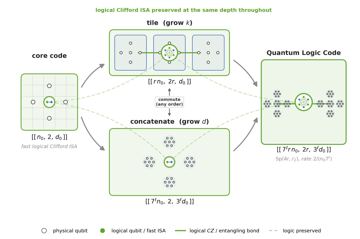
Block codes whose rate k/n is a large fraction of unity and whose logical Cliffords run transversally — depth-one layers of two-local physical gates — instead of d rounds of lattice surgery. Four members define the node. The iceberg code [[k+2,k,2]] detects any single-qubit error (Quantinuum: Self, Benedetti, Amaro; Nature Physics 20, 219, 2024-01-05) D[673]. Two-level concatenation gives [[(k₁+2)(k₂+2), k₁k₂, 4]]; [[80,48,4]] (k₁=6, k₂=8) is the largest cycle executed anywhere D[105]. The tesseract colour code [[16,6,4]] is a doubly-even self-dual 4D CSS code from the [16,5,8] Reed–Muller code (subsystem variant [[16,4,2,4]]), its logical Clifford group depth-one D[674]. Goto's many-hypercube codes concatenate [[4,2,2]] blocks to ~30% rate S[675].
Attributes: no carrier of its own (affinity 0.0), it inherits the platform's; no characteristic time and no entangling determinism here; no readout of its own; mobility by physical transport of the carriers, which supplies the required all-to-all; no control modality, placed nowhere; error structure as the code sees it, depolarising Pauli noise; no manufacturing.
Physics & limits
[[80,48,4]] costs 1.67 physical qubits per logical at distance 4 D[105], the tesseract 2.67 D[674]; a teraquop surface code (sized for 10¹² reliable operations) costs 650 under 0.1% noise S[655], IBM's [[144,12,12]] 24 at distance 12 D[248]. The comparison is not like-for-like, and that is the limitation: distance 4 corrects one error, suppression goes roughly as p², and there is no Λ-style exponential handle. Distance 2 corrects nothing — it detects, and detection means discarding.
Hence acceptance: the [[80,48,4]] cycle accepted 0.62(2) of shots after post-selecting uncorrectable errors D[105], and the 64-logical XY-model simulation accepted 3.2% at algorithmic depth D[97]. Acceptance falls exponentially in circuit volume, so a claim here that omits it is unreadable.
Transversality is not universality (Eastin–Knill): magic states come from outside the block — [[6,2,2]] at 7×10⁻⁵ on ions D[107], 5-to-1 colour-code distillation on atoms D[147]. Transversal CNOT correlates errors across blocks, so decoding must be block-wide; algorithmic fault tolerance is the compensating theory, a constant number of syndrome rounds per logical gate rather than d S[152]. Ion leakage at 1.1×10⁻⁵ per Clifford D[97] and atom loss are not Pauli errors, so loss-aware decoding is a precondition.
Engineering state of the art
Best demonstrated as of 3 Sep 2026: 48 error-corrected logical qubits in one [[80,48,4]] block on a 98-qubit machine, logical gate infidelity (1.0–1.2)×10⁻⁴ against ~8×10⁻⁴ bare physical two-qubit error D[97], [105]. Typical at scale is thinner — that platform's 94 "logical" qubits are distance-2 iceberg, detection only D[105].
Records timeline
| Year | Figure | Who | Tag+key |
|---|---|---|---|
| 2024-01 | Iceberg [[k+2,k,2]]: 8 logical qubits, 256 layers, logical quantum volume 2⁸ | Quantinuum | D[673] |
| 2024-09 | Tesseract [[16,6,4]]: graph states on 12 logical qubits, 5 correction rounds | Microsoft + Quantinuum | D[667] |
| 2025-11 | [[16,6,4]] on 448 atoms: 96 logical qubits active, hundreds of teleportations | Harvard/MIT/QuEra | D[4] |
| 2026-02 | [[80,48,4]]: 48 corrected logical qubits, cycle infidelity ≤4×10⁻⁵, acceptance 0.62(2) | Quantinuum Helios | D[105] |
| 2026-06 | Carbon [[12,2,4]] + tesseract: 11×–800× logical-error improvement | Microsoft + Quantinuum | D[667] |
The dominant budget term is the residual weight-2 error at distance 4 plus the discarded fraction: at 62% acceptance per cycle, a hundred-cycle circuit is out of reach.
Manufacturing, materials & supply chain
No fabrication of its own; the dependency is the connectivity hardware. On ions that is the QCCD trap — Helios runs 1,228 electrodes and at least seven laser wavelengths, and Sol (2027) moves to a Honeywell-fabricated 2D grid trap D[97]R[118]. On atoms it is AOD/SLM tweezer optics and the laser chain D[4]. Single points of failure: ion-trap chip fabrication (Honeywell in-house; IonQ bought SkyWater's foundry, ~$1.8 B, closed 2026-07-31 fact), acousto-optic deflectors, high-power lasers. Export control attaches to the machines, not the mathematics: US EAR quantum-computer controls and EU dual-use equivalents cover traps and lasers; the codes are published and ship as software.
Control, readout & I/O burden
The burden is decoding, not wiring. Syndrome extraction is shallow, but each transversal gate correlates errors across the block, so the decoder handles block-wide syndromes and, on atoms, loss flags, inside the reaction time. Not yet binding: ion cycles run 1–5 ms and atom cycles ~1–4.5 ms D[97]D[4] against decoders at tens of microseconds. Pinnacle instead assumes a 1 µs cycle and 10 µs reaction time S[29] — superconducting or photonic numbers, where real-time correlated decoding becomes the wall. At 10³ physical qubits one [[80,48,4]] block plus routing fits; at 10⁴ the constraint is all-to-all between blocks; at 10⁶ the family does not close without long-range couplers or bounded-degree qLDPC.
Role in the stack
Four architectures: primary on trapped-ion QCCD (Quantinuum) and alkali neutral atoms (Harvard/MIT, QuEra, Pasqal, Infleqtion, Google); alternate on ions in a linear Paul trap with laser gates (AQT, Quantum Art, Innsbruck) and ions with electronic (laser-free, microwave-driven) gates and chip control (IonQ/Oxford Ionics, eleQtron). It requires transport-supplied connectivity — AOD tweezer transport in a zoned architecture, ion shuttling through QCCD junctions and grid traps, or a single chain's motional bus — and provides for correlated, loss-aware decoding. It replaces the surface code at an explicit price: the surface code needs only nearest-neighbour coupling and has a mature ~1% threshold with exponential distance scaling, while this family needs all-to-all and buys width instead of depth, and it conflicts with nearest-neighbour connectivity outright.
Across families: this node explains the largest divergence in the 2026 fault-tolerance table — 48 and 96 logical qubits on ions and atoms against 1–2 on superconducting — a connectivity fact, not a qubit-quality fact. It adds no clock of its own; it sets the QEC cycles per logical layer, ≈1 with transversal gates plus correlated decoding versus ≈d for lattice surgery S[152]. Derived clock (= sum of the syndrome round: gate layers + transport + readout + reset): 9.66 ms on the ion QCCD architecture, transport-set, against the ~55 ms Helios full-width layer, and 1.31 ms on the alkali atom architecture against a measured ~1–4.5 ms round. Empty slots nearby: no high-rate transversal code on a nearest-neighbour platform, no member above distance 4, no magic-state factory inside a high-rate block.
Evidence — how the numbers were measured
Headline numbers come from repeated logical preparation and measurement in both bases, post-selected on detected-but-uncorrectable events. Two cautions: the Helios ≤4×10⁻⁵ cycle figure is a confidence upper bound from zero logical errors in 5,000 shots per basis, not a measured rate D[105]; and no number is interpretable without its acceptance D[105]D[97]. Leakage and loss sit outside the Pauli model — IonQ's break-even, within error bars in one code the paper does not identify (3.95 ± 0.68 s against 3.84 ± 0.48 s physical, while its [[18,4,3]] memory reaches 2.48 ± 0.40 s), needed leakage post-selection D[109]. Nothing here reports Λ-style distance scaling. Replication is good: the tesseract has run on two unrelated platforms D[667]D[4].
Conflicts. The tesseract is [[16,6,4]], not [[16,4,4]] — the Error Correction Zoo entry and the arXiv abstract agree D[674]D[667]. "48 corrected" and "94 detected" on Helios are different codes at different distances, routinely conflated D[105]. Iceberg's sub-100,000-qubit RSA-2048 claim assumes p=10⁻³ with 1 µs cycles S[29], not comparable to Gidney's <1 M S[7].
Not published: Iceberg Quantum's headquarters — trade press gives a Berlin base with a US presence, the founding institution is the University of Sydney, and the company site names no location P[677]C[676]; whether the Oxford Ionics–Iceberg Quantum partnership continues under IonQ — as of 2026-09-30 Iceberg Quantum lists PsiQuantum and Diraq as partners and names neither Oxford Ionics nor IonQ C[676]; the acceptance of the Harvard [[16,6,4]] 96-logical-qubit runs; and a dated patent-family count for this code family. Quantinuum's Q2-2026 claim of "near five-nines logical fidelity with a novel code family" has no public paper as of 2026-09-03. Goto's many-hypercube codes have no hardware demonstration; their 30% rate (64 logical in 216 physical qubits) is simulation only S[675].
Actors & economics
Who.
| Organisation | Role | Country | What exactly they do with this technology | Evidence |
|---|---|---|---|---|
| Quantinuum | developer | US/UK | Introduced the iceberg code; ran [[80,48,4]] on Helios | D[105]D[673] |
| Microsoft Quantum | developer / user | US | Co-authored the tesseract demonstrations on Quantinuum hardware | D[667] |
| Harvard/MIT (Lukin) | research | US | [[16,6,4]] with 96 logical qubits on 448 atoms | D[4] |
| QuEra | developer | US | Commercialises that architecture; Libra 2028 targets >256 logical | Rfact |
| IonQ (incl. Oxford Ionics) | developer | US/UK | Eight codes on 40 ions (nine in the June version), break-even within error bars in one unidentified code ([[18,4,3]] stays below the physical lifetime); Oxford Ionics and Iceberg Quantum partnered on a fault-tolerant architecture with Iceberg's qLDPC codes (2025-07, within QBI Stage A) | D[109]Cfact |
| Iceberg Quantum | supplier (architecture) | AU/DE/US | Only pure-play: licenses high-rate/qLDPC architectures (Pinnacle) | S[29]P[677] |
| DARPA | funder | US | QBI Stage B funds Quantinuum, IonQ, QuEra, Atom Computing | fact |
| IBM | competitor | US | Bivariate bicycle qLDPC is the substitution threat | D[248] |
Money.
- 2025-03-24 · Iceberg Quantum · pre-seed · $2 M · Blackbird lead, LocalGlobe · closed P[678]
- 2025-09-04 · Quantinuum · equity · $600 M at $10 B pre-money · NVentures, Quanta, QED, JPMorgan · closed fact
- 2025-09-17 · IonQ · M&A, Oxford Ionics · $1.075 B · closed fact
- 2025-11-06 · DARPA · QBI Stage B, up to $15 M each, eleven performers · announced fact
- 2026-02-13 · Iceberg Quantum · seed · $6 M · LocalGlobe lead, Blackbird, DCVC · cumulative ~$8 M · closed P[677]
- 2026-06-03 · Quantinuum · IPO · $1.68 B gross, Nasdaq QNT; Q2-2026 revenue $8.0 M · closed fact
- 2026-06-16 · Atom Computing · $100 M Series C + $100 M DoC CHIPS LOI · >$300 M · closed + LOI fact
- 2026-07-31 · IonQ · M&A, SkyWater Technology · ~$1.8 B · closed fact
Market & supply chain. Nobody sells a code. Value accrues to machine vendors that can quote logical-qubit counts (Quantinuum, QuEra, Atom/Microsoft), to one architecture licensor (Iceberg Quantum C[676]), and to the decoder layer (Riverlane, NVIDIA's NVQLink transport fact). Concentration risk is extreme: the experimental record rests on four groups — Quantinuum with Microsoft, Harvard/MIT with QuEra, Infleqtion, Innsbruck — and two hardware families, and one group authored both the code and the machine. Unit economics are the rate — 1.67 physical per logical at d=4 D[105] against 650 for a teraquop surface code S[655]. Goals paid for: G3 primarily, G2 (bare iceberg as a cheap detection layer D[673]), G7 where a machine is sold in logical qubits, G4 only if concatenation beyond d=4 survives leakage.
IP & standards. The iceberg code is published (Nature Physics 2024) D[673] and the tesseract catalogued in the open Error Correction Zoo P[674]; Microsoft and Quantinuum publish jointly rather than cross-licensing visibly D[667]. Pinnacle is a preprint with no disclosed patent position S[29]. No dated patent count exists for this code family — the PatSnap figures cited are device-class Pfact. Tooling is open; no standards body governs code choice.
Roadmaps & track record. Quantinuum (promised 2024-09 · Sol 2027 ~100 logical, Apollo 2029 · Helios on schedule 2025-11, [[80,48,4]] delivered 2026-02) Rfact — credible; code results ran ahead of the hardware. QuEra/Harvard (promised 2024-01 · 100 logical in 2026 · slipped to Libra 2028) Rfact — the 96 logical qubits were physics, not product. IonQ (promised 2025-06 · 25–50 physical per logical by 2030) Rfact — needs high-rate codes; its 2020 roadmap missed 2026 by ~40×. Iceberg Quantum (promised 2026-02 · partners at utility scale in 3–5 years) P[677] — seed-stage, no hardware.
Strategic reading. Winners: all-to-all platforms and anyone selling logical-qubit counts. Losers: 2D-local platforms, which must buy long-range couplers to compete on rate. The substitution threat is near — bounded-degree qLDPC gets most of the rate and real distance scaling without all-to-all D[248]; if IBM's gross-code module works in 2026–27, this family retreats to cheap distance-2/4 detection. Bargaining power sits with hardware vendors; a code-architecture supplier has none unless its IP proves essential.
Outlook & open questions
Confirm within 12–24 months if: a distance-6 or -8 member of the concatenated iceberg family runs with acceptance above 0.5 (Sol, 2027); a high-rate block is sustained over ≥50 QEC cycles without post-selection; or a partner names Pinnacle in a published roadmap by end-2027. Demote if 2027 machines still quote logical counts only at single-digit-percent acceptance at depth, or if IBM's gross-code module matches the rate at distance 12 on degree-≤7 connectivity. Best case by 2029: Apollo- and Libra-class machines run hundreds of logical qubits at constant syndrome rounds per logical gate S[29]S[7]. Worst case: the family stays a detection layer and bounded-degree qLDPC takes the fault-tolerant road.
Open questions: (1) does concatenation to d≥6 keep the rate advantage once leakage and loss are modelled honestly? (2) can a magic-state factory live inside a high-rate block? (3) what is the true acceptance scaling with circuit volume? (4) can block-wide loss-aware decoders keep up at 1 µs cycles? (5) is any nearest-neighbour route cheaper than long-range couplers? Watch Sol's first logical results, Quantinuum's unpublished "near five-nines" code-family claim, IBM Kookaburra, and the first partner adoption of Pinnacle.
References
- [4] D. Bluvstein et al., “A fault-tolerant neutral-atom architecture for universal quantum computation,” Nature, vol. 649, no. 8095, pp. 39–46, Nov. 2025, doi: 10.1038/s41586-025-09848-5. arXiv:2506.20661. D
- [7] C. Gidney, “How to factor 2048 bit RSA integers with less than a million noisy qubits,” arXiv:2505.15917, May 2025. S
- [29] P. Webster et al., “The Pinnacle Architecture: Reducing the cost of breaking RSA-2048 to 100 000 physical qubits using quantum LDPC codes,” arXiv:2602.11457, Feb. 2026. S
- [97] A. Ransford et al., “A 98-qubit trapped-ion quantum computer with all-to-all connectivity,” Nature, vol. 655, no. 8121, pp. 81–86, Jun. 2026, doi: 10.1038/s41586-026-10676-4. arXiv:2511.05465. D
- [105] S. Dasu et al., “Computing with many encoded logical qubits beyond break-even,” arXiv:2602.22211, Feb. 2026. D
- [107] S. Dasu et al., “Breaking even with magic: demonstration of a high-fidelity logical non-Clifford gate,” arXiv:2506.14688, Jun. 2025. D
- [109] E. Tham et al., “Breakeven demonstration of quantum low-density parity-check codes,” arXiv:2606.06455, Jun. 2026. D
- [118] Quantinuum, “Quantinuum Unveils Accelerated Roadmap to Achieve Universal, Fully Fault-Tolerant Quantum Computing by 2030,” Sep. 10, 2024. [Online]. Available: https://www.quantinuum.com/
press-releases/ Rquantinuum-unveils-accelerated-roadmap-to-achieve-universal-fault-tolerant-quantum-computing-by-2030 - [147] P. S. Rodriguez et al., “Experimental demonstration of logical magic state distillation,” Nature, vol. 645, no. 8081, pp. 620–625, Jul. 2025, doi: 10.1038/s41586-025-09367-3. D
- [152] H. Zhou et al., “Low-Overhead Transversal Fault Tolerance for Universal Quantum Computation,” Nature, vol. 646, no. 8084, pp. 303–308, 2025, doi: 10.1038/s41586-025-09543-5. arXiv:2406.17653. S
- [248] S. Bravyi et al., “High-threshold and low-overhead fault-tolerant quantum memory,” Nature, vol. 627, no. 8005, pp. 778–782, Mar. 2024, doi: 10.1038/s41586-024-07107-7. arXiv:2308.07915. D
- [655] C. Gidney and C. Jones, “New circuits and an open source decoder for the color code,” arXiv:2312.08813, Dec. 2023. S
- [667] A. Paetznick et al., “Improved quantum processor logical error rates via correction and detection,” Nature, vol. 654, no. 8118, pp. 349–355, Jun. 2026, doi: 10.1038/s41586-026-10628-y. D
- [673] C. N. Self, M. Benedetti, and D. Amaro, “Protecting expressive circuits with a quantum error detection code,” Nat. Phys., vol. 20, no. 2, pp. 219–224, Jan. 2024, doi: 10.1038/s41567-023-02282-2. arXiv:2211.06703. D
- [674] Error Correction Zoo, “[[16,6,4]] Tesseract color code,” Jun. 8, 2026. [Online]. Available: https://errorcorrectionzoo.org/
c/ Dstab_16_6_4 - [675] H. Goto, “High-performance fault-tolerant quantum computing with many-hypercube codes,” Sci. Adv., vol. 10, no. 36, Art. no. eadp6388, Sep. 2024, doi: 10.1126/sciadv.adp6388. arXiv:2403.16054. S
- [676] Iceberg Quantum, “Iceberg Quantum — Home.” [Online]. Available: https://www.iceberg-quantum.com/ C
- [677] M. Swayne, “Trifecta: Iceberg Quantum Unveils Pinnacle Architecture, Claims Sub-100,000 Qubits Could Break RSA-2048 And Raises $6 Million Seed Round,” The Quantum Insider, Feb. 13, 2026. [Online]. Available: https://thequantuminsider.com/
2026/ P02/ 13/ trifecta-iceberg-quantum-unveils-pinnacle-architecture-claims-sub-100000-qubits-could-break-rsa-2048-and-raises-6-million-seed-round/ - [678] Iceberg Quantum, “Iceberg Quantum Launches with $2M and PsiQuantum Partnership,” HPCwire, Mar. 24, 2025. [Online]. Available: https://www.hpcwire.com/
off-the-wire/ Piceberg-quantum-launches-with-2m-and-psiquantum-partnership/