Correlated / loss-aware decoding (transversal, atom loss) dec_corr
Decoders that consume atom-loss heralds as located erasures and decode across transversal gate layers instead of round-by-round.
Correlated / loss-aware decoding (transversal, atom loss)
Decodes across transversal gates and uses loss flags; 1.73× QEC gain on 448-atom processor.
Brief →Key references
Design space — attributes
- (a) carrier affinity
- natural
- (b) time · entangling
- —
- (c) readout
- —
- (d) mobility
- —
- (e) control
- —
- (f) error structure
- loss (erasure), erasure-convertible
- (g) manufacturing
- —
Evaluation space — dated attributes
Standard records
Actors & goals — annotations
Edges
Used by 6 machines (6 primary · 0 alternate)
- neutral atoms 6
- Magne Atom Computing + Microsoft, for QuNorth press press ▨ 🔎
- Phoenix (Gen-1) and Gen-2 Atom Computing press press ▤ SM §SIV (loss-aware decoding) ✅
- 448-atom fault-tolerant processor Harvard / MIT / QuEra paper press ▣ Fig. 2 (logical error per round: MLE with/without loss information) ✅
- metastable Yb-171 erasure array Princeton (Thompson group) paper paper paper ▣ Fig. 3e (unconditional decoding with erasure information) ✅
- Gemini-class QuEra paper product page ▣ Fig. 3b (MLE vs MLD); Extended Data Fig. 4; Methods: Decoding and post-selection ✅
- Libra QuEra press ▨ 🔎
Pictures
Every picture carries the story of what it shows and its credit line.
Correlated / loss-aware decoding (transversal, atom loss)
Decoders that consume atom-loss heralds as located erasures and decode across transversal gate layers instead of round-by-round.
Verdict. Real on one dataset (1.73(13)× over a loss-blind decoder, 448 atoms, four rounds); unproven under reloading, at depth, or in a second lab.
Λ = error-suppression factor per code-distance step; QBI = DARPA Quantum Benchmarking Initiative (Stage A concept → B R&D plan → C government V&V); G1–G7 = the report's goal classes (see Actors & economics).
Identity & lineage
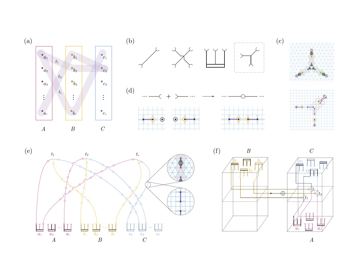
Not hardware, a decoding discipline. Loss-aware decoding consumes the herald: a missing atom is an erasure at a known site, so stabilisers touching the vacancy multiply into higher-weight supercheck operators that still commute with the surviving code [4]. Correlated decoding solves the joint syndrome history across transversal (block-to-block) layers rather than block-by-block; Cain et al. (Harvard, 2024-03-05) showed the rounds between Clifford gates drop O(d)→O(1) [738], generalised as algorithmic fault tolerance (Nature 2025) [152].
f = loss + erasure; a/c/d/e/g = none — classical compute, no fab or placement [graph].
Physics & limits
The herald is the asset: >80% of Rydberg-array leakage is atom loss, and imaging finds it [4]. A located erasure costs the decoder only the Pauli frame, not the position — why erasure conversion lifts circuit-level thresholds 3–4× at fixed gate physics [8]. The price is distance: each supercheck is a product of two stabilisers, so every vacancy locally thins the code. Correlated decoding pays differently: transversal CNOTs propagate errors between blocks, so the graph grows with circuit depth, not d. Nothing moves the floor — the unheralded residual is untouched, m_F leakage 0.008(1)% per atom per gate against atom loss 0.087(5)% fact.
Engineering state of the art
table
| Date | Figure | Who | Tag+key |
|---|---|---|---|
| 2025-11-10 | 1.73(13)× gain from loss flags + ML over conventional decoding, same 448-atom data | Harvard/MIT/QuEra | D[4]fact |
| 2026-03 | Correlated-loss decoder: 4% threshold vs 3.2% assuming independent loss; 144 µs/round; simulation | QPerfect | S[739]fact |
| 2026-06-12 | [[4,2,2]] ¹⁷¹Yb: unconditional decay 1.9(4)× slower with erasure information (3.6(1)× is the post-selected hold) | Princeton | D[142]fact |
Same circuit: 2.14(13)×, d=3→5, four rounds. Dominant term: atom loss, not Pauli error.
Not published: the closing date and price of BTQ's full acquisition of QPerfect, whose option was exercised between 2025-04 and 2026-07, and a dated patent family for loss-aware or correlated decoding.
Manufacturing, materials & supply chain
No fab: classical compute already bought for matching. Latency sets scope: 144 µs/round fits a 1–4.5 ms atom cycle with 7–30× margin [739] but is ~130× over a 1.1 µs superconducting cycle — why this stays atom-specific. Loss-flag bandwidth is one bit per site per round, so the wall at 10³–10⁴ atoms is the ~0.5–1 ms imaging and a decode window scaling with logical depth, not the link. Inherited single points of failure: Hamamatsu qCMOS imaging fact and two AOD vendors fact.
Role in the stack
The primary decoder on both Rydberg tweezer arrays, alkali (Rb/Cs) and alkaline-earth(-like) (Yb/Sr). Requires high-rate concatenated codes with transversal gates; provides the decoding half of algorithmic fault tolerance, whose constant-round claim is otherwise unbacked on hardware. Derived clock = sum of the syndrome round (gates 1 µs, transport 800 µs, 1Q 10 µs, readout 501 µs) ≈ 1.3 ms, ~0.76 kHz; the decoder must return inside it, not set it. Verification: 1.73× is a decoder-vs-decoder ratio on one lab's data, unreplicated; 4% is simulation [739]. Four rounds test neither drift nor reloading; Atom Computing's toric code is the control, suppression vanishing with reloading (0.63% vs 0.64% per cycle) [148]. Princeton's 1.9(4)×/3.6(1)× discrepancy is resolved: one paper, two quantities fact.
Actors & economics
Who.
| Organisation | Role | Country | What exactly | Evidence |
|---|---|---|---|---|
| Harvard/MIT | research | US | Correlated decoding, superchecks, 1.73(13)× | D[4], [738] |
| QuEra | developer | US | Co-author; Libra 2028 assumes it | D[4]C[153] |
| QPerfect (BTQ) | supplier | FR | Correlated-loss decoder; aQCess twin | S[739]C[740] |
| Atom Computing | user | US | Erasure-native Yb; reloading counter-example | D[148]C[154] |
Money.
2025-04-09 · BTQ Technologies · €2 M into QPerfect at €10 M pre-money (16.67%) · term sheet P[741]
2026-07-22 · QPerfect · aQCess twin, Equipex+ ANR-21-ESRE-0032 · announced C[740]
2026-06-16 · Atom Computing · $100 M Series C (Third Point) + $100 M CHIPS LOI · closed + LOI C[154]fact
2025-11-06 · DARPA QBI Stage B · Atom Computing, QuEra among eleven · ≤$15 M each fact
Market & supply chain. No component market: GPU/FPGA cycles already bought for matching; concentration risk sits upstream, in imaging and AODs. Pays G3/G4 only.
IP & standards. No dated patent family names loss-aware or correlated decoding as of 4 Sep 2026; methods open, code academic.
Roadmaps & track record. O(d)→O(1) rounds (2024-03): in Nature 2025, shown only in a four-round circuit. QuEra 100 logical (2024-01, for 2026): now Libra 2028 fact. Physics on time, products late.
Strategic reading. If it holds, atoms turn their worst liability into a cheap accounted channel and transversal architectures beat lattice surgery on spacetime cost: QuEra, Atom Computing, Pasqal and Infleqtion gain, superconducting vendors lose decoder latency as a differentiator. Substitution threat: a Rydberg CZ past 99.95% shrinks the loss term. Non-rival: no supplier can rent it.
Outlook & open questions
Confirm if the QPerfect decoder runs on real syndromes or a second vendor publishes its own loss-aware gain; demote if the gain dies under reloading or past four rounds. Best case 2029: default across neutral-atom FT stacks; worst case, one group's architecture, never past 10³ atoms. Open: does 1.73× hold at 10⁴ atoms, at depths where the correlated graph outgrows memory, and on ions [667]?
References
- [4] D. Bluvstein et al., “A fault-tolerant neutral-atom architecture for universal quantum computation,” Nature, vol. 649, no. 8095, pp. 39–46, Nov. 2025, doi: 10.1038/s41586-025-09848-5. arXiv:2506.20661. D
- [8] Y. Wu, S. Kolkowitz, S. Puri, and J. D. Thompson, “Erasure conversion for fault-tolerant quantum computing in alkaline earth Rydberg atom arrays,” Nat. Commun., vol. 13, Art. no. 4657, 2022, doi: 10.1038/s41467-022-32094-6. arXiv:2201.03540. S
- [142] B. Zhang et al., “Logical qubits with erasure conversion using metastable neutral atoms,” Nat. Phys., vol. 22, no. 6, pp. 910–916, Jun. 2026, doi: 10.1038/s41567-026-03309-0. arXiv:2506.13724. D
- [148] Atom Computing and Collaborators, “Quantum error correction with the toric code,” arXiv:2606.04079, Jun. 2026. D
- [152] H. Zhou et al., “Low-Overhead Transversal Fault Tolerance for Universal Quantum Computation,” Nature, vol. 646, no. 8084, pp. 303–308, 2025, doi: 10.1038/s41586-025-09543-5. arXiv:2406.17653. S
- [153] QuEra Computing, “QuEra Expands $230 Million Financing Round Advancing Quantum-Accelerated Supercomputing,” Sep. 9, 2025. [Online]. Available: https://www.quera.com/
press-releases/ Cquera-expands-230-million-financing-round-advancing-quantum-accelerated-supercomputing - [154] Atom Computing, “Atom Computing Raises More Than $300 Million to Accelerate Deployment of Fault-Tolerant, Neutral-Atom Quantum Computers,” PR Newswire, Jun. 16, 2026. [Online]. Available: https://www.prnewswire.com/
news-releases/ Catom-computing-raises-more-than-300-million-to-accelerate-deployment-of-fault-tolerant-neutral-atom-quantum-computers-302800832.html - [667] A. Paetznick et al., “Improved quantum processor logical error rates via correction and detection,” Nature, vol. 654, no. 8118, pp. 349–355, Jun. 2026, doi: 10.1038/s41586-026-10628-y. D
- [738] M. Cain et al., “Correlated decoding of logical algorithms with transversal gates,” arXiv:2403.03272, Mar. 2024. D
- [739] H. Perrin, G. Roger, and G. Pupillo, “Correlated Atom Loss as a Resource for Quantum Error Correction,” arXiv:2603.24237, Mar. 2026. S
- [740] BTQ Technologies, “BTQ Technologies' QPerfect Subsidiary and the University of Strasbourg Partner to Support France's First Public Neutral-Atom Quantum Computing Platform,” PR Newswire, Jul. 22, 2026. [Online]. Available: https://www.prnewswire.com/
news-releases/ Cbtq-technologies-qperfect-subsidiary-and-the-university-of-strasbourg-partner-to-support-frances-first-public-neutral-atom-quantum-computing-platform-302831874.html - [741] C. Choucair, “BTQ Technologies to Invest Over $2 Million in QPerfect to Advance Neutral Atom Quantum Computing,” The Quantum Insider, Apr. 9, 2025. [Online]. Available: https://thequantuminsider.com/
2025/ P04/ 09/ btq-technologies-to-invest-over-2-million-in-qperfect-to-advance-neutral-atom-quantum-computing/
G Bluvstein et al. (Harvard/MIT/QuEra), Nature 649, 39 (online 2025-11-10; arXiv:2506.20661, 2025-06-25): surface code on up to 448 atoms, 2.14(13)× below threshold in a four-round c… · 2025-11-10 · https://www.nature.com/articles/s41586-025-09848-5
G Evered, Xu, Li, Geim, Bonilla Ataides, Kalinowski, Bluvstein, Maskara, Kokail, Greiner, Vuletic, Lukin (Harvard/MIT), "High-fidelity entangling gates and nonlocal circuits with neu… · 2026-04-28 · https://arxiv.org/abs/2604.25987
G Perrin, Roger, Pupillo (Univ. Strasbourg/CNRS, QPERFECT SAS), "Correlated Atom Loss as a Resource for Quantum Error Correction", arXiv:2603.24237 (2026-03): fast correlated-loss de… · 2026-03 · https://arxiv.org/html/2603.24237
G CONFLICT RESOLVED: the 1.9(4)x and 3.6x figures both appear in arXiv:2506.13724v2 (Princeton [[4,2,2]] metastable 171-Yb) and describe different quantities — the logical decay rate… · 2026-09-04 · https://arxiv.org/html/2506.13724v2
G Hamamatsu Photonics ORCA-Quest qCMOS is the named single-photon-sensitivity camera in the Harvard/QuEra 448-atom fluorescence-imaging line and in MIT, NIST/UMD and Osaka neutral-at… · 2026-09 · https://www.hamamatsu.com/us/en/news/events/2026/APS-DAMOP-2026.html
G Only two acousto-optic deflector suppliers are named across the sourced neutral-atom literature: AA Opto-Electronic (France; DTSX-400 crossed AODs in the Harvard 448-atom system, a… · 2026-09-04 · https://gandh.com/news-and-resources/g-and-h-acousto-optic-deflectors-in-nature-papers
G QuEra: Libra fault-tolerant system 2028 (>256 logical, 10⁻⁶, on Braket) and gigaquop system 2028–29 — its Jan-2024 roadmap had promised 100 logical qubits in 2026 · 2026-06-15 · https://www.quera.com/press-releases/quera-announces-2028-fault-tolerant-quantum-computer-and-expanded-multi-year-strategic-collaboration-with-aws
G Atom Computing: $100 M Series C (Third Point) plus $100 M DoC CHIPS LOI, total > $300 M, 2026-06-16 · 2026-06-16 · https://www.prnewswire.com/news-releases/atom-computing-raises-more-than-300-million-to-accelerate-deployment-of-fault-tolerant-neutral-atom-quantum-computers-302800832.html
G DARPA QBI Stage B (announced 2025-11-06, ~12 months, up to $15 M each): Atom Computing, Diraq, IBM, IonQ, Nord Quantique, Photonic Inc., Quantinuum, Quantum Motion, QuEra, Silicon… · 2025-11-06 · https://www.darpa.mil/research/programs/quantum-benchmarking-initiative/stage-b-selection