FPGA real-time decoders (LCD, Deltaflow) dec_fpga
Room-temperature FPGAs running clustering or matching decoders fast enough to clear surface-code syndromes inside the QEC cycle, ahead of GPU and cryogenic alternatives.
FPGA real-time decoders (LCD, Deltaflow)
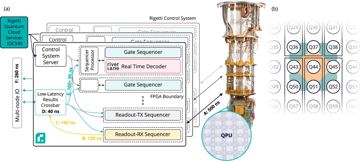
Local-clustering < 1 µs/round to d=17; Riverlane + Rigetti real-time loop 9.6 µs (6.5 µs decode + 3.1 µs communication, 2×2 stability patch, arXiv:2410.05202) vs Google 63 µs.
Brief →Key references
Design space — attributes
- (a) carrier affinity
- intermediate / carrier-agnostic
- (b) time · entangling
- —
- (c) readout
- —
- (d) mobility
- —
- (e) control
- —
- (f) error structure
- stochastic Pauli
- (g) manufacturing
- —
Evaluation space — dated attributes
Standard records
Actors & goals — annotations
Edges
Used by 1 machine (1 primary · 0 alternate)
- superconducting circuits 1
- Rigetti Ankaa-2 Rigetti Computing paper paper ▣ Fig. 3c–d (FPGA decode time at 156.25 MHz); Fig. 4 (response time); Methods: FPGA decoder integration ✅
Pictures
Every picture carries the story of what it shows and its credit line.
FPGA real-time decoders (LCD, Deltaflow)
Room-temperature FPGAs running clustering or matching decoders fast enough to clear surface-code syndromes inside the QEC cycle, ahead of GPU and cryogenic alternatives.
Verdict. Throughput under 1 µs per round is published to d=17, but live surface-code decoding is documented only to d=5 and closed-loop correction to d=3; the accuracy gap to neural decoders is real.
Λ = error-suppression factor per code-distance step; QBI = DARPA Quantum Benchmarking Initiative (Stage A concept → B R&D plan → C government V&V); G1–G7 = the report's goal classes (see Actors & economics).
Identity & lineage
Classical hardware consuming syndrome bits and emitting corrections inside the code cycle. The lineage is the backlog argument: if mean decode time exceeds cycle time, undecoded rounds accumulate without bound and the classical hardware sets the logical error rate. FPGAs won for deterministic latency, not speed.
Attributes: a compute module, not a carrier (affinity 0.5); no time, readout, mobility, control or fabrication of its own.
Error structure it consumes: Pauli syndromes from the rotated surface code.
Physics & limits
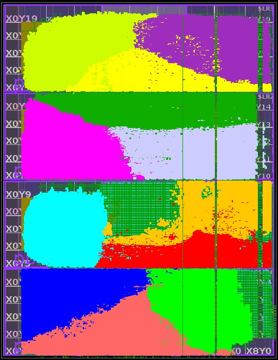
Throughput must clear one round per cycle — 1.1 µs on Willow-class hardware D[1] — which Riverlane's clustering decoder meets to d=17 D[238]. Reaction latency gates every non-Clifford gate and only a closed loop measures it: Shenzhen's closed one in 550 ns at d=3, inside a 1.25 µs cycle D[729]. Accuracy pays for latency: LCD thresholds at 0.55% against 0.7% for software MWPM D[238], and on identical Willow syndromes matching gave Λ = 2.04 where a neural decoder gave 2.14 D[1]. Area is the other wall: LCD at d=17 takes ~6% of a Xilinx VU19P's logic LUTs (lookup tables) per logical qubit D[238] — ~16 such logical qubits per top-end part.
Engineering state of the art
table
IBM's Relay-BP for the gross code reports a 24 ns iteration and under 1 µs per cycle below p = 3×10⁻³, from simulated syndromes S[48].
IBM's Relay-BP FPGA figures come from simulated syndromes, and the abstract's 24 ns / <1 µs conflicts with the 480 ns per 12-cycle window reported elsewhere fact. Riverlane's Series C is $75 M in its 2024 release and $85 M in its 2026 roadmap. The IBM–AMD FPGA decoder collaboration is reported only by trade press; its terms are not published.
Manufacturing, materials & supply chain
No fab: a commercial FPGA card in the room-temperature rack. Every published real-time decoder runs on AMD/Xilinx silicon (VU19P for LCD D[238], VMK180 for Micro Blossom D[727]); the only merchant alternative changed hands when Intel's sale of 51% of Altera to Silver Lake at an $8.75 B valuation, announced in April 2025, closed on 2025-09-15 G[735] — a duopoly with one side under private equity. High-end FPGAs sit inside US export-control scope. The I/O burden is the syndrome pipe: trivial at 10³ qubits, but at 10⁴–10⁶ the rate forces predecoding at 4 K or many parallel cards.
Role in the stack
An alternate decoder on the transmon lattice with tunable couplers. Requires the rotated surface code and provides the correction stream fault tolerance needs; it replaces GPU decoding, whose tail latency is non-deterministic — 3.84 µs mean, 3.96 µs max just to cross NVQLink C[324]. Its contribution to the derived clock is a floor, not a term: it must stay under the 1.1 µs cycle, and does. Verification: these are decoder-in-isolation figures on replayed or simulated syndromes; only two loops are live — the d=3 one and the in-loop clustering decoder on Rigetti Ankaa-2, the register's one carrier; Micro Blossom's quoted 367 ns is a repository figure in no paper, the published number being 0.8 µs D[727].
Actors & economics
Who.
| Organisation | Role | Country | What exactly they do | Evidence |
|---|---|---|---|---|
| Riverlane | supplier | UK | LCD and Deltaflow, the only merchant QEC stack | D[238] |
| AMD | supplier | US | The FPGA silicon under every published decoder | D[238] |
| user | US | 63 µs baseline at d=5 D[1], then neural decoding at d=7 | D[2] | |
| IQA Shenzhen | research | CN | First closed-loop neural FPGA decode on a live processor | D[729] |
Money.
2024-08-06 · Riverlane · Series C · $75 M · Planet First Partners lead · closed C[661]fact
2025-09-15 · Intel/Altera · divestment of 51% · $8.75 B enterprise valuation · Silver Lake · closed (announced 2025-04-14) G[735]fact
Market & supply chain. One merchant decoder vendor, one dominant FPGA vendor, NVIDIA pushing NVQLink as the alternative — open endpoint, single-sourced accelerator C[324]. Riverlane's stack ships integrated with Qblox control hardware C[659]. It pays into G3 and G4 only.
IP & standards. Riverlane GB 2641501 A "Quantum decoder" (published 2025-12-10) claims grouped processing elements running clustering on the decoding hypergraph — the LCD architecture itself G[662]. No decoder standard exists.
Roadmaps & track record. Riverlane (2026-03-12 · megaquop before 2030, teraquop from 2033 · LCD published on time C[658]). IBM (2025-10 · FPGA gross-code decoding · still simulation as of 2026-09-04 S[48]).
Strategic reading. Whoever owns the decoder sits between every superconducting QPU and fault tolerance — but the layer is thin enough that QPU vendors build it in-house, as IBM and Google did. AMD wins either way; the threat is NVQLink commoditising the interface.
Outlook & open questions
Confirm by end-2027: an FPGA decoder closing the loop on live syndromes at d ≥ 7 — no live d=7 decode by any decoder is documented, Google's neural d=7 result D[2] included — or Relay-BP on real gross-code hardware; demote if neither happens. Best case 2029: a portable interface with second-source silicon; worst case, per-vendor decoders nobody can compare. Does reaction latency or throughput bind first at d=17? Do decoder vendors survive QPU vendors building in-house? Does export control reach FPGAs?
References
- [1] Google Quantum AI and Collaborators, “Quantum error correction below the surface code threshold,” Nature, vol. 638, no. 8052, pp. 920–926, Dec. 2024, doi: 10.1038/s41586-024-08449-y. D
- [2] V. Sivak et al., “Reinforcement learning control of quantum error correction,” Nature, vol. 655, no. 8124, pp. 879–884, Jul. 2026, doi: 10.1038/s41586-026-10759-2. D
- [48] T. Maurer et al., “Real-time decoding of the gross code memory with FPGAs,” arXiv:2510.21600, Oct. 2025. S
- [238] A. B. Ziad et al., “Local clustering decoder as a fast and adaptive hardware decoder for the surface code,” Nat. Commun., vol. 16, no. 1, Art. no. 11048, Dec. 2025, doi: 10.1038/s41467-025-66773-x. D
- [324] S. Caldwell et al., “NVIDIA NVQLink Architecture Integrates Accelerated Computing with Quantum Processors,” NVIDIA Technical Blog, Nov. 17, 2025. [Online]. Available: https://developer.nvidia.com/
blog/ Cnvidia-nvqlink-architecture-integrates-accelerated-computing-with-quantum-processors/ - [658] Riverlane, “Riverlane publishes QEC Technology Roadmap that can accelerate quantum computing's path to utility scale by 3–5 years,” Mar. 12, 2026. [Online]. Available: https://www.riverlane.com/
press-release/ Criverlane-publishes-qec-technology-roadmap - [659] Qblox; Riverlane, “Qblox and Riverlane Demonstrate Integration Enabling Real-Time Quantum Error Correction,” PR Newswire, Mar. 17, 2026. [Online]. Available: https://www.prnewswire.com/
news-releases/ Cqblox-and-riverlane-demonstrate-integration-enabling-real-time-quantum-error-correction-302716254.html - [661] Riverlane, “Riverlane raises $75 million to meet surging global demand for quantum error correction technology,” Aug. 6, 2024. [Online]. Available: https://www.riverlane.com/
press-release/ Criverlane-raises-75-million-to-meet-surging-global-demand-for-quantum-error-correction-technology - [662] A. B. Ziad, A. Zalawadiya, B. Barber, and L. Skoric, “Quantum decoder,” Google Patents, Dec. 10, 2025. [Online]. Available: https://patents.google.com/
patent/ GGB2641501A/ en - [727] Y. Wu, N. Liyanage, and L. Zhong, “Micro Blossom: Accelerated Minimum-Weight Perfect Matching Decoding for Quantum Error Correction,” Proc. 30th ACM Int. Conf. Architectural Support for Programming Languages and Operating Systems (ASPLOS '25), vol. 2, Mar. 2025, doi: 10.1145/3676641.3716005. arXiv:2502.14787. Also https://github.com/
yuewuo/ . Dmicro-blossom - [729] X. Yang et al., “Real-time Surface-Code Error Correction Using an FPGA-based Neural-Network Decoder,” arXiv:2605.04892, May 2026. Also https://arxiv.org/
html/ . D2605.04892 - [735] Altera, “Altera Closes Silver Lake Investment to Become World's Largest Pure-play FPGA Solutions Provider,” Sep. 15, 2025. [Online]. Available: https://www.altera.com/
newsroom/ Gnews/ press-release/ altera-silver-lake