In-loop RL calibration / control steering dec_rl
Detection events from the running code double as the reward signal for a reinforcement-learning agent that retunes control parameters during QEC, replacing scheduled recalibration.
In-loop RL calibration / control steering
Reinforcement learning tunes > 1,000 control parameters during QEC: ~20% extra suppression, 3.5× drift robustness.
Brief →Key references
Design space — attributes
- (a) carrier affinity
- fabricated
- (b) time · entangling
- —
- (c) readout
- —
- (d) mobility
- —
- (e) control
- —
- (f) error structure
- coherent / calibration
- (g) manufacturing
- —
Evaluation space — dated attributes
Standard records
Actors & goals — annotations
Edges
Used by 1 machine (0 primary · 1 alternate)
- superconducting circuits 1
- Willow Google Quantum AI paper paper product page ▤ ✅ (alternate)
Pictures
Every picture carries the story of what it shows and its credit line.
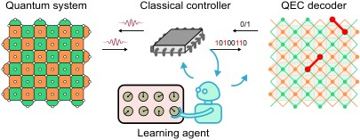
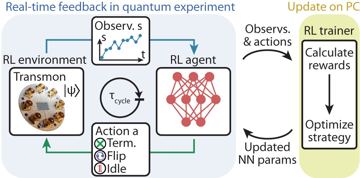
In-loop RL calibration / control steering
Detection events from the running code double as the reward signal for a reinforcement-learning agent that retunes control parameters during QEC, replacing scheduled recalibration.
Verdict. One team, one chip, one paper; it improves the point error at fixed distance and is not shown to change Λ, which is what the 10⁻⁶ milestone actually needs.
Λ = error-suppression factor per code-distance step; QBI = DARPA Quantum Benchmarking Initiative (Stage A concept → B R&D plan → C government V&V); G1–G7 = the report's goal classes (see Actors & economics).
Identity & lineage
RL as a control optimiser on superconducting qubits is not new: the widely quoted 99.92% CZ record between two fluxonium qubits coupled through a transmon is an RL-optimised mean of 99.922(9)% from 2023 fact, but offline and per-gate. Sivak, Morvan, Broughton, Cortiñas et al. (Google, arXiv 2025-11-11; Nature 655, 2026-07-08) changed the loop: detection events serve as both syndromes and learning signal, so calibration runs concurrently with computation [2].
a = 1.0, a fully engineered classical-control layer, f = coherent — it chases systematic drift (TLS, flux, temperature), not stochastic Pauli error [graph].
Physics & limits
No new physical floor: this tracks an existing floor without the dead time between calibrations. The load-bearing claim is architectural — optimisation speed independent of system size D[2], the only route past a per-parameter sweep that dies above ~10³ knobs. The limits follow from what the agent sees and what it turns: an averaged rate of detection events, and single-qubit and CZ gate parameters only D[2]. Willow's roughly hourly correlated bursts do produce detection events, but they decay within ~400 µs D[1], far faster than the agent can respond, and the paper leaves such fast correlated drift to hardware mitigation D[2]. Leakage out of the computational space, which Willow clears with a dedicated removal step after every round D[1], is not treated in the paper, and readout, at ~10⁻², is not among the tuned parameters. It does not change the exponent: no Λ is reported for the record d=7 run, so what moved is the point error at fixed distance, not the slope that decides whether d≈25 reaches 10⁻⁶.
The premise of in-loop recalibration is contested by a 2026 measurement: long-lived two-level systems (TLS) on a transmon give the environment 20 µs to 1 ms of memory — hundreds of ~1 µs error-correction cycles — so errors become history- and protocol-dependent, which the authors contrast with the Markovian (memoryless) assumption behind continuous calibration P[890].
Engineering state of the art
table
| Date | Figure | Who | Tag+key |
|---|---|---|---|
| 2026-07-08 | d=7 surface code decoded with AlphaQubit 2 (no live decode stated): 7.72(9)×10⁻⁴ per cycle; no Λ reported | Google Quantum AI | D[2]fact |
| 2026-07-08 | d=5 colour code, Tesseract decoder: 8.19(14)×10⁻³ per cycle; 3.5× stability against injected drift | Google Quantum AI | D[2] |
| 2024-12-09 | Λ = 2.14(2) with the neural decoder vs 2.04(2) with ensembled matching on identical Willow syndromes | Google Quantum AI | D[1]fact |
AlphaQubit 2's own real-time benchmarks (arXiv:2512.07737) ran on recorded data, and the reinforcement-learning paper does not state that its d=7 decode ran live.
Manufacturing, materials & supply chain
No dedicated silicon and, unlike matching or clustering decoders, no FPGA resource claim to audit fact. The cost is control-plane traffic — detection events out, parameter updates in, over the decoder's own link; NVQLink's 3.84 µs mean, 3.96 µs maximum round trip is the vendor-neutral version of it Cfact. Updates run on a slow timescale outside the 1.1 µs cycle, which is why it coexists with Willow where heavier in-loop computation would not. Supply is GPU/TPU capacity plus the control stack; no specific export rule.
Role in the stack
Requires no decoder inside its control loop — the reward is the detection-event rate; its decoder steering reweights a matching graph from logical-error estimates, not in real time, and the record d=7 run was decoded separately with the neural decoder AlphaQubit 2, published on its own only as a December 2025 preprint whose real-time speed was benchmarked on recorded or simulated data D[2]fact. Superconducting transmons only; derived round unchanged at 0.65 µs against the measured 1.1 µs QEC cycle, ~0.91 MHz. Verification: no Λ for the record run, no second-platform replication, and the only live closed-loop neural decoding anywhere is a d=3 demonstration with a 550 ns loop D[729]. No value conflict: the 20% and >1,000 parameters in trade press P[742] are the paper's own — about 20% further logical-error suppression after conventional calibration, over a thousand steered parameters — beside its 3.5× stability gain against injected drift D[2].
Actors & economics
Who.
| Organisation | Role | Country | What exactly | Evidence |
|---|---|---|---|---|
| Google Quantum AI | developer | US | RL control, AlphaQubit 2, Willow | D[2] |
| Google DeepMind | developer | UK | Neural decoders, AlphaQubit line | D[657] |
| Q-CTRL | supplier | AU | Boulder Opal calibration software | C[743] |
| IQA Shenzhen | research | CN | Only live closed-loop neural decoding | D[729] |
Money.
2024-10-08 · Q-CTRL · Series B expanded · USD $113 M (AUD $166 M) · GP Bullhound lead · closed C[743]
2025-10-03 · Google Quantum AI · absorbed Atlantic Quantum, cold-stage control · undisclosed Pfact
2025-11-06 · DARPA QBI Stage B · IBM the only transmon vendor, Google absent · ≤$15 M each fact
Market & supply chain. No component market; the priced substitute is calibration software plus GPU/TPU cycles, sold only by Q-CTRL, on Diraq, Oxford Quantum Circuits and Rigetti C[743]. Pays G3/G4.
IP & standards. No dated patent family for RL-steered QEC calibration as of 4 Sep 2026; Google publishes the method and withholds the decoder — that is the moat.
Roadmaps & track record. Google's next milestone, a long-lived logical qubit at 10⁻⁶ (no date): 7.72×10⁻⁴ at d=7 is three orders short, needing d≈25 at Λ≈2 D[1]; Google is absent from QBI Stage B G. Q-CTRL shipped Boulder Opal on three platforms by 2024-10 — delivered, at nothing like Google's scale.
Strategic reading. Software margin on hardware someone else owns. If it diffuses, control vendors and Q-CTRL capture it and calibration headcount falls; if AlphaQubit 2 stays in-house, Google's advantage is the decoder, not the RL. Substitution threat: hardware that drifts less — fluxonium, cold-stage SFQ control — shrinks the problem.
Outlook & open questions
Confirm if RL-in-loop calibration appears on a second platform, or a Λ is published for an RL-steered run; demote if it stays Willow-only. Best case 2029: standard across superconducting FT stacks, sold by control vendors. Worst case: one unreplicated chip. Open: does size-independent optimisation survive outside simulation, and can the loop be made decoder-agnostic?
References
- [1] Google Quantum AI and Collaborators, “Quantum error correction below the surface code threshold,” Nature, vol. 638, no. 8052, pp. 920–926, Dec. 2024, doi: 10.1038/s41586-024-08449-y. D
- [2] V. Sivak et al., “Reinforcement learning control of quantum error correction,” Nature, vol. 655, no. 8124, pp. 879–884, Jul. 2026, doi: 10.1038/s41586-026-10759-2. D
- [657] J. Bausch et al., “Learning high-accuracy error decoding for quantum processors,” Nature, vol. 635, no. 8040, pp. 834–840, Nov. 2024, doi: 10.1038/s41586-024-08148-8. D
- [729] X. Yang et al., “Real-time Surface-Code Error Correction Using an FPGA-based Neural-Network Decoder,” arXiv:2605.04892, May 2026. Also https://arxiv.org/
html/ . D2605.04892 - [742] J. Burt, “Google Uses AI Reinforcement Learning For Quantum Error Correction,” The Next Platform, Jul. 20, 2026. [Online]. Available: https://www.nextplatform.com/
compute/ P2026/ 07/ 20/ google-uses-ai-reinforcement-learning-for-quantum-error-correction/ 5275023 - [743] Q-CTRL, “Q-CTRL Sets Global Quantum Technology Fundraising Record, Increasing Series B to USD $113M, Led by GP Bullhound,” Oct. 8, 2024. [Online]. Available: https://q-ctrl.com/
blog/ Cq-ctrl-sets-global-quantum-technology-fundraising-record-increasing-series-b-to-usd-113m-led-by-gp-bullhound - [890] J. R. Guimarães et al., “Quantum environment afterglow from broadband excitation spectroscopy in superconducting qubits,” arXiv:2609.31280, Sep. 2026. P
G AlphaQubit2 is named and described as "a scalable and real-time neural decoder for topological quantum codes" in Sivak, Morvan, Broughton et al. (Google Quantum AI), "Reinforcement… · 2026-07-08 · https://link.springer.com/article/10.1038/s41586-026-10759-2
G Google Quantum AI, "Quantum error correction below the surface code threshold" (Nature 638, 920; arXiv:2408.13687): the real-time decoder for the distance-5 10^6-cycle run is a spe… · 2024-12-09 · https://arxiv.org/abs/2408.13687
G Ding, Hays, Sung, ... Serniak, Oliver (MIT / MIT Lincoln Laboratory), Phys. Rev. X 13, 031035 (2023-09-25): fluxonium CZ with transmon coupler, peak CZ fidelities 99.85-99.9%, rein… · 2023-09-25 · https://journals.aps.org/prx/abstract/10.1103/PhysRevX.13.031035
G Ziad, Zalawadiya, Topal, Camps, Gehér, Stafford, Turner (Riverlane), "Local clustering decoder as a fast and adaptive hardware decoder for the surface code", Nature Communications… · 2025-12-17 · https://www.nature.com/articles/s41467-025-66773-x
G NVIDIA developer blog (2025-11-17) detail: RoCE round trip 3.84 us mean, 0.035 us standard deviation, 3.96 us MAXIMUM over 1,000 samples (a bounded tail, not just a mean); BP+OSD o… · 2025-11-17 · https://developer.nvidia.com/blog/nvidia-nvqlink-architecture-integrates-accelerated-computing-with-quantum-processors/
G Atlantic Quantum (fluxonium, cold-stage control) joined Google Quantum AI, 2025-10-03 · 2025-10-03 · https://thequantuminsider.com/2025/10/03/atlantic-quantum-joins-google-quantum-ai/
G DARPA QBI Stage B (announced 2025-11-06, ~12 months, up to $15 M each): Atom Computing, Diraq, IBM, IonQ, Nord Quantique, Photonic Inc., Quantinuum, Quantum Motion, QuEra, Silicon… · 2025-11-06 · https://www.darpa.mil/research/programs/quantum-benchmarking-initiative/stage-b-selection