Magic-state factory (cultivation / distillation / code switching) code_magic
The subsystem that manufactures non-Clifford resource states so a code with transversal Cliffords can run universal circuits.
Magic-state factory (cultivation / distillation / code switching)
Non-Clifford resource; cultivation reaches 10⁻⁹ T-error at ~cost of a CNOT (theory), 0.9999 shown at 8% acceptance.
Brief →Key references
Design space — attributes
- (a) carrier affinity
- intermediate / carrier-agnostic
- (b) time · entangling
- —
- (c) readout
- —
- (d) mobility
- static nearest-neighbour wiring
- (e) control
- —
- (f) error structure
- stochastic Pauli
- (g) manufacturing
- —
Evaluation space — dated attributes
Standard records
Actors & goals — annotations
Edges
Used by 14 machines (0 primary · 14 alternate)
- superconducting circuits 7
- Fujitsu >10,000 physical / ~250 logical (STAR) Fujitsu + AIST + RIKEN press ▨ ✅ (alternate)
- Willow Google Quantum AI paper paper product page ▤ ✅ (alternate)
- IBM Quantum Blue Jay IBM blog ▣ Fig. 2 (factory f, code-factory adapter a'); §2.5 T injections ✅ (alternate)
- IBM Quantum Heron r2 IBM paper paper press ▣ Fig. 3 (magic-state injection); Fig. 4 (|H_L>, |T_L> density matrices) ✅ (alternate)
- IBM Quantum Heron r3 (ibm_pittsburgh) IBM blog press ▤ 🔎 (alternate)
- IBM Quantum Starling IBM blog ▣ Fig. 2 (factory f, code-factory adapter a′); §2.5 T injections ✅ (alternate)
- Zhejiang University 125-qubit surface-code processor Zhejiang University + Graduate School of China Academy of Engineering Physics (Beijing) paper ▣ Fig. 4a (logical magic-state preparation); §V 🔎 (alternate)
- trapped ions 5
- Apollo Quantinuum blog ▥ ✅ (alternate)
- System Model H1 (H1-1) Quantinuum blog press ▤ 🔎 (alternate)
- System Model H2 (H2-1, H2-2) Quantinuum paper paper paper ▤ ✅ (alternate)
- Helios Quantinuum paper paper paper ▤ 🔎 (alternate)
- University of Innsbruck trapped-ion demonstrator (Institut für Experimentalphysik) University of Innsbruck paper paper paper ▣ Fig. 4 (FT magic state |H>_L); Fig. 5 (T-gate injection) ✅ (alternate)
- neutral atoms 2
- 448-atom fault-tolerant processor Harvard / MIT / QuEra paper press ▣ Fig. 4 (3D Reed–Muller 45° plateau = transversal T) ✅ (alternate)
- Gemini-class QuEra paper product page ▣ Fig. 3 (5-to-1 MSD); Fig. 1b; Fig. 4c,d ✅ (alternate)
Pictures
Every picture carries the story of what it shows and its credit line.
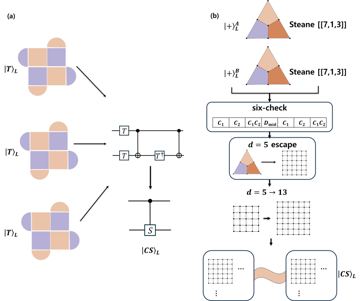
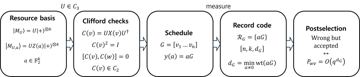
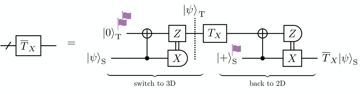
Magic-state factory (cultivation / distillation / code switching)
The subsystem that manufactures non-Clifford resource states so a code with transversal Cliffords can run universal circuits.
Verdict. Three routes are demonstrated on three carriers, but every headline number is a post-selected stand-alone state; no factory has yet fed a real algorithm.
Λ = error-suppression factor per code-distance step; QBI = DARPA Quantum Benchmarking Initiative (Stage A concept → B R&D plan → C government V&V); G1–G7 = the report's goal classes (see Actors & economics).
Identity & lineage
A magic-state factory manufactures the non-Clifford resource states — |T⟩, |H⟩, |CCZ⟩ (controlled-controlled-Z) — that gate teleportation injects to supply the rotation a host code cannot perform transversally. Eastin–Knill forbids a transversal universal gate set on any code with distance, so universality must be bought with spacetime volume, and the factory is where that purchase is made. Bravyi and Kitaev showed in 2004–05 that Cliffords plus noisy ancillas give universality, and that ancillas polarised beyond roughly 65% along a magic direction purify asymptotically S[689]. Three families exist: distillation, code switching, and cultivation — grow and verify one state in place (Gidney, Shutty, Jones, 2024-09) S[690].
Attributes. a — carrier affinity 0.5: a code-layer construct inheriting whatever carrier hosts it. b: no characteristic time of its own, entangling not applicable; it runs at the host's cycle. c — readout: none of its own, it consumes the host's mid-circuit measurement. d — mobility: static, a fixed tile region. e — control: no modality, no placement — compiled, not wired. f — error structure as the code sees it: Pauli. g — manufacturing: none.
Physics & limits
The factory converts fidelity into volume at a rate set by the protocol's suppression exponent. Fifteen-to-one distillation on the quantum Reed–Muller code suppresses input error cubically, so 10⁻⁹ from a 10⁻³ injected state needs two concatenated levels and the footprint that dominated the field's resource estimates. Cultivation changes the price rather than the exponent: a |T⟩ is grown in a small patch, checked fault-tolerantly, then escaped to a large one, reaching 2×10⁻⁹ under 10⁻³ uniform depolarising circuit noise and 4×10⁻¹¹ at 5×10⁻⁴, with about the gate count of a lattice-surgery CNOT of equal reliability and an order of magnitude fewer qubit-rounds than distillation S[690].
Two quantities set the floor. The host's physical error rate fixes achievable output error; the acceptance rate fixes throughput and has no analogue in code memory. All three routes are heralded, so a factory is a yield problem: Google retained 8% of attempts D[42], the [[6,2,2]] route discarded 14.8% D[107], code switching succeeded 82.58% of the time D[666]. The dangerous failure is the undetected one — a coherent logical fault entering the algorithm where no later correction helps — so required output error is roughly the inverse T-count: IBM's 10⁸-gate Starling target implies ~10⁻⁹ per state, exactly cultivation's theoretical figure. Erasure conversion, noise bias or faster cycles move the floor; a code with a transversal non-Clifford gate would delete the node.
Engineering state of the art
Best demonstrated is Google's cultivation run: 0.9999(1) fidelity at 8% retention, 40× error reduction, including code-switching into a surface code and a purpose-built fault-tolerant protocol to bound the fidelity D[42]. Typical at scale is nothing — as of 3 September 2026 no factory has run inside an algorithm anywhere, and every result is stand-alone and post-selected. Demonstrated (10⁻⁴) sits five orders above required (10⁻⁹), and acceptance looks harder to close than fidelity.
Records timeline
| Year | Figure | Who | Tag+key |
|---|---|---|---|
| 2005 | Purification threshold ≈65% polarisation along a magic direction | Bravyi, Kitaev | S[689] |
| 2025-06-17 | Magic-state infidelity 7×10⁻⁵ at 14.8% discard; logical controlled-Hadamard ≤2.3×10⁻⁴, [[6,2,2]] on 8 qubits | Quantinuum | D[107] |
| 2025-07-14 | First logical-level 5-to-1 distillation, d=3 and d=5 colour codes, neutral atoms | QuEra, Harvard, MIT | D[147] |
| 2025-10-15 | Code switching [[15,1,3]]→[[7,1,3]]: ≤5.1(2.7)×10⁻⁴ at 82.58% success | Quantinuum | D[666] |
| 2025-12-15 | Cultivation on a superconducting processor: 0.9999(1), 8% acceptance, 40× | Google Quantum AI | D[42] |
The dominant budget term is the escape step, where the state enters a large patch and loses post-selection; below it sit host two-qubit errors, mean 1.2×10⁻³ on the leading transmon system C[32].
Manufacturing, materials & supply chain
Nothing is fabricated: the bill of materials is host-code patches, mid-circuit measurement and classical compute, and the unit of cost is qubit-rounds. An attempt escaping to distance 15 implies a working region of order 10³ physical qubits per concurrent attempt, against a teraquop (10¹² reliable operations) memory footprint of 650 physical per logical at 0.1% noise S[655] — a handful of logical qubits per factory, not the hundreds implied by two-level distillation. The supply chain is classical: real-time decoders (Riverlane, NVIDIA, Zurich Instruments), the accept/reject interconnect, and the tooling that certifies output; the verification stack is the single point of failure. Export-control exposure is inherited — controls attach to the host machine under the 2024 US quantum-computer rules, not to a code.
Control, readout & I/O burden
The factory adds no wires and one hard latency requirement: each attempt ends in an accept/reject verdict that must reach the scheduler before the state decays, so it rides the memory's real-time decode path and competes for its bandwidth. On a 1.1 µs superconducting cycle D[1] a distance-15 escape is about 17 µs per attempt, and at 8% acceptance the attempt rate must be ~12× consumption. On QCCD ion and neutral-atom hosts the cycle is 1–5 ms, the same attempt costs 15–75 ms, and throughput binds rather than fidelity. Measured decode latency is 63 µs at d=5 D[1], above the per-attempt budget; Riverlane's sub-microsecond-per-round FPGA decoder D[238] and NVQLink's 3.84 µs mean round trip P[324] are what make pipelining possible. The wall: at 10³ qubits factory and algorithm do not coexist; at 10⁴ one or two fit; at 10⁶ the problem is scheduling tens of factories, each with its own decoder stream.
Role in the stack
It sits, as an alternate, on four architectures: the transmon lattice with tunable couplers (Google, IBM, Rigetti, IQM, OQC, USTC/Zhejiang, Fujitsu), trapped-ion QCCD (Quantinuum), the linear Paul trap with individual laser addressing (AQT, Innsbruck) and the alkali neutral-atom architecture (Harvard/MIT, QuEra, Pasqal, Infleqtion, Google's 2026 atom track). It requires a host — the rotated surface code with its yoked variants, or the colour code — and provides the non-Clifford axis without which a stabiliser machine is classically simulable. Cultivation replaces multi-level distillation; the switching price is architectural, since cultivation is surface-code-native and post-selection-heavy while code switching needs a colour code. It is one primitive reaching all three leading carriers with no substitute, so its value lies entirely in what it unlocks. It does not set the derived clock but multiplies it — derived clock = sum of the syndrome round: gate layers + transport + readout + reset for the architecture, so 0.65 µs superconducting (1.1 µs measured) and 9.66 ms for QCCD ions, times escape depth and inverse acceptance. Empty neighbouring slots: no factory on bosonic, photonic or spin platforms, none on a qLDPC code.
Evidence — how the numbers were measured
Every headline number is a post-selected stand-alone fidelity, measured on a state then discarded rather than used. Google reports a bound from a purpose-built fault-tolerant measurement protocol, not a tomographic estimate D[42]; the 7×10⁻⁵ figure is quoted at a stated discard rate D[107]; code switching's 5.1(2.7)×10⁻⁴ carries an uncertainty of the same order as the value D[666]; the neutral-atom paper reports improvement over input rather than an absolute output infidelity D[147]. Unmeasured everywhere: throughput under scheduling load, the cost of discards, factory-to-consumer correlations, and the loss channels post-selection removes. Independent checking is unusually strong — Wan, Zhong and Zapirain decompose d=5 cultivation circuits into about 8 Clifford terms on average via the ZX-calculus, over 10⁶× fewer than prior stabiliser decompositions D[691]. No value conflicts were found among the sources used.
A factory's output can be certified with the operations the code already has: Bell-coherence fidelity estimation measures the infidelity ε of any pure resource state, including continuous-angle rotation states, to a fixed relative accuracy from Θ(1/ε) copies using only Clifford gates and Pauli measurements — optimal even against collective measurements — and in distance-3 surface-code simulations it needed up to about 27× fewer states than direct fidelity estimation P[896]. The measured copies are consumed.
Not published in the abstracts of [42] and [147]: the escape-stage code distance, physical-qubit count and cycle count of Google's cultivation run, and the absolute output infidelity, atom count and acceptance rate of the QuEra/Harvard/MIT distillation, whose stated figure is the improvement over the input. Not published: a dated patent-family count for magic-state preparation. The distance-15 escape region of order 10³ qubits and ~17 µs per attempt are derived from [690] and [1], not quoted by a source.
Actors & economics
Who.
| Organisation | Role | Country | What exactly they do | Evidence |
|---|---|---|---|---|
| Google Quantum AI | developer | US | Invented cultivation; first superconducting demonstration | S[690] D[42] |
| Quantinuum | developer | US/UK | Code switching and the [[6,2,2]] logical non-Clifford gate | D[107], [666] |
| QuEra Computing | developer | US | First logical-level 5-to-1 distillation on colour codes | D[147] |
| Harvard University | research | US | 448-atom universal fault-tolerance architecture | D[4] |
| IBM | developer | US | Starling budgets 10⁸ logical gates; on Heron, post-selected magic-state injection only, no factory | R[67] |
| NVIDIA | supplier | US | NVQLink, the accept/reject path a pipelined factory needs | P[324] |
| Riverlane | supplier | UK | Sub-microsecond decoding, the throughput gate on cultivation | D[238] |
| DARPA | funder | US | QBI Stage B funds IBM, Quantinuum, QuEra and eight others | fact |
Money.
- 2025-09-04 · Quantinuum · capital raise · $600 M at $10 B pre-money · NVentures, Quanta, QED, JPMorgan · closed fact
- 2025-09-09 · QuEra · financing round · $230 M+ · Google, SoftBank Vision Fund 2, NVentures · closed fact
- 2025-11-06 · DARPA · QBI Stage B · up to $15 M each · eleven teams · announced fact
- 2026-06-03 · Quantinuum · IPO · $1.68 B gross, Nasdaq QNT; FY guidance $28–32 M · closed fact
- 2026-06 · IBM · corporate commitment · $10 B, US quantum manufacturing and R&D · announced C[67]
Market & supply chain. Nobody sells a magic-state factory; it is bundled into a machine and given away in a compiler. The sellable adjacencies are real-time decoding and interconnect, resource estimation, and the host hardware. Concentration is extreme: Google, Quantinuum, and QuEra with Harvard and MIT hold every demonstrated result except Innsbruck's code switching and the magic-state injections on IBM's Heron and Zhejiang University's 125-qubit processor, and two of the three routes trace to one theory group. G3 and G4 pay for this directly, G6 indirectly; G1, G2 and G5 pay nothing, which is why a primitive on every fault-tolerance critical path carries almost no dedicated revenue.
IP & standards. No dated patent-family count specific to magic-state factories was found from a named database as of 3 September 2026; PatSnap's landscape published on 2026-06-30 counts IBM 4,388, Google 2,385 and Microsoft 1,175 quantum patent families but does not break them down to this node Pfact. There is no interface standard; the de-facto portability layer is the Quantum Intermediate Representation used in the 2023 real-time demonstration C[692], the verification layer open-source stabiliser and ZX simulation D[691]. No litigation on record.
Roadmaps & track record. Google (2024-09-26, "as cheap as a CNOT"): demonstrated 2025-12-15 at 0.9999, fifteen months theory to silicon, still five orders above target. Quantinuum (2024-09-10, universal fault tolerance by 2029): two demonstrations, both on the 20-qubit H1-1, none yet on Helios. QuEra (2024-01, 100 logical qubits in 2026): distillation shown 2025-07, count not met, restated as Libra in 2028. IBM (2025-06-10, Starling 2029): no factory result, Kookaburra slipped a year. Credibility: Google highest, with theory, hardware and verification tooling in one place; Quantinuum high on primitives, unproven at scale; QuEra high on primitives, slipped roadmap; IBM unevidenced here.
Strategic reading. If cultivation holds at scale, the winner is whoever has the fastest cycle and the best sub-microsecond decoder — favouring superconducting over ions and atoms by two to three orders of magnitude in throughput; the loser is the distillation-dominated resource estimate that made fault tolerance look ten times dearer than it now appears, and any security timeline resting on it. Substitution threats are real but undemonstrated: transversal non-Clifford codes, algorithmic fault tolerance, Clifford-heavy redesign. Bargaining power sits with the platform vendor, since the factory is a compiler asset; the only supplier leverage is the accept/reject path.
Outlook & open questions
Confirm, within 12–24 months, if a cultivated state is consumed by a logical algorithm rather than measured in isolation, with end-to-end error below 10⁻⁶ by end-2027; if cultivation reaches a discard rate below 50%, against 92% today; if any magic-state result appears on IBM hardware before Starling, or any factory runs on a qLDPC code. Demote if Google's next processor cannot push cultivation below 10⁻⁵ while raising acceptance, or if the fidelity bound fails to survive consumption. Best case by 2029: in-line cultivation near 10⁻⁹ and factories a minority of the footprint, so T-count-limited algorithms become clock-limited. Worst case: acceptance stays near 10%, throughput binds, distillation returns as a second stage and the 10³-physical-per-logical estimates with it. Open questions: does the bound survive use rather than measurement; what does post-selection cost under real scheduling; can code switching be made deterministic; is a qLDPC-native factory possible; does erasure conversion raise this threshold as it raises the memory's. Watch Google's next cultivation paper, the first Helios magic-state numbers, IBM Kookaburra and QuEra Libra.
References
- [1] Google Quantum AI and Collaborators, “Quantum error correction below the surface code threshold,” Nature, vol. 638, no. 8052, pp. 920–926, Dec. 2024, doi: 10.1038/s41586-024-08449-y. D
- [4] D. Bluvstein et al., “A fault-tolerant neutral-atom architecture for universal quantum computation,” Nature, vol. 649, no. 8095, pp. 39–46, Nov. 2025, doi: 10.1038/s41586-025-09848-5. arXiv:2506.20661. D
- [32] Y. Chen and M. Devoret, “Our quantum hardware: the engine for verifiable quantum advantage,” Google Blog, Oct. 22, 2025. [Online]. Available: https://blog.google/
innovation-and-ai/ Ctechnology/ research/ quantum-hardware-verifiable-advantage/ - [42] E. Rosenfeld et al., “Magic state cultivation on a superconducting quantum processor,” arXiv:2512.13908, Dec. 2025. D
- [67] IBM, “IBM Sets the Course to Build World's First Large-Scale, Fault-Tolerant Quantum Computer at New IBM Quantum Data Center,” Jun. 10, 2025. [Online]. Available: https://newsroom.ibm.com/
2025-06-10-IBM-Sets-the-Course-to-Build-Worlds-First-Large-Scale,-Fault-Tolerant-Quantum-Computer-at-New-IBM-Quantum-Data-Center R - [107] S. Dasu et al., “Breaking even with magic: demonstration of a high-fidelity logical non-Clifford gate,” arXiv:2506.14688, Jun. 2025. D
- [147] P. S. Rodriguez et al., “Experimental demonstration of logical magic state distillation,” Nature, vol. 645, no. 8081, pp. 620–625, Jul. 2025, doi: 10.1038/s41586-025-09367-3. D
- [238] A. B. Ziad et al., “Local clustering decoder as a fast and adaptive hardware decoder for the surface code,” Nat. Commun., vol. 16, no. 1, Art. no. 11048, Dec. 2025, doi: 10.1038/s41467-025-66773-x. D
- [324] S. Caldwell et al., “NVIDIA NVQLink Architecture Integrates Accelerated Computing with Quantum Processors,” NVIDIA Technical Blog, Nov. 17, 2025. [Online]. Available: https://developer.nvidia.com/
blog/ Pnvidia-nvqlink-architecture-integrates-accelerated-computing-with-quantum-processors/ - [655] C. Gidney and C. Jones, “New circuits and an open source decoder for the color code,” arXiv:2312.08813, Dec. 2023. S
- [666] L. Daguerre, R. Blume-Kohout, N. C. Brown, D. Hayes, and I. H. Kim, “Experimental Demonstration of High-Fidelity Logical Magic States from Code Switching,” Phys. Rev. X, vol. 15, no. 4, Art. no. 041008, Oct. 2025, doi: 10.1103/dck4-x9c2. arXiv:2506.14169. D
- [689] S. Bravyi and A. Kitaev, “Universal Quantum Computation with ideal Clifford gates and noisy ancillas,” Phys. Rev. A, vol. 71, Art. no. 022316, 2005, doi: 10.1103/PhysRevA.71.022316. arXiv:quant-ph/0403025. S
- [690] C. Gidney, N. Shutty, and C. Jones, “Magic state cultivation: growing T states as cheap as CNOT gates,” arXiv:2409.17595, Sep. 2024. S
- [691] K. H. Wan, Z. Zhong, and A. Zapirain, “Simulating magic state cultivation with few Clifford terms,” Quantum, vol. 10, Art. no. 2134, Jun. 2026, doi: 10.22331/q-2026-06-12-2134. D
- [692] Quantinuum, “A Quantinuum-led team has built the quantum programming tools for real-time magic state distillation on a quantum computer,” Oct. 24, 2023. [Online]. Available: https://www.quantinuum.com/
blog/ Ca-quantinuum-led-team-has-built-the-quantum-programming-tools-for-real-time-magic-state-distillation-on-a-quantum-computer - [896] S. Takahashi and K. Fujii, “Efficient fidelity estimation of general quantum resource states via Clifford circuits,” arXiv:2610.05222, Oct. 2026. P