Bosonic concatenation (repetition-cat, LDPC-cat, GKP+qLDPC) code_bosonic
A discrete outer code — repetition or qLDPC — wrapped around a bosonic inner qubit whose noise is already shaped, so the outer code corrects only one residual channel.
Bosonic concatenation (repetition-cat, LDPC-cat, GKP+qLDPC)
Outer code exploits inner bias/shift correction; Ocelot's two points are not a distance scan; LDPC-cat assumes 0.1% phase-flip (measured ~10%).
Brief →Key references
Design space — attributes
- (a) carrier affinity
- hybrid (fabricated host)
- (b) time · entangling
- —
- (c) readout
- —
- (d) mobility
- static nearest-neighbour wiring
- (e) control
- —
- (f) error structure
- biased, Gaussian (small-shift)
- (g) manufacturing
- —
Evaluation space — dated attributes
Ocelot's 'd=3→5 nearly flat' is not a distance scan: the two points sit at different mean photon numbers. Gouzien et al. size ECC-256, not RSA-2048.
Standard records
Actors & goals — annotations
Edges
Used by 8 machines (8 primary · 0 alternate)
- superconducting circuits 7
- Alice & Bob Boson 4 Alice & Bob press ▥ Boson 4 milestone ✅
- Alice & Bob Graphene Alice & Bob press ▣ Fig. 3, Fig. 9 ([165,34,22] layout); §III (758 cats) ✅
- Alice & Bob Helium (on-premise system) Alice & Bob whitepaper press ▥ §Cats' Hardware Efficiency: Repetition Code and LDPC Connectivity; §MILESTONE 2: Build a Logical Qubit; Fig. 'Error Rate vs Qubit Count for Logical Qubits' ✅
- Alice & Bob Helium 2 ("Galvanic Cat") Alice & Bob press ▨ 🔎
- AWS Ocelot AWS Center for Quantum Computing ▣ Fig. 3 (phase-flip correction circuit), Fig. 5 (logical memory performance); §IV-VI ✅
- Nord Quantique single-mode GKP Nord Quantique paper press ▤ abstract; results ✅
- Nord Quantique Tesseract Nord Quantique product page press ▥ results ✅
- photonics 1
- Aurora Xanadu paper press link ▣ Fig. 3c,d (decoder-driven repetition-code checks); §Experiment ✅
Pictures
Every picture carries the story of what it shows and its credit line.

Bosonic concatenation (repetition-cat, LDPC-cat, GKP+qLDPC)
A discrete outer code — repetition or qLDPC — wrapped around a bosonic inner qubit whose noise is already shaped, so the outer code corrects only one residual channel.
Verdict. The whole family rests on one number, the phase-flip rate under a gate. Measured hardware is two orders of magnitude away from every published resource estimate.
Λ = error-suppression factor per code-distance step; QBI = DARPA Quantum Benchmarking Initiative (Stage A concept → B R&D plan → C government V&V); G1–G7 = the report's goal classes (see Actors & economics).
Identity & lineage
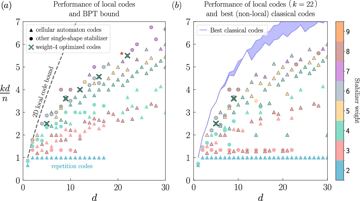
The construction shapes the inner qubit's noise so the outer code has less to do. A cat qubit stabilised by two-photon dissipation suppresses bit-flips exponentially in photon number while phase-flips grow only linearly, so a 1D repetition code suffices: distance d costs d cats, not d². A GKP inner qubit instead hands up an analogue shift syndrome that a qLDPC outer code decodes with soft information. Theory came first and is precise. Gouzien et al. (PRL 131, 040602, 2023) size a repetition-cat machine at 126,133 cats, 19 photons each, for a 256-bit elliptic-curve logarithm in 9 hours at an assumed loss ratio of 10⁻⁵ S[95]; Ruiz et al. then gave 2D-local LDPC-cat codes, 758 cats for 100 logical qubits at ≤10⁻⁸ per cycle, assuming ~0.1% phase-flip S[96].
Attributes: partly fabricated (0.75); static, no control channel or readout of its own; biased plus Gaussian error — "Outer code exploits inner bias/shift correction; Ocelot d=3→5 nearly flat; LDPC-cat assumes 0.1% phase-flip (measured ~10%)" (graph record).
Physics & limits
The family trades one error channel against another, and the exchange rate is the noise bias. Photon number buys exponential bit-flip suppression and pays linearly in phase-flips, so an architecture picks the point where bit-flips fall below the outer code's reach and lives with the rate left — assumed near 10⁻³. Hardware is not there: in Ocelot's CX at |α|² = 2 the phase-flip is 9.6(4)×10⁻² and the bit-flip 3.5(4)×10⁻³, a bias above 25 under the gate and above 30 idle D[80] — a per-CX figure, not per cycle. The deeper limit: bias belongs to the idle manifold and a dissipative CX degrades the asymmetry the code is built on, so the open problem is a bias-preserving gate, not a better memory. What moves the floor: a larger ratio of two-photon dissipation to single-photon loss, and unitary rather than dissipative gates.
Engineering state of the art
One hardware result with a measured logical error carries the family: Ocelot (Putterman et al., AWS and Caltech, Nature 638, 927, 2025-02-26), a repetition code over five cat qubits with four ancilla transmons and five buffer modes — logical error 1.75(2)% at distance 3 and 1.65(3)% at distance 5, per 2.8 µs cycle D[80]. These are not the same operating point (d=3 at |α|² = 1, d=5 at |α|² = 1.5), so the repeated "flat below threshold" mixes a distance step with a photon-number step and scaling is not isolated. No bias-preserving cat–cat CNOT exists — the AWS-affiliated proposal is unitary and simulated S[81] — and no GKP-plus-qLDPC hardware exists. The register lists two more code runs on hardware, neither with a published logical error rate: Alice & Bob Helium (on-premise system), 18 cats as one logical qubit, and Aurora, a distance-2 repetition code on a GKP cluster state, detection only.
table
| Year | Figure | Who | Tag+key |
|---|---|---|---|
| 2024-01 | LDPC-cat, 2D-local: 758 cats → 100 logical at ≤10⁻⁸/cycle, assumes 0.1% phase-flip | Ruiz et al. | S[96] |
| 2025-02 | Ocelot: 1.75(2)% at d=3 (|α|²=1) → 1.65(3)% at d=5 (|α|²=1.5), 2.8 µs cycle | AWS/Caltech | D[80] |
| 2026-07 | Unitary bias-preserving cat–cat CNOT; d=7 repetition of 13 cats below 10⁻⁶, simulated | AWS-affiliated | S[81] |
Manufacturing, materials & supply chain
No process step of its own: this is an architecture and a decoder, and the graph record leaves fabrication unset. It inherits the cat or GKP host, and the superconducting hosts differ by builder. Yale's GKP oscillator is a seamless coaxial-stub cavity of high-purity aluminium with a tantalum transmon ancilla on a sapphire chip Dfact; Nord Quantique's is a double-post cavity of high-purity aluminium with an auxiliary transmon D[82]. AWS's Ocelot holds its cats in tantalum resonators on one die, bump-bonded to a second die that carries the aluminium junctions, and adds an ancilla transmon per repetition check — four for five cats D[80]. Alice & Bob's cats are tantalum-on-sapphire circuits with no transmon at all: two-photon dissipation through a buffer mode stabilises them, and the buffer also carries the readout factCfact. All four run in a dilution refrigerator. The accounting worth keeping is Ocelot's fourteen engineered elements for five data cats — the real denominator behind any "fewer qubits" comparison D[80]. Helium draws about 40 kW for a logical qubit using as few as 18 cats C[87]. No code-specific export control exists; ECCN 3A904 applies to the host G[301].
Control, readout & I/O burden
The decoder is the cheap part: a 1D repetition syndrome stream is simpler than 2D matching and, at 2.8 µs, inside existing FPGA decoders. The cost moved into analogue stabilisation — each cat needs a two-photon dissipation drive and a buffer pump, plus readout (through the buffer at Alice & Bob, through an ancilla transmon per check on Ocelot), so lines per data qubit exceed a bare transmon's. The saving is in code distance, not wiring: at 10³ cats the cryostat resembles a 10³-transmon machine with extra pumps. The cycle is also 2.5× slower than a 1.1 µs surface-code cycle D[1].
Role in the stack
The code requires a biased cat or a GKP inner qubit; as the terminal outer layer it has no dependents, and it replaces fusion-based discrete-variable fault tolerance. It sits on two architectures, as the primary code on both: bosonic cavity qubits with cat and GKP encodings (Alice & Bob, AWS, Nord Quantique) and continuous-variable photonic GKP, where Xanadu concatenates GKP under qLDPC Cfact. Switching inner qubits is no re-parameterisation: the cat branch buys a 1D outer code and owes a bias-preserving gate; the GKP branch buys an analogue syndrome and owes ~10 dB of squeezing. Its derived-clock contribution (= sum of the syndrome round: gate layers + transport + readout + reset) is d₂ = 2 gate layers, a 1.44 µs round against the measured 2.8 µs cycle D[80]. The neighbouring empty slot is an LDPC-cat memory on hardware — unbuilt as of 4 Sep 2026.
Evidence — how the numbers were measured
The "100–1000× fewer qubits" claim is a resource estimate, not a measurement, and both papers state the assumption plainly: ~0.1% phase-flip S[95], [96]; hardware is at 9.6×10⁻² per CX D[80]. No protocol captures gate-level bias preservation under load, because the gate does not exist; Ocelot has no independent replication and mixes operating points across its distance comparison. Helium is sold but publishes no logical-performance data, and the roadmap quotes a September 2025 peak bit-flip time of 252 minutes against a 44-minute mean for the same run C[412].
No LDPC-cat or GKP-plus-qLDPC code has run on hardware. Not published: a dated patent-family count specific to bosonic codes, and AWS's funding for the Ocelot programme.
Actors & economics
Who.
| Organisation | Role | Country | What exactly they do | Evidence |
|---|---|---|---|---|
| AWS | Developer | US | Ocelot repetition-cat hardware; cat–cat CNOT proposal | D[80] |
| Alice & Bob | Developer | FR | Cat hardware; Graphene repetition-cat roadmap | C[412] |
| Nord Quantique | Developer | CA | GKP inner qubits for an outer code | D[82] |
| Xanadu | Developer | CA | Optical GKP under qLDPC, roadmap stage | Rfact |
| D-Wave | Developer | US | Bosonic gate-model roadmap after buying Quantum Circuits | Cfact |
Money.
- 2025-01-28 · Alice & Bob · Series B · €100 M · NVentures extension 2026-05-22, undisclosed · closed Cfact
- 2025-11-06 · DARPA · QBI Stage B: Nord Quantique and Xanadu in, Alice & Bob not · ≤$15 M each · closed fact
- 2026-01-20 · D-Wave · acquisition of Quantum Circuits · $550 M ($300 M stock, $250 M cash) · closed Cfact
- 2026-05-18 · Nord Quantique · growth equity · $30 M at a $1.4 B valuation · closed Cfact
Market & supply chain. Nobody sells this layer; it is bundled into machines with a superconducting bill of materials, so concentration risk sits with amplifier and refrigerator vendors, not foundries. G3 and G4 pay for it indirectly: what customers buy is the qubit-count claim, which is why GENCI's June 2026 Helium purchase precedes any published logical-performance number Cfact.
IP & standards. No dated, code-specific patent-family count was found in any named database. The constructions are academic and openly published, so defensible IP sits in the stabilisation circuits — buffer design, two-photon dissipation, bias-preserving gates — not the codes. No standards activity found.
Roadmaps & track record. Alice & Bob (as of 2026-09-04): Helium, 12–18 cats and one logical qubit at 10⁻², current; then 48, 250 and finally 2,000 cats for 100 logical at 10⁻⁶ in 2030, with a stated 13-minute bit-flip requirement R[412]. D-Wave (2026-06-01): 10 logical in 2030, 100 in 2032, Λ = 10 Rfact. Xanadu: fault tolerance 2028–29 Rfact. Every roadmap is in logical qubits while the demonstrated quantity is one at 10⁻²; AWS publishes no dated roadmap and holds the only scaling data.
Strategic reading. This family is the bosonic companies' only argument against better-funded transmon incumbents: close the phase-flip gap and they leapfrog on qubit count per dollar. Fail, and qLDPC-on-transmon or dual-rail erasure takes the slot without needing an unproven bias-preserving gate.
Outlook & open questions
Confirm or demote within 12–24 months: a demonstrated bias-preserving cat–cat CNOT; a distance scan at fixed photon number; any LDPC-cat or GKP-plus-qLDPC hardware result. Best case by 2029: a repetition-cat logical qubit with isolated below-threshold scaling and a measured bias-preserving gate, making the 758-cat estimate arguable. Worst case: phase-flip stays near 10⁻¹ and the family survives as a research line. Open: whether bias survives any two-qubit gate.
References
- [1] Google Quantum AI and Collaborators, “Quantum error correction below the surface code threshold,” Nature, vol. 638, no. 8052, pp. 920–926, Dec. 2024, doi: 10.1038/s41586-024-08449-y. D
- [80] H. Putterman et al., “Hardware-efficient quantum error correction via concatenated bosonic qubits,” Nature, vol. 638, no. 8052, pp. 927–934, Feb. 2025, doi: 10.1038/s41586-025-08642-7. D
- [81] Y. Ye et al., “Bias-preserving cat-cat CNOT gate via vacuum-conditional beam-splitter,” arXiv:2607.22852, Jul. 2026. S
- [82] S. Turcotte et al., “Quantum error correction of a grid-state qubit with state preparation and measurement errors below 10⁻³,” arXiv:2607.06718, Jul. 2026. D
- [87] N. Coppola, “Alice & Bob Unveils First Quantum System, Helium,” Alice & Bob, Jun. 10, 2026. [Online]. Available: https://alice-bob.com/
newsroom/ Calice-bob-unveils-first-quantum-system/ - [95] É. Gouzien, D. Ruiz, F.-M. Le Régent, J. Guillaud, and N. Sangouard, “Performance Analysis of a Repetition Cat Code Architecture: Computing 256-bit Elliptic Curve Logarithm in 9 Hours with 126133 Cat Qubits,” Phys. Rev. Lett., vol. 131, Art. no. 040602, Jul. 2023, doi: 10.1103/PhysRevLett.131.040602. arXiv:2302.06639. S
- [96] D. Ruiz, J. Guillaud, A. Leverrier, M. Mirrahimi, and C. Vuillot, “LDPC-cat codes for low-overhead quantum computing in 2D,” Nat. Commun., vol. 16, Art. no. 1040, 2025, doi: 10.1038/s41467-025-56298-8. arXiv:2401.09541. S
- [301] US Department of Commerce, Bureau of Industry and Security, “Commerce Control List Additions and Revisions; Implementation of Controls on Advanced Technologies Consistent With Controls Implemented by International Partners,” Federal Register, vol. 89, p. 72926, Sep. 6, 2024. [Online]. Available: https://www.federalregister.gov/
documents/ G2024/ 09/ 06/ 2024-19633/ commerce-control-list-additions-and-revisions-implementation-of-controls-on-advanced-technologies - [412] Alice & Bob, “Roadmap,” Jun. 23, 2026. [Online]. Available: https://alice-bob.com/
roadmap/ C