GKP grid encoding enc_gkp
A qubit encoded in periodic grid states of one bosonic mode — microwave cavity or optical — correcting small quadrature shifts and handing the decoder an analogue syndrome.
GKP grid encoding
Grid states in a bosonic (microwave cavity) or optical mode; corrects small shifts; needs ~10 dB squeezing.
Brief →Key references
Design space — attributes
- (a) carrier affinity
- hybrid (fabricated host)
- (b) time · entangling
- —
- (c) readout
- —
- (d) mobility
- —
- (e) control
- —
- (f) error structure
- Gaussian (small-shift)
- (g) manufacturing
- —
Evaluation space — dated attributes
Nord Quantique (microwave), Xanadu (optical). The GKP-qudit work is Brock et al. (UC Santa Barbara + Google, Nature 641, 612), not Yale; Nord Quantique's magic-state SPAM is 8(5)×10⁻³ (7(7)×10⁻⁴ on cardinal states).
Actors & goals — annotations
Edges
Used by 3 machines (3 primary · 0 alternate)
- superconducting circuits 2
- Nord Quantique single-mode GKP Nord Quantique paper press ▣ Fig. 1b–d (char.-function tomography, Δ=0.38); §II.2 Grid-state encoding ✅
- Nord Quantique Tesseract Nord Quantique product page press ▣ Fig. 1b-d (characteristic-function tomography of grid states, Δ=0.38); §II.2 Grid-state encoding ✅
- photonics 1
- Aurora Xanadu paper press link ▣ Fig. 1 (architecture layout: GBS → refinery breeding) ✅
Pictures
Every picture carries the story of what it shows and its credit line.
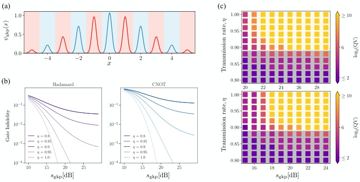
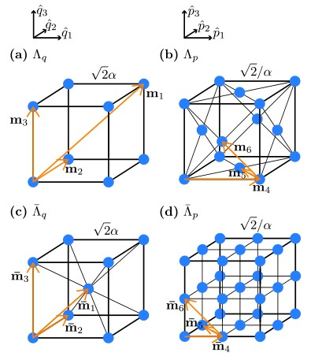
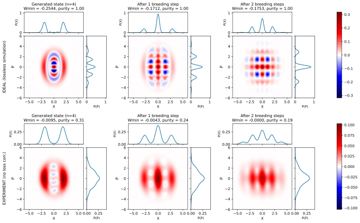
GKP grid encoding
A qubit encoded in periodic grid states of one bosonic mode — microwave cavity or optical — correcting small quadrature shifts and handing the decoder an analogue syndrome.
Verdict. The only encoding whose syndrome is continuous, and the only one whose every headline number is still post-selected. Unconditional logical error remains unpublished on both branches.
Λ = error-suppression factor per code-distance step; QBI = DARPA Quantum Benchmarking Initiative (Stage A concept → B R&D plan → C government V&V); G1–G7 = the report's goal classes (see Actors & economics).
Identity & lineage
Gottesman, Kitaev and Preskill (Phys. Rev. A 64, 012310, 2001) encode a qubit in a comb of position/momentum grid states of one oscillator: the stabilisers are commuting displacements, and shifts below half the lattice spacing are correctable S[413]. Ideal grid states need infinite energy, so every device approximates them at finite squeezing. The graph record's 2020 date is Campagne-Ibarcq et al. (Yale, Nature 584, 2020-08-19): square and hexagonal GKP states in a superconducting microwave cavity, logical errors suppressed by feedback on non-destructive measurement rather than post-selection D[414].
Attributes: partly fabricated (0.75) — a continuous-variable mode inside a fabricated cavity or photonic circuit; no control channel, readout or transport of its own; Gaussian error structure. "Grid states in a bosonic (microwave cavity) or optical mode; corrects small shifts; needs ~10 dB squeezing" (graph record).
Physics & limits
The syndrome is analogue: measuring each quadrature modulo the lattice period returns a real number, so the decoder receives the size of the shift, not a bit. That soft information is GKP's architectural argument, and why concatenating GKP under an outer code beats concatenating a bare qubit. The floor is squeezing: finite squeezing broadens each comb tooth, and once the shift distribution has weight beyond half the lattice spacing the correction applies the wrong displacement and the error becomes logical. The graph record's ~10 dB is the working requirement, architecture-dependent rather than a constant, and loss is what spends it. What moves the floor: higher-Q cavities, lower-loss photonics, state breeding to raise effective above physical squeezing, and an outer code that relaxes the per-mode requirement.
Engineering state of the art
Best demonstrated is a memory, not a computation. The largest coherence gain from any bosonic code remains Yale's 2.27(7), on a GKP qubit with reinforcement-learning-tuned real-time correction D[415]; the qudit extension gives 1.82(3) for a qutrit and 1.87(3) for a ququart, cavity T1 = 631 µs D[83]. Nord Quantique's single-mode grid qubit reaches 0.0081(2) logical error per round and SPAM 7(7)×10⁻⁴ on cardinal states, but only on shots surviving an all-agree post-selection, 0.24 in preparation × 0.39 in measurement D[82]. Nothing here resembles Λ scaling, and the dominant budget term is acceptance, not the conditional error rate quoted.
table
| Year | Figure | Who | Tag+key |
|---|---|---|---|
| 2023-03 | Real-time GKP correction beyond break-even, gain 2.27(7) | Yale | D[415] |
| 2025-05 | GKP qudits beyond break-even: qutrit 1.82(3), ququart 1.87(3) | UCSB/Google Quantum AI | D[83] |
| 2025-06 | GKP state on an integrated SiN chip at room temperature, 0.62 dB effective squeezing | Xanadu | D[174] |
| 2026-07 | Single-mode grid qubit: 0.0081(2)/round, survival 0.24×0.39 | Nord Quantique | D[82] |
Manufacturing, materials & supply chain
The two branches share no supply chain. Microwave GKP is machined, not lithographed: aluminium or niobium 3D cavities — Nord Quantique's is a double-post design — plus an ancilla transmon and readout chain per mode, and a refrigerator whose volume, not wafer area, sets the qubit count D[82]. Optical GKP is a 300 mm silicon-nitride process at room temperature, with squeezed-light generation, photon-number-resolving detection and packaging as cost drivers; Xanadu reports 0.085 dB edge-coupling loss per facet, with Corning and DISCO Cfact. No GKP-specific export control exists; the microwave branch inherits ECCN 3A904 G[301].
Control, readout & I/O burden
Microwave GKP is control-heavy per mode. Stabilisation needs conditional-displacement drives and feedback inside the cavity lifetime, and each mode carries an ancilla transmon whose errors propagate into it — the ancilla, not the cavity, is the practical limit at 360 µs–1 ms storage D[82], [83]. The I/O unit is a mode plus a full transmon control-and-readout chain, so at 10³ modes the wiring burden exceeds a bare transmon lattice; efficiency pays only once one mode replaces many physical qubits. Optical GKP substitutes homodyne detection per mode and GHz feed-forward across thousands of detector channels, unproven at system level D[173].
Role in the stack
GKP requires a bosonic cavity mode in the microwave branch and a roughly 10 dB squeezed mode in the optical one; it supplies the inner qubit for bosonic concatenation and is the direct alternative to cat encoding in that slot. It sits, as an alternate, on the cat-and-GKP bosonic cavity architecture (Nord Quantique; Alice & Bob and AWS on the cat variant) and, as the primary encoding, on the continuous-variable photonic GKP architecture (Xanadu), whose design concatenates GKP under a qLDPC outer code Cfact. Switching from cat to GKP swaps a biased channel for an unbiased one with an analogue syndrome: the outer code must be redesigned. The graph record fixes no characteristic time, so its contribution to the derived clock (= sum of the syndrome round: gate layers + transport + readout + reset, 1.44 µs on the cat-and-GKP architecture) is a stabilisation round no actor publishes.
Evidence — how the numbers were measured
Three quantities are reported as if commensurable. Gain is a ratio of decay rates against the best passive encoding D[83], [415]; logical error per round is conditional on survival D[82]; effective squeezing is a state-quality measure D[174]. None converts into another. Xanadu's 0.62 dB effective squeezing is not comparable with raw quadrature squeezing such as the 1.4 dB on periodically poled thin-film lithium niobate D[345], and its "24.1× above threshold" is a system-loss metric Rfact. No independent replication of the Nord Quantique or UCSB/Google results exists as of 4 Sep 2026.
The ~10 dB squeezing requirement is architecture-dependent; no single threshold paper sets it. Nord Quantique's "100+ logical by 2029" comes from company web material with no dated release. Not published: an unconditional (non-post-selected) logical error rate for any GKP demonstration, on either branch; how Xanadu's "24.1× above threshold" system-loss figure relates to its 0.62 dB effective squeezing; and a GKP-specific patent family or export-control category.
Actors & economics
Who.
| Organisation | Role | Country | What exactly they do | Evidence |
|---|---|---|---|---|
| Nord Quantique | Developer | CA | Single-mode microwave grid qubits | D[82] |
| Xanadu | Developer | CA | On-chip optical GKP sources; GKP-under-qLDPC architecture | D[174] |
| Google Quantum AI | Research | US | Qudit GKP beyond break-even, with UCSB | D[83] |
| Corning | Supplier | US | Fibre-array packaging for Xanadu's chips | Cfact |
Money.
- 2025-11-06 · Nord Quantique and Xanadu · DARPA QBI Stage B selections · $5 M initial, up to $15 M each · DARPA · closed fact
- 2026-03-26 · Xanadu · SPAC listing with Crane Harbor · ~$302 M gross, ~40% below plan · closed; ~US$686 M liquidity at 2026-06-30 Cfact
- 2026-05-18 · Nord Quantique · growth equity · $30 M at a $1.4 B valuation · closed Cfact
- 2026-08-28 · Xanadu · Toronto factory funding · CAD 195 M · Government of Canada · announced fact
Market & supply chain. No one sells GKP; both branches buy their host platform's equipment — cavity machining, TWPA readout and refrigerators on one side, a narrow set of squeezed-light and photon-number-resolving detector suppliers plus specialist packaging on the other. G3 and G4 are the only goals that pay for GKP.
IP & standards. No dated GKP-specific patent-family count was found; aggregate sector figures (IBM 4,388, Google 2,385 families in PatSnap's landscape published on 2026-06-30) do not break out continuous-variable encodings P[312]. The 2001 construction is prior art, pushing defensible IP into state preparation, breeding and ancilla-control circuits. No standards activity found.
Roadmaps & track record. Xanadu (promised 2026-08-31): loss 24.1× above threshold in 2026 → 1.0× in 2030, 200 logical qubits by 2029, 1,000+ by 2031, on a GKP-plus-qLDPC architecture Rfact. Nord Quantique (company material): 100+ logical by 2029 at "1:1 physical to logical" R[93]. Xanadu quantified its roadmap but raised ~40% below plan against a best published state of 0.62 dB; Nord Quantique's claim rests on a device whose combined survival is under 10%.
Strategic reading. GKP is the hardware-efficiency bet against surface-code brute force: if the squeezing and acceptance gaps close, one mode replaces the tens-to-hundreds of physical qubits an outer code needs. If they hold, both developers fall back on cat or discrete-variable encodings and lose the qubit-count argument behind their valuations, while surface-code incumbents lose nothing. Cat encoding is the substitution threat in the same slot.
Outlook & open questions
Confirm or demote within 12–24 months: does any GKP demonstration publish an unconditional logical error rate; does Nord Quantique lift combined survival above 10%; does an optical GKP state pass 1 dB effective squeezing. Best case by 2029: a multi-mode GKP logical qubit below break-even without post-selection, under a qLDPC outer code. Worst case: it stays a post-selected memory while cat and erasure encodings carry the bosonic architecture.
References
- [82] S. Turcotte et al., “Quantum error correction of a grid-state qubit with state preparation and measurement errors below 10⁻³,” arXiv:2607.06718, Jul. 2026. D
- [83] B. L. Brock et al., “Quantum error correction of qudits beyond break-even,” Nature, vol. 641, no. 8063, pp. 612–618, May 2025, doi: 10.1038/s41586-025-08899-y. D
- [93] Nord Quantique, “Company website.” [Online]. Available: https://www.nordquantique.com/ R
- [173] H. A. Rad et al., “Scaling and networking a modular photonic quantum computer,” Nature, vol. 638, no. 8052, pp. 912–919, Jan. 2025, doi: 10.1038/s41586-024-08406-9. D
- [174] M. V. Larsen et al., “Integrated photonic source of Gottesman–Kitaev–Preskill qubits,” Nature, vol. 642, no. 8068, pp. 587–591, Jun. 2025, doi: 10.1038/s41586-025-09044-5. D
- [301] US Department of Commerce, Bureau of Industry and Security, “Commerce Control List Additions and Revisions; Implementation of Controls on Advanced Technologies Consistent With Controls Implemented by International Partners,” Federal Register, vol. 89, p. 72926, Sep. 6, 2024. [Online]. Available: https://www.federalregister.gov/
documents/ G2024/ 09/ 06/ 2024-19633/ commerce-control-list-additions-and-revisions-implementation-of-controls-on-advanced-technologies - [312] PatSnap, “Quantum Computing Patent Landscape 2026,” Jun. 30, 2026. [Online]. Available: https://www.patsnap.com/
resources/ Pblog/ rd-blog/ quantum-computing-patent-landscape/ - [345] X. Shi et al., “Squeezed Light Generation in Periodically Poled Thin-Film Lithium Niobate Waveguides,” arXiv:2508.08599, Aug. 2025. D
- [413] D. Gottesman, A. Kitaev, and J. Preskill, “Encoding a qubit in an oscillator,” Phys. Rev. A, vol. 64, no. 1, Art. no. 012310, Jun. 2001, doi: 10.1103/PhysRevA.64.012310. arXiv:quant-ph/0008040. S
- [414] P. Campagne-Ibarcq et al., “Quantum error correction of a qubit encoded in grid states of an oscillator,” Nature, vol. 584, no. 7821, pp. 368–372, Aug. 2020, doi: 10.1038/s41586-020-2603-3. D
- [415] V. V. Sivak et al., “Real-time quantum error correction beyond break-even,” Nature, vol. 616, no. 7955, pp. 50–55, Apr. 2023, doi: 10.1038/s41586-023-05782-6. D