Metastable ('omg') erasure encoding enc_omg
Qubit lives in a metastable manifold so its dominant decay leaves the subspace detectably, converting Pauli errors into located erasures.
Metastable ('omg') erasure encoding
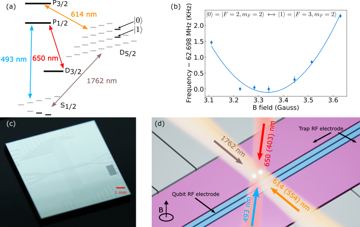
Qubit in metastable manifold so that decay leaves the subspace detectably; ions (proposal) and Yb atoms (shown).
Brief →Key references
Design space — attributes
- (a) carrier affinity
- natural
- (b) time · entangling
- —
- (c) readout
- —
- (d) mobility
- —
- (e) control
- —
- (f) error structure
- erasure-convertible
- (g) manufacturing
- —
Evaluation space — dated attributes
The 3.6(1)× often quoted is the post-selected hold; the architecturally relevant figure is the unconditional 1.9(4)× (arXiv:2506.13724 v1 and v2).
Actors & goals — annotations
Edges
Used by 1 machine (1 primary · 0 alternate)
- neutral atoms 1
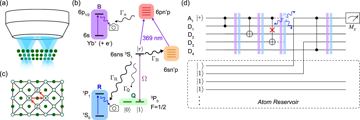
- metastable Yb-171 erasure array Princeton (Thompson group) paper paper paper ▣ Fig. 1 (3P0 qubit; leakage to 1S0 detected via 1P1 imaging) ✅
Pictures
Every picture carries the story of what it shows and its credit line.
Metastable ('omg') erasure encoding
Qubit lives in a metastable manifold so its dominant decay leaves the subspace detectably, converting Pauli errors into located erasures.
Verdict. Physics confirmed on atoms and ions, but measured conversion is 38–50%, not the 98% theory assumed, and no vendor ships it. Demote unless a >70%-conversion gate appears by end-2027.
Λ = error-suppression factor per code-distance step; QBI = DARPA Quantum Benchmarking Initiative (Stage A concept → B R&D plan → C government V&V); G1–G7 = the report's goal classes (see Actors & economics).
Identity & lineage
An omg encoding places the computational basis inside a long-lived metastable manifold, chosen so the dominant decay takes the atom or ion out of the qubit subspace into a state a cycling transition lights up. The error is then not a Pauli flip on an unknown qubit but a heralded, located loss — an erasure.
The name is the ion-side blueprint: optical–metastable–ground, three manifolds in one species so one ion serves as qubit, ancilla and coolant (Allcock, Campbell, Chiaverini, Chuang, Hudson, Wineland and colleagues, 2021) D[333]. Wu, Kolkowitz, Puri and Thompson made it quantitative for neutral atoms: 98% of ¹⁷¹Yb errors convertible, threshold rising from 0.937% under Pauli noise to 4.15% under erasure noise S[8]. Kang, Campbell and Brown carried it to ions S[392]. First hardware: Princeton, 2023 D[141].
Attributes (technology graph): a carrier affinity 0.0, natural carriers. b no characteristic time, no entangling mechanism of its own. c no readout of its own; it delegates to the mid-circuit erasure check it enables. d no mobility. e no control modality or placement. f error structure as the code sees it: erasure. g no manufacturing. Shared by both host families: neutral atoms and trapped ions.
Physics & limits
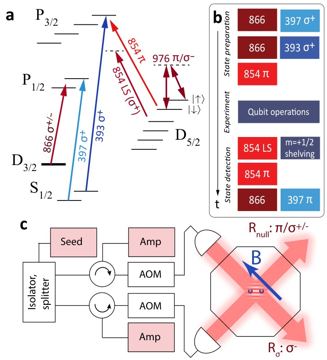
The mechanism is a hierarchy of lifetimes. In ¹⁷¹Yb the qubit is the nuclear spin of the 6s6p ³P₀ clock state; in ⁴⁰Ca⁺ two Zeeman sublevels of D₅/₂. Both live long against circuit duration and decay to the ground manifold, which scatters photons on a strong transition while the metastable one does not. A short fluorescence check therefore reports which site left the code space without touching those that stayed — Princeton measured the induced error on survivors below 10⁻⁵ D[141].
The floor is set by errors that stay inside the manifold — Raman scattering back into the qubit subspace, magnetic dephasing across small Zeeman splittings, off-resonant coupling between the computational sublevels — all un-heralded Pauli noise. Oregon measured the split: ~94% of spontaneous Raman scattering and nearly all decay events detected, but only half the total error budget converted D[393]; Princeton's [[4,2,2]] run converted 38(6)% D[142]. Erasure buys more per unit rate — at 1% erasure the surface code tolerates 0.51% Pauli error, 5.2× the standard protocol S[334]fact — but the gain scales with conversion fraction, so the residual is a floor only better gate physics removes.
Engineering state of the art
Best demonstrated as of 3 Sep 2026: a two-qubit gate at 99.16% after erasure subtraction on ⁴⁰Ca⁺ D[393], and a [[4,2,2]] block whose decay slows 1.9(4)× with erasure information D[142]. Typical at scale: nothing — every shipped machine uses ground-manifold qubits.
Records timeline
| Year | Figure | Who | Tag+key |
|---|---|---|---|
| 2022-01 | 98% of ¹⁷¹Yb errors convertible; threshold 0.937% → 4.15% | Princeton | S[8] |
| 2023-10 | Metastable ¹⁷¹Yb: 1Q 0.9990(1), CZ 0.980(1), check error <10⁻⁵ | Princeton | D[141] |
| 2023-10 | ⁸⁸Sr Bell ≥0.9971 after erasure excision | Caltech | D[143] |
| 2024-11 | ⁴⁰Ca⁺ Bell 97.73% raw → 99.16% erasure-subtracted, ≈400 µs | Oregon | D[393] |
| 2026-06 | [[4,2,2]]: CZ 0.984(1), 38(6)% erasures, decay 1.9(4)× slower | Princeton | D[142] |
| 2026-08 | Mid-circuit ground-state cooling and ancilla readout | Oregon | D[394] |
The dominant term is the unconverted residual: half the ≈1.4% raw ⁴⁰Ca⁺ gate error survives the check D[393], as does 62(6)% of a 1.6(1)% CZ error on ¹⁷¹Yb D[142] — far worse than 99.854% raw on Harvard's Rb array D[4] or 7.9×10⁻⁴ on Helios D[97].
Manufacturing, materials & supply chain
No fabrication step: the manufacturing attribute is "none" and the encoding rides whatever trap the host uses. What it changes is optics — a shelving/clock laser (578 nm for ¹⁷¹Yb, 674 nm for Ca⁺, 1762 nm for Ba⁺), repumps out of the manifold, and in Oregon's case a Raman pair at 976 nm detuned −43 THz, bought with power D[393]. Suppliers are the field's usual set: Toptica, M Squared, Menlo Systems and NKT Photonics for sources; Stable Laser Systems for ultra-low-expansion cavities; Hamamatsu and Andor for check cameras. Single points of failure: the ULE cavity and the clock laser, both sub-ten-vendor markets. Export-control exposure runs through the lasers, not the encoding — Wassenaar Category 6 controls and the US BIS quantum rule of 2024-09-06 apply whichever manifold carries the qubit.
Control, readout & I/O burden
Per-qubit line count is unchanged — the encoding's main commercial attraction. What grows is wavelength count and calibration: extra state preparation, a shelving fidelity, and a check whose false-positive rate feeds the decoder. The check's cost against the clock is the decisive number, and it is favourable on both hosts. Atom arrays already pay 0.5–1 ms imaging inside a 1–4.5 ms round D[4]S[31], so a check that is the imaging is nearly free; ion machines run ~55 ms per layer D[97], making a few-hundred-µs fluorescence check ~1% of it. Yale and AWS showed erasure qubits win only when check time is short against the cycle S[395]fact — here it is. The wall at 10³–10⁶ qubits is decoder bandwidth, not I/O: erasure flags roughly double the syndrome payload.
Role in the stack
Three architectures carry it: Rydberg tweezer array — alkaline-earth(-like) (Yb/Sr), erasure-native as the primary encoding (Atom Computing with Microsoft, Princeton, Caltech), and two trapped-ion architectures as an alternate — linear Paul trap with individual laser addressing (IonQ, AQT, Quantum Art) and electronic qubit control (laser-free, microwave-driven gates) (IonQ with Oxford Ionics, eleQtron). It requires an alkaline-earth(-like) atom or a trapped ion with an accessible metastable manifold; it provides the detectable-decay structure a mid-circuit erasure check consumes; it replaces ground-manifold hyperfine encoding. Switching costs a re-calibrated preparation and readout chain plus one or two lasers. Derived clock = sum of the syndrome round: gate layers + transport + readout + reset: 1.5×10⁻³ s on the electronic-gate ion architecture (gate-set), where the encoding adds ≈1%, and 1.3×10⁻³ s on the alkaline-earth tweezer array (transport-set), where it adds nothing. A rare Layer-2 node with no clock penalty, so conversion fraction, not speed, is what to watch. Empty neighbouring slots: no erasure-native encoding for fabricated carriers, and no sub-100-µs erasure check for ions D[394].
Evidence — how the numbers were measured
Headline numbers come from Bell-state and randomised-benchmarking estimators with post-selection: shots where the check fired are discarded, so the "erasure-subtracted" fidelity is conditional — legitimate for a channel, illegitimate as a system figure of merit. Princeton's [[4,2,2]] result is the honest form: 1.9(4)× is logical, with erasure information actually used D[142]. Not captured: the check's false-positive and false-negative rates, which can halve effective distance S[395], and correlated leakage.
Conflicts. (i) The graph record records the [[4,2,2]] improvement as 3.6×; arXiv:2506.13724 v1 and v2 both state 1.9(4)×, which we use, treating 3.6× as superseded fact. (ii) Oregon's Bell fidelities read 98.56%/99.14% in the arXiv HTML and 98.61%/99.16% in Physical Review A, detuning −43 vs −44 THz; journal values used D[393]. (iii) The 98% conversion figure S[8] is an upper bound on an idealised error inventory, not a missed target.
Not published: the duration and fidelity of Oregon's quantum-logic non-destructive metastable readout [394].
Actors & economics
Who.
| Organisation | Role | Country | What exactly they do with this technology | Evidence |
|---|---|---|---|---|
| Princeton | research | US | Originated ¹⁷¹Yb metastable erasure conversion; [[4,2,2]] demo | D[8], [141], [142] |
| University of Oregon | research | US | Only metastable-ion gate with erasure conversion; omg mid-circuit cooling | D[393], [394] |
| Caltech | research | US | Sr Rydberg erasure excision | D[143] |
| UCLA | research | US | omg blueprint co-author; metastable ion theory | D[333], [392] |
| MIT Lincoln Laboratory | research | US | Blueprint co-author; single-ion spin-cat correction | D[333], [396] |
| Duke | research | US | Surface-code comparison, ground vs metastable ions | S[392] |
| Atom Computing | developer | US | ¹⁷¹Yb arrays, adoptable without changing species; QBI Stage B | fact |
| QuEra | developer | US | Rb arrays using atom loss, not metastable erasure | Cfact |
| Infleqtion | developer | US | Sr/Rb arrays, 12 logical qubits with loss correction | fact |
| IonQ | developer | US | Laser-free gates remove the error omg heralds | D[102]fact |
| Quantinuum | developer | US | Ba⁺ Helios; natural omg host, no metastable programme | D[97] |
| Microsoft | user | US | Sells Magne with Atom Computing; erasure-aware decoding | fact |
Money. No financing event is earmarked for metastable encoding; this money buys the host platforms.
- 2025-09-17 · IonQ · M&A, Oxford Ionics · $1.075 B · announced 2025-06-09 · closed fact
- 2025-11-04 · US DOE · five National QIS Research Centers renewed · $625 M / five years · closed fact
- 2025-11-06 · DARPA · QBI Stage B, 11 teams incl. Atom Computing, QuEra, IonQ · ≤$15 M each · selected fact
- 2026-02-17 · Infleqtion · IPO, NYSE (INFQ) · >$550 M gross · closed fact
- 2026-04-27 · Quantum Art · Series A extension · $140 M · closed P[125]
- 2026-05-21 · US Dept of Commerce · CHIPS LOIs, Atom Computing $100 M, Infleqtion $100 M · $2.013 B total · non-binding fact
- 2026-06-16 · Atom Computing · Series C plus DoC LOI · >$300 M cumulative · Third Point · closed + LOI C[154]fact
- 2026-06 · Quantinuum · IPO, Nasdaq (QNT) · $1.68 B · after $600 M at $10 B pre-money · closed G[123]
- 2026-07 · IonQ · M&A, SkyWater Technology · $1.8 B · closed G[19]
- 2026-08-28 · Pasqal · SPAC completion · ~$360 M cash · €16.5 M 2025 revenue · closed P[156]
Market & supply chain. No one sells an omg product; the enabling lasers, cavities and cameras are already a dependency of every host platform, so adoption adds one or two laser channels against systems like Magne (€80 M, 50 logical) fact. Only G3 and G4 (early and large-scale fault tolerance) pay for it; G1 benefits marginally via erasure excision in simulators D[143]. G2 and G5–G7 do not.
IP & standards. No patent family specific to metastable erasure encoding was found in a named database as of 3 Sep 2026; nearest granted art is Amazon Technologies US 11,748,652 B1 on heralded amplitude-damping decay (2023-09-05) fact. No litigation, no standards body; Stim models the encoding in software C[397].
Roadmaps & track record. (2021 · omg blueprint · partly delivered — Oregon entanglement 2024 D[393], mid-circuit cooling 2026 D[394]; no product.) (2022-01 · 98% conversion · missed by 2.6×, 38(6)% measured D[142].) (2028 · QuEra Libra >256 logical · on roadmap, no metastable commitment fact.) (2026/27 · Magne 50 logical · installing, ground-manifold Yb fact.) The vendors made no omg promises to break.
Strategic reading. Winners would be alkaline-earth(-like) atom vendors and ion vendors still using laser gates; losers, decoder stacks tuned for Pauli noise. Substitution bites from both sides: atom loss is >80% of array leakage and Harvard detected it on ground-manifold Rb for 2.14(13)× below threshold D[4], while laser-free ion gates at 8.4×10⁻⁵ delete the error omg catches D[102].
Outlook & open questions
Confirm if a gate reports >70% of total error converted with residual below 3×10⁻³, or a vendor announces a metastable product line. Demote if no conversion fraction above 50% is published by end-2027, or a laser-free ion gate below 10⁻⁴ ships at scale. Best case by 2029: an alkaline-earth array runs a distance-5 code with erasure-aware decoding and reports Λ above the loss-only baseline. Worst case: atom loss remains the only erasure anyone needs and this stays a two-laboratory programme.
Open questions. (1) Why is measured conversion 38–50% when the model says 98% — gate, check, or error inventory? (2) Does erasure information still help once false negatives are folded in at distance ≥5? (3) Is the residual Pauli error set by sublevel choice or by the gate laser? (4) Can a metastable ancilla be read non-destructively inside a 1 ms atom cycle? Watch the next Princeton follow-up, whether Atom Computing exposes the metastable manifold, and whether Quantinuum's unpublished "novel code family" is erasure-structured.
References
- [4] D. Bluvstein et al., “A fault-tolerant neutral-atom architecture for universal quantum computation,” Nature, vol. 649, no. 8095, pp. 39–46, Nov. 2025, doi: 10.1038/s41586-025-09848-5. arXiv:2506.20661. D
- [8] Y. Wu, S. Kolkowitz, S. Puri, and J. D. Thompson, “Erasure conversion for fault-tolerant quantum computing in alkaline earth Rydberg atom arrays,” Nat. Commun., vol. 13, Art. no. 4657, 2022, doi: 10.1038/s41467-022-32094-6. arXiv:2201.03540. S
- [19] IonQ, “IonQ Completes Acquisition of SkyWater Technology,” Jul. 31, 2026. [Online]. Available: https://www.ionq.com/
news/ Gionq-completes-acquisition-of-skywater-technology - [31] H. Zhou et al., “Resource Analysis of Low-Overhead Transversal Architectures for Reconfigurable Atom Arrays,” Proc. 52nd Annu. Int. Symp. Comput. Archit. (ISCA), 2025, doi: 10.1145/3695053.3731039. arXiv:2505.15907. S
- [97] A. Ransford et al., “A 98-qubit trapped-ion quantum computer with all-to-all connectivity,” Nature, vol. 655, no. 8121, pp. 81–86, Jun. 2026, doi: 10.1038/s41586-026-10676-4. arXiv:2511.05465. D
- [102] A. C. Hughes et al., “Trapped-ion two-qubit gates with >99.99% fidelity without ground-state cooling,” arXiv:2510.17286, Oct. 2025. D
- [123] Quantinuum, “Quantinuum Announces Pricing of Upsized Initial Public Offering,” Jun. 3, 2026. [Online]. Available: https://www.quantinuum.com/
press-releases/ Gquantinuum-announces-pricing-of-upsized-initial-public-offering - [125] M. Abdel-Kareem, “Quantum Art Extends Series A to $140M to Scale Trapped-Ion Architecture,” Quantum Computing Report, Apr. 27, 2026. [Online]. Available: https://quantumcomputingreport.com/
quantum-art-extends-series-a-to-140m-to-scale-trapped-ion-architecture/ P - [141] S. Ma et al., “High-fidelity gates with mid-circuit erasure conversion in a metastable neutral atom qubit,” Nature, vol. 622, p. 279, 2023, doi: 10.1038/s41586-023-06438-1. arXiv:2305.05493. D
- [142] B. Zhang et al., “Logical qubits with erasure conversion using metastable neutral atoms,” Nat. Phys., vol. 22, no. 6, pp. 910–916, Jun. 2026, doi: 10.1038/s41567-026-03309-0. arXiv:2506.13724. D
- [143] P. Scholl, A. L. Shaw, R. B.-S. Tsai, R. Finkelstein, J. Choi, and M. Endres, “Erasure conversion in a high-fidelity Rydberg quantum simulator,” Nature, vol. 622, p. 273, 2023, doi: 10.1038/s41586-023-06516-4. arXiv:2305.03406. D
- [154] Atom Computing, “Atom Computing Raises More Than $300 Million to Accelerate Deployment of Fault-Tolerant, Neutral-Atom Quantum Computers,” PR Newswire, Jun. 16, 2026. [Online]. Available: https://www.prnewswire.com/
news-releases/ Catom-computing-raises-more-than-300-million-to-accelerate-deployment-of-fault-tolerant-neutral-atom-quantum-computers-302800832.html - [156] M. Swayne, “Pasqal Completes SPAC Merger With $360 Million in Cash,” The Quantum Insider, Aug. 28, 2026. [Online]. Available: https://thequantuminsider.com/
2026/ P08/ 28/ pasqal-completes-spac-merger-with-360-million-in-cash/ - [333] D. T. C. Allcock et al., “omg blueprint for trapped ion quantum computing with metastable states,” Appl. Phys. Lett., vol. 119, no. 21, Art. no. 214002, Nov. 2021, doi: 10.1063/5.0069544. arXiv:2109.01272. D
- [334] A. Kubica et al., “Erasure Qubits: Overcoming the T₁ Limit in Superconducting Circuits,” Phys. Rev. X, vol. 13, no. 4, Art. no. 041022, Nov. 2023, doi: 10.1103/PhysRevX.13.041022. arXiv:2208.05461. S
- [392] M. Kang, W. C. Campbell, and K. R. Brown, “Quantum Error Correction with Metastable States of Trapped Ions Using Erasure Conversion,” PRX Quantum, vol. 4, no. 2, Art. no. 020358, Jun. 2023, doi: 10.1103/PRXQuantum.4.020358. arXiv:2210.15024. S
- [393] A. Quinn et al., “High-fidelity entanglement of metastable trapped-ion qubits with integrated erasure conversion,” Phys. Rev. A, vol. 113, no. 4, Art. no. L040601, Apr. 2026, doi: 10.1103/p3cy-8yjk. arXiv:2411.12727. D
- [394] S. Brudney et al., “Mid-circuit ground-state cooling and ancilla readout in the omg architecture,” arXiv:2608.13181, Aug. 2026. D
- [395] K. Chang et al., “Surface Code with Imperfect Erasure Checks,” PRX Quantum, vol. 6, no. 4, Art. no. 040355, Dec. 2025, doi: 10.1103/d1v7-nctj. S
- [396] K. DeBry et al., “Error correction of a logical qubit encoded in a single atomic ion,” Nat. Phys., vol. 22, no. 9, pp. 1446–1452, Sep. 2026, doi: 10.1038/s41567-026-03315-2. D
- [397] quantumlib, “Gates supported by Stim,” GitHub. [Online]. Available: https://github.com/
quantumlib/ CStim/ blob/ main/ doc/ gates.md