Mid-circuit erasure check ro_erasure
Ancilla- or fluorescence-based test of whether a qubit is still in its code space, flagging decay/leakage as a located erasure without reading the logical state.
Mid-circuit erasure check
Ancilla-based detection of leakage/loss without disturbing the code: 384 ns (transmon), 1.8 µs (cavity), 20 µs (Yb atoms).
Key references
Design space — attributes
- (a) carrier affinity
- intermediate / carrier-agnostic
- (b) time · entangling
- —
- (c) readout
- ancilla erasure check · 398 ns · non-destructive · mid-circuit
- (d) mobility
- —
- (e) control
- microwave @ room temperature
- (f) error structure
- erasure-convertible
- (g) manufacturing
- —
Evaluation space — dated attributes
Standard records
Actors & goals — annotations
Edges
Used by 11 machines (10 primary · 1 alternate)
- superconducting circuits 9
- AWS dual-rail transmon erasure line AWS Center for Quantum Computing (named Amazon Center for Quantum Computing in the Apr 2026 paper) paper ▣ Fig. 1 (symmetric resonator + Purcell filter), Fig. 2a-b (χ-matching), Fig. 3; §II-IV ✅
- D-Wave gate-model dual-rail system D-Wave Quantum press ▣ Fig. 1a (transmon + readout resonator per cavity); main text: end-of-line erasure-detected measurement ✅
- OQC ATHENA Oxford Quantum Circuits product page ◌ 🔎
- OQC ATLAS Oxford Quantum Circuits product page ◌ 🔎
- OQC GENESIS Oxford Quantum Circuits product page product page press ▣ Fig. 1c,d (EOL three-state readout); Fig. 2 (erasure fraction) ✅
- OQC TITAN Oxford Quantum Circuits product page ◌ 🔎
- Aqumen Seeker Quantum Circuits Inc. (acquired by D-Wave, Jan 2026) press ▣ Fig. 1a (per-cavity SPAM transmon + readout resonator); Fig. 2c, Fig. 3a (erasure fraction) ✅
- SUSTech biased-erasure cavity qubit Southern University of Science and Technology paper ▣ Fig. 2a–d (cascaded parity measurement, erasure detection error map); Methods: Mid-circuit erasure detection ✅
- SUSTech four-dual-rail-qubit processor Southern University of Science and Technology (Huang et al.) paper paper ▣ §III; Fig. 2a (erasure check) ✅
- neutral atoms 2
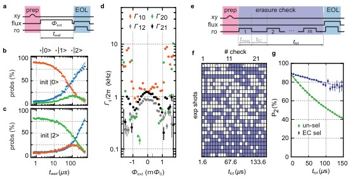
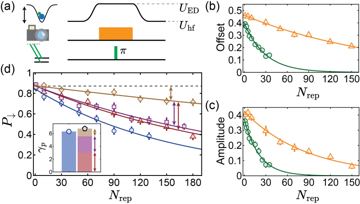
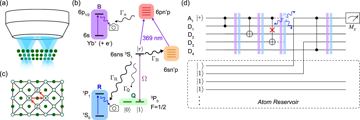
- metastable Yb-171 erasure array Princeton (Thompson group) paper paper paper ▣ Fig. 1a (EMCCD fast imaging); Fig. 3b, Fig. 4a (mid-circuit erasure checks) ✅
- Magne Atom Computing + Microsoft, for QuNorth press press ◌ 🔎 (alternate)
Pictures
Every picture carries the story of what it shows and its credit line.
Mid-circuit erasure check
Ancilla- or fluorescence-based test of whether a qubit is still in its code space, flagging decay/leakage as a located erasure without reading the logical state.
Verdict. The check is solved on transmons (384 ns, residual 6×10⁻⁴); unsolved are erasure fraction under two-qubit gates, false negatives and the cycle-time tax. Demote if no erasure system shows logical Λ > 2 by end-2027.
Λ = error-suppression factor per code-distance step; QBI = DARPA Quantum Benchmarking Initiative (Stage A concept → B R&D plan → C government V&V); G1–G7 = the report's goal classes (see Actors & economics).
Identity & lineage
A mid-circuit erasure check asks "is this qubit still inside its code space?" and returns a one-bit herald with the qubit's location without disturbing the logical state. It needs an encoding whose dominant decay leaves the code space: dual-rail (one excitation in two transmons or two cavities; loss leaves the detectable vacuum) or a metastable atomic qubit (³P₀ in ¹⁷¹Yb, D₅/₂ in ⁴⁰Ca⁺) whose ground-state decay fluoresces under a beam the qubit does not see. Proposals: Princeton/Yale, 2022-01 — 98% of ¹⁷¹Yb errors convertible, surface-code threshold 0.937%→4.15% S[8]; AWS dual-rail transmons, 2022-08 S[334]; Yale cavities, 2022-12 S[399]. Demonstrations: Princeton ¹⁷¹Yb D[141] and Caltech ⁸⁸Sr D[143] in 2023-05; AWS transmons D[400] and Yale cavities D[401] in 2023-07.
Attributes from the technology graph (legend: a affinity natural↔fabricated; b time, deterministic/heralded; c readout mechanism, time, destructive?, mid-circuit?; d mobility; e control @ placement; f error structure; g manufacturing):
- a = 0.5, carrier-agnostic.
- b = n/a.
- c = ancilla erasure check, ≈400 ns (10^−6.4 s), non-destructive, mid-circuit — the transmon record D[85], not the atomic 20 µs D[141].
- d = none.
- e = microwave @ room temperature (atoms: optical).
- f = erasure-convertible (located, heralded loss).
- g = none (a protocol, not an object).
Rank 1 of 111; shared by the superconducting and neutral-atom families.
Physics & limits
In a transmon dual-rail pair the logical states are |10⟩ and |01⟩, so a T1 decay of either transmon lands in |00⟩. The check is a joint dispersive readout tuned so that both logical states pull the shared resonator equally while the vacuum pulls it differently; AWS reaches a residual logical splitting of −0.7(5) kHz against a −4.25 MHz dispersive shift D[85]. In a cavity pair an ancilla sensitive to the total photon number does the same job in 1.82 µs D[404]. For atoms a decay from ³P₀ to ¹S₀ is caught by 20 µs of fluorescence on ¹S₀–¹P₁, invisible to the metastable qubit, so survivors pick up less than 10⁻⁵ error per check D[141].
Each check costs one exposure to T1: AWS measures 2.54(1)×10⁻² erasure per 384 ns check against a residual undetected error of 6.0(2)×10⁻⁴; their ratio, the erasure bias of 42(1), is what a code cares about D[85].
Three floors are intrinsic. False negatives re-enter the code as leakage: Yale's 3.7% false-negative rate times its erasure rate gives a missed-erasure fraction of 9.0(5)×10⁻⁴ D[404]; AWS's are the readout's ≈0.8% separation error D[85]. Back-action: residual χ mismatch dephases the qubit by 8(3)×10⁻⁵ per check and the readout tone halves the erasure lifetime while on D[85]. Time: in atoms the 20 µs check stretches to 420 µs when Rydberg population must decay before imaging — hence 56(4)% of single-qubit but only ≈33% of two-qubit errors are converted D[141]. The code sees a located erasure p_e, a Pauli residual ≈p_e/40 and an unheralded leakage tail ≈FN×p_e; under that channel the surface-code threshold is 4.15% S[8] and biased-erasure codes reach 8.2–10.3% S[643]. The floor moves with longer T1, stronger readout and, for atoms, faster Rydberg-leakage detection.
Engineering state of the art
Best demonstrated: one dual-rail transmon qubit checked in 384 ns with a 6×10⁻⁴ residual (2026-04) D[85]; a cavity CZ with 0.5% erasure and 0.03% Pauli error (2026-08) D[84]. Typical at scale (3 Sep 2026): nothing above ten erasure qubits except OQC GENESIS, 16 dual-rail sites with error-detected readout — SUSTech's four dual-rail transmons at 98.8% logical Bell fidelity (2025-04) D[406], Quantum Circuits' 8-qubit Seeker (2024-11) C[86]. On atoms, Princeton's [[4,2,2]] blocks D[142] and JILA's 20-atom GHZ state D[644] (2025-06) are the largest erasure-checked circuits; Microsoft/Atom Computing's 24 logical qubits use end-of-round loss imaging, not mid-circuit checks D[149].
table
| Year | Figure | Who | Tag | Src |
|---|---|---|---|---|
| 2023-05 | 20 µs check at 0.986 detection fidelity; 56(4)% of 1Q errors converted | Princeton ¹⁷¹Yb | D | [141] |
| 2023-07 | Erasure 2.19(2)×10⁻³ per gate, residual ≈40× lower, <0.1% dephasing per check | AWS transmons | D | [400] |
| 2024-06 | 1.82 µs mid-circuit check, FP 0.51%, FN 3.7% | Yale cavities | D | [404] |
| 2024-11 | ⁴⁰Ca⁺ Bell 98.56→99.14% with erasure excision; 1 ms check | Oregon | D | [393] |
| 2025-06 | ¹⁷¹Yb error-detected CZ 99.78(4)%, >90% Rydberg-decay detection | JILA | D | [644] |
| 2025-06 | [[4,2,2]] teleportation 0.771→0.802 with erasure-selected ancillas | Princeton | D | [142] |
| 2026-04 | 384 ns check, residual 6.0(2)×10⁻⁴, bias 42(1) | AWS | D | [85] |
| 2026-08 | Dual-rail CZ 500 ns, erasure ≈0.5% per gate, Pauli 0.029(6)%, bit-flip 2.8(4)×10⁻⁶ | Quantum Circuits | D | [84] |
Dominant term today: on transmons the idling erasure during the check (T1 ≈25 µs); on cavities the ancilla's decoherence; on atoms undetectable two-qubit errors and the Rydberg dead time.
Manufacturing, materials & supply chain
Transmon dual-rail uses standard superconducting lithography, but the pair must be flux-tunable to find a χ-matched point and dodge two-level systems, and both must be good — a yield-squared problem; AWS's five-day samples fluctuate with near-resonant TLSs D[85]. Cavity dual-rail needs two machined high-Q cavities plus an ancilla per qubit, hand-assembled — hence Quantum Circuits' plan of 8 → 17 → 49 → 181 qubits over 2024–2028 R[94]. The atomic check needs only an imaging beam and a camera. Cost and energy per checked qubit are unpublished. The transmon check inherits the dispersive-readout chain, whose amplifiers and refrigerators are the concentrated items. Export exposure: the BIS rule of 2024-09-06 G[301] fact lists parametric amplifiers and cryo-CMOS (3A901), refrigerators of ≥600 µW at ≤0.1 K (3A904) and quantum computers (4A906), these only when their qubit count and C-NOT error fall in the same band, from 34–99 qubits at ≤ 10⁻⁴ to any error from 2,000 qubits fact; the rule does not say whether a dual-rail qubit counts as one or two.
Control, readout & I/O burden
Superconducting: one readout resonator per dual-rail qubit on a multiplexed feedline, two flux lines per qubit, one TWPA per line — twice a transmon's I/O. Replacing an erased qubit within the cycle needs feed-forward of a few hundred ns. At 10³ qubits the wiring is the transmon wall doubled; at 10⁴ only cold multiplexing or cryo-CMOS works, helped by the one-bit flag; at 10⁶ the 384 ns per cycle and 2×10⁶ transmons are the price of the 40× bias. Atoms: one global 20 µs pulse and one camera frame per check — lines do not grow with N, but camera readout and processing (0.1–1 ms) set the loop latency, and fast frames cost survival (98.80(44)% for Kyoto's 17.6 µs ¹⁷⁴Yb imaging D[261]); the wall beyond 10⁴ atoms is frame budget.
Role in the stack
Two architectures: superconducting dual-rail erasure and alkaline-earth(-like) neutral atoms. It requires an erasure-detectable encoding — dual-rail, or the metastable "omg" (optical–metastable–ground) encoding — and provides the flags that dual-rail encodings and erasure-adapted codes consume. It displaces leakage removal and post-selection on bare transmons. The price of switching is 2× transmons plus a check every cycle; on atoms the metastable manifold costs single-qubit fidelity (99.12(4)% in ³P₀ against 99.968(3)% in the ground state of JILA's omg device D[645]). The pairing "fabricated carrier with an erasure error structure" is genuine; "natural carrier with ≤10 µs readout" is inherited from the transmon time, not earned by the 20 µs atomic check. Derived clock = sum of the syndrome round: gate layers + transport + readout + reset: dual-rail architecture 2.8 µs, set by the gate layers, with the 0.40 µs check a seventh of it; atom architecture 1.3 ms, set by transport, the check ≈1.5% of it. Neighbouring empty slots: the cold-stage decoder (a natural consumer of one-bit heralds) and the microwave–optical transducer.
Evidence — how the numbers were measured
FP/FN (false-positive/false-negative rates) come from preparing |0_L⟩, |1_L⟩ and the erased state and repeating the check; AWS quotes FP ≈ FN ≈0.8% and derives residual and bias from repeated-check and interleaved sequences under continuous detection D[85]. Gate-level erasure fractions are flag statistics and the residual Pauli error a low-depth linear fit D[84]. Atomic conversion fractions rest on the 0.986 detection fidelity D[141]; Caltech's ≥0.9971 Bell fidelity is a post-excision, SPAM-corrected bound D[143].
Not captured: survival (every headline fidelity is conditioned on "no erasure"; at 2.5% per check, forty checks halve the sample); false negatives, visible only as leakage in a multi-round code; spectator dephasing on shared feedlines, unbenchmarked beyond four qubits; drift (TLS-driven swings over 5–18 days D[85]); the time tax. Independent replications: AWS (2023, 2026) D[85], [400], Yale (2023, 2024) D[401], [404], Quantum Circuits (2026) D[84], SUSTech (2025) D[406], UMass (2026) D[405]; Princeton (2023, 2025) D[141], [142], Caltech (2023) D[143], JILA (2025) D[644]; Oregon (2024) D[393].
Conflicts. D-Wave says its qubits detect "approximately 90% of errors" C[94]; at gate level the fraction is 83–94% depending on whether the Pauli residual is the <0.1% bound or the 0.029% fit D[84]. Atomic two-qubit conversion is 33–38% D[141], [142] against the proposal's 98% S[8]. The [[4,2,2]] gain from erasure information is 1.9(4)× in the 2025-06 arXiv text D[142] but 3.6× as carried in the graph from the 2026-06 Nature Physics version D[142]; the arXiv value is used pending the published text.
Quantum Circuits' cumulative funding of ≈ $84 M to May 2024 is a trade-press figure P[646]; the company's release states no total. Oregon's metastable-ion Bell fidelities read 98.61 → 99.16 % in abstract summaries and 98.56 → 99.14 % in the arXiv v1 full text, the values used here D[393]. Not published: whether Quantum Circuits is the unnamed 18th DARPA QBI Stage A company — DARPA names 17 of 18 fact; the cost or energy per checked qubit, from any actor; a patent count for the Yale/Quantum Circuits dual-rail cavity families beyond two individual patents; AWS's spending on its dual-rail programme, and the grants attributable to this primitive behind the Princeton, Caltech, Yale, Oregon and SUSTech groups; and the atomic species of Google's neutral-atom track.
Actors & economics
Who.
| Organisation | Role | Country | What it does with the check | Evidence |
|---|---|---|---|---|
| Quantum Circuits Inc. | developer | US | Cavity dual-rail qubits; 8-qubit Seeker; 17-qubit system due 2026; D-Wave unit since 2026-01 | D[84] C[86] fact |
| AWS Center for Quantum Computing | developer | US | 384 ns χ-matched transmon check | D[85], [400] |
| Yale University | research | US | Cavity dual-rail origin; ancilla check | D[401], [403], [404] |
| SUSTech (Shenzhen) | research | China | Four dual-rail transmon qubits | D[406] |
| Princeton University | research | US | ¹⁷¹Yb metastable conversion; [[4,2,2]] | D[141], [142] |
| Google Quantum AI | developer | US | Atom track under Kaufman (ex-JILA ¹⁷¹Yb omg), 2026-03 | fact P[158] D[644], [645] |
| Atom Computing | developer | US | ¹⁷¹Yb 1,225-atom systems; loss by imaging; Magne with Microsoft | D[149] fact |
Money.
- 2024-05 · Quantum Circuits · Series B extension · $26.5 M · Sequoia · cumulative ≈$84 M · closed P[646] fact
- 2024-08-15 · Quantum Circuits · Series B close · >$60 M · ARCH, F-Prime, Sequoia, Hither Creek · overlaps the extension · closed C[647] fact
- 2025-07-17 · QuNorth · Magne order, 50 logical qubits · €80 M · Atom Computing/Microsoft · ordered fact
- 2025-11-06 · DARPA QBI Stage B · up to $15 M each · eleven teams, no dual-rail vendor · official G[65] fact
- 2026-01-07 · D-Wave · acquires Quantum Circuits · $550 M ($300 M stock + $250 M cash) · closed 2026-01-19/20 C[14], [648] fact
- 2026-05-21 · D-Wave; Atom Computing · US DoC CHIPS letters of intent · $100 M each · LOI fact
- 2026-06-16 · Atom Computing · Series C · $100 M · Third Point Ventures · >$300 M cumulative · closed C[154] fact
- 2026-08-06 · D-Wave · H1-2026 results · revenue $5.9 M (−67% YoY), cash $546.2 M · reported fact
Market & supply chain. Nobody sells an erasure check; it rides on the amplifiers and refrigerators of dispersive readout (concentrated, BIS-listed G[301]). Unit economics are unpublished; the structural cost is 2× transmons or two cavities plus an ancilla per qubit, against Quantum Circuits' claim of 10–20 physical per logical instead of ~200 C[86]. Only G3 and G4 pay, once codes run 10⁵–10⁶ rounds.
IP & standards. Amazon Technologies: US 11,748,652 B1, "Heralding of amplitude damping decay noise for quantum error correction" (Kubica, Retzker; filed 2021-12-10, granted 2023-09-05): heralded decay via a level outside the code space, dual-rail included G[336]. Yale: US 12,288,135, ancilla with an asymmetric error channel (filed 2019-06-28, granted 2025-04-29) G[408]. The Yale/Quantum Circuits cavity families now sit with D-Wave. No standard; Stim's HERALDED_ERASE instruction P[397] commoditises the decoding side.
Roadmaps & track record.
- D-Wave: promised 2026-01-07 · initial dual-rail system available in 2026 · not delivered as of 2026-09-03 C[14].
- D-Wave: promised 2026-06-01 · 17 qubits with logical error 2× below physical (2026), 49 / 20× (2027), 181 / 2,000× (2028), 10 logical (2030), 100 logical (2032), Λ = 10 · pending, no logical data R[94] fact.
Credibility: Quantum Circuits/D-Wave high on physics, unproven on dates; AWS publishes results and promises no product; Princeton delivered the single-qubit half of its 2022 proposal S[8] D[141]; Atom Computing on schedule, uncommitted to mid-circuit checks.
Strategic reading. If erasure checks scale, the winners own high-T1 fabrication and the readout chain — D-Wave, AWS and the alkaline-earth(-like) camp (Atom Computing, Google); the losers are bare-transmon roadmaps buying threshold with Λ alone. Substitution threats: qutrit erasure qubits D[405] remove the 2× overhead; fast Yb imaging D[261] and loss-aware decoding erode the case for metastable encodings. Bargaining power stays with platform vendors, not suppliers.
Outlook & open questions
Confirm within 12–24 months if: D-Wave ships the 17-qubit system with published logical error 2× below physical by mid-2027 R[94]; any group runs ≥10 rounds of a distance-3 code on dual-rail qubits with survival reported; atomic two-qubit conversion reaches ≥70% with a check ≤50 µs; a χ-matched check reaches ≤250 ns with residual ≤3×10⁻⁴. Demote if by end-2027 no erasure system reports Λ >2 on unconditioned data. Best case by 2029: 100–200 dual-rail qubits at Λ ≈4–10 with 2 µs cycles, and Yb machines running erasure-aware codes. Worst case: erasure stays a two-qubit showpiece while bare transmons reach 10⁻³ and Λ ≈3 without it.
Open questions: (1) does the 40× bias survive parallel checks on qubits sharing feedlines? (2) can Rydberg leakage be made bright within microseconds? (3) what does a decoder do with false negatives at 10⁻³ as leakage accumulates? Watch: D-Wave's 2026 delivery, AWS's next multi-qubit paper, Google/Kaufman Yb results.
References
- [8] Y. Wu, S. Kolkowitz, S. Puri, and J. D. Thompson, “Erasure conversion for fault-tolerant quantum computing in alkaline earth Rydberg atom arrays,” Nat. Commun., vol. 13, Art. no. 4657, 2022, doi: 10.1038/s41467-022-32094-6. arXiv:2201.03540. S
- [14] D-Wave Quantum Inc., “D-Wave Announces Agreement to Acquire Quantum Circuits Inc., Establishing World's Leading Quantum Computing Company,” Jan. 7, 2026. [Online]. Available: https://www.dwavequantum.com/
company/ Cnewsroom/ press-release/ d-wave-to-acquire-quantum-circuits-inc-establishing-world-s-leading-quantum-computing-company/ - [65] DARPA, “Stage B selection,” Nov. 6, 2025. [Online]. Available: https://www.darpa.mil/
research/ Gprograms/ quantum-benchmarking-initiative/ stage-b-selection - [84] N. Mehta et al., “An entangling gate for dual-rail erasure qubits,” Nature, vol. 656, no. 8126, pp. 47–53, Aug. 2026, doi: 10.1038/s41586-026-10822-y. arXiv:2503.10935. D
- [85] J. S.-C. Hung et al., “Fast, High-Fidelity Erasure Detection of Dual-Rail Qubits with Symmetrically Coupled Readout,” arXiv:2604.16292, Apr. 2026. D
- [86] Quantum Circuits, “Quantum Circuits Makes Error-Detecting Qubits,” Nov. 19, 2024. [Online]. Available: https://quantumcircuits.com/
resources/ Cquantum-circuits-make-error-detecting-qubits/ - [94] M. Swayne, “D-Wave's New Gate-Model Roadmap Puts Pin in 2032 For 100 Logical-Qubit System,” The Quantum Insider, Jun. 1, 2026. [Online]. Available: https://thequantuminsider.com/
2026/ R06/ 01/ d-waves-new-gate-model-roadmap-puts-pin-in-2032-for-100-logical-qubit-system/ - [141] S. Ma et al., “High-fidelity gates with mid-circuit erasure conversion in a metastable neutral atom qubit,” Nature, vol. 622, p. 279, 2023, doi: 10.1038/s41586-023-06438-1. arXiv:2305.05493. D
- [142] B. Zhang et al., “Logical qubits with erasure conversion using metastable neutral atoms,” Nat. Phys., vol. 22, no. 6, pp. 910–916, Jun. 2026, doi: 10.1038/s41567-026-03309-0. arXiv:2506.13724. D
- [143] P. Scholl, A. L. Shaw, R. B.-S. Tsai, R. Finkelstein, J. Choi, and M. Endres, “Erasure conversion in a high-fidelity Rydberg quantum simulator,” Nature, vol. 622, p. 273, 2023, doi: 10.1038/s41586-023-06516-4. arXiv:2305.03406. D
- [149] B. W. Reichardt et al., “Fault-tolerant quantum computation with a neutral atom processor,” arXiv:2411.11822, Nov. 2024. D
- [154] Atom Computing, “Atom Computing Raises More Than $300 Million to Accelerate Deployment of Fault-Tolerant, Neutral-Atom Quantum Computers,” PR Newswire, Jun. 16, 2026. [Online]. Available: https://www.prnewswire.com/
news-releases/ Catom-computing-raises-more-than-300-million-to-accelerate-deployment-of-fault-tolerant-neutral-atom-quantum-computers-302800832.html - [158] M. Swayne, “Google Paves a Two-Lane Quantum Roadmap by Adding Neutral Atom Systems,” The Quantum Insider, Mar. 24, 2026. [Online]. Available: https://thequantuminsider.com/
2026/ P03/ 24/ google-paves-a-two-lane-quantum-roadmap-by-adding-neutral-atom-systems/ - [261] R. Yokoyama et al., “Minimally Destructive Fast Imaging of Single Atoms in an Optical Tweezer Array with Coherent Excitation,” arXiv:2605.24175, Jun. 2026. Also https://arxiv.org/
abs/ . D2605.24175 - [301] US Department of Commerce, Bureau of Industry and Security, “Commerce Control List Additions and Revisions; Implementation of Controls on Advanced Technologies Consistent With Controls Implemented by International Partners,” Federal Register, vol. 89, p. 72926, Sep. 6, 2024. [Online]. Available: https://www.federalregister.gov/
documents/ G2024/ 09/ 06/ 2024-19633/ commerce-control-list-additions-and-revisions-implementation-of-controls-on-advanced-technologies - [334] A. Kubica et al., “Erasure Qubits: Overcoming the T₁ Limit in Superconducting Circuits,” Phys. Rev. X, vol. 13, no. 4, Art. no. 041022, Nov. 2023, doi: 10.1103/PhysRevX.13.041022. arXiv:2208.05461. S
- [336] A. M. Kubica and A. Retzker, “Heralding of amplitude damping decay noise for quantum error correction,” Google Patents, Sep. 5, 2023. [Online]. Available: https://patents.google.com/
patent/ GUS11748652B1/ en - [393] A. Quinn et al., “High-fidelity entanglement of metastable trapped-ion qubits with integrated erasure conversion,” Phys. Rev. A, vol. 113, no. 4, Art. no. L040601, Apr. 2026, doi: 10.1103/p3cy-8yjk. arXiv:2411.12727. D
- [397] quantumlib, “Gates supported by Stim,” GitHub. [Online]. Available: https://github.com/
quantumlib/ PStim/ blob/ main/ doc/ gates.md - [399] J. D. Teoh et al., “Dual-rail encoding with superconducting cavities,” Proc. Natl. Acad. Sci. USA, vol. 120, no. 41, Art. no. e2221736120, Oct. 2023, doi: 10.1073/pnas.2221736120. arXiv:2212.12077. S
- [400] H. Levine et al., “Demonstrating a long-coherence dual-rail erasure qubit using tunable transmons,” Phys. Rev. X, vol. 14, no. 1, Art. no. 011051, Mar. 2024, doi: 10.1103/PhysRevX.14.011051. arXiv:2307.08737. D
- [401] K. S. Chou et al., “Demonstrating a superconducting dual-rail cavity qubit with erasure-detected logical measurements,” arXiv:2307.03169, Jul. 2023. D
- [403] A. Koottandavida et al., “Erasure Detection of a Dual-Rail Qubit Encoded in a Double-Post Superconducting Cavity,” Phys. Rev. Lett., vol. 132, no. 18, Art. no. 180601, May 2024, doi: 10.1103/PhysRevLett.132.180601. arXiv:2311.04423. D
- [404] S. J. de Graaf et al., “A mid-circuit erasure check on a dual-rail cavity qubit using the joint-photon number-splitting regime of circuit QED,” npj Quantum Inf., vol. 11, no. 1, Jan. 2025, doi: 10.1038/s41534-024-00944-4. arXiv:2406.14621. D
- [405] B.-J. Liu et al., “Hardware-Efficient Erasure Qubits With Superconducting Transmon Qutrits,” arXiv:2604.08672, Apr. 2026. D
- [406] W. Huang et al., “Logical multi-qubit entanglement with dual-rail superconducting qubits,” Nat. Phys., vol. 22, no. 4, pp. 591–597, Mar. 2026, doi: 10.1038/s41567-026-03211-9. arXiv:2504.12099. D
- [408] Justia, “Shruti PURI Inventions, Patents and Patent Applications - Justia Patents Search.” [Online]. Available: https://patents.justia.com/
inventor/ Gshruti-puri - [643] K. Sahay, J. Jin, J. Claes, J. D. Thompson, and S. Puri, “High-Threshold Codes for Neutral-Atom Qubits with Biased Erasure Errors,” Phys. Rev. X, vol. 13, no. 4, Art. no. 041013, Oct. 2023, doi: 10.1103/PhysRevX.13.041013. arXiv:2302.03063. S
- [644] A. Senoo et al., “High-fidelity entanglement and coherent multi-qubit mapping in an atom array,” arXiv:2506.13632, Nov. 2025. D
- [645] J. W. Lis et al., “Mid-circuit operations using the omg-architecture in neutral atom arrays,” arXiv:2305.19266, May 2023. D
- [646] M. Swayne, “Quantum Circuits Inc. Quietly Raises $26.5 Million,” The Quantum Insider, May 29, 2024. [Online]. Available: https://thequantuminsider.com/
2024/ P05/ 29/ quantum-circuits-inc-quietly-raises-26-5-million/ - [647] Quantum Circuits, Inc., “Quantum Circuits Secures More Than $60 Million in Series B Investment,” PR Newswire, Aug. 15, 2024. [Online]. Available: https://www.prnewswire.com/
news-releases/ Cquantum-circuits-secures-more-than-60-million-in-series-b-investment-302221428.html - [648] D-Wave Quantum Inc., “D-Wave Completes Acquisition of Quantum Circuits Inc., Creating World's Leading Quantum Computing Company,” Business Wire, Jan. 19, 2026. [Online]. Available: https://www.businesswire.com/
news/ Chome/ 20260119513563/ en/ D-Wave-Completes-Acquisition-of-Quantum-Circuits-Inc.-Creating-Worlds-Leading-Quantum-Computing-Company